Eosinophilic Fasciitis: Symptoms, Causes, Diagnosis, Treatment, Prognosis and When to Seek Emergency Care — What You Need to Know

Updated: 2 days ago
Medically reviewed by Dr. Baraa Alnahhal, MD · Last reviewed: September 2026
Quick Answer
Eosinophilic fasciitis is a rare autoimmune disease in which the fascia — the stretchy connective tissue that covers muscles beneath the skin — swells and thickens rapidly, usually in the arms or legs. It most often affects adults ages 30 to 60. Symptoms include muscle pain, tender or swollen skin, thickened or puckered "orange peel" skin, and stiffness. Only about 300 cases have been reported in the scientific literature, and the cause is unknown, though infections, allergic reactions, certain medications and intense physical activity may trigger it. There is no cure, but corticosteroids and other treatments relieve symptoms for most people, and the disease typically goes into remission within a few years. It can progress quickly, so new, persistent arm or leg pain should be evaluated promptly.
TL;DR: Eosinophilic Fasciitis at a Glance
Eosinophilic fasciitis is an extremely rare autoimmune condition. The body's immune system attacks its own fascia — the stretchy connective tissue under the skin that covers muscles — causing it to swell and thicken quickly. Symptoms usually appear in the arms or legs, and the disease can noticeably affect daily life in as little as a few weeks. There is no cure, but most cases respond to corticosteroids and go into remission within a few years.
Limitation statement: This article uses only figures published by the source. The only statistic available is that only about 300 cases have been reported in scientific journals — no formal prevalence rate exists. Other numbers quoted elsewhere on the internet (including estimates of "1 in 100,000") are not supported by this source and have not been included.
Fact | What the source says |
What it is | A rare autoimmune disease that makes fascia swell and thicken quickly |
How rare | Extremely rare — only ~300 cases reported in scientific journals; likely underrecognized and underreported |
Who gets it | Most commonly adults ages 30–60, though anyone can develop it |
Where it strikes | Most often the arms (inner, palm side) and legs (front, near shins) |
How fast it progresses | Can noticeably affect you in as little as a few weeks |
Is there a cure | No — but most cases go into remission in a few years |
Emergency care | Go to the ER if you suddenly can't move or use a part of your body |
What Is Eosinophilic Fasciitis?
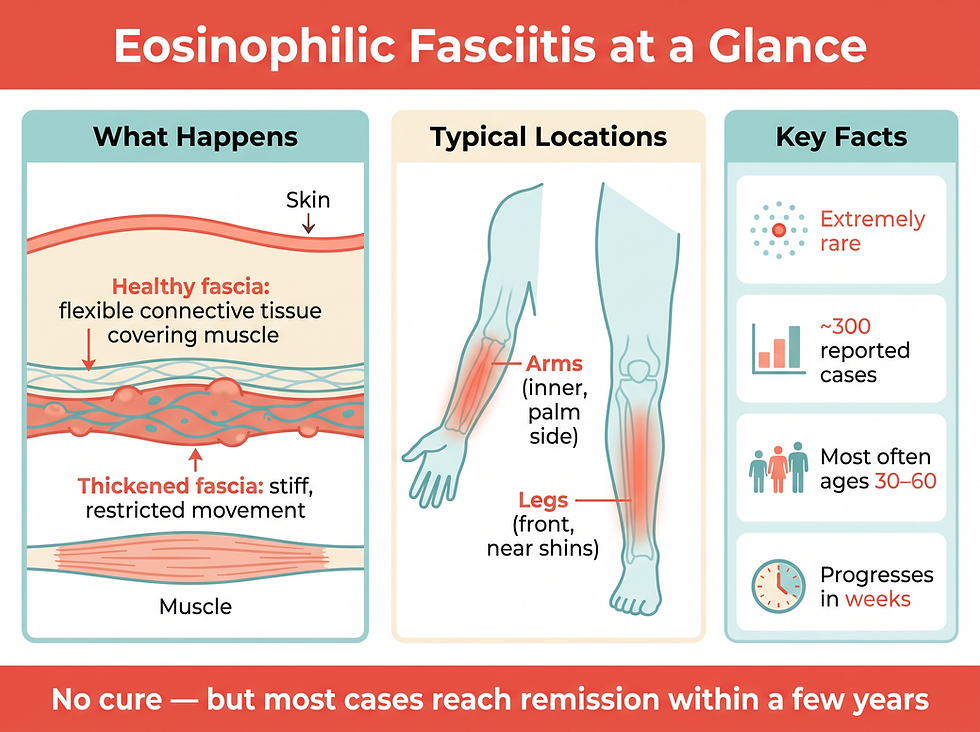
Eosinophilic fasciitis is a rare autoimmune disease that causes the fascia to swell and thicken very quickly. Autoimmune means your immune system — which normally protects you — mistakenly attacks your own body instead.
The fascia is the stretchy connective tissue that sits under your skin and covers your muscles. A helpful analogy from the source is a piece of netting you would use to carry groceries: it surrounds and holds things together while staying flexible. When the fascia is healthy, your skin and muscles move freely.
When eosinophilic fasciitis inflames and thickens the fascia, it becomes harder to move your skin and muscles. If left untreated, the fascia can become "frozen" — a complication called a contracture.
The disease progresses quickly. It can noticeably affect you in as little as a few weeks. That fast pace is one reason prompt medical evaluation matters.

What part of the body does eosinophilic fasciitis affect?
Eosinophilic fasciitis most commonly affects the arms and legs. The source describes the typical pattern in the table below.
Body area | How it is typically affected |
Arms | Most commonly the inside of the arm — the palm side |
Legs | Most commonly the front of the leg, near the shins |
Joints | Often the joints and the area around them |
Face, chest, abdomen | Less commonly affected |
How is eosinophilic fasciitis different from scleroderma?
Eosinophilic fasciitis shares symptoms with more common conditions, and it is sometimes confused with scleroderma. But the two diseases affect different tissues.
Eosinophilic fasciitis affects the fascia. Scleroderma, by contrast, is caused by excess collagen being deposited in the skin and organs, hardening them in a way the source compares to scar tissue that damages healthy tissue.
Feature | Eosinophilic fasciitis | Scleroderma |
Main tissue affected | Fascia (under the skin, over muscles) | Skin and organs |
What hardens | Swollen, thickened fascia | Excess collagen deposits, like scar tissue |
How common | Extremely rare (~300 reported cases) | More common than eosinophilic fasciitis |
This overlap in symptoms is why the source urges anyone with new skin, muscle or joint symptoms to see a provider as soon as possible — an accurate diagnosis may require a rheumatologist.
Who is at risk of developing eosinophilic fasciitis?
Anyone can develop eosinophilic fasciitis. However, it is most commonly diagnosed in people between the ages of 30 and 60.
The source also notes that people with certain other conditions may be more likely to develop eosinophilic fasciitis. These include:
Associated condition | Notes |
Aplastic anemia | Blood disorder affecting blood cell production |
Hemolytic anemia | Red blood cells are destroyed faster than made |
Lymphoma | Cancer of the lymphatic system |
Leukemia | Cancer of blood-forming tissue |
Certain thyroid diseases | Thyroid-related autoimmune conditions |
What Are the Symptoms of Eosinophilic Fasciitis?
Eosinophilic fasciitis produces both early and progressively severe symptoms as the fascia thickens.
What does eosinophilic fasciitis feel like?
Common symptoms include muscle pain, tender skin, visible swelling or inflammation, and skin that feels thicker than usual. The source describes the skin in some patients as puckered, with an "orange peel" appearance.
Symptom | What you may experience |
Muscle pain | Aching or soreness, often in arms or legs |
Tender skin | Areas of skin that hurt to touch |
Inflammation and swelling | Visible or palpable swelling |
Thicker skin | Skin that feels dense or hardened |
Puckered skin | An "orange peel" texture in affected areas |
Carpal tunnel syndrome | Tingling and numbness if fascia in the hand or wrist presses on the median nerve |
Arthritis | Joint inflammation similar to rheumatoid arthritis |
Can eosinophilic fasciitis damage joints?
Yes. The source explains that the disease can cause joint inflammation similar to rheumatoid arthritis. If that inflammation continues unchecked, it can damage the cartilage in your joints and lead to chronic arthritis.
When the fascia in your hand or wrist is affected, swelling can put pressure on the median nerve and cause carpal tunnel syndrome.
What happens if eosinophilic fasciitis is left untreated?
If left untreated, the swelling can "freeze" the fascia in place. This complication is called a contracture, and it restricts your range of motion.
What Causes Eosinophilic Fasciitis?
The exact cause of eosinophilic fasciitis is unknown. The source notes that it develops suddenly and sometimes seemingly randomly.
Researchers have identified possible triggers based on published studies. The source lists the following as suspected causes or triggers:
Possible trigger | Description |
Infections | Viral or bacterial infections that may set off the immune response |
Allergic reactions | Immune overreaction to an allergen |
Certain medications or recreational drugs | Some drugs may provoke the autoimmune response |
Intense physical activity | Some people first notice symptoms after strenuous exercise, running or physically demanding work |
How Is Eosinophilic Fasciitis Diagnosed?
Because eosinophilic fasciitis mimics other conditions, diagnosis requires specific testing. The source describes three main diagnostic approaches.
Test | What it shows | How reliable it is |
Fascia biopsy (most reliable) | A small section of affected skin and muscle is examined in a lab | Most reliable way to confirm the diagnosis |
Blood test | Elevated eosinophils — the white blood cells that give the disease its name | Helpful but cannot diagnose the condition alone; a biopsy is still needed in most cases |
MRI imaging | Identifies internal inflammation, including inflammation of the fascia | Useful but less conclusive than a biopsy |
The disease is actually named after these elevated eosinophils. However, the source is clear that a blood test alone cannot confirm the diagnosis — a fascia biopsy is needed in most cases.
How Is Eosinophilic Fasciitis Treated?

Eosinophilic fasciitis rarely improves without treatment. The mainstay of treatment is corticosteroids, which reduce inflammation and lower immune system activity.
What medications treat eosinophilic fasciitis?
Corticosteroids — most commonly prednisone — are the primary treatment. They reduce inflammation and calm the immune response driving the disease.
Treatment | How it helps | Key notes from the source |
Corticosteroids (e.g., prednisone) | Reduce inflammation and immune activity | Main treatment; most common drug is prednisone |
NSAIDs (ibuprofen, naproxen) | Reduce pain | Over-the-counter; ask your provider before use if you take corticosteroids; no more than 10 days in a row without permission |
Immune-suppressing medications | Calm the immune attack | Choice depends on severity |
Surgery | Releases or removes affected fascia | Reserved for contractures |
Are there non-medication treatments?
Yes. The source highlights physical therapy as a key non-medication treatment. Stretching exercises can help loosen tightening fascia and preserve mobility.
Treating related complications is also part of care — for example, managing carpal tunnel syndrome or arthritis that develops alongside the primary disease.
How soon will treatment make you feel better?
Inflammation should start to improve within a few hours of your first corticosteroid dose. However, that relief may be temporary — symptoms can return as the medication wears off. That is why the source emphasizes taking medications exactly as prescribed, for as long as prescribed.
Can you work or go to school with eosinophilic fasciitis?
Most people do not need to miss work or school. The source states you shouldn't need to miss time if you can do your job or schoolwork without putting extra stress on the affected fascia. Your provider will tell you which activities to avoid. Always ask before resuming intense physical activity.
What Is the Prognosis for Eosinophilic Fasciitis?
There is no cure for eosinophilic fasciitis. However, the outlook for most patients is hopeful.
Most people have the disease for a few years before it goes into remission — meaning symptoms stop. Some people never experience a recurrence. Others find the disease returns later.
Can eosinophilic fasciitis be prevented?
There is no known way to prevent eosinophilic fasciitis.
Questions to ask your healthcare provider
Bringing prepared questions to your appointment helps you get the most out of limited visit time. Consider asking:
# | Question |
1 | Do I have eosinophilic fasciitis or another condition? |
2 | How quickly will my symptoms progress? |
3 | Which treatments will I need? |
4 | Will I need surgery? |
5 | When can I safely resume physical activity? |
When Should You See Your Provider?
Go to the emergency room if you suddenly can't move or use a part of your body.
Beyond emergencies, the source advises seeing a provider as soon as possible if you notice any new symptoms in your arms, legs or joints — especially pain or swelling that does not improve after a few days of rest. Because eosinophilic fasciitis can progress very quickly, earlier evaluation means faster diagnosis.
If you have already been diagnosed and your symptoms are worsening, or a body part is beginning to stiffen, contact your provider right away.
What to Remember
Eosinophilic fasciitis is extremely rare. The disease can progress quickly, but most cases respond to corticosteroids and enter remission within a few years. Talk to your healthcare provider if you notice new pain in your arms or legs, especially if it's not going away or getting better after a few days. Eosinophilic fasciitis can progress very quickly, so the sooner you get your symptoms examined, the faster your provider can diagnose what's causing them. Your provider will work with you to find a combination of corticosteroids and other treatments to manage your eosinophilic fasciitis symptoms.
Clinical care-team note (verbatim from the source): "Eosinophilic fasciitis is extremely rare. Talk to your healthcare provider if you notice new pain in your arms or legs, especially if it's not going away or getting better after a few days. Eosinophilic fasciitis can progress very quickly, so the sooner you get your symptoms examined, the faster your provider can diagnose what's causing them. Your provider will work with you to find a combination of corticosteroids and other treatments to manage your eosinophilic fasciitis symptoms."
Conclusion: Act Quickly When Symptoms Persist
Eosinophilic fasciitis is rare, progresses quickly and has no cure — yet most patients achieve remission within a few years of treatment. The gap between "untreated contracture" and "managed remission" is early, accurate diagnosis.
Take these three steps:
Get evaluated promptly if you have new, persistent pain or swelling in your arms, legs or joints — especially if rest doesn't help within a few days.
Follow your treatment plan exactly. Take corticosteroids as prescribed and complete physical therapy exercises; relief may be temporary if doses are missed.
Go to the emergency room if you suddenly cannot move or use a body part.
This article provides general information and is not a substitute for professional medical advice. Always consult a qualified healthcare provider for diagnosis and treatment.
Frequently Asked Questions
What is eosinophilic fasciitis?
Eosinophilic fasciitis is a rare autoimmune disease in which the fascia — the stretchy connective tissue that lies under the skin and covers muscles — swells and thickens rapidly. It most often affects the arms and legs of adults ages 30 to 60.
Is eosinophilic fasciitis an autoimmune disease?
Yes. In eosinophilic fasciitis, the immune system attacks the body's own fascia instead of protecting it. This is what "autoimmune" means — the source defines it as the immune system attacking the body rather than defending it.
How common is eosinophilic fasciitis?
It is extremely rare. Only about 300 cases have been reported in scientific journals, and the source notes it is likely underrecognized and underreported. No formal prevalence rate exists.
Who is most likely to get eosinophilic fasciitis?
Anyone can develop it, but it is most commonly diagnosed in adults ages 30 to 60. People with aplastic anemia, hemolytic anemia, lymphoma, leukemia or certain thyroid diseases may be more likely to develop it.
What causes eosinophilic fasciitis?
The exact cause is unknown. It develops suddenly and sometimes randomly. Possible triggers identified in studies include infections, allergic reactions, certain medications or recreational drugs, and intense physical activity.
Can exercise trigger eosinophilic fasciitis?
Some people first notice symptoms after intense physical activity — such as running, working out or performing a physically demanding job. The source lists this as a recognized possible trigger.
What are the early signs of eosinophilic fasciitis?
Early signs include muscle pain, tender skin, visible inflammation or swelling, and skin that begins to feel thicker than usual. Symptoms typically appear in the arms (palm side) or legs (front, near the shins).
What does eosinophilic fasciitis skin look like?
Affected skin can look puckered, with an "orange peel" texture. It may also feel thicker, tender and swollen.
Why is it called "eosinophilic" fasciitis?
The disease is named after eosinophils — a type of white blood cell. A blood test for eosinophilic fasciitis typically shows elevated eosinophil levels. However, a blood test alone cannot confirm the diagnosis.
How is eosinophilic fasciitis diagnosed?
The most reliable method is a fascia biopsy — a small section of affected skin and muscle sent to a lab. Blood tests showing elevated eosinophils and MRI imaging showing internal inflammation support the diagnosis but are not conclusive on their own.
What is the difference between eosinophilic fasciitis and scleroderma?
Eosinophilic fasciitis affects the fascia under the skin. Scleroderma involves excess collagen deposited in the skin and organs, hardening them like scar tissue. They share symptoms but affect different tissues.
Which doctor treats eosinophilic fasciitis?
Because symptoms overlap with more common conditions, you may be referred to a rheumatologist — a specialist in autoimmune and inflammatory diseases.
How fast does eosinophilic fasciitis progress?
It can progress very quickly. The source states it can noticeably affect you in as little as a few weeks.
Is eosinophilic fasciitis painful?
Yes. Muscle pain and tender skin are among the most common symptoms.
Can eosinophilic fasciitis cause joint problems?
Yes. It can cause joint inflammation similar to rheumatoid arthritis. If untreated, this inflammation can damage cartilage and lead to chronic arthritis.
Can eosinophilic fasciitis cause carpal tunnel syndrome?
Yes. When the fascia in the hand or wrist swells, it can press on the median nerve and produce carpal tunnel syndrome.
What is a contracture in eosinophilic fasciitis?
A contracture is when the inflamed fascia becomes "frozen" in place, restricting movement. It occurs when the disease is left untreated.
Is there a cure for eosinophilic fasciitis?
No. There is no cure, but most cases respond to treatment and go into remission within a few years.
How is eosinophilic fasciitis treated?
Corticosteroids — most commonly prednisone — are the main treatment. Others include NSAIDs for pain (no more than 10 days in a row without permission), immune-suppressing medications, physical therapy, treatment of complications, and surgery for contractures.
How long does it take for eosinophilic fasciitis treatment to work?
Inflammation should start to improve within a few hours of your first corticosteroid dose. Relief may be temporary as medication wears off, which is why the full prescribed course matters.
Can eosinophilic fasciitis come back after remission?
Yes. Most people go into remission within a few years. Some never experience a recurrence, while others find the disease returns later.
Can I work while being treated for eosinophilic fasciitis?
Most people do not need to miss work or school, provided their job or schoolwork does not place extra stress on the affected fascia. Ask your provider which activities to avoid.
When should I go to the emergency room for eosinophilic fasciitis?
Go to the emergency room if you suddenly cannot move or use a part of your body.
When should I call my doctor about arm or leg pain?
Contact your provider as soon as possible for any new symptoms in your arms, legs or joints — especially pain or swelling that does not improve after a few days of rest. If you are already diagnosed and symptoms worsen or a body part begins to stiffen, call right away.
Can eosinophilic fasciitis be prevented?
There is no known way to prevent eosinophilic fasciitis.
Does eosinophilic fasciitis affect children?
The source says anyone can develop the disease, with most cases appearing in adults ages 30 to 60. It does not list children as a typical group.
Will I need surgery for eosinophilic fasciitis?
Surgery is reserved for contractures. In that case, a surgeon may release the fascia or remove part of it to restore movement.
What should I avoid with eosinophilic fasciitis?
Avoid activities that place extra stress on the affected fascia, and ask your provider before resuming intense physical activity. Also avoid taking NSAIDs for more than 10 days in a row without your provider's permission, especially if you are on corticosteroids.
Is eosinophilic fasciitis life-threatening?
The source does not describe eosinophilic fasciitis as life-threatening. The main risks are contractures, chronic arthritis and reduced mobility — which are why prompt treatment matters.
Additional Resources
For further reading, these authoritative external references support the information above:
Comments