Dermatofibrosarcoma Protuberans (DFSP): What It Is, Symptoms, Causes, Diagnosis, Treatment and Outlook — What You Need to Know

Updated: 2 days ago
Medically reviewed by Dr. Baraa Alnahhal, MD · Last reviewed: September 2026
Quick Answer
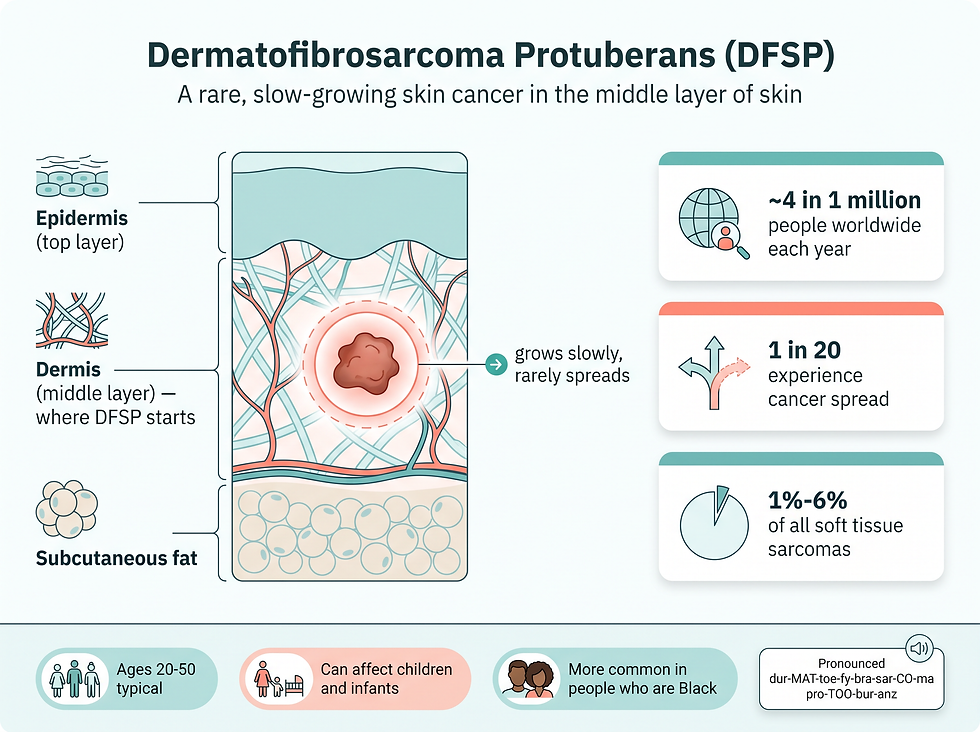
Dermatofibrosarcoma protuberans (DFSP, pronounced “dur-MAT-toe-fy-bra-sar-CO-ma pro-TOO-bur-anz”) is a rare, slow-growing skin cancer that starts in the dermis, the middle layer of the skin. It rarely spreads — only about 1 in 20 people experience metastasis — but it can return after surgical treatment, so removal matters. It often begins as a small flat patch that looks like a bruise on the chest, back, shoulders, abdomen, or buttocks. Surgical removal, usually Mohs surgery performed by dermatologists, is the treatment of choice, and with proper treatment more than 99% of people live 10 years or longer. Call your provider if you notice persistent bumps, growths that bleed easily, or changes to moles, birthmarks, scars, or tattoos.
TL;DR
Dermatofibrosarcoma protuberans (DFSP) is a rare, slow-growing malignant (cancerous) soft tissue tumor — a sarcoma — that begins in the dermis, your skin's middle layer. Despite being cancer, it rarely spreads; roughly 1 in 20 people with DFSP experience metastasis, most often when the cancer isn't treated or grows deep into fat and muscle. It is rare — about 4 out of 1 million people worldwide develop it each year, and it accounts for 1% to 6% of all soft tissue sarcomas. Up to 9 in 10 people who develop DFSP have an acquired gene change (mutation) that occurs after birth; it is not inherited. Early on, DFSP looks like a flat, painless bruise-like patch; as it grows, firm reddish-brown nodules appear. Dermatologists diagnose it with a skin biopsy and typically treat it with Mohs surgery, which removes the tumor layer by layer until cancer-free margins are confirmed. Recurrence is the main challenge: 20% to 30% or more of people develop recurrent DFSP within three years after wide excision, compared with up to 4% to 5% after Mohs surgery. Imatinib (a targeted drug) and radiation are options for cases that can't be fully removed surgically. With proper treatment, more than 99% of people live 10 years or longer.
Limitation statement: All statistics in this article (1 in 20 metastasis rate; 4 per 1 million annual incidence; 1%–6% of soft tissue sarcomas; 9 in 10 with the gene mutation; ~5% Bednar tumors; 20%–30% wide-excision recurrence; 4%–5% Mohs recurrence; >99% 10-year survival) come from the referenced clinical source. Exact figures vary by study and population, and these should not be read as precise individual-risk estimates.
What is dermatofibrosarcoma protuberans (DFSP)?
Dermatofibrosarcoma protuberans is a rare skin cancer that begins in your dermis, your skin's middle layer. Your healthcare provider might simply call it DFSP.
This slow-growing cancer rarely spreads. Still, you need treatment to remove the tumor and prevent cancer from coming back (recurrence) or spreading (metastatic cancer). With proper treatment, DFSP has a high survival rate.
Is DFSP benign?
No. DFSP is a malignant (cancerous) soft tissue tumor and a type of skin cancer.
DFSP is a sarcoma (soft tissue tumor) — cancer that develops in muscle, fat, and skin. These tumors can also affect bones.
Can DFSP metastasize (spread)?
Cancer that spreads outside the original tumor is metastatic cancer. Approximately 1 in 20 people with DFSP experience cancer spread.
Metastatic DFSP is most likely to occur if you don't get treatment or the cancer goes deep into fat and muscle.
For unknown reasons, DFSP can be more aggressive when it develops during pregnancy.
A small percentage of people with DFSP have an aggressive type called fibrosarcomatous dermatofibrosarcoma protuberans (DFSP-FS). These tumors are more likely to spread and come back after surgical removal.
How common is DFSP?
DFSP is a rare cancer that affects approximately 4 out of 1 million people worldwide each year. It accounts for 1% to 6% of all soft tissue sarcomas.
The cancer typically affects adults ages 20 to 50, but children also get this skin cancer. Some infants have DFSP at birth. DFSP appears to affect people who are Black more often than people of other ethnicities.
What are the types of DFSP?
Pathologists (doctors who examine bodies and body tissues) examine cells under a microscope to determine the type of DFSP. Types include:
Type | Key features |
Bednar tumors (pigmented DFSP) | Contain cells with a lot of melanin, the substance that gives skin its color. May have a mix of colors, including red, brown, blue, and purple. About 5% of DFSP diagnoses. |
Giant cell fibroblastoma | Consists of giant cells. Also known as juvenile DFSP because it mostly affects children and teens. |
Fibrosarcomatous DFSP (DFSP-FS) | A more aggressive cancerous soft tissue sarcoma. More likely to spread and come back after surgical removal. |
Myxoid DFSPs | Made of an abnormal type of connective tissue called myxoid stroma. Rare. |
What are the symptoms of DFSP?
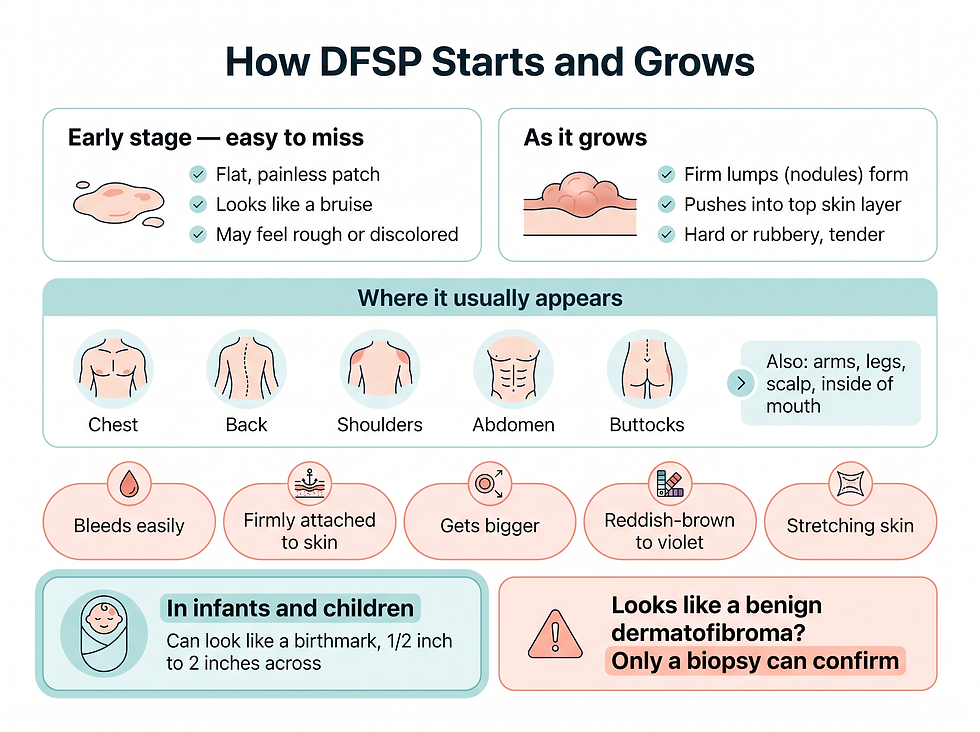
Early symptoms of DFSP are easy to dismiss or not notice. The tumors typically appear on your chest, back, shoulders, abdomen, or buttocks. Tumors can also form on your arms, legs, scalp, and inside of your mouth.
At first, you may notice a small patch of skin that looks like a bruise. The spot is flat and painless. It may feel rough and look discolored.
In infants and children, DFSP can look like a birthmark. These spots are usually about 1/2 inch to 2 inches (1 centimeter to 5 centimeters) across.
DFSP symptoms become more noticeable as the cancer grows. The growing tumor pushes into the top layer of skin (epidermis), and firm lumps (nodules) of tissue appear on the skin — that's the “protuberans” part of the name.
Nodule characteristics | What to look for |
Bleeding | Easy to crack open or bleed. |
Mobility | Firmly attached to your skin (don't move). |
Growth | Getting bigger and stretching your skin. |
Texture | Hard or rubbery. |
Color | Reddish-brown to violet, blue, or red. |
Sensation | Tender. |
What other conditions cause DFSP symptoms?
A noncancerous skin condition called cellular dermatofibroma can look like DFSP, especially during the cancer's early stage. Cellular dermatofibromas are benign soft tissue tumors that typically appear on your legs. They may be itchy or painful. Most dermatofibromas don't need treatment.
This DFSP-vs.-dermatofibroma similarity is exactly why a biopsy — not a visual exam — settles the question.
What causes DFSP?
As many as 9 in 10 people who develop DFSP have a gene change (mutation) that causes the condition. This gene change occurs in cells after you're born — you don't inherit it from a parent.
What are the risk factors for DFSP?
In addition to racial factors, a skin injury or scar may increase your risk of DFSP. Causes of skin injuries linked to DFSP include:
Skin injury | Example |
Burns | Significant burn injuries |
Radiation therapy | Prior radiation to the area |
Surgical incisions | Scars from past surgery |
Tattoos | Tattooed skin |
How is DFSP diagnosed?
Dermatologists — medical doctors who specialize in skin cancer and skin diseases — diagnose DFSP.
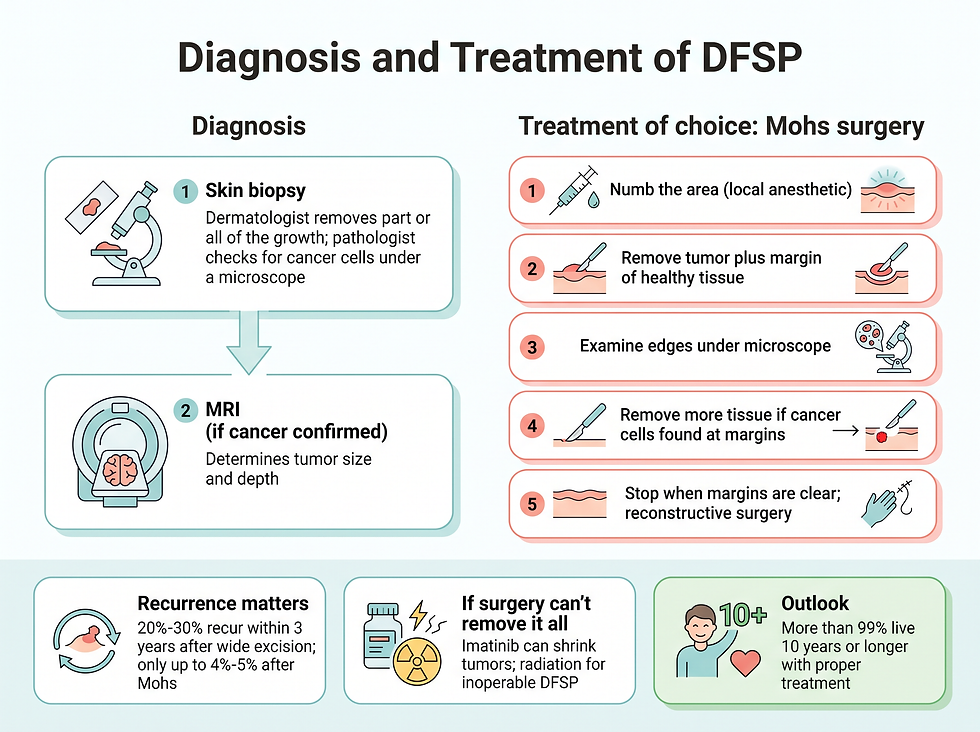
Step 1 — Skin biopsy. Your provider performs a skin biopsy to remove part or all of the growth. Pathologists examine the tissue under a microscope to check for cancer cells.
Step 2 — MRI (if cancer is confirmed). If the skin biopsy determines you have DFSP, you may get an MRI to determine the size and depth of the tumor.
How is DFSP treated?
Surgical removal is the treatment of choice for DFSP. Dermatologists perform Mohs surgery to remove DFSP tumors. During the procedure, your provider:
Injects a local anesthetic into the treatment area to numb it.
Surgically cuts out (excises) the cancerous tumor, including a small amount of surrounding healthy tissue (called the margin).
Uses a microscope to examine the tissue edges (margin) for cancer cells.
Removes more tissue from the tumor site, if cancer cells are seen at the margins.
Stops removing tissue when they can't find any more cancer cells in the margin.
Performs reconstructive surgery.
What are the nonsurgical DFSP treatments?
DFSP tumors can grow back after surgical removal. 20% to 30% or more of people experience a recurrence of DFSP within three years after wide excision, and up to 4% to 5% recur after Mohs surgery. But tumors can recur for 10 years or more.
Nonsurgical option | When it's used |
Imatinib (targeted therapy) | To treat metastatic DFSP or tumors that are too large or difficult to surgically remove. Can also shrink the tumor, making surgical removal possible. |
Radiation treatment | For incompletely excised DFSP or inoperable DFSP. |
What is the outlook for people with DFSP?
With proper treatment, more than 99% of people with this nonaggressive, slow-growing cancer live 10 years or longer.
What steps can improve your outlook?
Step | Details |
Regular skin self-exams | Detect skin changes early. |
Provider skin exams | Every three to six months for the first three years after treatment, then annually (or as recommended). |
Minimize sun exposure | Apply sunscreen, wear sun-protective clothing, and avoid the outdoors when UV rays are strongest — this reduces risk for other skin cancers. |
When should I call my provider?
You should call your healthcare provider if you notice new skin changes, such as:
Skin change | What it looks like |
Persistent bumps or growths | New or lasting skin growths. |
Changes to existing marks | Changes to moles, birthmarks, scars, or tattoos. |
Easy bleeding | Skin growths that bleed easily. |
A note from the clinical source: “Many skin changes are harmless. But some changes can indicate skin cancer or another skin disease that requires treatment. You should contact your healthcare provider whenever you notice changes to your skin. Dermatofibrosarcoma protuberans (DFSP) is a rare skin cancer that's unlikely to spread. Still, you need surgical treatment to keep the tumors from spreading. A prompt diagnosis and treatment are critical to improving your outlook.” — Note from the clinical source, Aug 2022
What should I ask my provider?
You may want to ask your healthcare provider:
Question | Why it matters |
What caused the skin cancer? | Understands your individual risk. |
Am I at risk for other types of skin cancer? | Guides future screening. |
What's the best treatment for me? | Personalizes surgical and nonsurgical options. |
Am I at risk for metastatic cancer? | Frames recurrence and monitoring expectations. |
How often should I get cancer screenings? | Sets a follow-up schedule. |
Conclusion: DFSP Is Rare and Rarely Spreads — But Early Removal Is Critical
Dermatofibrosarcoma protuberans is an unusual skin cancer: slow-growing, rarely spreading, yet stubborn about returning if not fully removed. Most people who develop it are adults between 20 and 50, and the first sign is often something easily dismissed — a flat, painless patch that looks like a bruise on the chest, back, or shoulders.
The encouraging news is substantial: with proper treatment, more than 99% of people live 10 years or longer, and Mohs surgery gives the best chance of clean removal. The caution is equally important — recurrence can happen years later, so regular skin self-exams and provider follow-ups stay with you long after treatment.
Take the next step: If you notice a persistent bump or growth, a skin growth that bleeds easily, or changes to a mole, birthmark, scar, or tattoo, schedule an appointment with a dermatologist. Most skin changes are harmless — but the ones that aren't benefit enormously from prompt attention.
External References
Sources
Medical disclaimer: This article is for informational purposes only and is not a substitute for professional medical advice, diagnosis, or treatment. Always seek the advice of a qualified healthcare provider with any questions about a skin condition or possible skin cancer. Prompt evaluation of new or changing skin growths is important.
Frequently Asked Questions (FAQ)
What is dermatofibrosarcoma protuberans (DFSP)?
DFSP is a rare, slow-growing skin cancer that begins in the dermis, the middle layer of the skin. It is a malignant (cancerous) soft tissue tumor — a sarcoma — and a type of skin cancer. It rarely spreads, but it can return after treatment, so surgical removal is needed to prevent recurrence or metastasis.
How do you pronounce dermatofibrosarcoma protuberans?
It's pronounced “dur-MAT-toe-fy-bra-sar-CO-ma” “pro-TOO-bur-anz.” Healthcare providers usually shorten it to DFSP.
Is DFSP benign or cancerous?
DFSP is malignant (cancerous). It is a soft tissue tumor (sarcoma) — cancer that develops in muscle, fat, and skin — and it is classified as a type of skin cancer.
How common is DFSP?
DFSP is rare. It affects approximately 4 out of 1 million people worldwide each year and accounts for 1% to 6% of all soft tissue sarcomas.
Who gets DFSP?
The cancer typically affects adults ages 20 to 50, but children get it too, and some infants have DFSP at birth. It appears to affect people who are Black more often than people of other ethnicities.
Can DFSP spread (metastasize)?
Approximately 1 in 20 people with DFSP experience cancer spread. Metastatic DFSP is most likely if you don't get treatment or the cancer grows deep into fat and muscle. For unknown reasons, DFSP can be more aggressive when it develops during pregnancy.
What are the types of DFSP?
There are four recognized types: Bednar tumors (pigmented DFSP, about 5% of diagnoses, with melanin-rich cells in mixed colors), giant cell fibroblastoma (juvenile DFSP, mostly affecting children and teens), fibrosarcomatous DFSP (DFSP-FS, a more aggressive type more likely to spread and recur), and myxoid DFSPs (made of abnormal connective tissue called myxoid stroma, rare).
What causes DFSP?
As many as 9 in 10 people who develop DFSP have a gene change (mutation) that causes the condition. This mutation occurs in cells after you're born — you don't inherit it from a parent.
Does DFSP run in families?
No. The gene change that causes DFSP occurs after birth and is not inherited from a parent.
Can scars or skin injuries cause DFSP?
A skin injury or scar may increase your risk of DFSP. Linked injuries include burns, radiation therapy, surgical incisions, and tattoos.
What does DFSP look like in the early stages?
Early DFSP appears as a small patch of skin that looks like a bruise — flat, painless, possibly rough and discolored. In infants and children it can look like a birthmark, typically 1/2 inch to 2 inches (1 to 5 centimeters) across. Early symptoms are easy to dismiss or not notice.
Where does DFSP usually appear?
DFSP tumors typically appear on the chest, back, shoulders, abdomen, or buttocks. They can also form on the arms, legs, scalp, and inside of the mouth.
How can I tell if a skin growth is DFSP?
Growing DFSP pushes into the top layer of skin, forming firm nodules. These nodules are easy to crack open or bleed, firmly attached to the skin (they don't move), getting bigger and stretching the skin, hard or rubbery, reddish-brown to violet/blue/red, and tender. However, a benign condition called cellular dermatofibroma can look similar in early stages — only a biopsy can confirm.
Does DFSP hurt?
The early bruise-like patch is painless. As it grows, the firm nodules can be tender.
How is DFSP diagnosed?
Dermatologists diagnose DFSP with a skin biopsy — removing part or all of the growth. Pathologists examine the tissue under a microscope to check for cancer cells. If DFSP is confirmed, an MRI may be ordered to determine the size and depth of the tumor.
Can DFSP be confused with other skin conditions?
Yes. A benign (noncancerous) skin condition called cellular dermatofibroma can look like DFSP, especially in its early stage. Dermatofibromas typically appear on the legs, may be itchy or painful, and most don't need treatment. This resemblance is why biopsy confirmation matters.
What is the treatment for DFSP?
Surgical removal is the treatment of choice. Dermatologists perform Mohs surgery: they numb the area, excise the tumor with a margin of healthy tissue, examine the edges under a microscope, remove more tissue if cancer cells are seen at the margins, and stop once margins are clear. Reconstructive surgery follows.
What is Mohs surgery for DFSP?
Mohs surgery is a precise tissue-sparing technique in which the surgeon removes the tumor layer by layer and checks each layer under a microscope for cancer cells during the same visit, removing more tissue only where cancer is found, until the margins are clear.
Can DFSP come back after surgery?
Yes, recurrence is DFSP's main challenge. 20% to 30% or more of people experience recurrence within three years after wide excision, and up to 4% to 5% recur after Mohs surgery. Tumors can recur for 10 years or more — which is why follow-up skin exams continue long after treatment.
What happens if DFSP can't be fully removed by surgery?
Imatinib (a targeted therapy) can treat metastatic DFSP or tumors that are too large or difficult to remove surgically, and can shrink tumors to make surgery possible. Radiation treatment is an option for incompletely excised or inoperable DFSP.
What is imatinib?
Imatinib is a medication used to treat metastatic DFSP or tumors that are too large or difficult to surgically remove. It can also shrink the tumor, making surgical removal possible.
What is the survival rate for DFSP?
With proper treatment, more than 99% of people with this nonaggressive, slow-growing cancer live 10 years or longer.
Is DFSP curable?
DFSP has a high survival rate and is very treatable with surgery. However, because it can recur — sometimes more than 10 years later — long-term monitoring with skin exams is part of care.
What should I do to protect myself after DFSP treatment?
Regularly perform skin self-exams to detect changes early, get skin exams at your provider's office every three to six months for the first three years after treatment (then annually), and minimize sun exposure by applying sunscreen, wearing sun-protective clothing, and avoiding peak UV hours — this reduces risk for other skin cancers.
When should I see a provider about a skin growth?
Call your provider if you notice persistent bumps or new skin growths, changes to moles, birthmarks, scars, or tattoos, or skin growths that bleed easily. Prompt diagnosis and treatment are critical to improving your outlook.
Comments