Denys-Drash Syndrome: What It Is, the Classic Triad, Symptoms, Causes, Diagnosis, Treatment and Outlook — What You Need to Know

Updated: 2 days ago
Medically reviewed by Dr. Baraa Alnahhal, MD · Last reviewed: September 2026
Quick answer
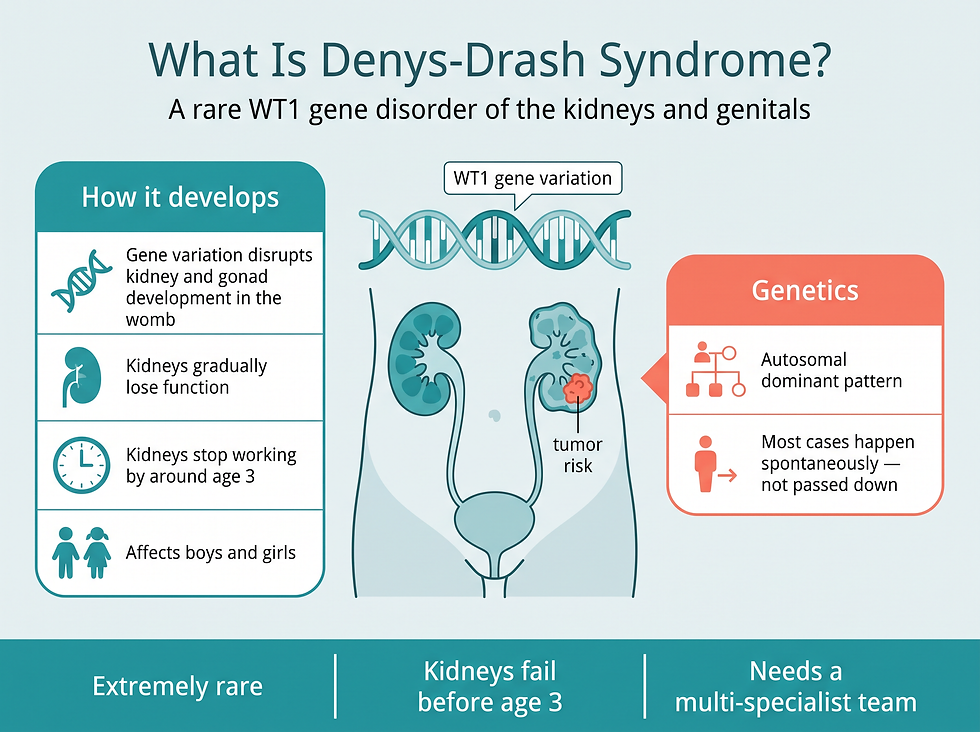
Denys-Drash syndrome is a rare genetic disorder of the WT1 gene that affects how a child’s kidneys and reproductive organs develop. It is defined by a distinctive triad: nephrotic syndrome that progresses to kidney failure, a greatly elevated risk of Wilms tumor (a kidney cancer), and atypical genital development, especially in boys. Kidney failure typically occurs before age 3, so treatment centers on dialysis, kidney transplant, and carefully planned surgeries. It cannot be prevented, but a specialist care team (nephrologist, oncologist, urologist, endocrinologist and geneticist) works with families to preserve kidney function as long as possible and support the child’s long-term health.
TL;DR
Denys-Drash syndrome (DDS) is a rare WT1 gene disorder defined by three problems that develop in early childhood: kidney disease that reaches kidney failure by about age 3, a Wilms tumor in roughly 9 out of 10 affected children, and atypical development of the genitals. Most cases arise spontaneously rather than being passed down. Treatment focuses on preserving kidney function, then dialysis or kidney transplant once the kidneys fail, along with surgery and cancer treatment as needed. Because it is so rare, care is coordinated by a multi-specialist pediatric team, and genetic counseling is recommended for families with a history of related WT1 disorders.
What this guide can and cannot tell you: because DDS is extremely rare, its prevalence isn’t reliably published, and there isn’t much information on long-term outcomes. This article uses only the statistics stated in the underlying clinical source; no numbers have been estimated or invented.
What is Denys-Drash syndrome?
Denys-Drash syndrome is a genetic disorder that affects how the kidneys and genitals develop. In affected children, the kidneys gradually stop working, typically by the time they reach age 3. The condition also greatly increases the risk of developing a kidney tumor.
Because it involves such vital organs, DDS is considered both rare and serious. Kidney function worsens through the first few years of life, and when the kidneys fail they can no longer filter blood properly. This leads to swelling and a buildup of waste products in the body.
Why is Denys-Drash syndrome called a “triad”?
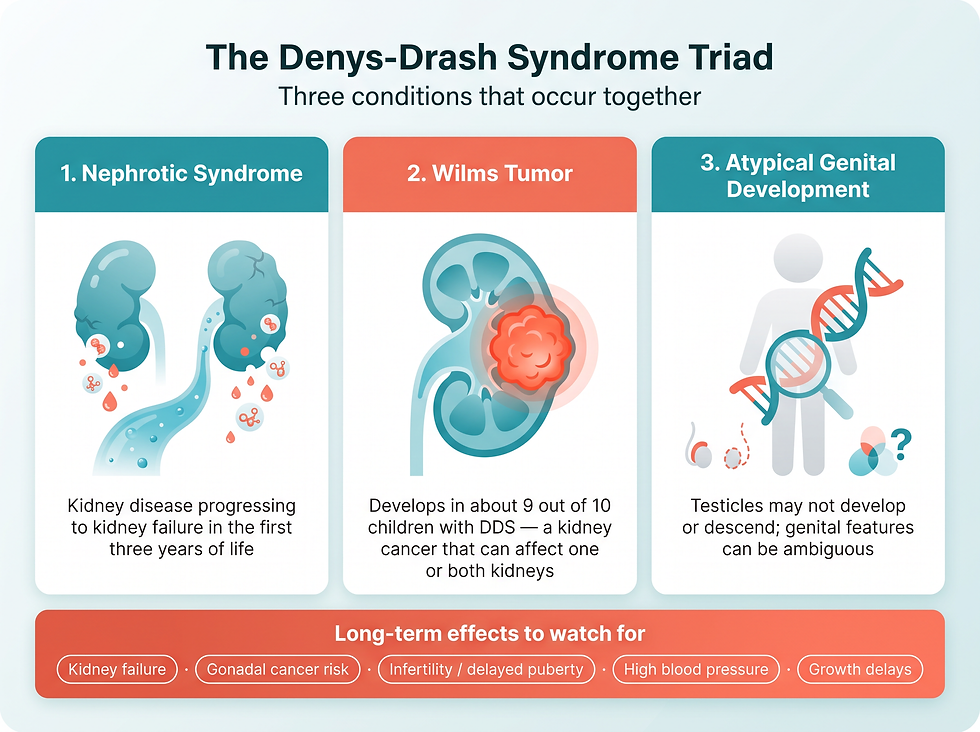
DDS is recognized by a distinctive combination of three conditions that tend to occur together:
Nephrotic syndrome: a specific type of kidney disease that progresses to kidney failure during the first three years of life.
Wilms tumor: a kidney cancer that can affect one or both kidneys.
Atypical genitals: abnormal development of the reproductive organs, in which a male child has nonfunctioning testicles and a penis that doesn’t develop as expected.
The triad is the key recognition pattern that helps specialists distinguish DDS from other rare genetic disorders, including the related WT1 gene conditions Frasier syndrome, WAGR syndrome and Meacham syndrome, which are often confused with it.
How common is Denys-Drash syndrome?
Denys-Drash syndrome is very rare. Because it affects so few children, there isn’t a lot of information on long-term outcomes, and doctors may not encounter it often in their careers. This is one reason diagnosis can take time.
What are the symptoms of Denys-Drash syndrome?
Signs of the kidney component typically appear within the first year of life. Recognizing them early matters, because preserving kidney function for as long as possible is a central goal of treatment.
Nephrotic syndrome signs in infants
Children with DDS show signs of nephrotic syndrome early. These may include:
Sign | What it means |
Protein in the pee (proteinuria) | Kidneys are leaking protein into urine instead of keeping it in the blood |
Low protein in the blood (hypoproteinemia) | Protein lost through urine lowers blood protein levels |
Systemic infections | Infections that affect the whole body |
Swollen belly (abdominal distension) | Fluid buildup causes visible abdominal swelling |
Too many fats in the blood (hyperlipidemia) | Blood lipid levels rise abnormally |
Too much bad cholesterol (hypercholesterolemia) | LDL cholesterol climbs higher than normal |
Kidney dysfunction | Overall decline in how well the kidneys work |
Wilms tumor signs
A Wilms tumor, a malignant (cancerous) tumor that can affect one or both kidneys, develops in about 9 out of 10 children who have DDS. It can grow large and spread in the body. Symptoms may include:
Possible Wilms tumor symptom | Note |
A hard lump in the abdomen | Often the first thing parents notice |
Abdominal pain | May accompany the lump |
Blood in the pee (hematuria) | Can look pink, red or cola-colored |
Fever | May be persistent or unexplained |
High blood pressure (hypertension) | Detected at checkups |
Atypical genital development
Male children with DDS have the expected male chromosome pattern (46, XY), but their internal and external sex organs aren’t typical, a category known as disorders of sexual development. Features may include:
A small, curved and shortened penis with partial foreskin.
A small, empty scrotum that may look like it has a crack or indent (cleft) in the middle.
A pee hole (urethral opening) that’s lower than expected (hypospadias), located at the base of the penis, in the middle of the scrotum folds, or near the anus.
Testicles that don’t develop as expected (gonadal dysgenesis) and don’t descend into the scrotum, remaining inside the abdomen or pelvis instead.
This combination can give the genitals both male and female features, described as ambiguous genitals.
Female children can also have DDS. Their external genitals look as expected, but their ovaries may not develop as expected, the same developmental concern that affects testicles in male children.
What are the long-term effects?
The long-term picture of DDS touches several systems:
Long-term effect | Description |
Kidney failure | All children with DDS develop kidney disease; it progresses to kidney failure before age 3 |
Kidney tumors | Tumors develop in almost all children with DDS |
Gonadal cancer risk | Abnormal gonad development raises the risk of gonadoblastoma |
Fertility and hormone effects | Infertility and delayed puberty are possible |
High blood pressure | Ongoing blood pressure management may be needed |
Fluid buildup (edema) | Swelling from the kidneys’ inability to balance fluids |
Urinary tract infections | UTIs may recur |
Blood clots | Thrombosis inside blood vessels is a possible complication |
Growth and development delays | Growth delays and delayed milestones such as rolling over, crawling, standing and walking |
What causes Denys-Drash syndrome?
A genetic variation in the Wilms tumor suppressor gene 1 (WT1) causes Denys-Drash syndrome. The WT1 gene makes a protein that regulates how the kidneys and gonads develop during fetal development. When these organs don’t develop as expected, it can affect how a child’s kidneys work, how the external genitals look, and it increases the risk of a Wilms tumor.
Is Denys-Drash syndrome inherited?
DDS follows an autosomal dominant pattern of inheritance, meaning only one biological parent needs to have the changed gene to pass it on to a child. However, there’s an important nuance: in most cases, the variation happens spontaneously. That means a biological parent does not pass it down in the majority of cases.
Can Denys-Drash syndrome be prevented?
No. A specific gene variation causes DDS, and it usually arises spontaneously, so there is no way to prevent it.
How is Denys-Drash syndrome diagnosed?
Because DDS is so rare, it may take some time to get an official diagnosis. However, atypical genitals can usually be identified at birth. If kidney problems are suspected, further evaluation follows.
What tests diagnose Denys-Drash syndrome?
Test | What it checks |
Pee tests | Protein and other kidney-related changes in urine |
Blood tests | Protein levels, kidney function and electrolytes |
Imaging tests (abdominal ultrasound or CT scan) | Structure of the kidneys and abdomen |
Kidney biopsy | Tissue-level confirmation of the kidney disease |
Which specialists are involved?
A Denys-Drash syndrome diagnosis and treatment plan typically involves several specialists working together:
Pediatric urologist: urinary and genital structures.
Pediatric oncologist: Wilms tumor care.
Endocrinologist: hormones and development.
Nephrologist: kidney function and failure.
Geneticist: genetic confirmation and counseling.
How is Denys-Drash syndrome treated?
Treatment for DDS is a coordinated plan that balances all of the risks involved. The first priority is keeping the child’s kidneys working for as long as possible.
Treatment to preserve kidney function
Approach | Details |
Blood pressure medication | Controls hypertension that worsens kidney damage |
Electrolyte balancing | Keeps sodium, potassium and other minerals in range |
Physical activity | Regular movement supports overall health |
Diet | Fruits, vegetables, whole grains, nuts and legumes; avoid salt; low potassium and low phosphates |
Treatment when the kidneys fail
Treatment | What it does |
Dialysis | Does the filtering work the kidneys can no longer do |
Kidney transplant | A new kidney restores function |
Bilateral nephrectomy | Removing both kidneys to prevent Wilms tumors |
Wilms tumor treatment | Surgery plus chemotherapy and/or radiation therapy |
Gonadectomy | Removing the testicles or ovaries; screening for testicular or ovarian cancer can be challenging, so removal is sometimes recommended |
Treatment for atypical genitals
For atypical genitals, parents work with their child’s providers to determine the best path for long-term well-being, including future sexual function and possible fertility. Treatment may include hormone replacement therapy (HRT) and, if medically necessary, reconstructive surgery.
Importantly, if surgery isn’t medically necessary, some parents choose to hold off on surgery that changes the appearance of their child’s genitals, waiting until the child is old enough to make decisions about their own body.
Treatment for male children with atypical testicles
As a child grows, surgery may be needed: orchiectomy (removal) or orchiopexy (repositioning) of the testicles. Some boys may also need several separate penile reconstruction surgeries to create a functional, typical-looking penis.

What is the outlook for children with Denys-Drash syndrome?
Because DDS is rare, there isn’t a lot of information on long-term outcomes. What is known is that affected children need close supervision by a team of specialists who regularly check kidney function. As function declines, tests, medications and procedures keep the kidneys working for as long as possible. When kidney failure happens, the child will need dialysis or a kidney transplant to survive.
The outlook also includes surgery: kidney removal (nephrectomy) if the kidneys fail or a Wilms tumor develops, with possible chemotherapy or radiation for the tumor, and genital reconstruction surgeries where needed. Finally, because atypical genitals can have a significant impact on mental health as a child grows, providers may recommend a counselor or therapist to help navigate complicated feelings and determine the best course of treatment.
When should your child see a provider?
If your child has Denys-Drash syndrome, regular appointments are important so providers can monitor kidney health. Contact a provider right away if you notice any signs of kidney failure:
Swelling
Vomiting
Lack of appetite
Peeing less than usual
What experts say
“Finding out your child has a rare genetic disorder is a challenge many parents don’t expect. And because Denys-Drash syndrome affects vital organs and how your child’s external genitals look, it can be even more distressing. It’s normal to have a wide range of feelings. Your child’s healthcare providers also expect you to have a lot of questions. They can guide you through the most appropriate treatments for your child to help ensure the best outcome.”
Conclusion
Denys-Drash syndrome is a rare but serious WT1 gene disorder defined by three challenges: kidney disease that reaches failure by age 3, a Wilms tumor in about 9 out of 10 affected children, and atypical genital development. Most cases arise spontaneously, so it isn’t preventable, but with a coordinated team of specialists and today’s treatment options, families can preserve kidney function as long as possible and move through dialysis, transplant and surgery with expert support.
Your next step: if you suspect your child is showing any signs described here (swelling, protein in the urine, a hard abdominal lump, or atypical genital development), talk to your child’s healthcare provider as soon as possible. Early recognition and specialist care make the biggest difference.
Frequently asked questions
What is Denys-Drash syndrome?
Denys-Drash syndrome is a rare genetic disorder of the WT1 gene that affects the kidneys and genitals. It is defined by a triad: nephrotic syndrome that progresses to kidney failure, Wilms tumor (kidney cancer), and atypical genital development. Kidneys typically fail by age 3, and treatment usually involves dialysis and surgeries.
What causes Denys-Drash syndrome?
A genetic variation in the Wilms tumor suppressor gene 1 (WT1). The WT1 protein regulates how the kidneys and gonads develop during fetal development. When these organs don’t develop as expected, kidney function, genital appearance and tumor risk are all affected.
Is Denys-Drash syndrome genetic or inherited?
It is genetic and follows an autosomal dominant inheritance pattern: only one biological parent needs the changed gene to pass it on. However, in most cases the variation happens spontaneously, meaning a parent does not pass it down.
Is Denys-Drash syndrome curable?
There is no cure for the underlying genetic disorder. Treatment manages the consequences: preserving kidney function, dialysis or kidney transplant after kidney failure, and surgery plus chemotherapy or radiation if a Wilms tumor develops.
What are the symptoms of Denys-Drash syndrome in babies?
Within the first year of life, signs of nephrotic syndrome appear: protein in the pee, low protein in the blood, whole-body infections, a swollen belly, high blood fats and cholesterol, and kidney dysfunction. Atypical genitals are usually recognizable at birth.
Does Denys-Drash syndrome cause kidney failure?
Yes. All children with DDS develop kidney disease, and it progresses to kidney failure before they reach age 3. Dialysis or a kidney transplant becomes necessary to survive.
What is the Denys-Drash syndrome triad?
The triad is three conditions occurring together: (1) nephrotic syndrome progressing to kidney failure in the first three years of life, (2) Wilms tumor, a kidney cancer affecting one or both kidneys, and (3) atypical genital development.
What is a Wilms tumor in Denys-Drash syndrome?
A Wilms tumor is a malignant kidney tumor. It develops in about 9 out of 10 children with DDS and can affect one or both kidneys, grow large and spread. Providers sometimes recommend removing both kidneys (bilateral nephrectomy) to prevent it.
What are Wilms tumor symptoms in a child with DDS?
A hard lump in the abdomen, abdominal pain, blood in the pee, fever and high blood pressure.
Can girls have Denys-Drash syndrome?
Yes. Female children can have DDS. Their external genitals look as expected, but their ovaries may not develop as expected, similar to the testicular development problem in male children.
Why do boys with DDS have atypical genitals?
Although male children with DDS have the expected 46, XY chromosome pattern, their internal and external sex organs aren’t typical. Features can include a small, curved penis with partial foreskin, an empty cleft scrotum, hypospadias (a urethral opening lower than expected), and undescended testicles, sometimes producing ambiguous genitals.
What is hypospadias in Denys-Drash syndrome?
Hypospadias means the urethral opening (pee hole) is lower than expected: at the base of the penis, in the middle of the scrotum folds, or near the anus.
What happens to the testicles in Denys-Drash syndrome?
The testicles don’t develop as expected (gonadal dysgenesis) and don’t descend into the scrotum, staying inside the abdomen or pelvis instead. This raises the risk of gonadoblastoma, a type of gonadal cancer, and may lead to infertility and delayed puberty.
Is Denys-Drash syndrome related to WAGR syndrome?
They are related but distinct WT1 gene disorders. Frasier syndrome, WAGR syndrome and Meacham syndrome involve the same gene variation and can be confused with DDS; genetic counseling helps clarify the risk for each condition.
What is the difference between Denys-Drash syndrome and Frasier syndrome?
Both are WT1 gene disorders. The clinical source identifies them as separate conditions in the same gene family; a geneticist is needed to distinguish which specific variation and condition a child has.
How is Denys-Drash syndrome diagnosed?
Atypical genitals can usually be identified at birth. If kidney problems are suspected, diagnosis involves pee tests, blood tests, imaging (abdominal ultrasound or CT scan) and a kidney biopsy. A team of specialists (pediatric urologist, oncologist, endocrinologist, nephrologist and geneticist) typically collaborates on diagnosis and treatment planning.
Why does diagnosis take time for Denys-Drash syndrome?
Because DDS is so rare, it may take some time to get an official diagnosis. Infrequent exposure to the condition means providers often need multiple tests and specialist input.
What is the treatment for Denys-Drash syndrome?
Initial treatment preserves kidney function: blood pressure medication, electrolyte balancing, physical activity and a kidney-friendly diet (fruits, vegetables, whole grains, nuts, legumes; avoid salt; low potassium and phosphates). Once the kidneys fail, treatment includes dialysis and possibly kidney transplant. Wilms tumors are treated with surgery and chemotherapy or radiation. Gonadectomy may be recommended, and atypical genitals are managed with HRT and, if medically necessary, reconstructive surgery.
What is dialysis in Denys-Drash syndrome?
Dialysis does the filtering work the failing kidneys can no longer do. It becomes necessary once kidney function declines past a survivable point; a kidney transplant may replace it.
Why would both kidneys be removed in DDS?
Providers may recommend bilateral nephrectomy to prevent Wilms tumors, since tumors develop in almost all children with DDS.
Can a child with Denys-Drash syndrome get a kidney transplant?
Yes. A kidney transplant is a treatment option once the child’s own kidneys fail, allowing them to survive after dialysis.
Should surgery on atypical genitals be delayed?
If surgery isn’t medically necessary, some parents choose to wait until their child is old enough to make decisions about their own body. Parents work with providers to weigh long-term well-being, future sexual function and possible fertility.
Does Denys-Drash syndrome affect mental health?
As children grow, atypical genitals can have a big impact on mental health. Providers may recommend a counselor or therapist to help navigate complicated feelings and determine the best course of treatment.
Can Denys-Drash syndrome be prevented?
No. It is caused by a specific gene variation that in most cases happens spontaneously. Genetic counseling and testing may be recommended if there is a family history of DDS or related WT1 conditions (Frasier syndrome, WAGR syndrome, Meacham syndrome).
Is genetic counseling recommended for Denys-Drash syndrome?
Yes, if you or your partner have a family history of DDS or related WT1 gene conditions. Genetic counseling helps you understand the risk of your child having these conditions.
What are the warning signs of kidney failure in a child with DDS?
Contact a provider right away if you notice swelling, vomiting, lack of appetite, or peeing less than usual.
What is the life expectancy for Denys-Drash syndrome?
Because DDS is rare, there isn’t a lot of information on long-term outcomes. With dialysis or kidney transplant after kidney failure, and treatment for Wilms tumors, children require lifelong specialist supervision.
Which doctors treat Denys-Drash syndrome?
A team of specialists: a pediatric urologist, pediatric oncologist, endocrinologist, nephrologist and geneticist.
Does Denys-Drash syndrome cause developmental delays?
Possible long-term effects include growth delays and delayed developmental milestones, such as turning from stomach to back, crawling, standing and walking.
When should I contact my child’s provider about Denys-Drash syndrome?
Schedule regular appointments so providers can monitor kidney health, and contact a provider right away for any signs of kidney failure: swelling, vomiting, lack of appetite, or reduced urination.
External references
Cleveland Clinic: Denys-Drash Syndrome (primary source, medically reviewed, last updated Jul 13, 2026)
Disclaimer: This content is provided for general educational purposes only and is not a substitute for professional medical advice, diagnosis or treatment. Always seek the advice of a qualified healthcare provider with any questions regarding a medical condition, and never disregard professional medical advice or delay seeking care because of something you read here.
Comments