Corneal Edema: Symptoms, Causes, Diagnosis, Treatment and Outlook — What You Need to Know

Updated: 2 days ago
Medically reviewed by Dr. Baraa Alnahhal, MD · Last reviewed: September 2026
Quick Answer
Corneal edema is swelling of the cornea — the clear, dome-shaped outer layer of the eye — caused by fluid buildup when the cornea can no longer pump out enough fluid. It can follow an injury, an infection, inflammation after eye surgery (including cataract surgery), or inherited conditions such as Fuchs' dystrophy. Symptoms include eye pain, blurred vision, light sensitivity, halos around lights, and rarely blisters. Treatment targets the swelling and its cause, with nonsurgical options like hypertonic solutions and bandage lenses, or surgery such as a corneal transplant for severe scarring. The outlook is generally good when the edema and its underlying condition are treated.
TL;DR: Corneal edema = a swollen cornea. Its inner cell layer (the endothelium) normally pumps fluid out of the cornea; when that layer is damaged, fluid backs up and vision blurs — often worst in the morning. Injuries, infections, inflammation after eye surgery, glaucoma, tight contact lenses, some medications, and inherited diseases can all cause it. Mild cases may resolve on their own; treatment ranges from eye drops and bandage lenses to corneal transplant surgery. Prognosis is generally good with treatment. Limitation note: the underlying reference material contains no prevalence or treatment-success statistics, so none are claimed here.
What Is Corneal Edema?
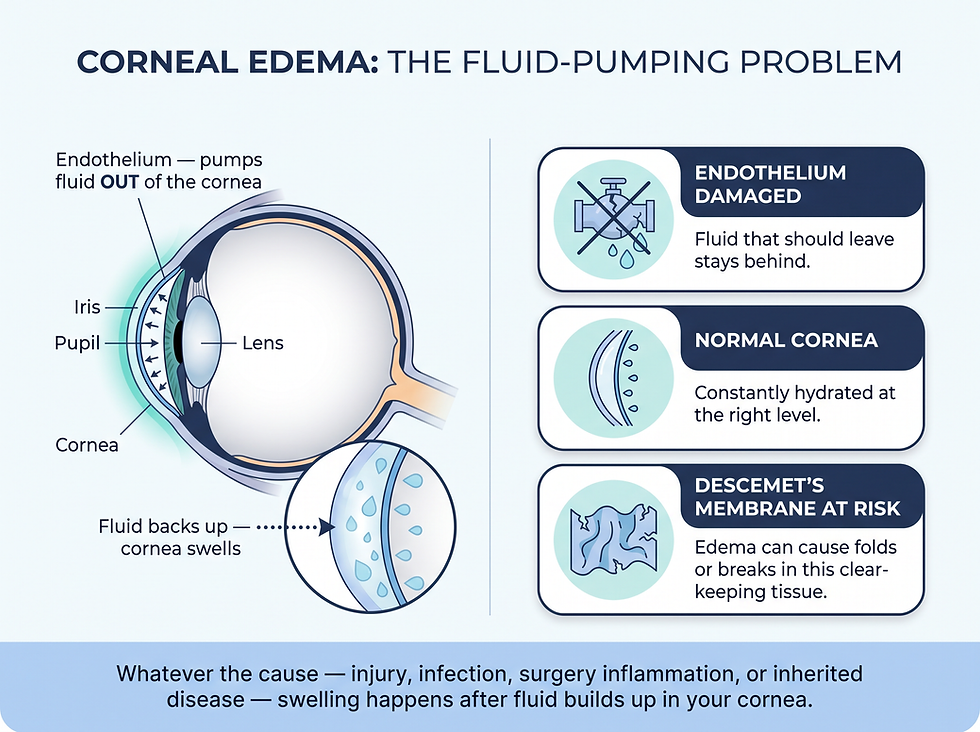
Corneal edema is swelling in your cornea — the clear, dome-shaped outer layer of your eye. It can happen after an injury or an infection. It can also happen because of inflammation after eye surgery, including cataract surgery, or due to inherited conditions. Whatever the cause, the swelling happens after fluid builds up in your cornea.
Because your cornea helps you see clearly, swelling in this layer can cause problems with your vision.
What Role Does the Endothelium Play?
Your cornea has an inner layer of cells called the endothelium. The endothelium is responsible for pumping fluid out of your cornea, which helps maintain a certain level of hydration at all times.
Damage to the endothelium affects this pumping process. Fluid that should leave your cornea stays there because the endothelium stops working properly, causing swelling.
Can Corneal Edema Damage the Inner Layers of the Eye?
Yes. If you have corneal edema, you could develop folds or even breaks in a tissue called Descemet's membrane. This membrane is part of a layer of the cornea and works to keep the cornea clear. It is an important part of the cornea's structure and helps to maintain stability.
Why Is Corneal Edema Different From Other Corneal Conditions?
The table below places corneal edema next to the related corneal problems covered by the underlying reference material. For the broader picture, see our corneal disease guide.
Condition | What Happens | How It Relates to Edema |
|---|---|---|
Corneal edema | Fluid builds up in the cornea because the pumping layer fails | The umbrella term for this article |
Keratitis | Inflammation of the cornea | A cause of corneal edema |
Iritis | Inflammation of the iris | A cause of corneal edema |
Fuchs' dystrophy | Inherited condition; endothelial cells can no longer pump fluid out | A cause of corneal edema; may also cause blisters |
Glaucoma | Damage to the optic nerve with high eye pressure | High pressure can cause swelling |
What Are the Signs and Symptoms of Corneal Edema?
If you have corneal swelling, your symptoms may be worse when you wake up because your eyes are closed while you sleep, keeping fluid in.
Signs and symptoms of corneal edema may include:
Eye pain or discomfort, feeling like something is in your eye
Blurred vision
Sensitivity to light (photophobia)
Seeing halos around lights
Blisters (rarely)
Corneal microcystic edema — very tiny blisters along with the swelling

When Should You See a Healthcare Provider?
Contact a healthcare provider if you have symptoms that affect your vision or that cause discomfort or pain. If you have an eye condition, follow the suggestions of your eye care provider on how often to make appointments and how to take your medications.
If you notice... | Do this |
|---|---|
Blurred vision, light sensitivity, halos, or eye pain that affects daily life | Contact an eye care provider for evaluation |
Any symptoms after recent eye surgery | Contact your eye care provider — you may have another condition needing treatment |
Persistent eye discomfort you cannot explain | Get a complete eye exam |
An existing eye condition (e.g., glaucoma, Fuchs' dystrophy) | Follow your provider's appointment and medication guidance |
What Causes Corneal Edema?
Generally, causes of corneal edema include issues with your endothelium, injuries, and inflammation. In some cases, a provider can't find a cause — that is called idiopathic corneal edema. Corneal diseases and other conditions can also cause your cornea to retain fluid.

Can Eye Injuries Cause Corneal Edema?
Yes. Eye injuries can happen because of trauma, including car or industrial accidents, physical fights, and exposure to dangerous chemicals. Injuries can take the form of scratches, penetration, or burns.
Can Eye Surgery Cause Corneal Edema?
Swelling is expected after most eye surgeries. Though it is normal to have some swelling after eye surgery, it usually goes away after a couple of weeks. But in some people with preexisting conditions, the swelling may become permanent.
Can Eye Diseases Cause Corneal Edema?
Yes. The table below summarizes the eye diseases the underlying reference material links to corneal edema.
Eye Disease | What It Is | How It Leads to Swelling |
|---|---|---|
Iritis | Inflammation of the iris | Inflammation can cause the cornea to retain fluid |
Keratitis | Inflammation of the cornea | Inflammation can cause the cornea to retain fluid |
Fuchs' dystrophy | Inherited condition | Endothelial cells can no longer pump fluid out; may also cause blisters |
Glaucoma | Condition that damages the optic nerve | Can lead to high eye pressure, which can cause swelling |
Can Medications or Contact Lenses Cause Corneal Edema?
Yes. Other factors that can cause corneal edema include taking some medications, wearing contact lenses that are too tight, and infections.
How Is Corneal Edema Diagnosed?
To diagnose swelling of your cornea, an eye care specialist will first ask you questions about your symptoms and medical history. They will give you a complete eye exam and use magnifying equipment to be able to see your cornea.
A provider may also measure the thickness of your cornea using a test called pachymetry. They may also use ultrasound to assess your eyes.
Another test you may have is optical coherence tomography of the anterior segment of your eye — the part of the eye that contains your cornea. This type of test uses reflected light to assess your eye health and is not invasive.
Diagnostic Step | What It Involves |
|---|---|
Symptom and history review | Questions about your symptoms and medical history |
Complete eye exam | Standard exam of the eye |
Magnifying equipment | Allows the specialist to see the cornea in detail |
Pachymetry | Measures the thickness of your cornea |
Ultrasound | Assesses your eyes |
Anterior segment optical coherence tomography (OCT) | Uses reflected light to assess eye health; not invasive |
How Is Corneal Edema Treated?
A healthcare provider will treat corneal edema and any condition that is causing or contributing to the swelling. In some mild cases, corneal edema can resolve on its own.
What Nonsurgical Treatments Are Available?
Your provider may recommend topical items (applied directly to your eye) or other forms of medications, such as pills or shots, including:
Antibiotics for infections
Corticosteroids for inflammation
Hypertonic solutions to encourage dehydration of your cornea
Topical treatments for glaucoma to reduce eye pressure
Bandage contact lenses to provide relief for blisters
What Surgical Treatments Are Available?
Surgical options include:
Surgery to transplant a new cornea — either partial or full thickness — if there is severe scarring
Surgery to reduce eye pressure from glaucoma
Treatment Approach | Options | Best Suited For |
|---|---|---|
Observation | Mild cases may resolve on their own | Mild corneal edema |
Medications (drops, pills, shots) | Antibiotics, corticosteroids, hypertonic solutions, glaucoma drops, bandage contact lenses | Infections, inflammation, fluid reduction, pressure control, blister relief |
Surgery | Cornea transplant (partial or full thickness) | Severe scarring |
Surgery | Glaucoma pressure-reduction surgery | Swelling driven by high eye pressure |
How Can I Prevent Corneal Edema?
You may be able to reduce your risk of corneal edema by taking care to protect your eyes while working or participating in sports. Wear protective gear while riding a motorcycle or bike and while working.
Getting regular eye exams as recommended by a provider can help you find issues early. Managing health conditions can help, especially if they are conditions that can cause corneal edema.
Follow your provider's instructions on how to clean your contact lenses and how long you should wear them.
Prevention Step | Why It Helps |
|---|---|
Protect your eyes at work and during sports | Reduces trauma — a direct cause of edema |
Wear protective gear on motorcycles, bikes, and at work | Prevents scratches, penetration, and chemical exposure |
Get regular eye exams | Finds issues early |
Manage health conditions | Especially conditions that can cause corneal edema |
Follow lens-cleaning and wear-time instructions | Prevents tight-lens and infection-related swelling |
What Can I Expect If I Have Corneal Edema?
The prognosis (outlook) for most cases of corneal edema is generally good if you get treatment for the edema and the underlying conditions.
A note from the reference source: "Corneal edema, or corneal swelling, can be quite uncomfortable. If your eyes hurt or if you've had eye surgery, contact your eye care provider. You may have another condition that needs treatment. Getting medical help early is likely to bring the best results. Your vision is important to you and to your healthcare team members."
Conclusion
Corneal edema is a fluid problem in the clearest part of your eye. When the endothelium — the cornea's inner pumping layer — can't keep fluid moving out, the cornea swells and vision blurs, often most noticeably in the morning. The causes are varied, from trauma and infection to surgery-related inflammation and inherited disease, and the fix always starts with treating both the swelling and its root cause.
The good news: most cases have a generally good outlook when the edema and underlying conditions are treated, and some mild cases clear up on their own. If you have eye pain, blurred vision, light sensitivity, or halos around lights — especially after eye surgery — don't wait. Getting medical help early is likely to bring the best results.
Talk to an eye care specialist. A complete eye exam, pachymetry, and modern imaging can pinpoint what's happening in your cornea — and start you on the right treatment, whether that's drops, bandage lenses, or surgery. Your vision is important to you and to your healthcare team.
Frequently Asked Questions About Corneal Edema
What is corneal edema in simple terms?
Corneal edema is swelling of the cornea — the clear, dome-shaped outer layer of your eye — caused by fluid buildup. It happens when the eye's pumping layer can't remove enough fluid, and it can follow an injury, infection, surgery inflammation, or an inherited condition.
What does corneal edema look or feel like?
Common signs include eye pain or discomfort (a feeling that something is in your eye), blurred vision, sensitivity to light, halos around lights, and — rarely — blisters. Symptoms are often worse when you wake up because closed eyes during sleep keep fluid in.
Why is my vision blurry in the morning?
Symptoms of corneal edema may be worse when you wake up because your eyes are closed while you sleep, keeping fluid in the cornea.
What causes corneal edema?
Generally, causes include issues with the endothelium (the cornea's inner pumping cell layer), injuries, and inflammation. Eye surgery, glaucoma, iritis, keratitis, Fuchs' dystrophy, infections, some medications, and contact lenses that are too tight can all contribute. Sometimes no cause is found, which is called idiopathic corneal edema.
Can eye surgery cause corneal edema?
Yes. Swelling is expected after most eye surgeries and usually goes away after a couple of weeks. But in some people with preexisting conditions, the swelling may become permanent.
Can Fuchs' dystrophy cause corneal edema?
Yes. Fuchs' dystrophy is an inherited condition in which the cornea's endothelial cells are no longer able to pump fluid out of the cornea, causing swelling and sometimes blisters.
Can glaucoma cause corneal edema?
Yes. Glaucoma damages the optic nerve and can lead to high eye pressure, which can cause the cornea to swell.
Can contact lenses cause corneal edema?
Wearing contact lenses that are too tight is listed as one of the factors that can cause corneal edema.
Can medications cause corneal edema?
Yes. Taking some medications is among the other factors that can cause corneal edema.
What is Descemet's membrane and how does edema affect it?
Descemet's membrane is part of a layer of the cornea that keeps the cornea clear and helps maintain its stability. If you have corneal edema, you could develop folds or even breaks in this tissue.
What is corneal microcystic edema?
Corneal microcystic edema happens when you have very tiny blisters along with the swelling.
Is corneal edema reversible?
In some mild cases, corneal edema can resolve on its own. For other cases, treatment of the edema and its underlying cause can address the swelling.
How is corneal edema diagnosed?
An eye care specialist reviews your symptoms and medical history, gives a complete eye exam using magnifying equipment, and may order pachymetry (corneal thickness measurement), ultrasound, or anterior segment optical coherence tomography — a non-invasive test using reflected light.
What is pachymetry?
Pachymetry is a test that measures the thickness of your cornea, which helps diagnose and monitor corneal edema.
What is anterior segment OCT?
Optical coherence tomography of the anterior segment of the eye assesses the part of the eye containing your cornea using reflected light. It is not invasive.
What are the nonsurgical treatments for corneal edema?
Options include antibiotics for infections, corticosteroids for inflammation, hypertonic solutions to encourage dehydration of the cornea, topical glaucoma treatments to reduce eye pressure, and bandage contact lenses to relieve blisters.
When do I need corneal transplant surgery?
Surgery to transplant a new cornea — either partial or full thickness — may be needed if there is severe scarring.
Will I need surgery for glaucoma-related corneal edema?
If glaucoma is contributing, surgery to reduce eye pressure from glaucoma is one of the surgical options.
What is idiopathic corneal edema?
Idiopathic corneal edema means the provider can't find a cause for the corneal swelling.
What is the prognosis for corneal edema?
The prognosis for most cases of corneal edema is generally good if you get treatment for the edema and the underlying conditions.
Can I prevent corneal edema?
You may be able to reduce your risk by protecting your eyes at work and during sports, wearing protective gear on motorcycles and bikes, getting regular eye exams, managing health conditions, and following your provider's contact-lens cleaning and wear-time instructions.
When should I see a healthcare provider?
Contact a healthcare provider if you have symptoms that affect your vision or that cause discomfort or pain. If your eyes hurt or you've had eye surgery, contact your eye care provider — you may have another condition that needs treatment.
How quickly should I get treatment?
Getting medical help early is likely to bring the best results. Your vision is important to you and to your healthcare team.
Sources
Last reviewed and updated: Aug. 18, 2023.
External References
Medical Disclaimer
This article is for general educational purposes only and is not a substitute for professional medical advice, diagnosis, or treatment. Always seek the advice of a qualified healthcare provider with any questions regarding a medical condition. Never disregard professional medical advice or delay seeking care because of something you have read here.
Comments