Convulsive Syncope: Symptoms, Causes, Diagnosis and Treatment — What You Need to Know

Updated: 2 days ago
Medically reviewed by Dr. Baraa Alnahhal, MD · Last reviewed: September 2026
Quick Answer: Convulsive syncope is a rare type of fainting that includes jerking muscle movements after you lose consciousness. It can look like a seizure, but it isn't one. It is a rare subtype of vasovagal syncope caused by too little blood reaching your brain, and in many cases there is no long-term condition to blame. Unconsciousness lasts fewer than 30 seconds, movements are usually fewer than 10 per episode, and people recover quickly. If you pass out, with or without jerking movements, seek emergency medical care right away, because a provider needs to confirm a serious condition did not cause the faint.
What Is Convulsive Syncope?
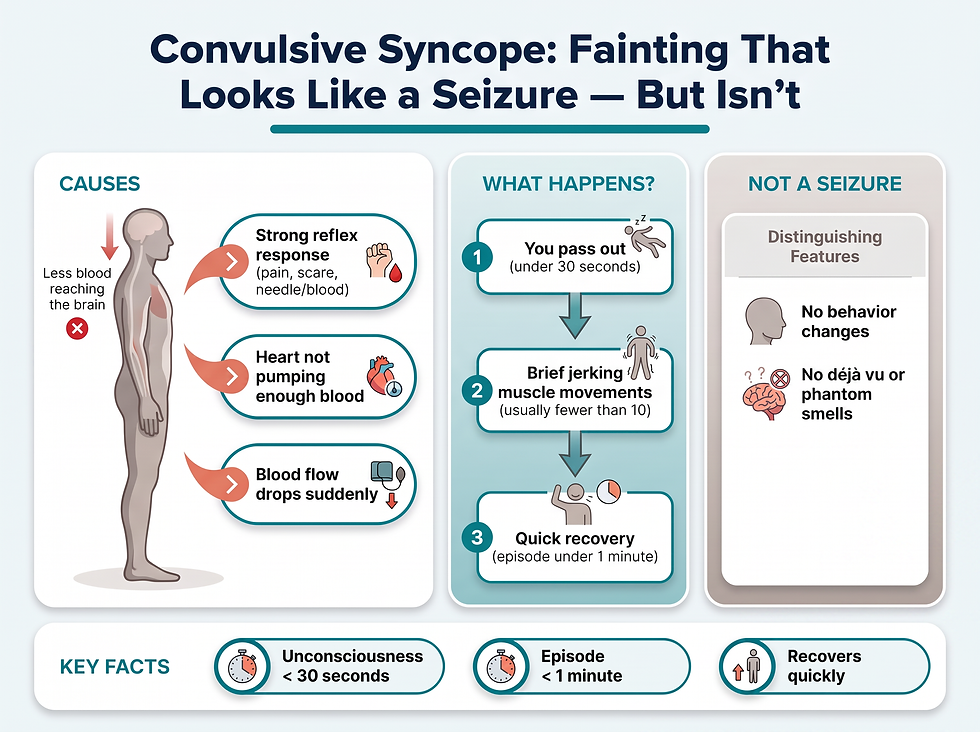
Convulsive syncope is fainting that includes jerking muscle movements after you pass out. It is a rare subtype of vasovagal syncope.
In some people, just seeing a needle or blood can make them faint and have convulsions. But the episode lasts less than one minute, and people recover quickly.
Although it may look worse than other fainting episodes, it is very similar to ordinary fainting. And even though people may mistake it for a seizure, it is not one. Treatments can help prevent future episodes once you learn the cause.
TL;DR: The Short Version
Convulsive syncope is a rare form of fainting where brief jerking movements follow a loss of consciousness. It happens when too little blood reaches the brain, sometimes triggered by something as simple as seeing a needle or blood. It often looks like a seizure, which is why people panic, but it is not one. Key differences: unconsciousness is brief (under 30 seconds), movements are limited (typically fewer than 10 per episode), and recovery is quick. Most importantly, any fainting episode warrants emergency medical care, because only a provider can confirm whether a serious heart issue or a true seizure caused it.
It's normal to be concerned when you have syncope and convulsions. But fainting is often your body's reaction to an issue that doesn't last. Still, getting medical care can ease your mind and lead you to treatments if you need them.
When Should You Seek Emergency Care?
Any fainting episode, with or without jerky muscle movements, deserves prompt medical attention.
Situation | What to do |
You pass out, with or without jerky movements | Get emergency medical care right away; a provider needs to determine whether a serious condition made you faint |
You hit your head when you fell | You may have injuries that need care, so get checked even if you feel fine |
Your episode included behavior changes, déjà vu, or smells that weren't there | These suggest a true seizure rather than convulsive syncope, so tell your provider |
You have recovered fully | Still schedule follow-up evaluation to learn the cause and prevent repeat episodes |
Why Does Fainting Include Jerking Movements?
Too little blood getting to your brain causes convulsive syncope. This can happen because of a strong response to something around you or because your heart is not pumping enough blood.
It is important to understand that these movements are not epileptic. Convulsive syncope is not a seizure, even though bystanders may call it one.
What Are the Symptoms of Convulsive Syncope?
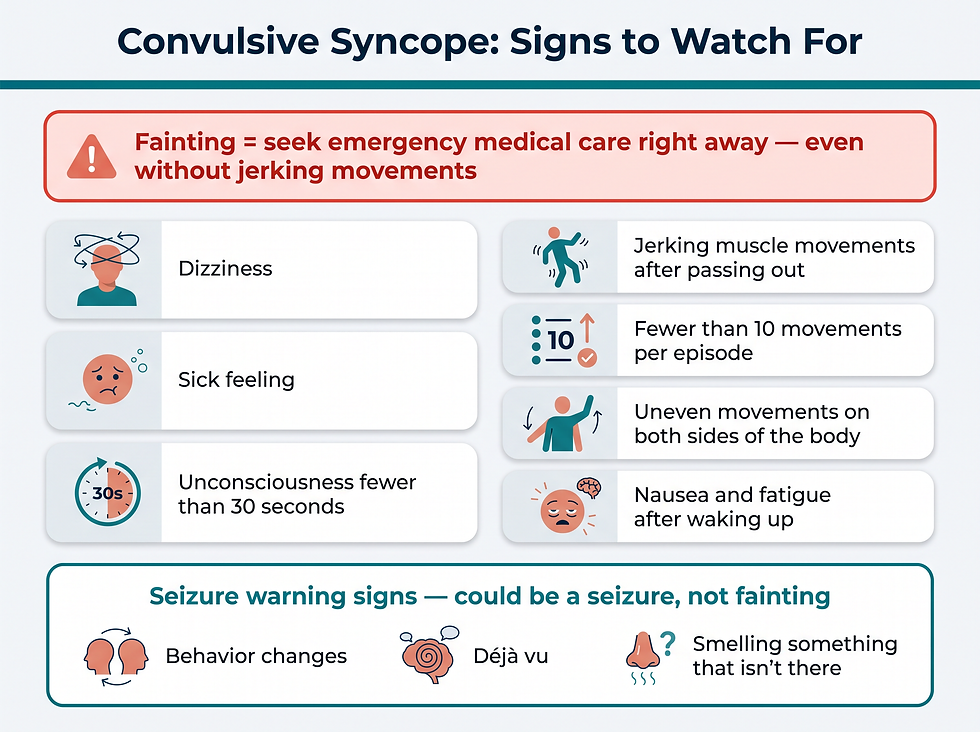
Convulsive syncope symptoms may include the following.
Symptom | Detail |
Dizziness | A warning sensation before fainting |
Sick feeling | General sense of illness or unease |
Loss of consciousness | Lasts fewer than 30 seconds |
Jerking muscle movements | Happen after you pass out |
Movement count | Fewer than 10 muscle movements per episode |
Uneven movements | Movements that are not the same on both sides of your body |
Nausea and fatigue | Occur after waking up |
How do you know it is not a seizure?
A healthcare provider will make sure you aren't having a heart issue or a seizure. You may have had a seizure if you had behavior changes, déjà vu, or thought you smelled something that wasn't really there. To learn more about true seizures, see our epilepsy guide and our guide to grand mal (tonic-clonic) seizures.
What Causes Convulsive Syncope?
Too little blood getting to your brain causes convulsive syncope. This can happen because of a strong response to something around you or because your heart isn't pumping enough blood.
Trigger | Why it matters |
Unexpected pain | A sudden pain response can drop blood flow to the brain |
Reacting to a scare | A strong fright triggers the same reflex |
Being physically active | Exercise changes how blood is distributed |
Peeing or pooping | Body processes that shift blood pressure |
What Are the Risk Factors?
Risk factors for convulsive syncope include things that decrease blood flow to your brain.
Risk factor | How it reduces blood flow to the brain |
Having a medical procedure, like getting a shot | A strong response to the procedure |
Losing too much fluid | Dehydration lowers blood volume |
Working in a job that requires standing for hours | Prolonged standing pools blood in the legs |
Standing up quickly | Sudden posture change drops brain blood flow |
Being in a painful or stressful situation | Stress responses alter blood pressure |
How to lower your risk
You may be able to decrease your risk of convulsive syncope as you would for other kinds of fainting. You can stay hydrated, avoid standing for long periods, stand up slowly, manage pain and emotional stress, and look away when getting a shot.

How Is Convulsive Syncope Diagnosed?
A healthcare provider will make sure you aren't having a heart issue or seizure. Diagnostic tests may include the following.
Test | What it checks |
Physical exam | Overall health and clues from your history |
Electrocardiogram (EKG) | Heart rhythm and electrical activity |
Echocardiogram | How well the heart pumps |
CT (computed tomography) scan | Brain structure |
MRI (magnetic resonance imaging) scan | Detailed brain imaging |
Electroencephalogram (EEG) | Brain electrical activity, key for ruling out seizures |
What Are the Complications?
The main risks come from the fall itself.
Fall injury: You can hurt yourself if you fall when you have syncope and convulsions.
Impact injury: You may get hurt if your arms hit something nearby when they're moving.
How Is Convulsive Syncope Treated?
Treatment varies based on the cause of syncope. You may need to start taking medicines or have a procedure to keep you from fainting again.
Treatment | Type |
Fludrocortisone | Medication |
Midodrine | Medication |
Pacemaker | Procedure/device |
Implantable cardioverter defibrillator (ICD) | Device |
What Should You Do If You Feel Like You're Going to Faint?
You may be able to keep yourself from fainting in some simple ways. If you feel like you're going to faint, try the following positions.
Action | How to do it |
Lie down | Get horizontal as soon as you feel it coming |
Grip a rubber ball | Squeeze it firmly in your hand |
Cross your legs | Look down and clasp your hands while standing |
Sit with your head between your knees | A seated position that boosts blood return |
Squat | Put your body in a squatting position |
Kneel | Kneel as if you're about to tie your shoe |
What Can You Expect Long-Term?
You could faint again if you don't know what's making it happen. If you do know the cause, it's possible to avoid fainting in the future.
Often, passing out happens because of a short-term situation. In many cases, it's not a serious problem. But to be safe, it's a good idea to get medical attention. If a medical condition is making you pass out, you can get treatment for it.
Questions to ask your provider
What caused this episode?
Do I need testing?
Do I need to take medicine?
Can I still drive?
The Bottom Line
Convulsive syncope sounds frightening: fainting with jerking movements looks, to anyone watching, like a seizure. But it is a distinct and usually brief event: unconsciousness under 30 seconds, fewer than 10 jerks, and a quick recovery, caused by a temporary drop in blood flow to the brain. Often there is no long-term condition to blame. Get emergency medical care after any fainting episode so a provider can rule out a heart issue or true seizure, work through the tests, and once the cause is known, use hydration, posture habits, and if necessary medications or devices to prevent it from happening again.
Take action today: if you or someone you know has fainted, with or without shaking, seek emergency medical care right away, and bring the question list above to your follow-up appointment.
Frequently Asked Questions
What is convulsive syncope?
Convulsive syncope is fainting that includes jerking muscle movements after you pass out. It is a rare subtype of vasovagal syncope.
Is convulsive syncope a seizure?
No. It is not a seizure, even though people may mistake it for one. Behavior changes, déjà vu, or smells that weren't really there suggest a true seizure instead.
How long does an episode last?
The episode lasts less than one minute, and unconsciousness lasts fewer than 30 seconds. People recover quickly.
Why do the jerking movements happen?
Too little blood getting to your brain causes convulsive syncope. The movements are the body's response to that blood-flow drop, not abnormal brain electrical activity.
Can something simple trigger it, like seeing a needle?
Yes. In some people, just seeing a needle or blood can make them faint and have convulsions.
How can I lower my risk?
Stay hydrated, avoid standing for long periods, stand up slowly, manage pain and emotional stress, and look away when getting a shot.
Should I go to the ER if I faint?
Yes. If you pass out, with or without jerky muscle movements, get emergency medical care right away. A provider can determine if a serious condition made you faint.
What tests will I need?
A physical exam, electrocardiogram (EKG), echocardiogram, CT scan, MRI, and electroencephalogram (EEG) may be used.
What treatments are available?
Treatment varies based on the cause and may include fludrocortisone, midodrine, a pacemaker, or an implantable cardioverter defibrillator (ICD).
Will I faint again?
You could faint again if you don't know what's making it happen. If you do know the cause, it's possible to avoid fainting in the future.
Can I still drive after an episode?
Ask your provider. It is one of the key questions to raise at your appointment.
Related Reading
Sources
1. Cleveland Clinic. Convulsive Syncope (medically reviewed; last updated November 10, 2025). https://my.clevelandclinic.org/health/diseases/convulsive-syncope
External references: Am Fam Physician: Syncope: Evaluation and Differential Diagnosis · Heart: Reflex syncope: assessment and management · Arrhythmia Alliance: Reflex Syncope
Medical disclaimer: This article is for general informational purposes only and does not constitute medical advice. It is not a substitute for professional medical diagnosis or treatment. Always seek the advice of your physician or other qualified healthcare provider with any questions regarding a medical condition. If you think you may have a medical emergency, call your doctor or emergency services immediately.
Comments