Chronic Granulomatous Disease: Symptoms, Causes, Diagnosis and Treatment — What You Need to Know

Updated: 2 days ago
Medically reviewed by Dr. Baraa Alnahhal, MD · Last reviewed: September 2026
Quick Answer
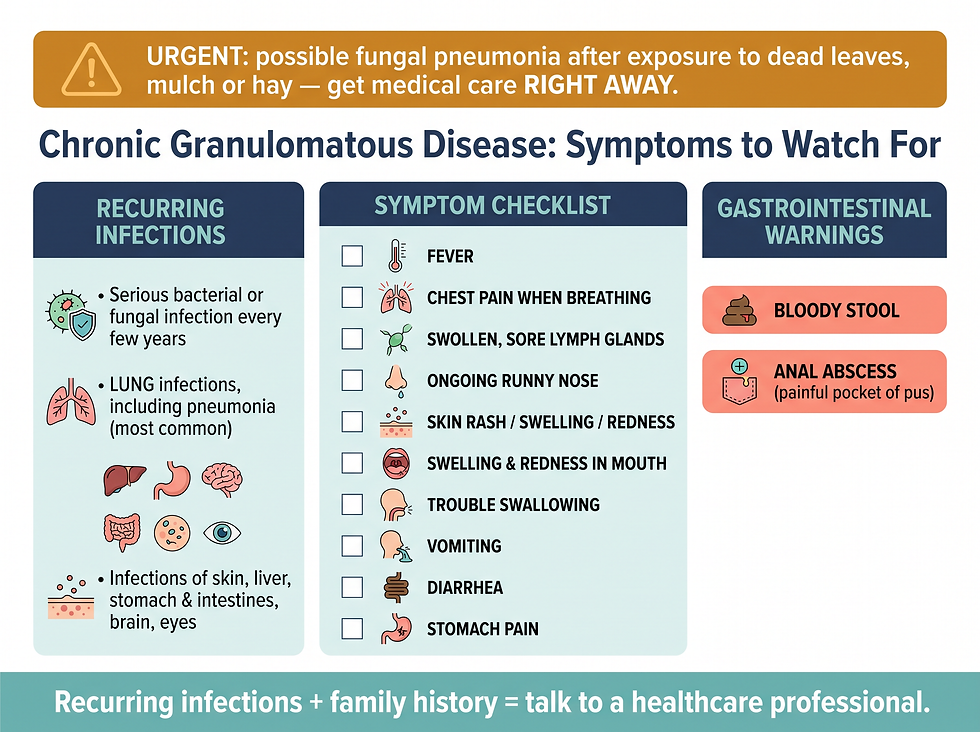
Chronic granulomatous disease (CGD) is a genetic condition in which infection-fighting white blood cells — called phagocytes — don't work properly. Without working phagocytes, the body can't protect itself from bacterial and fungal infections. People with CGD get serious infections every few years, most commonly in the lungs (pneumonia), but also in the skin, liver, stomach and intestines, brain and eyes.
CGD is inherited and runs in families; most people are diagnosed in childhood, though some are diagnosed in adulthood. Boys are more likely to have it. Treatment focuses on preventing infections with daily antibiotics and antifungals, occasional interferon-gamma injections, and — for some — a stem cell transplant that can provide a cure. If you or your child has possible fungal pneumonia after exposure to dead leaves, mulch or hay, get medical care right away.
TL;DR
CGD is a rare inherited disorder where phagocytes — the white blood cells that destroy fungi and bacteria — can't function normally, leaving the body vulnerable to repeated serious bacterial and fungal infections. Symptoms show up as recurring fevers, chest pain when breathing, swollen and sore lymph glands, runny nose, skin rashes, mouth swelling, trouble swallowing, and gastrointestinal problems including vomiting, diarrhea, stomach pain, bloody stool and anal abscesses. Lung infections, including pneumonia, are the most common.
The cause is a change in one of five genes (inherited from a parent) that should produce an enzyme active in phagocytes; in some cases no gene change is found and the cause is unknown. Diagnosis involves neutrophil function testing (often the DHR test), genetic testing, and sometimes prenatal testing for families with an affected child. Treatment aims to prevent infections with antibiotics/antifungals, boost the immune system with interferon-gamma injections, and — for some — cure the condition with a stem cell transplant. Gene therapy is being explored for the future.
Limitation statement: This article is based exclusively on two expert-reviewed clinical overviews dated March 28, 2025. The sources contain no prevalence, incidence or survival statistics, and no statistics are presented or invented here. CGD is described as rare in the sources' reference materials; individual cases vary and treatment decisions belong to your healthcare team.
When Should You Seek Care?
CGD is rare, but its warning signs follow a recognizable pattern — repeated infections, plus one exposure situation that needs immediate attention.
If you think you or your child has a type of fungal pneumonia from being around dead leaves, mulch or hay, get medical care right away. If you or your child often has infections and the symptoms listed above, talk to a healthcare professional. — Source overview [1]
Situation | What to do |
|---|---|
You or your child may have fungal pneumonia after exposure to dead leaves, mulch or hay | Get medical care right away |
Frequent bacterial or fungal infections with symptoms such as fever, chest pain, swollen lymph glands | Talk to a healthcare professional |
Persistent GI problems (vomiting, diarrhea, stomach pain, bloody stool, anal abscess) | Talk to a healthcare professional |
What Exactly Is Chronic Granulomatous Disease?
Chronic granulomatous (gran-u-LOM-uh-tus) disease (CGD) is a genetic condition in which infection-fighting white blood cells don't work properly. These white blood cells are called phagocytes.
When phagocytes don't work as they should, they can't protect the body from bacterial and fungal infections.
People with CGD may develop infections in their lungs, skin, lymph nodes, liver, stomach and intestines, or other areas. They also may develop clusters of white blood cells in infected areas.
CGD is inherited, meaning it runs in families. Most people are diagnosed with CGD during childhood, but some people may not be diagnosed until adulthood.
CGD is one of several conditions in which part of the immune system doesn't work as it should. For the bigger picture, see our guide to primary immunodeficiency: signs, causes, diagnosis, and treatment.

What Are the Symptoms of Chronic Granulomatous Disease?
People with chronic granulomatous disease get a serious bacterial or fungal infection every few years. An infection in the lungs, including pneumonia, is common. For general background on lung infections, see our complete guide to pneumonia.
People with CGD may develop a serious type of fungal pneumonia after being exposed to dead leaves, mulch or hay. It's also common to experience infections of the skin, liver, stomach and intestines, brain, and eyes.
Symptoms that may happen with infections include:
Symptom | What you may notice |
|---|---|
Fever | Often accompanies the infections |
Chest pain when inhaling or exhaling | Linked to lung infections |
Swollen and sore lymph glands | Glands feel enlarged and tender |
An ongoing runny nose | Persistent, not a passing cold |
Skin irritation | A rash, swelling or redness |
Swelling and redness in the mouth | Inside the mouth or on the lips |
Trouble swallowing | Feeding or eating becomes difficult |
Vomiting | Gastrointestinal involvement |
Diarrhea | Gastrointestinal involvement |
Stomach pain | Gastrointestinal involvement |
Bloody stool | Gastrointestinal involvement |
Painful pocket of pus near the anus (abscess) | A specific gastrointestinal complication |
Swollen, sore glands can have many causes. Our guide to swollen lymph nodes: symptoms, causes, and when to seek care explains when they need attention.
What Causes Chronic Granulomatous Disease?
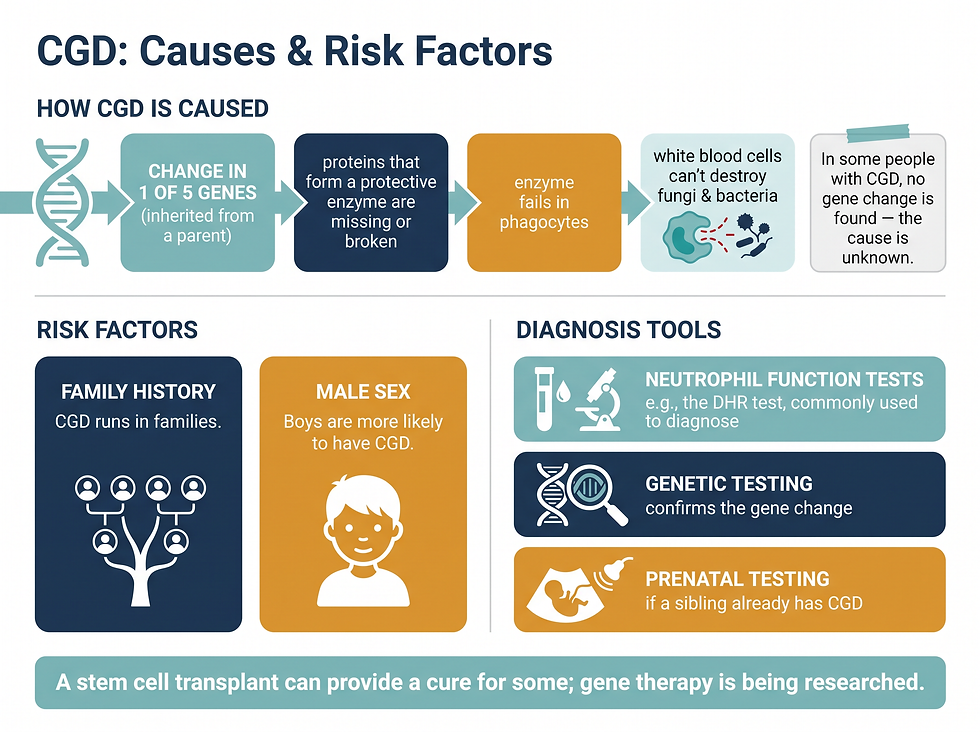
A change in one of five genes can cause CGD. People with CGD inherit the changed gene from a parent.
These genes produce proteins that form an enzyme. This enzyme helps your immune system work properly. The enzyme is active in white blood cells, called phagocytes, that protect you from infections by destroying fungi and bacteria. The enzyme also is active in immune cells that help your body heal.
When there are changes to one of these genes, the protective proteins are not produced. Or they're produced, but they don't work properly.
Some people with CGD don't have one of these changed genes. In these cases, medical professionals don't know what causes the condition.
Who Is at Higher Risk?
CGD is inherited and runs in families — having a family history of CGD is the main risk context. Beyond that, the sources identify one demographic risk factor:
Risk factor | Note |
|---|---|
Family history | CGD is inherited; a changed gene comes from a parent |
Being male | Boys are more likely to have CGD |
The sources contain no other risk-factor data — no lifestyle, environmental or other demographic risk factors are established in these overviews.
How Is Chronic Granulomatous Disease Diagnosed?
To diagnose CGD, a healthcare professional will review a family and medical history and do a physical exam. Several tests are used:
Test | What it does |
|---|---|
Neutrophil function tests | A dihydrorhodamine 123 (DHR) test or other tests see how well neutrophils — a type of white blood cell — are functioning; commonly used to diagnose CGD |
Genetic testing | Confirms the presence of a specific genetic alteration that results in CGD |
Prenatal testing | May be done to diagnose CGD if one of your children already has been diagnosed |
How Is Chronic Granulomatous Disease Treated?
Treatment for CGD is aimed at helping avoid infections and manage the condition. Treatments may include:
Treatment | What it involves |
|---|---|
Infection management | A healthcare professional works to prevent bacterial and fungal infections before they start. May include a trimethoprim and sulfamethoxazole combination or itraconazole. Additional antibiotics or antifungal medicines may be necessary should infection happen |
Interferon-gamma | Occasional injections may help boost cells in the immune system to fight infections |
Stem cell transplantation | For some people, a stem cell transplant can provide a cure for CGD. The decision depends on prognosis, donor availability and personal preference |
Are There Treatments on the Horizon?
Yes — but they're still in the research stage. Gene therapy is currently being explored for CGD treatment, but further research is necessary. Researchers also are investigating repairing defective genes to treat CGD.
What Should Parents Ask at the Appointment?
If you suspect CGD in yourself or your child, go in prepared. Bring a written list of every infection you can remember — the type, the location (lungs, skin, liver, stomach, intestines), how serious it was, and when it happened. Recurring infections every few years is the pattern that points to CGD.
Share your full family medical history, since CGD is inherited and runs in families. Mention any exposure to dead leaves, mulch or hay, particularly if it preceded breathing problems or chest pain. Ask which tests will confirm the diagnosis — neutrophil function testing (such as the DHR test) and genetic testing — and whether a referral to an immunology specialist makes sense.
If a diagnosis is confirmed, ask about daily infection-prevention medicines, what exposures to avoid, what to do at the first sign of a lung infection, and whether a stem cell transplant is a realistic option for your situation.
Conclusion
Chronic granulomatous disease is one of those conditions where understanding the mechanism makes everything else fall into place. Phagocytes are the immune system's cleanup crew — but in CGD, a change in one of five inherited genes means those cells can't destroy certain fungi and bacteria. The result is a predictable pattern: serious infections every few years, most often in the lungs, but also on the skin and in the liver, stomach, intestines, brain and eyes.
The inheritance piece matters for families. CGD runs in families, most people are diagnosed in childhood, and boys are more likely to have it. That's why family history and recurring infections together should prompt a conversation with a healthcare professional — and why diagnostic tools like the DHR test and genetic testing exist to settle the question.
The outlook story is one of real options. Daily infection-prevention medicines and occasional interferon-gamma injections help manage the condition. For some people, a stem cell transplant can provide a cure. And researchers are actively exploring gene therapy and gene repair as potential future treatments.
If you or your child keeps getting infections — especially lung infections, skin infections or gastrointestinal problems — don't write it off as bad luck. Talk to a healthcare professional. And if there's any chance of fungal pneumonia after being around dead leaves, mulch or hay, get medical care right away.
Sources
[1] Chronic granulomatous disease — Symptoms & Causes — reviewed by medical experts; dated March 28, 2025.
[2] Chronic granulomatous disease — Diagnosis & Treatment — reviewed by medical experts; dated March 28, 2025.
FAQ
What is chronic granulomatous disease?
CGD is a genetic condition in which infection-fighting white blood cells, called phagocytes, don't work properly, so they can't protect the body from bacterial and fungal infections.
Is chronic granulomatous disease a genetic disease?
Yes. CGD is inherited, meaning it runs in families. Most people are diagnosed in childhood, but some aren't diagnosed until adulthood.
What are phagocytes?
Phagocytes are white blood cells that protect you from infections by destroying fungi and bacteria. They are the cells that don't work properly in CGD.
Why do people with CGD get so many infections?
When phagocytes don't work as they should, they can't protect the body from bacterial and fungal infections — so serious infections recur, typically every few years.
What kind of infections are most common with CGD?
An infection in the lungs, including pneumonia, is common. Infections of the skin, liver, stomach and intestines, brain, and eyes are also common.
Can dead leaves or mulch really make someone with CGD sick?
Yes. People with CGD may develop a serious type of fungal pneumonia after being exposed to dead leaves, mulch or hay. If you think you or your child has this kind of pneumonia after such exposure, get medical care right away.
What does an infection feel like in CGD?
Symptoms that may happen with infections include fever, chest pain when inhaling or exhaling, swollen and sore lymph glands, an ongoing runny nose, skin irritation (rash, swelling or redness), swelling and redness in the mouth, trouble swallowing, and gastrointestinal problems.
Can CGD cause stomach and bowel problems?
Yes. Gastrointestinal problems may include vomiting, diarrhea, stomach pain, bloody stool, and a painful pocket of pus near the anus, called an abscess.
How often do infections happen with CGD?
People with chronic granulomatous disease get a serious bacterial or fungal infection every few years.
What causes chronic granulomatous disease?
A change in one of five genes can cause CGD. These genes produce proteins that form an enzyme active in phagocytes; when the genes change, the protective proteins are not produced — or they don't work properly.
Is CGD passed from parents to children?
Yes. People with CGD inherit the changed gene from a parent; the condition runs in families.
What role does the enzyme play in CGD?
The enzyme produced by these genes is active in phagocytes (which destroy fungi and bacteria) and in immune cells that help your body heal. It's what helps the immune system work properly.
Do all people with CGD have a gene change?
No. Some people with CGD don't have one of these changed genes. In these cases, medical professionals don't know what causes the condition.
Are boys more likely to get CGD?
Yes. Boys are more likely to have CGD, according to the sources.
Can adults be diagnosed with CGD?
Yes. Most people are diagnosed with CGD during childhood, but some people may not be diagnosed until adulthood.
What is a granuloma in CGD?
People with CGD may develop clusters of white blood cells in infected areas — these clusters are called granulomas (the "granulomatous" in the condition's name).
How is CGD diagnosed?
A healthcare professional reviews family and medical history and does a physical exam. Diagnosis may involve neutrophil function tests (such as the DHR test), genetic testing, and sometimes prenatal testing.
What is the DHR test?
A dihydrorhodamine 123 (DHR) test is a neutrophil function test that checks how well neutrophils — a type of white blood cell — are functioning. It is commonly used to diagnose CGD.
Can CGD be diagnosed before birth?
Yes, in some cases. A healthcare professional may do prenatal testing to diagnose CGD if one of your children already has been diagnosed with CGD.
Can CGD be cured?
For some people, a stem cell transplant can provide a cure for CGD. Whether to pursue it depends on prognosis, donor availability and personal preference.
What medicines are used to manage CGD?
Treatment to prevent bacterial and fungal infections may include a trimethoprim and sulfamethoxazole combination or itraconazole. Additional antibiotics or antifungal medicines may be needed if infection happens.
What is interferon-gamma for CGD?
Interferon-gamma is given by occasional injection and may help boost cells in the immune system to fight infections.
Is gene therapy available for CGD?
Gene therapy is currently being explored for CGD treatment, but further research is necessary. Researchers are also investigating repairing defective genes to treat CGD.
What should I do if my child keeps getting serious infections?
Talk to a healthcare professional — especially if infections recur every few years, involve the lungs, skin, liver, stomach or intestines, and are accompanied by symptoms like fever, chest pain or swollen lymph glands. Family history of CGD makes evaluation especially important.
What should I avoid with CGD?
Avoid exposure that can trigger serious fungal pneumonia — specifically dead leaves, mulch and hay. Seek medical care right away if exposure occurs and symptoms develop.
External References
National Organization for Rare Disorders (NORD): https://rarediseases.org
NIH — MedlinePlus Genetics: https://medlineplus.gov/genetics/
Immune Deficiency Foundation: https://primaryimmune.org
NIH — National Institute of Allergy and Infectious Diseases (NIAID): https://www.niaid.nih.gov
Medical Disclaimer
This article is for general informational purposes only and does not constitute medical advice, diagnosis, or treatment. Always seek the advice of your physician or another qualified health provider with any questions you may have regarding a medical condition. Never disregard professional medical advice or delay seeking care because of something you have read here. Chronic granulomatous disease is a serious inherited immune disorder, and fungal pneumonia from exposure to dead leaves, mulch or hay can require urgent care. Only a healthcare professional, using appropriate testing, can determine whether you or your child has CGD and what treatment is right for you.
Comments