Broken Femur (Femur Fracture): Types, Symptoms, Causes, Diagnosis, Treatment and Outlook — What You Need to Know

Updated: 2 days ago
Medically reviewed by Dr. Baraa Alnahhal, MD · Last reviewed: September 2026
TL;DR: A broken femur is a medical emergency that demands immediate professional care. Because this bone is essential for mobility and weight-bearing, fractures are categorized by their break pattern, such as spiral or comminuted, and by whether the bone has penetrated the skin. Surgeons typically use internal metal hardware to ensure the bone heals in the correct alignment. Recovery is a long-term process involving temporary traction, surgical repair, and extensive rehabilitation to regain leg strength and function.
Quick Answer: What Is a Broken Femur and How Is It Treated?
A broken femur, or femur fracture, is a severe injury involving the thighbone, the longest and strongest bone in the human body. Because of the femur's strength, a fracture typically requires high-impact trauma, such as a motor vehicle accident, a fall from a significant height, or a gunshot wound. Symptoms include excruciating pain, swelling, and visible deformity of the leg. Treatment almost always requires surgery, most commonly open reduction and internal fixation (ORIF), in which metal rods or plates stabilize the bone. Initial recovery from surgery takes four to six months, while a full return to normal activities can take up to a year of dedicated physical therapy.
Broken Femur at a Glance
Bone status: the longest and strongest bone in the human body.
Common causes: car accidents, falls from height, gunshots, sports.
Surgery recovery: typically four to six months after the operation.
Full recovery: can take up to one year to return to all activities.
Primary treatment: open reduction and internal fixation (ORIF).
Emergency requirement: call 911 immediately; do not attempt to stand or walk.

What Is a Femur Fracture?
A femur fracture is the medical term for a break in the thighbone. As the primary structural bone of the leg, the femur is designed to withstand significant force. When a fracture occurs, healthcare providers classify it by the shape and pattern of the break, which helps determine the most effective surgical approach.
Buckle (impacted): the bone ends are driven into each other by force.
Comminuted: the bone has splintered or crushed into three or more pieces.
Oblique: the break occurs at an angle across the bone.
Spiral: the break wraps around the bone, often from a twisting injury.
Transverse: the break is a straight horizontal line across the bone.
What Are the Symptoms of a Broken Femur?
A broken femur is almost always immediately apparent because of the severity of the pain and the physical changes to the leg. Because the femur is surrounded by large muscles and major blood vessels, symptoms often involve significant soft tissue impact.
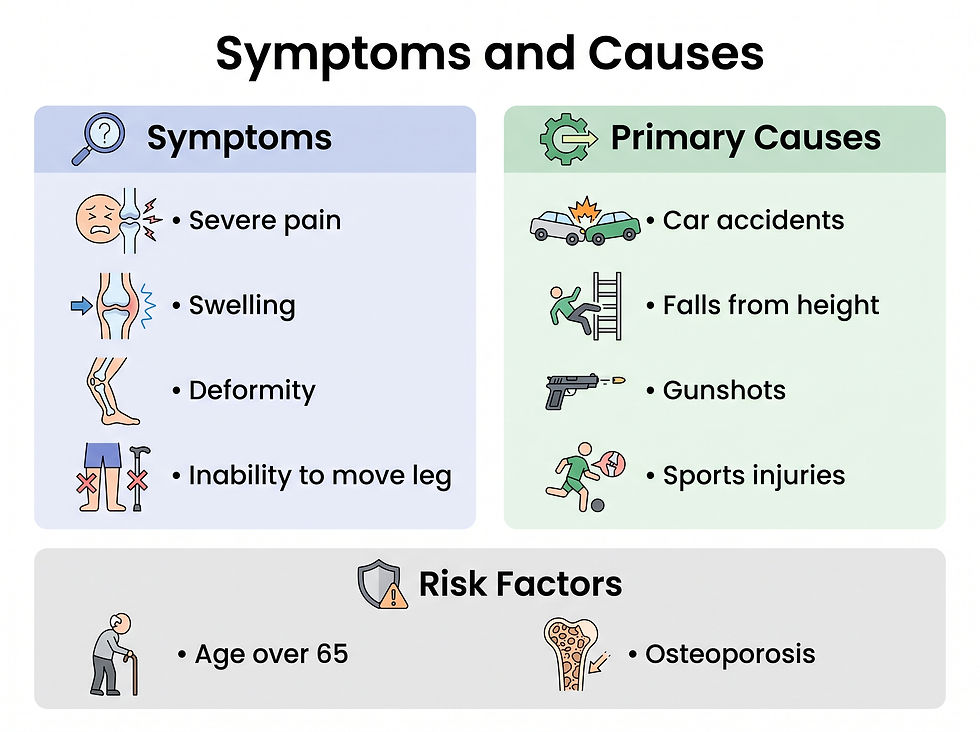
Pain: severe, excruciating pain in the thigh and leg.
Physical appearance: visible deformity or a bump that is not normally present.
Leg function: complete inability to move, use, or put weight on the leg.
Tissue changes: significant swelling, tenderness, bruising, or discoloration.
Skin status: open wounds if the bone has broken through the skin.
What Causes a Broken Femur?
Because the femur is exceptionally strong, it usually takes a high-energy impact to cause a fracture. These injuries are most common in high-speed accidents or significant falls, though underlying health conditions can increase the risk of a break from less severe forces.
High-impact trauma: car accidents, falls from heights, or gunshot wounds.
Sports injuries: high-velocity collisions in contact or extreme sports.
Advanced age: being over 65 increases fall risk and bone vulnerability.
Osteoporosis: reduced bone density makes fractures more likely from minor falls.
Osteopenia: early-stage bone thinning that weakens the femur structure.
How Is a Broken Femur Diagnosed?
Diagnosis typically occurs in an emergency setting after a traumatic event. Healthcare providers perform a rapid physical assessment while prioritizing stabilization of the patient and the injured limb. Imaging is essential to visualize the fracture pattern and plan for surgery.
Physical exam: assessing for deformity, swelling, and nerve or vessel damage.
X-ray: the primary tool for identifying the break location and pattern.
CT scan: provides detailed 3D views if the fracture is complex.
MRI: used to assess damage to surrounding muscles and ligaments.
How Is a Broken Femur Treated?
Treatment for a broken femur almost always requires surgery to ensure the bone is correctly realigned and stabilized. Because the femur must support the body's weight, the repair must be robust enough to allow for eventual movement and weight-bearing.
ORIF surgery: realigning the bone and securing it with internal hardware.
Intramedullary rod: a metal rod inserted through the center of the femur for support.
Plates and screws: used to secure fractures near joints or in multiple pieces.
Traction: temporary stabilization using weights and pulleys before surgery.
External fixation: a temporary frame outside the body to hold the bone straight.
Physical therapy: essential rehabilitation to regain strength and mobility.
How Can I Prevent a Broken Femur?
While high-impact accidents are difficult to predict, many femur fractures, especially in older adults, can be prevented by addressing bone health and environmental safety. Reducing fall risks and maintaining bone density are the most effective long-term strategies.
Bone density care: managing osteoporosis through diet and medication.
Fall prevention: removing home hazards like loose rugs or poor lighting.
Safety equipment: wearing appropriate gear during high-risk sports.
Home safety: using handrails and non-slip mats, especially for those over 65.
Regular screening: discussing bone health and fall risk with a provider.

What Is the Outlook for a Broken Femur?
The outlook for a broken femur is generally good with proper surgical treatment and rehabilitation, though the recovery process is long. Most patients can return to their usual activities within a year, provided they follow their physical therapy regimen and allow the bone adequate time to heal.
When Should You Seek Emergency Care?
A broken femur is a medical emergency. If you suspect you or someone else has a fractured thighbone, call 911 or your local emergency services immediately. Do not attempt to stand, walk, or move the injured leg, as this can cause further damage to muscles, nerves, and blood vessels.
What Are the Warning Signs After Surgery?
Call your healthcare provider immediately if you experience any of the following after surgery:
Shortness of breath or sudden chest pain (learn about pulmonary embolism).
Fever higher than 101°F (38.3°C).
Drainage or pus leaking from the surgical incision.
Sudden, sharp pain in your calf or increased leg swelling (possible blood clot).
Skin discoloration or worsening pain at the surgery site.
Breaking any bone is scary. And that’s especially true when you experience the kinds of injuries that can break your femur. It will take time to heal, but you’ll get better gradually. Give yourself credit every step of the way while you recover. It’s hard work, and you deserve to be proud of your progress.
Conclusion and Next Steps
A broken femur is one of the most serious orthopedic injuries, requiring immediate surgical intervention and a long-term commitment to recovery. While the road to full mobility can take up to a year, modern surgical techniques like ORIF provide a reliable path to healing. Following your surgical team's instructions and participating fully in physical therapy are the most important factors in achieving a successful outcome.
Prioritize immediate care: never delay seeking emergency treatment for a suspected femur fracture.
Follow the rehab plan: commit to several months of physical therapy to regain leg function.
Address bone health: if the break was caused by a fall, speak with your doctor about bone density testing.
Frequently Asked Questions (FAQ)
Is a broken femur a medical emergency?
Yes, a broken femur is a serious, potentially life-threatening injury that requires immediate emergency medical care and surgery.
Can you walk on a broken femur?
No. You should never attempt to stand, walk, or move on a leg if you suspect the femur is broken, as this can cause severe internal damage.
What is the most common surgery for a femur fracture?
Open reduction and internal fixation (ORIF) is the standard treatment, often involving the insertion of a metal rod into the bone's center.
How long does it take to recover from femur surgery?
Initial recovery from the operation usually takes four to six months, while full recovery can take up to a year.
Why is the femur so hard to break?
The femur is the longest and strongest bone in the body, designed to support your weight and withstand significant force during movement.
What is an open fracture?
An open (or compound) fracture occurs when the broken bone pierces through the skin, which significantly increases the risk of infection.
What is traction?
Traction is a temporary method using weights and pulleys to keep the broken bone stable and aligned before a patient can undergo surgery.
Can osteoporosis cause a broken femur?
Yes, osteoporosis weakens the bones, making it possible for the femur to break from a relatively minor fall that wouldn't affect healthy bone.
What are the risks of femur surgery?
Potential complications include blood clots, bone infections (osteomyelitis), malunion (healing in the wrong position), or compartment syndrome.
Do the metal rods stay in forever?
In most cases, the metal rods, plates, and screws used to repair a femur fracture stay in the body permanently unless they cause specific issues later.
What is a comminuted fracture?
A comminuted fracture is a complex break where the bone has splintered or been crushed into three or more distinct pieces.
Why is physical therapy necessary?
Physical therapy is essential to rebuild the leg muscles that atrophy during the healing process and to restore the joint's range of motion.
Can a broken femur cause a blood clot?
Yes, both the injury itself and the subsequent surgery increase the risk of developing blood clots in the leg (deep vein thrombosis).
What is external fixation?
External fixation is a temporary treatment where screws are placed in the bone and connected to a stabilizing frame outside the body.
Is a femur fracture the same as a broken hip?
While they are close together, a femur fracture typically refers to the shaft of the bone, whereas a hip fracture involves the upper end of the femur near the joint.
How do doctors know if a femur is broken?
Diagnosis is confirmed through a physical exam and imaging tests such as X-rays, CT scans, or MRIs.
Can children break their femurs?
Yes, children can break their femurs, often from falls or sports, though their bones generally heal faster than those of adults.
What is a spiral fracture?
A spiral fracture is a break that wraps around the bone, usually caused by a severe twisting force applied to the leg.
How long is the hospital stay?
The length of stay varies depending on the severity of the injury and the patient's overall health, but it often involves several days for observation and initial rehab.
Can a femur break heal on its own?
Because the femur is a weight-bearing bone, it almost never heals correctly without surgical intervention to realign and stabilize it.
What is malunion?
Malunion occurs when a broken bone heals in an incorrect position, which can lead to long-term pain or difficulty walking.
Are femur fractures life-threatening?
They can be, particularly if the break causes significant internal bleeding or if complications like fat embolisms or blood clots occur.
Can you prevent a broken femur?
You can reduce the risk by maintaining bone health, preventing falls, and using proper safety equipment during high-risk activities.
What is an intramedullary rod?
It is a specialized metal rod that a surgeon inserts into the hollow center of the femur to provide internal stability while the bone heals.
Does age affect recovery?
Yes, older adults, especially those with other health conditions, may face a longer and more complex recovery process.
What should I do if I suspect a fracture?
Immediately call 911, keep the person still, and do not attempt to move the leg until professional medical help arrives.
What is a displaced fracture?
A displaced fracture means the two ends of the broken bone have moved out of alignment, creating a gap that must be closed during surgery.
Can a broken femur cause chest pain?
Post-surgery chest pain or shortness of breath can be a sign of a serious complication like a blood clot traveling to the lungs (pulmonary embolism).
How soon can I start physical therapy?
Your surgical team will determine the timeline, but gentle movements often begin very soon after surgery to prevent stiffness.
Sources and External References
Medical disclaimer: This article is for informational purposes only and does not constitute medical advice. Always seek the advice of your physician or other qualified health provider with any questions you may have regarding a medical condition. Never disregard professional medical advice or delay in seeking it because of something you have read in this article.
Comments