Anhidrosis (Lack of Sweat): Causes, Warning Signs, and Heat-Safety Guide

Updated: 2 days ago
Medically reviewed by Dr. Baraa Alnahhal, MD · Last reviewed: September 2026
Editorial note: This article is for general education only. It is not medical advice, a diagnosis, or a treatment plan. Anhidrosis can be a sign of an underlying condition that deserves evaluation, and it can raise the risk of dangerous heat illness. If you notice you sweat little or not at all in hot weather or during activity that normally causes sweating, or if you develop signs of heat exhaustion or heatstroke, see a healthcare provider promptly. Never stop a prescription medication without talking to your provider first.
TL;DR
Anhidrosis is the inability to sweat normally, which removes the body's main cooling mechanism and lets heat build up to dangerous levels [1]. It can affect one area or the whole body and is often caused by medications (especially anticholinergics), nerve damage (commonly from diabetes), skin damage, or inherited and autoimmune conditions [1] [2]. Many cases go unnoticed until heat causes dizziness, flushing, muscle cramps, or weakness [1]. The condition itself is usually not curable, but medication-related cases are often reversible, underlying causes are treatable, and simple heat-safety habits keep most people out of danger [1].
Quick Answer: What Is Anhidrosis?
Anhidrosis (an-hi-DROH-sis) means your sweat glands do not work properly, so you cannot sweat enough — or at all — to cool your body down [1]. Because sweating is the body's main way of releasing heat, people with anhidrosis can overheat in hot weather, during exercise, or in warm rooms. The condition is not dangerous on its own, but it raises the risk of heat exhaustion and heatstroke, which are medical emergencies. Causes include certain medications, nerve damage, skin damage, and some genetic or autoimmune conditions — and some medication-related cases are reversible once the drug is stopped or changed [1] [2].
What Exactly Is Anhidrosis?
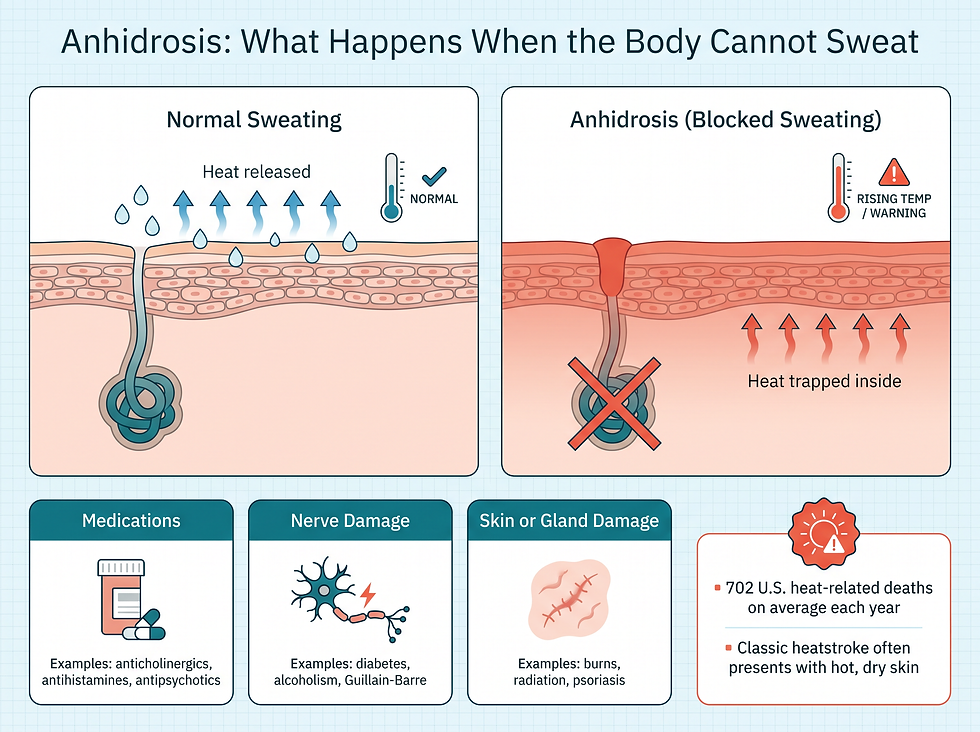
Anhidrosis (pronounced an-hi-DROH-sis) is a condition in which you cannot sweat (perspire) normally in one or more areas of your body [1]. Sweating is your body's built-in air conditioning. Moisture released through the skin evaporates and carries heat away. When that system fails, heat builds up inside the body instead of escaping.
You may also see the related term hypohidrosis, which means sweating less than usual rather than not at all [1]. The two conditions overlap, share causes, and are managed the same way.
The missing sweat can follow different patterns. Some people do not sweat in one specific body area. Others barely sweat anywhere. A third pattern is patchy: dry spots on one part of the body paired with heavy sweating somewhere else, as the body tries to compensate for the areas that do not work [1]. When sweating elsewhere still cools you down, that pattern is usually not dangerous — but it is still worth discussing with a provider.
How Common Is Anhidrosis?
Here is the honest answer: no one knows exactly how many people have anhidrosis [1]. Many mild cases never cause symptoms and are never diagnosed. Most people only discover they sweat less than expected when heat or exercise pushes their body to respond — and the response never comes.
What research does tell us is that anhidrosis is a clinical finding rather than a single disease — it shows up in many different conditions [2]. Its frequency therefore depends on the underlying cause.
Condition or cause | What the data shows |
Anhidrosis overall | Prevalence unknown; many mild cases go unnoticed [1] |
Hypohidrotic ectodermal dysplasia (no or sparse sweat glands) | About 1 in 100,000 births in the U.S.; up to 7 in 10,000 births reported internationally [2] |
Horner syndrome (one cause of one-sided anhidrosis) | Occurs in roughly 1 in 6,000 people [2] |
Fabry disease (inherited metabolic cause) | About 1 in 40,000 people [2] |
Naegeli-Franceschetti-Jadassohn syndrome (rare inherited cause) | About 1 in 2–4 million people [2] |
The broader context matters too. Heat itself is a silent public health burden in the United States. From 2004 to 2018, exposure to heat caused an average of 702 deaths per year, and people who cannot sweat are among those at highest risk [3].
What Causes Anhidrosis?
If you have anhidrosis, your sweat glands are not working as they should. There are many possible causes, and the three big families are: the nerve signal that tells the glands to fire, the gland itself, and the skin surface the sweat must pass through [2]. Some people are born with the condition; others develop it later in life [1].
Medications are the most common known drug-related cause. Anticholinergic medications block the chemical messenger that triggers sweat production. The list is longer than most people expect:
Drug class | Common examples |
Anticholinergics | Glycopyrrolate (Cuvposa®, Robinul®), doxepin (Silenor®, Zonalon®), atropine (Atropen®), cyproheptadine, hyoscyamine (Levsin/SL®, Hyosyne®) [1] |
Tricyclic antidepressants | Amitriptyline [1] |
Antihistamines | Diphenhydramine (Benadryl®, Nytol®) [1] |
Bladder antispasmodics | Oxybutynin (Ditropan XL®), tolterodine (Detrol®) [1] |
Antipsychotics / antiemetics | Chlorpromazine, clozapine (Clozaril®), quetiapine (Seroquel®) [1] |
Antiepileptics | Topiramate (Topamax®), zonisamide (Zonegran®) [1] |
Antihypertensives | Clonidine (Catapres®) [1] |
Opioids | Fentanyl, morphine, hydrocodone, oxycodone [1] |
Neuromuscular paralytics | Botulinum toxins (Botox® and similar) [1] |
The important framing: drug-induced anhidrosis is usually reversible. If a medication is the cause, sweating often returns after it is stopped or changed — but only a healthcare provider can make that call safely.
Beyond medications, the other cause families include:
Cause family | How it disrupts sweating |
Skin damage | Burns, radiation therapy, or pore-clogging skin diseases such as psoriasis physically block or destroy sweat pathways [1] [2] |
Gland damage | Surgery, trauma, or scar formation damage the glands directly [1] [2] |
Nerve damage (peripheral) | Diabetes, alcoholism, and Guillain-Barré syndrome damage the nerves that carry sweat signals [1] |
Inherited metabolic disorders | Fabry disease and hypohidrotic ectodermal dysplasia affect sweat gland formation or function [1] [2] |
Connective tissue disorders | Systemic sclerosis, systemic lupus erythematosus, and Sjögren syndrome [1] [2] |
Autonomic nervous system disorders | Ross syndrome and Harlequin syndrome [1] |
Central nervous system diseases | Multiple system atrophy, dementia with Lewy bodies, Parkinson's disease, stroke, and spinal cord disease [1] [2] |
Severe dehydration | Excessive dehydration can shut sweating down [1] |
One thing this list makes clear: anhidrosis is not caused by anything you did wrong. It is a consequence of medications, genetics, nerve disease, or skin injury — and in many cases the cause is never fully explained.
What Are the Symptoms of Anhidrosis?
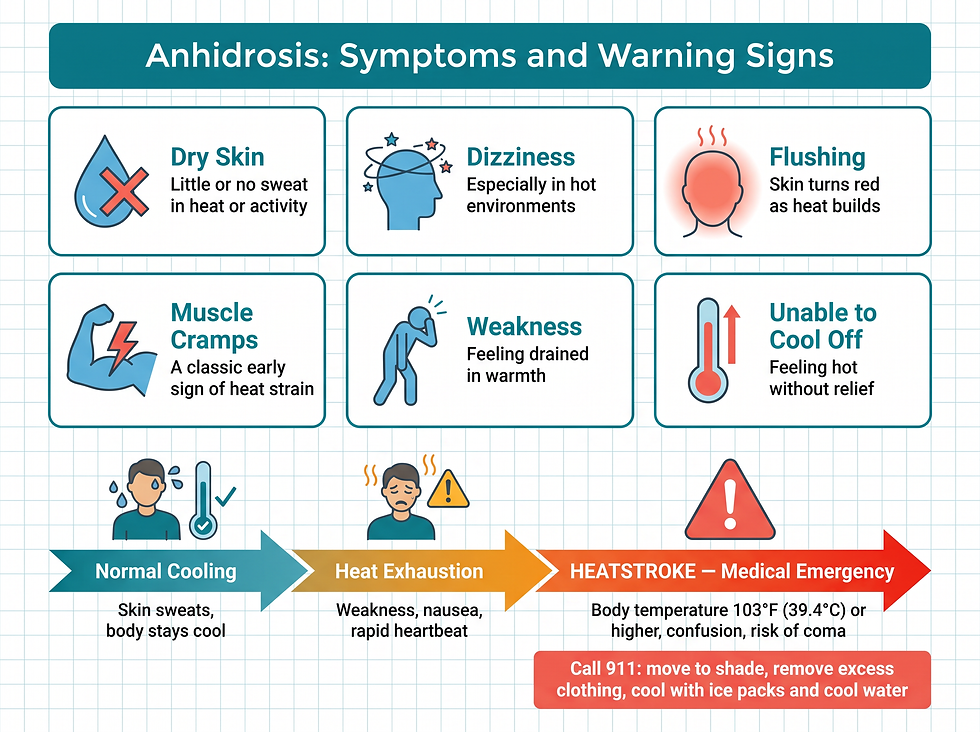
The frustrating reality of anhidrosis is that the condition itself is often invisible. The earliest "symptoms" are frequently noticed by someone else — or only after the body starts overheating. Recognized signs include:
Symptom | How it shows up |
Little or no sweating | Skin stays dry in heat or during activity that normally produces sweat [1] |
Dizziness | Especially in hot environments [1] |
Flushing | Skin turns red as the body struggles to dump heat [1] |
Muscle cramps | A classic early sign of heat strain [1] |
Overall weakness | Feeling drained in warmth [1] |
Feeling hot without relief | Unable to cool off even after resting [1] |
Two patterns deserve extra attention.
Compensatory sweating. Some people sweat heavily in some areas while staying dry in others, because the body overcompensates for the areas that do not sweat. This pattern is usually not dangerous on its own, since the body can still cool down — but it can be a clue that a sweating problem exists [1].
Heat illness — the real emergency. The most serious consequence of anhidrosis is not the condition itself but what heat can do when sweating fails.
Stage | What happens | What to do |
Heat exhaustion | Weakness, nausea, and rapid heartbeat after strenuous activity in hot weather [1] | Move to a cooler place, drink water, apply cool compresses, or take a cool shower [1] |
Heatstroke | Body temperature reaches 103°F (39.4°C) or higher — a life-threatening condition that can cause confusion, loss of consciousness, coma, and death [1] | Call 911 immediately. Move into shade, remove unnecessary clothing, and cool the person with ice packs, cool water sponging, wet towels, or a hose [1] |
National data puts these risks in perspective. Body temperature can climb to 106°F (41.1°C) within 10 to 15 minutes in extreme heat [4], and the "classic" form of heatstroke — which mostly affects older adults — characteristically presents with hot, dry skin, because the sweating response has failed [5]. People with anhidrosis are precisely the population that cannot rely on that response.
What Should I Do If I Have Symptoms of Anhidrosis?
Make an appointment to see your healthcare provider and describe your inability to sweat along with any other symptoms [1]. Do not wait for a heat emergency to raise the issue.
If you develop symptoms in a heated environment, act immediately: get out of the heat and move to shade or an air-conditioned space, loosen your clothes, and apply cool damp cloths to your body if possible. Seek medical attention if your symptoms do not improve as you cool down [1].
How Is Anhidrosis Diagnosed?
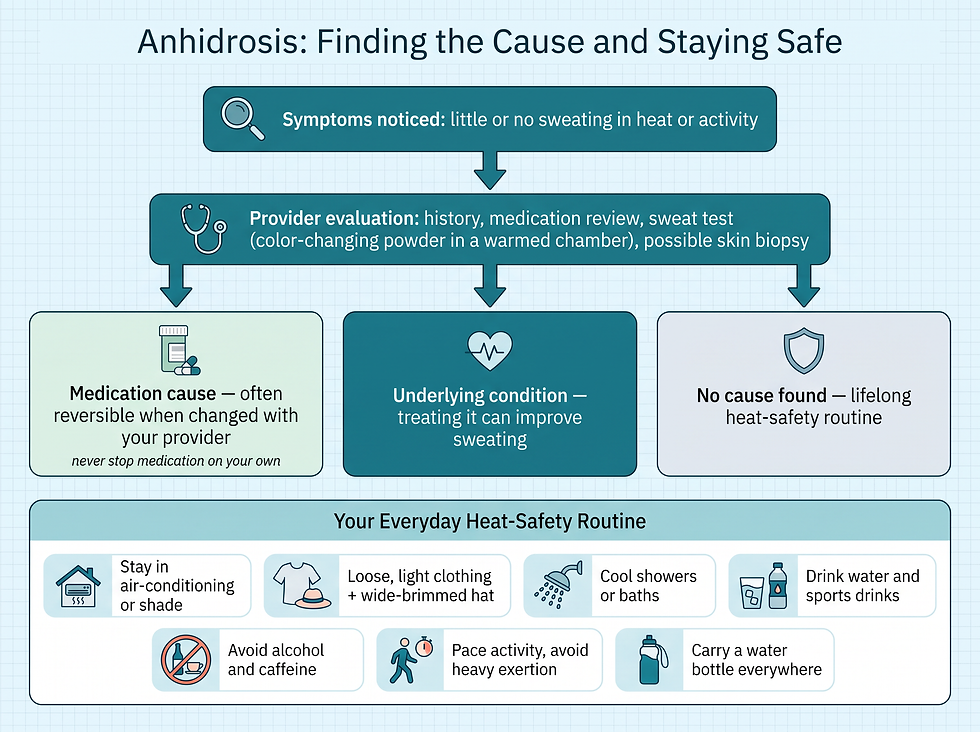
Diagnosis usually starts with a careful history. Providers ask when the sweating changed, which areas are affected, what medications you take, and whether you have conditions like diabetes or autoimmune disease [2].
The key diagnostic tool is the sweat test (thermoregulatory sweat test). Your skin is coated with a powder that changes color where sweat forms. You are then placed in a warmed chamber that makes you perspire, letting the provider see exactly which parts of your body sweat — and which do not [1].
Test | What it looks for |
Sweat test (color-changing powder + heated chamber) | Maps which body areas sweat and which do not [1] |
Skin biopsy | Looks for nerve fiber damage that could explain a neuropathic cause [1] [2] |
Blood work and further testing | Searches for underlying conditions such as diabetes, autoimmune disease, or metabolic disorders [1] |
Because the sweat pattern itself is only a symptom of a deeper problem, providers also look for the cause — reviewing medications, checking nerve function, and ruling out the conditions listed above.
Is There Treatment for Anhidrosis?
Yes — but the right treatment depends entirely on the cause, and in some cases the most important "treatment" is simply managing your environment.
If a medication is the cause, the condition is often reversible. Stopping or changing the drug can restore sweating — but never stop a prescription on your own. Talk to your healthcare provider first [1].
If an underlying medical condition is causing the anhidrosis, that condition may be treatable, and treating it can improve the sweating problem [1].
If no cause is found, management focuses on staying safe in the heat. That means learning to avoid situations where not sweating could cause harm, plus everyday cooling habits:
Self-care step | Why it helps |
Stay in cool, air-conditioned places; move into shade outdoors | Reduces the heat your body must shed [1] |
Wear loose, light-colored clothing and a wide-brimmed hat | Limits heat absorption [1] |
Take cool showers or sit in a bath of cool water | Active cooling when sweating cannot do the job [1] |
Drink plenty of water or sports drinks; avoid alcohol and caffeine-heavy drinks | Prevents dehydration, which itself can worsen sweating [1] |
Move slowly; avoid heavy exertion in heat | Prevents heat buildup faster than your body can release it [1] |
Carry a water bottle everywhere | For drinking — and for pouring on your skin in an emergency [1] |
Learn the signs of heat exhaustion and heatstroke | Faster response can be life-saving [1] |
What Is the Outlook for Anhidrosis?
Anhidrosis is usually a life-long condition — but the prognosis depends heavily on whether an underlying, treatable cause can be found [1]. Treating that cause should improve the sweating problem. When a medication is responsible, anhidrosis usually reverses once the medication is discontinued [1].
For people whose anhidrosis is chronic and irreversible, the outlook is good as long as heat exposure is managed. Living with anhidrosis means learning your limits, planning around the weather, and knowing the warning signs that heat has started to win.
Key Takeaways
Anhidrosis is the inability to sweat normally — a condition that removes your body's main cooling system and is most dangerous in heat [1]. It may be caused by medications (most commonly anticholinergics), nerve damage, skin damage, or genetic and autoimmune conditions, and mild cases often go unnoticed [1] [2]. The stakes are real: uncontrolled overheating can progress from heat exhaustion to heatstroke, a medical emergency with a body temperature of 103°F or higher [1] [4].
The good news is equally real. Medication-related anhidrosis is often reversible, many underlying causes are treatable, and simple habits — staying cool, hydrating, pacing activity, and recognizing warning signs — keep most people living fully and safely with the condition [1].
If you notice you sweat little or not at all on hot days or during activities that normally cause sweating, talk with your healthcare provider. And if you develop confusion, extreme weakness, or a temperature of 103°F or higher in the heat, call 911 — every minute of cooling counts [1].
Frequently Asked Questions
Is anhidrosis a disease on its own? No — it is a clinical finding, a sign that something is affecting your sweat glands or the nerves that control them. Finding the underlying cause is the core of diagnosis [1] [2].
What is the difference between anhidrosis and hypohidrosis? Anhidrosis means sweating is absent; hypohidrosis means sweating is reduced. They overlap, share causes, and are managed the same way [1].
Can medications cause you to stop sweating? Yes — drugs are the most common known cause, especially anticholinergics, certain antidepressants, antihistamines, bladder medications, antipsychotics, antiepileptics, blood-pressure drugs, opioids, and botulinum toxin [1]. Drug-induced anhidrosis is often reversible when the medication is changed.
Is anhidrosis dangerous? The condition itself is not, but it raises your risk of heat exhaustion and heatstroke — and heatstroke is life-threatening [1] [5].
Can anhidrosis go away? It can, if the cause is treatable. Medication-related cases usually reverse when the drug is stopped (with your provider's guidance), and treating an underlying condition can restore sweating [1].
How do doctors test for anhidrosis? With a sweat test: a color-changing powder is applied to the skin and you sit in a heated chamber so the provider can see exactly which areas sweat [1]. A skin biopsy can look for nerve damage [1].
Who is most likely to have anhidrosis? Anyone — it can be inherited or develop at any age from medications, diabetes, autoimmune disease, skin injury, or neurological conditions. The most common consequences fall on older adults: roughly 39% of U.S. heat-related deaths occur in people 65 and older [2] [3].
How do I stay safe in the heat if I cannot sweat? Stay in air-conditioned or shaded spaces, wear loose light clothing, drink plenty of fluids, avoid alcohol and caffeine, pace your activity, carry water, and know the warning signs of heat exhaustion and heatstroke [1].
Read More From Our Health Library
References
Cleveland Clinic — Anhidrosis (Lack of Sweat) (medically reviewed, last updated 04/19/2021) — https://my.clevelandclinic.org/health/diseases/15891-anhidrosis-lack-of-sweat
StatPearls / NIH — Anhidrosis (Harper CD, Bermudez R; updated 06/21/2023) — https://www.ncbi.nlm.nih.gov/books/NBK555988/
CDC — Heat-Related Deaths, United States, 2004–2018 (MMWR, published 06/19/2020) — https://www.cdc.gov/mmwr/volumes/69/wr/mm6924a1.htm
CDC / NIOSH — Heat-Related Illnesses (updated 09/17/2024) — https://www.cdc.gov/niosh/heat-stress/about/illnesses.html
StatPearls / NIH — Heat Stroke (Morris A, Patel G; updated 02/13/2023) — https://www.ncbi.nlm.nih.gov/books/NBK537135/
American Academy of Family Physicians — Heat Exhaustion and Heatstroke — https://familydoctor.org/condition/heat-exhaustion-heatstroke/
Coon EA, Cheshire WP — Sweating Disorders (Continuum, 2020;26(1):116-137) — https://journals.lww.com/continuum/fulltext/2020/02000/sweating_disorders.10.aspx
Gauer R, Meyers BK — Heat-Related Illnesses (Am Fam Physician, 2019;99(8):482-489) — https://www.aafp.org/pubs/afp/issues/2019/0415/p482.html
Comments