Agenesis of the Corpus Callosum (ACC): The Missing Bridge Between Your Brain's Two Halves

Updated: 2 days ago
Medically reviewed by Dr. Baraa Alnahhal, MD · Last reviewed: September 2026
TL;DR
Agenesis of the corpus callosum (ACC) is a congenital (present-at-birth) condition in which the corpus callosum — a thick bundle of nerve fibers that connects the left and right hemispheres of the brain and allows both sides to communicate — is partially or completely missing. It ranges in severity: some people have only minor effects on everyday activities, while others need lifelong, multidisciplinary management. Signs often appear in a child's first two years (developmental delays, seizures, feeding difficulty, unusual muscle tone), though mild cases may surface only at school age. Research suggests a large majority of cases have an underlying genetic cause, and treatment focuses on symptom management — antiseizure medication, physical, occupational, speech, and visual therapies, education support, and shunts for hydrocephalus. Isolated ACC does not directly affect lifespan, and a normal life is possible with the right care team.
Quick Answer
What it is: Agenesis of the corpus callosum is a congenital condition in which the corpus callosum — the thick nerve-fiber bundle connecting the brain's left and right hemispheres — is partially or completely missing, making communication between the two sides of the brain harder.
Types: Complete agenesis means the entire corpus callosum is missing; partial agenesis (hypogenesis or dysgenesis) means part is missing. Each form can be isolated (only the corpus callosum) or complex (other brain areas affected too).
Who it affects: Most cases trace to an underlying genetic cause such as aneuploidy, chromosomal rearrangements, or DISC1 gene variants. It can occur alongside conditions like Aicardi, Apert, Dandy-Walker, and Joubert syndromes, and trisomies 13 and 18.
How it is managed: There is no cure; treatment manages symptoms through antiseizure medications, early intervention, physical, occupational, speech, and visual therapies, cognitive behavioral therapy, and shunts for hydrocephalus. Isolated ACC does not directly affect lifespan.
What Is Agenesis of the Corpus Callosum?
Agenesis of the corpus callosum (ACC) is a congenital condition (present at birth) where you're missing or partially missing the corpus callosum. This is a thick bundle of nerve fibers that connect the right and left hemispheres (sides) of your brain. It allows both sides of your brain to communicate with each other.
The corpus callosum processes your senses, movement, and advanced thinking. ACC can lead to symptoms like developmental delays, cognitive impairment, or difficulty with fine motor skills. Treatment is available to help manage symptoms.
A helpful way to picture it: think of your corpus callosum as a wooden bridge over a river. It allows people to move freely from one side to the other. With ACC, the bridge is missing planks or doesn't exist at all — in some cases you may still cross, but getting to the other side becomes much more challenging.
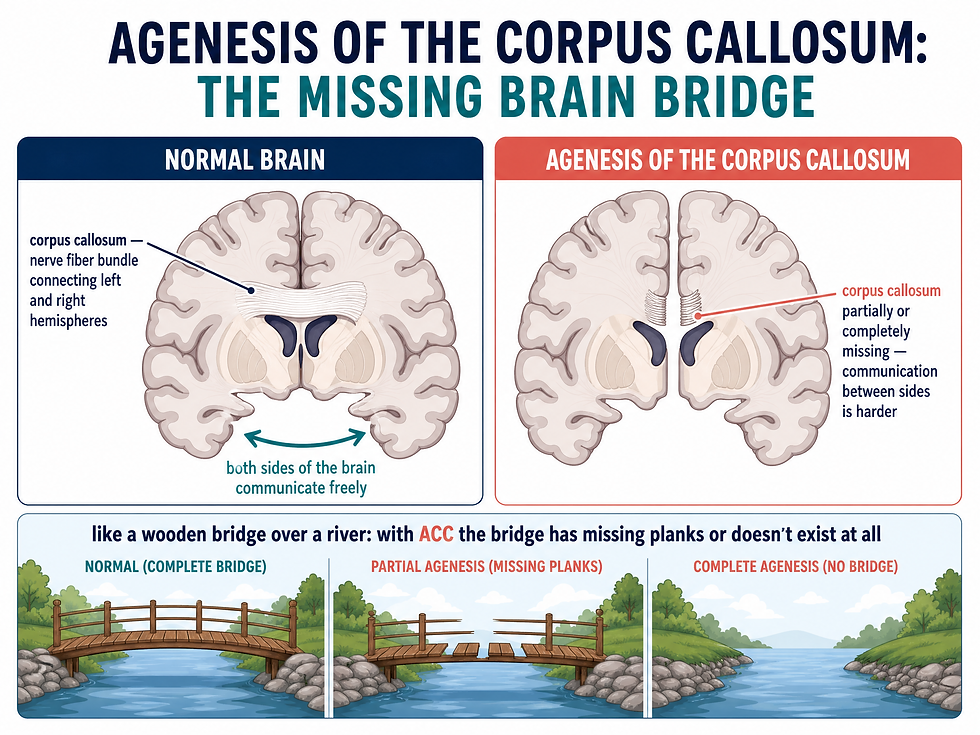
In a normal brain, the corpus callosum — a thick nerve-fiber bundle — connects the left and right hemispheres so both sides communicate freely. In agenesis of the corpus callosum, this bundle is partially or completely missing, making communication between the sides harder. The analogy: a wooden bridge over a river; with ACC the bridge has missing planks (partial agenesis) or doesn't exist at all (complete agenesis).
What Are the Types of Agenesis of the Corpus Callosum?
There are two types of ACC, each of which can be further classified as isolated or complex:
Type | Definition |
Complete agenesis | All of the corpus callosum is missing |
Partial agenesis (hypogenesis or dysgenesis) | Part of the corpus callosum is missing |
Classification | Definition |
Isolated | Only the corpus callosum is affected |
Complex | Other parts of the brain beyond the corpus callosum are also affected |
What Are the Symptoms of Agenesis of the Corpus Callosum?
Signs and symptoms of ACC may include:
Symptom | Detail |
Developmental delays | Rolling over, sitting up, walking, talking |
Cognitive impairment | Or intellectual disability |
Vision, hearing, and speech | Challenges in these areas |
Seizures | Can occur in some cases |
Feeding difficulty | Particularly in infants |
Muscle tone | Tight or loose muscle tone |
Head size | Abnormally large (macrocephaly) or small (microcephaly) |
Hydrocephalus | Rare |
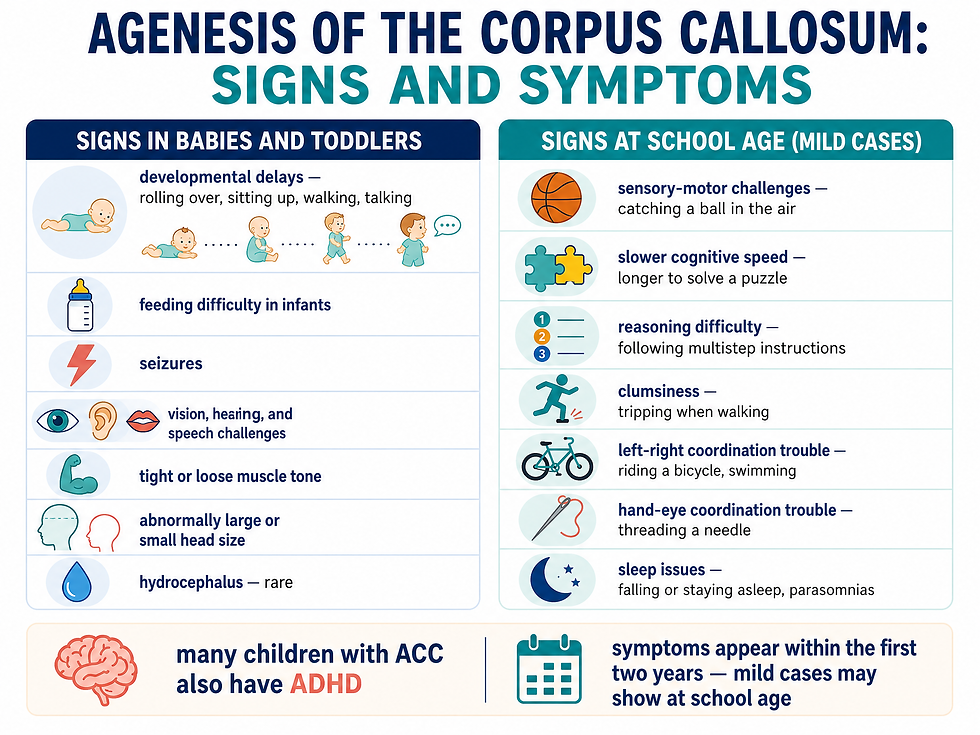
Early signs in babies and toddlers include developmental delays (rolling, sitting, walking, talking), feeding difficulty, seizures, vision/hearing/speech challenges, tight or loose muscle tone, abnormal head size, and rarely hydrocephalus. In mild cases, symptoms may not surface until school age — trouble catching a ball, slower puzzle-solving, difficulty following multistep instructions, clumsiness, left-right and hand-eye coordination trouble, and sleep issues. Many children with ACC also have ADHD, and symptoms often appear within the first two years of life.
When Do Parents Notice Symptoms?
As a parent or caregiver, you might notice symptoms within your child's first two years. Mild cases may not have obvious symptoms until your child reaches school age.
Symptoms That Appear at School Age
You might first notice trouble with the following:
School-Age Sign | Example |
Sensory-motor information | Catching a ball in the air |
Cognitive speed | It takes your child longer than others to solve a puzzle |
Reasoning and problem-solving | Following multistep instructions |
The symptoms of ACC vary from person to person. They depend on how much of the corpus callosum is missing and whether the condition affects other parts of the brain.
What Are the Behavior Problems Associated With ACC?
The following are examples of behaviors that may happen with agenesis of the corpus callosum:
Behavior Challenge | Example |
Clumsiness | Tripping when walking |
Left-right coordination | Riding a bicycle or swimming |
Hand-eye coordination | Threading a needle or playing an instrument |
Sleep issues | Difficulty falling asleep, staying asleep, or parasomnias |
Many children also experience neurodevelopmental disorders like ADHD with ACC.
What Causes Agenesis of the Corpus Callosum?
Healthcare providers aren't entirely sure what causes the corpus callosum to not develop as expected. Research suggests a large majority are from an underlying genetic cause, including:
Genetic Cause | Explanation |
Aneuploidy | Cells in your body have one extra or are missing chromosomes |
Chromosomal rearrangements | A chromosome segment breaks off and either rotates and reattaches to the same chromosome (inversion) or reattaches to another chromosome (translocation) |
Genetic variants | Changes to the DISC1 gene may lead to symptoms |
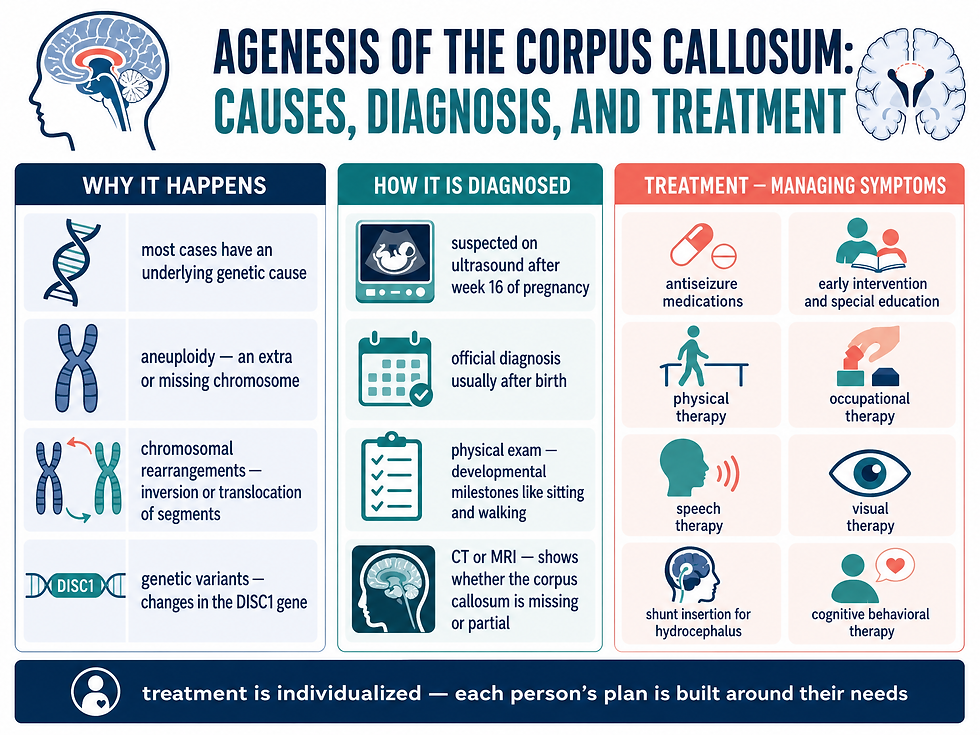
Most cases trace to an underlying genetic cause: aneuploidy (an extra or missing chromosome), chromosomal rearrangements (inversion or translocation of segments), or genetic variants in the DISC1 gene. Diagnosis is usually suspected on ultrasound after week 16 of pregnancy and confirmed after birth with a physical exam and CT or MRI. Treatment manages symptoms with antiseizure medications, early intervention and special education, physical, occupational, speech, and visual therapies, shunt insertion for hydrocephalus, and cognitive behavioral therapy — each person's plan is individualized.
Does ACC Happen With Other Conditions?
Yes — some types of ACC can occur with other congenital conditions (present at birth):
Associated Condition | Type |
Aicardi syndrome | A rare congenital condition |
Apert syndrome | A congenital condition |
Dandy-Walker syndrome | A congenital brain condition |
Joubert syndrome | A congenital condition |
L1 syndrome | A congenital condition |
Schizencephaly | A congenital brain condition |
Trisomy 13 (Patau syndrome) | A chromosomal condition |
Trisomy 18 (Edwards syndrome) | A chromosomal condition |
What Are the Risk Factors for Agenesis of the Corpus Callosum?
Some pregnancy complications may affect how the fetus develops, increasing the risk of ACC:
Risk Factor | Detail |
Infection or injury to the fetus | During the 12th to 24th week of pregnancy |
Alcohol use disorder | Resulting in fetal alcohol syndrome |
Phenylketonuria | A metabolic condition |
How Is Agenesis of the Corpus Callosum Diagnosed?
A healthcare provider may suspect ACC during an ultrasound after the 16th week of pregnancy. An official diagnosis usually happens after birth.
The Physical Exam
Your provider will perform a physical exam and take testing. During the exam, your provider will learn more about your symptoms and medical history. For children, a provider will ask parents or caregivers if their child is meeting developmental milestones for their age, like sitting upright on their own or walking.
Imaging Tests
Your provider may order imaging tests to confirm a diagnosis:
Test | What It Shows |
CT scan | Whether the corpus callosum is missing or partially developed |
MRI | Whether the corpus callosum is missing or partially developed |
Other tests may be necessary if your provider suspects ACC occurs with another condition.
How Is Agenesis of the Corpus Callosum Treated?
ACC treatment focuses on helping you manage symptoms. This could include:
Treatment | Purpose |
Antiseizure medications | Manages seizures |
Early intervention / special education | School-based support programs |
Physical therapy | Improves movement and motor skills |
Occupational therapy | Improves daily-living skills |
Speech therapy | Supports communication |
Visual therapy | Supports vision challenges |
Shunt insertion | For hydrocephalus |
Cognitive behavioral therapy | Supports mental health and adaptation |
Treatment varies for each person. A healthcare provider will create a treatment plan that focuses on your needs.
What's the Prognosis for Agenesis of the Corpus Callosum?
This condition affects each person differently. It can affect your cognitive function (thinking), motor skills, and behavior. Your outlook varies based on how much of your corpus callosum is missing, and ranges in severity.
For some, ACC only has a minor effect on everyday activities. For others, it needs lifelong management under the supervision of many different providers. Your provider can give you information on your outlook specifically, as it's as unique as you are.
You may have trouble participating in sports or activities, learning in school, or accomplishing your daily routine independently. This can affect your mental health and emotional well-being. A mental health professional, along with others on your care team, can help you adapt and manage how symptoms affect you.
What's the Life Expectancy for ACC?
Isolated ACC doesn't directly affect your lifespan. However, your lifespan can vary if you have another condition with ACC or if symptoms affect other parts of your brain.
Can Agenesis of the Corpus Callosum Be Prevented?
As the cause isn't well understood, there isn't a way to prevent agenesis of the corpus callosum. Expecting parents can reduce their risk of having a child with ACC by taking care of themselves during pregnancy. This includes avoiding alcohol use and protecting yourself from infections or injury. A healthcare provider can help you manage your health and the fetus's health.
Genetic testing is also available if you plan on expanding your family and want to learn more about your risk of having a child with a genetic condition.
Can You Live a Normal Life With Agenesis of the Corpus Callosum?
Yes, this is possible. But what's normal for you may be different from what someone else might consider normal. Your child can still play and participate in fun activities, go to school, and socialize with others. You may face some challenges, but your healthcare providers can help you adapt if necessary.
When Should I See a Healthcare Provider?
Talk to a healthcare provider if your child misses developmental milestones for their age or if anything seems "off" about your child's behavior or functioning. You know your child best, so talk to their healthcare provider if you see signs of ACC.
Living With ACC: Questions to Ask Your Provider
Because ACC affects people in different ways, consider asking your healthcare provider:
How much of the corpus callosum is missing?
Is there another condition causing symptoms with ACC?
What type of treatment do you recommend?
Are there side effects of treatment?
Conclusion
Agenesis of the corpus callosum sounds alarming — a child born without the brain's central bridge — but the evidence paints a wide spectrum rather than a single fate. The corpus callosum is the thick nerve-fiber bundle that lets the brain's two hemispheres share senses, movement plans, and advanced thinking; when it is partially or completely missing, communication between sides becomes harder, like crossing a river on a bridge with missing planks or no bridge at all. Symptoms run the gamut from missed milestones, seizures, and feeding trouble in infancy to clumsiness, coordination trouble, and slower problem-solving that only shows up at school age. A large majority of cases trace to genetic causes — aneuploidy, chromosomal rearrangements, or DISC1 variants — and ACC can travel alongside other congenital syndromes, so comprehensive testing matters. There is no cure, but symptom management is real and individualized: antiseizure medication, therapies of every stripe, education support, and shunts when hydrocephalus enters the picture. Crucially, isolated ACC does not directly shorten a lifespan, and a meaningful, engaged life — school, play, friendship — remains within reach with a care team that adapts to the child rather than the diagnosis.
CTA: If your baby or young child is missing milestones, feeding poorly, having seizures, or moving in ways that feel off, talk to a healthcare provider now — don't wait for the "wait and see" advice to stretch past the first two years. If prenatal ultrasound after week 16 raises questions, ask about confirmatory imaging and a referral to a pediatric neurologist. After diagnosis, come to the conversation with the four questions above, and ask for a written, individualized treatment plan that names every therapist and specialist on the team.
Frequently Asked Questions
What is agenesis of the corpus callosum?
Agenesis of the corpus callosum (ACC) is a congenital condition — present at birth — in which the corpus callosum, the thick bundle of nerve fibers connecting the brain's left and right hemispheres, is partially or completely missing. Because this bundle lets both sides of the brain communicate, ACC can affect thinking, movement, and behavior.
What is the difference between complete and partial agenesis?
In complete agenesis, the entire corpus callosum is missing. In partial agenesis (also called hypogenesis or dysgenesis), only part of it is missing. Each type can also be classified as isolated — affecting only the corpus callosum — or complex — involving other parts of the brain as well.
What are the first signs of ACC in a baby?
Symptoms may appear within a child's first two years and can include developmental delays such as rolling over, sitting up, walking, and talking, plus feeding difficulty in infants, seizures, vision, hearing, and speech challenges, tight or loose muscle tone, abnormally large or small head size, and rarely hydrocephalus.
Can a child with ACC live a normal life?
Yes, this is possible. What counts as "normal" varies from person to person. Children with ACC can play, participate in activities, go to school, and socialize, though they may face challenges that healthcare providers can help them adapt to.
What causes agenesis of the corpus callosum?
The exact cause isn't fully understood, but research suggests a large majority of cases have an underlying genetic cause, including aneuploidy (an extra or missing chromosome), chromosomal rearrangements such as inversions or translocations, and genetic variants in the DISC1 gene.
How is ACC diagnosed?
A provider may suspect ACC on an ultrasound after the 16th week of pregnancy, but official diagnosis usually happens after birth. It involves a physical exam — including whether the child is meeting developmental milestones — and imaging tests such as CT or MRI, which show whether the corpus callosum is missing or only partially developed.
How is ACC treated?
Treatment focuses on managing symptoms and is individualized. It may include antiseizure medications, early intervention and special education programs, physical, occupational, speech, and visual therapies, cognitive behavioral therapy, and a shunt if hydrocephalus is present.
Does ACC affect life expectancy?
Isolated ACC does not directly affect lifespan. However, lifespan can vary if ACC occurs alongside another condition or if symptoms affect other parts of the brain.
Internal Links
External References
Medical Disclaimer
This article is for general informational purposes only and is not a substitute for professional medical advice, diagnosis, or treatment. Agenesis of the corpus callosum is a congenital brain condition that varies widely in severity from person to person, and only a licensed healthcare provider — typically a pediatric neurologist — can diagnose it through developmental assessment and imaging such as CT or MRI. Symptoms like missed milestones, seizures, feeding difficulty, or unusual muscle tone in an infant or child warrant prompt medical evaluation. Never delay seeking medical care because of something you have read here.
Comments