
Aicardi Syndrome: What It Is, Who It Affects, and How It Is Treated

Updated: 2 days ago
Medically reviewed by Dr. Baraa Alnahhal, MD · Last reviewed: September 2026
This article is for educational purposes only and is not a substitute for professional medical advice, diagnosis, or treatment. Rare-disease decisions should always be made with a child's medical team.
TL;DR
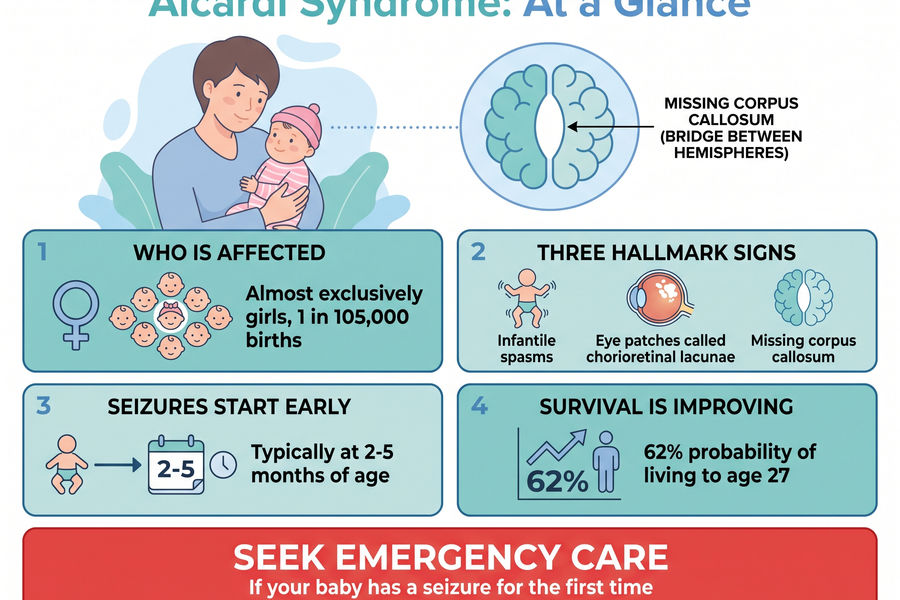
Aicardi syndrome is a rare, present-at-birth condition that almost exclusively affects girls. It combines seizures that begin in early infancy, absent or partial connections between the brain's two halves, and distinctive eye defects. Around 1 in 105,000 live births are affected, and recent studies show most children now survive well into their twenties, though care is lifelong and seizures can be difficult to control.
Quick Answer
Aicardi syndrome is a rare neurological and eye disorder found nearly always in girls, caused by a gene change on the X chromosome. It is defined by three hallmark features: infantile spasms (seizures starting around 2–5 months of age), missing tissue between the eyes' retinas called chorioretinal lacunae, and partial or complete absence of the corpus callosum, the structure connecting the brain's two hemispheres. Seizures are treated with antiseizure medications and sometimes a vagus nerve stimulator, and children benefit from lifelong physical, occupational, and speech therapy. Survival has improved markedly: the chance of living to age 27 is about 62%, and many children with milder symptoms reach adulthood.
What Is Aicardi Syndrome?
Aicardi syndrome is a rare condition present at birth that affects the brain and eyes. Most children experience seizures, developmental delays, and intellectual disability. The condition can shorten life expectancy in some cases, but the severity varies widely from person to person, and not every case is severe.
The syndrome was first described in 1965 by a French neurologist, and since then researchers have refined how it is diagnosed and understood. It affects the development of the brain while a baby grows in the womb, which is why the signs are typically visible on brain imaging shortly after birth.
What Are the Three Hallmark Features of Aicardi Syndrome?
Doctors look for a classic triad of features to diagnose Aicardi syndrome. These three characteristics together define the condition.
Agenesis of the corpus callosum: partial or complete absence of the corpus callosum, the thick bundle of nerve fibers that connects the brain's left and right halves.
Chorioretinal lacunae: punched-out missing patches of tissue in the retina at the back of the eye, often on both sides.
Infantile spasms: a specific type of seizure that begins in the first months of life, often appearing as sudden whole-body jerks.

Chorioretinal lacunae show up in roughly 75% of the eyes of affected children, making them one of the most reliable diagnostic clues. The corpus callosum is normally responsible for transferring information between the two brain hemispheres, so its absence affects how the brain develops and functions.
Seizures usually begin when a baby is between two and five months old, with a 2024 study of 245 published cases finding a median onset of just 2.2 months. The first seizures often appear as infantile spasms — brief, sudden jerks of the whole body that happen all at once.
Who Gets Aicardi Syndrome, and How Rare Is It?
Aicardi syndrome is one of the rarest conditions in medicine, and it has an unusual pattern: it almost exclusively affects girls. Researchers believe the condition is typically fatal for boys before birth or shortly after, because males have only one X chromosome carrying the change, while females have a second, healthy X chromosome that allows them to survive.
Incidence in the U.S.: about 1 in 105,000 live births.
Incidence in the Netherlands: about 1 in 93,000 live births.
Incidence range (U.S., per MedlinePlus): 1 in 105,000 to 167,000 newborns.
Prevalence in Norway: 0.63 cases per 100,000 females.
U.S. prevalence: greater than 853 known cases.
Worldwide prevalence: several thousand cases; commonly cited estimate around 4,000–5,000.
Sex affected: almost exclusively females.
The condition does not run in families. Nearly all cases result from a new, spontaneous gene change that occurs at conception rather than being passed down from a parent.
What Causes Aicardi Syndrome?
The condition is linked to a gene change on the X chromosome, though researchers have not yet identified a single specific gene responsible in most patients. It is described as X-linked dominant, meaning the change on one X chromosome is enough to cause the condition.
Because the change occurs on the X chromosome and is presumed to be lethal in males, Aicardi syndrome is seen almost exclusively in girls. Very rare cases in boys usually involve an extra X chromosome.
Importantly for parents, Aicardi syndrome does not tend to repeat within families. The gene change happens spontaneously, and the risk of having another child with the condition is considered low, though a genetic counselor can provide personalized guidance.
What Are the Signs and Symptoms?
The first sign is often seizures appearing in a baby's earliest months, frequently before parents even suspect a problem. Beyond the classic triad, the condition can involve a wide range of additional features.
Seizures: infantile spasms starting around 2–5 months; epilepsy that may continue with different seizure types, sometimes several times a day.
Development: missed milestones such as sitting upright or speaking first words; intellectual disability ranging from mild to severe.
Eyes: optic nerve coloboma, chorioretinal lacunae, small or underdeveloped eyes (microphthalmia); severe cases can lead to blindness.
Brain imaging: missing corpus callosum, brain asymmetry, abnormal folds (polymicrogyria), cysts, enlarged ventricles, misplaced nerve cells (heterotopia).
Muscle and movement: hypotonia (weak, floppy muscles), microcephaly (small head), difficulty sitting, grasping, or walking.
Skeleton and appearance: spine and rib abnormalities leading to scoliosis, large ears, short space between nose and upper lip, small malformed hands, thin eyebrows.
Digestive: difficulty feeding that may require tube feeding, constipation, diarrhea, and acid reflux (GERD).
Because children may have one or multiple characteristics rather than all of them, diagnosis requires a combination of brain imaging, eye examination, and seizure documentation rather than any single sign.
What Complications Can Aicardi Syndrome Cause?
The main complication concerns early death, which in severe cases is most often driven by seizures that are prolonged and difficult to treat, feeding problems, and breathing difficulties. Children also face a higher risk of life-threatening outcomes from respiratory infections such as pneumonia, because muscle weakness in the lungs and diaphragm makes it harder to clear secretions and breathe deeply.
Frequent seizures can themselves interfere with learning and development, which is one reason that finding an effective seizure treatment plan early matters so much. Skeletal problems such as scoliosis can worsen over time and may need orthopedic attention.
How Is Aicardi Syndrome Diagnosed?
Some signs, such as brain asymmetry or missing structures, may be detected before birth on a prenatal ultrasound. Most children, however, are diagnosed in the first year of life after seizures begin or developmental delays become apparent.
Brain MRI: checks for absence or partial formation of the corpus callosum, cysts, asymmetry, and abnormal brain folds.
EEG (electroencephalogram): checks for patterns of infantile spasms and other seizure activity.
Eye exam by a pediatric ophthalmologist: checks for chorioretinal lacunae, optic disc coloboma, and other retinal abnormalities.
A modern diagnostic standard asks for two of the three classic features plus at least two major supporting features. A 2024 modeling study found that 60% of published cases showed the classic triad while 40% were identified through these revised criteria. The same study found the median delay from symptom onset to diagnosis was only about one month, reflecting how distinctive the combination of features is.
How Is Aicardi Syndrome Treated?
There is no cure for Aicardi syndrome, and no single treatment works for every child. Management focuses on controlling seizures, supporting development, and addressing feeding and mobility needs throughout life.
Antiseizure medications are the first line of treatment. Because this form of epilepsy can be difficult to control, doctors often need to try several medication types before finding one that reduces seizure frequency. When medications alone are not enough, a vagus nerve stimulator — a device that sends electrical impulses to the brain — may be added.
Seizure control: trial of antiseizure medications; vagus nerve stimulation if medications fail.
Physical therapy: improving sitting, standing, walking, and muscle tone.
Occupational therapy: building daily living skills such as feeding and grasping.
Speech therapy: supporting communication, including gestures and alternative methods.
Education: special education programs tailored to the child's abilities.
Vision support: glasses and regular exams in mild cases; adaptive technologies or Braille in severe cases.
Feeding support: tube feeding when oral feeding is unsafe or insufficient.
Many children still achieve meaningful skills — feeding themselves, sitting, walking, or using short sentences and hand gestures — though reaching these milestones takes longer than usual. Support is available to families and caregivers as well, and care is planned to be lifelong.

When Should You See a Doctor?
If a child did not receive a diagnosis during infancy and is missing developmental milestones for their age — such as speaking first words or sitting upright on their own — contact their healthcare provider.
Contact emergency services if your child has a seizure for the first time.
What Is the Outlook for Children With Aicardi Syndrome?
The outlook varies widely and is difficult to predict for any individual child, because symptoms range from mild to severe. What parents can rely on today is better than older estimates suggested.
Probability of survival to age 27: 0.62 (62%), 95% confidence interval 0.47–0.77.
Mortality by age 1: about 6%.
Mortality by age 5: about 17%.
Age where risk of death peaks: 16 years.
Historical survival (older cohort): 76% at 6 years; 40% at 15 years.
The more recent data are encouraging: the 2008 study of 408 cases found longer survival than earlier reports, which the researchers suggest hints at higher functioning capacity and informs counseling for families. Many people with milder symptoms survive into adulthood, while severe symptoms may shorten life expectancy.
Living With Aicardi Syndrome: Questions to Ask the Care Team
After a diagnosis, parents commonly have many questions. Useful topics to raise with the child's healthcare provider include how severe the symptoms are likely to be, which warning signs to watch for, what to do during a seizure, which treatment is recommended and its side effects, and what the child's life expectancy may look like.
Key Takeaways
Aicardi syndrome is a rare, present-at-birth condition seen almost exclusively in girls, defined by the combination of infantile spasms, chorioretinal lacunae, and absence of the corpus callosum. Seizures usually start in the first months of life and can be difficult to control, but a range of medications and devices can help. With modern care, most children now survive into their twenties and beyond, and many with milder symptoms reach adulthood. Lifelong therapy, vision support, and family resources make a real difference in quality of life.
If your baby is having unexplained jerking movements, spasms, or developmental delays, do not wait. Early diagnosis allows the care team to begin seizure treatment and supportive therapies when they matter most. Talk to your pediatrician about any concerns — and call emergency services if your child has a seizure for the first time.
Frequently Asked Questions
What exactly is Aicardi syndrome?
Aicardi syndrome is a rare neurological and eye disorder present at birth, defined by three features: infantile spasms (early seizures), missing patches of retina called chorioretinal lacunae, and partial or complete absence of the corpus callosum, the structure connecting the brain's two halves.
Is Aicardi syndrome genetic? Can it be inherited?
It is linked to a gene change on the X chromosome, but it almost never runs in families. Nearly all cases result from a new, spontaneous change at conception, so the risk to future siblings is considered low.
Why does Aicardi syndrome almost only affect girls?
The condition is believed to be typically fatal for boys before birth or shortly after, because males have only one X chromosome carrying the change. Girls survive because they have a second, unaffected X chromosome. Very rare affected boys usually have an extra X chromosome.
When do seizures start in Aicardi syndrome?
Seizures typically begin between two and five months of age as infantile spasms — sudden, brief whole-body jerks. A 2024 study of 245 cases found the median onset at 2.2 months.
Is Aicardi syndrome curable?
There is no cure. Treatment focuses on controlling seizures with medications and sometimes a vagus nerve stimulator, plus lifelong physical, occupational, and speech therapy and vision support.
Can a child with Aicardi syndrome learn to walk or talk?
Many children still reach skills such as self-feeding, sitting, walking, or using short sentences and gestures, though milestones come later than usual. The range depends heavily on symptom severity.
What is the life expectancy for Aicardi syndrome?
Recent data show a 62% probability of surviving to age 27, and many children with milder symptoms live into adulthood. Severe cases carry higher mortality, most often from difficult-to-treat seizures and breathing complications.
Can Aicardi syndrome be detected before birth?
Some brain signs can appear on prenatal ultrasound, but most children are diagnosed in the first year of life through MRI, EEG, and a pediatric eye exam.
Related Reading
References
https://my.clevelandclinic.org/health/diseases/6028-aicardi-syndrome
https://link.springer.com/article/10.1186/s13023-024-03375-8
https://medlineplus.gov/genetics/condition/aicardi-syndrome/
https://rarediseases.info.nih.gov/diseases/5764/aicardi-syndrome
https://www.aao.org/education/disease-review/aicardi-syndrome-aic
Comments