Adenovirus: What It Is, How It Spreads, and How It Is Treated

Updated: 2 days ago
Medically reviewed by Dr. Baraa Alnahhal, MD · Last reviewed: September 2026
Editorial note: This article is for general education only. It is not medical advice. For decisions about diagnosis, treatment, or vaccination, consult a licensed healthcare provider. Medical facts and statistics are drawn from the numbered references at the end of the article.
TL;DR
Adenovirus is a group of about 50 viruses that cause cold- and flu-like infections of the respiratory system, the digestive tract, and the eyes. Infections peak in winter and early spring, hit children under five hardest, and usually resolve on their own within two weeks. There is no specific treatment or public vaccine — rest, fluids, and symptom relief are the standard approach — but people with weakened immune systems can develop life-threatening illness, so they should seek care early.
Quick Answer
What is adenovirus? Adenoviruses are a family of about 50 virus types that infect humans, most commonly the respiratory system. Most infections are mild and pass within a few days to two weeks. Young children under five are affected most often. People with weakened immune systems, heart disease, or lung disease face the highest risk of severe illness. There are no antiviral medicines for general use and no vaccine for the public; treatment focuses on rest, fluids, and over-the-counter symptom relief.
What Exactly Is Adenovirus?
Adenovirus is not one virus — it is a family of related viruses. Researchers have identified roughly 50 types of adenoviruses that can infect humans, and more than 100 serologically distinct types across animals. Most infections are asymptomatic or mild, but the virus can reach nearly every major organ system.
Unlike flu or SARS-CoV-2, adenoviruses do not follow a strict seasonal calendar. Infections occur year-round, though they peak in winter and early spring. The virus is also unusually tough outside the body. Because adenoviruses lack the fragile lipid envelope that protects coronaviruses and influenza, their proteins are bound directly to a hard protein shell called a capsid. That structure makes them resistant to many common disinfectants, allowing them to remain infectious on surfaces for days to weeks — one estimate puts survival at up to 30 days on contaminated surfaces.
Virus family size: About 50 types infect humans; 100+ types across animals
Main targets: Respiratory tract, eyes, digestive system
Seasonality: Year-round, peaking in winter and early spring
Symptom duration: A few days to up to two weeks in most cases
Surface survival: Days to weeks; estimates up to 30 days
Public vaccine: None available
How Does Adenovirus Spread?
Adenoviruses are very contagious, and their resilience makes them harder to control than many other viruses. Transmission happens through close contact such as shaking hands, hugging, or kissing; through the air via droplets from coughing and sneezing; through contaminated surfaces when a person touches their eyes, nose, or mouth before washing; through contact with the stool of an infected person, which matters most during diaper changes; and through under-chlorinated pool water, though waterborne spread is less common.

Two features make adenovirus spread especially sneaky. First, the virus survives on surfaces long enough that a contaminated doorknob, toy, or locker can infect someone hours or days later. Second, people continue shedding the virus for days or even weeks after recovering, so someone who feels fully better can still pass it on without any symptoms.
What Are the Symptoms of Adenovirus?
Symptoms depend on which part of the body the virus infects. The respiratory tract is the most common site, and adenovirus there mimics a cold or the flu. Digestive infections cause stomach illness, and rarer forms can reach the bladder or the nervous system.
Respiratory: Cough, fever, runny nose, sore throat, swollen lymph nodes — most common
Ears and eyes: Ear infection (otitis media), pink eye (conjunctivitis) — common
Lungs: Chest cold (bronchitis), pneumonia — less common
Digestive: Diarrhea, gastroenteritis with stomach pain, nausea, vomiting — common, especially in young children
Bladder: Urinary tract infections — rare
Nervous system: Encephalitis, meningitis — rare
A useful rule of thumb: pink eye combined with a sore throat or fever is a classic adenovirus signature. Pharyngoconjunctival fever — fever, sore throat, and pink eye together — is one of the virus's well-known presentations.
How Long Do Symptoms Last?
Most adenovirus symptoms last from a few days to up to two weeks. The incubation period runs from 2 to 14 days, with most people developing symptoms around 5 to 6 days after exposure. Severe infections can last longer, and a cough may linger well after other symptoms clear. Fever higher than 104°F (40°C) or a fever lasting more than five days warrants a call to a healthcare provider.
Who Gets Adenovirus?
Anyone can catch adenovirus at any age, but the risk is far from equal. Children under five are affected most often, and daycare is a major transmission hub: young children are in close contact, put objects in their mouths, and wash their hands less reliably.
The vulnerability window extends through childhood. One large U.S. hospital study found that 85% of adenovirus-related pediatric hospitalizations occurred in children under six, and adenovirus made up 18.9 of every 10,000 hospital discharges nationwide (6.9 per 100,000 children). Hospitalizations rose significantly between 1997 and 2019, and were more common in winter, in the Midwest, and in lower-income families.
Adults face their own risk settings. Crowded, closed environments — dormitories, military barracks, hospitals, and nursing homes — drive outbreaks in adults. Recruit training centers have historically recorded some of the highest adenovirus illness rates anywhere, with documented epidemic weeks reaching 52 cases per 1,000 recruits.
Children under 5: Highest — daycare exposure, mouthing objects, developing hand hygiene
Military recruits and dorm residents: High — crowded quarters, close contact
Hospital and nursing home patients: High — closed facilities, vulnerable populations
Immunocompromised people: High for severe illness — transplant recipients, cancer patients, HIV/AIDS
People with heart or lung disease: Elevated for severe illness — reduced reserve when lungs are inflamed
Healthy adults: Low — usually mild, self-limited infection
Why Is Adenovirus More Dangerous for Some People?
For most healthy people, adenovirus is a passing nuisance. For people with weakened immune systems — organ or stem cell transplant recipients, cancer patients, people with HIV/AIDS — the picture changes dramatically. In these groups, adenovirus can spread through the bloodstream and affect multiple organs, and mortality rates can reach as high as 70%.
Latent (dormant) adenovirus can persist in the kidneys and lymphoid tissue for years and reactivate when immunity drops. Severe cases may involve pneumonia, liver failure, or brain inflammation, occasionally requiring mechanical ventilation. In the national pediatric hospital study, about 12% of hospitalized children needed mechanical ventilation, and the overall case fatality was 1.4% — concentrated in children with immune deficiency, complex chronic conditions, pneumonia, or brain infections.
How Is Adenovirus Diagnosed?
Most mild infections never need a diagnosis at all — they are treated like any cold. Lab testing is not routine, but providers may order it when symptoms are severe or a community outbreak is underway.
Clinical evaluation: Symptoms, season, exposure history, and outbreak patterns suggest adenovirus
Nose or throat swab: Mucus sample tested with rapid antigen or PCR tests that detect viral DNA or proteins
Blood testing: Used in severe cases to detect the virus in the bloodstream
Cell culture: Grows the virus in the lab; accurate but takes several days
Because adenovirus mimics the common cold, flu, RSV, and even SARS-CoV-2, laboratory testing is the only way to confirm the culprit with certainty — which is usually only pursued when the outcome matters, such as in severe illness or outbreak control.
How Is Adenovirus Treated?
There is no specific antiviral treatment for adenovirus, and antibiotics have no effect on viruses. Most infections are managed with simple supportive care: rest, plenty of fluids, and over-the-counter fever reducers and pain relievers used as directed.
Mild infection, healthy person: Rest, fluids, OTC fever/pain relief; symptoms resolve in days to two weeks
Severe symptoms or high fever: Evaluation by a healthcare provider; hydration support
Weakened immune system: Early medical attention; possible hospitalization
Severe, disseminated, or multi-organ infection: Hospital care; antiviral medication (such as cidofovir) in rare cases
The antiviral cidofovir is reserved for severe disease, mostly in immunocompromised patients, because it carries meaningful side effects. If you take over-the-counter medicines, follow label directions and check with a pharmacist or provider about combining products.
How Can You Prevent Adenovirus?
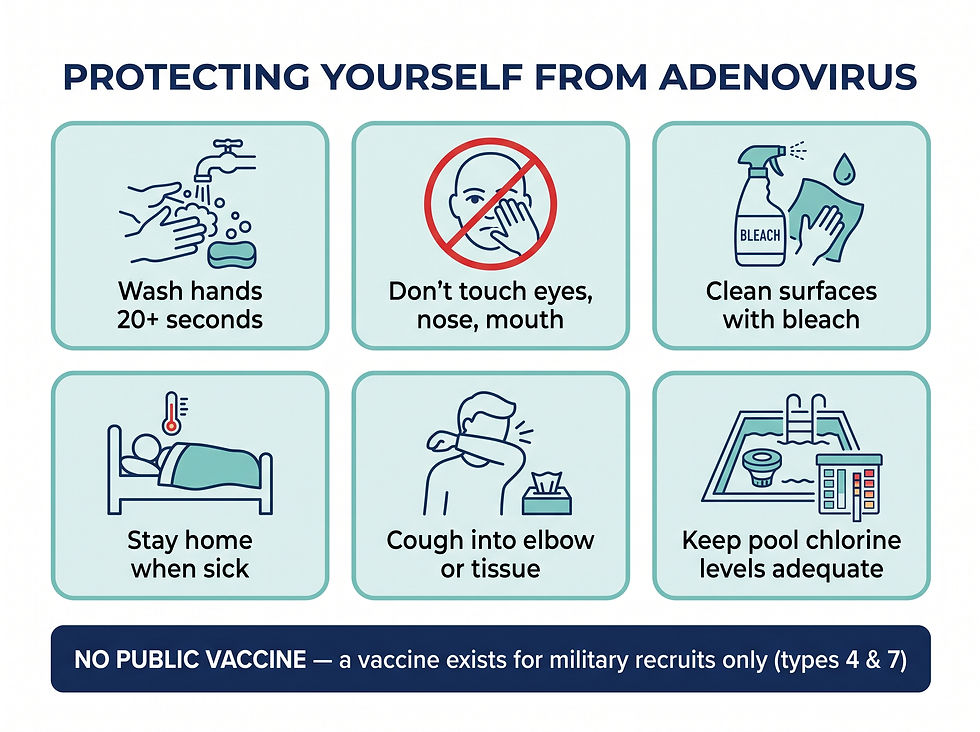
Because there is no public vaccine, prevention rests on hygiene habits. Handwashing with soap and water for at least 20 seconds is the first line of defense — hand sanitizer alone does not match adenovirus's disinfectant resistance, and health guidance emphasizes bleach-based cleaning of hard surfaces, since alcohol-based products are less reliable against this virus family.
Wash hands: Soap and water, at least 20 seconds, especially in childcare and healthcare settings
Don't touch your face: Keep unwashed hands away from eyes, nose, and mouth
Disinfect surfaces: Bleach-and-water mixture on counters, sinks, toys, and hard surfaces
Avoid the sick: Keep distance from people showing symptoms
If you're sick: Stay home, cough into your elbow or a tissue, avoid hugging and kissing, don't share utensils, cups, towels, or pillows
Pool hygiene: Ensure adequate chlorine levels at pools to prevent conjunctivitis outbreaks
Is There an Adenovirus Vaccine?
A vaccine exists — but only for the military. The U.S. Food and Drug Administration has approved an oral live vaccine against adenovirus types 4 and 7, the types historically responsible for recruit outbreaks. It is given only to military personnel at elevated risk, typically recruits ages 17 to 50. Safety and effectiveness have not been studied in the general public or in people with weakened immune systems, and because it is a live virus, it can be shed in stool.
When Should You Call a Healthcare Provider?
Most adenovirus infections pass quickly on their own, but certain signs should prompt a call — especially for infants, older adults, and anyone immunocompromised:
Fever above 104°F (40°C): Signals a more serious inflammatory response
Fever lasting more than five days: Duration itself is a reason to be evaluated
Difficulty breathing: Possible pneumonia or lower respiratory infection
Dehydration: Common with adenovirus gastroenteritis, especially in toddlers
Decreased alertness or activity: May signal neurological involvement or severe illness
Fussiness or poor sleep in infants: Nonverbal children show distress differently

Adenovirus vs. Coronavirus: What's the Difference?
Both viruses cause cold-like symptoms and spread through droplets and touch, which makes them easy to confuse. The structural difference explains their very different staying power. Coronaviruses carry a fragile lipid envelope around their capsid; when that envelope breaks down, the virus loses the proteins that make it infectious, so enveloped viruses are easier for disinfectants to destroy. Adenoviruses have no envelope — their proteins attach directly to the capsid — which is why they persist longer on surfaces and shrug off many common cleaners.
Envelope: Adenovirus: none (naked capsid) — Coronaviruses: lipid envelope
Disinfectant resistance: Adenovirus: high, lingers on surfaces for weeks — Coronaviruses: lower, envelope breakdown inactivates virus
Seasonality: Adenovirus: year-round, winter/early-spring peak — Coronaviruses: varies by strain
Typical course: Adenovirus: days to two weeks — Coronaviruses: days to weeks
Post-recovery shedding: Adenovirus: days to weeks, often asymptomatic — Coronaviruses: variable
Adenovirus and Viral Vector Vaccines
Adenoviruses play a second, positive role in medicine. Researchers use a modified, harmless version of adenovirus as a viral vector — a delivery vehicle that carries instructions into cells to train the immune system against other diseases. These vector vaccines do not give you the virus that causes adenovirus infection and do not alter your DNA. Several widely used vaccines, including some COVID-19 and Ebola vaccines, use this adenovirus-vector technology.
What Is the Outlook?
For people who are otherwise healthy, the prognosis is excellent. Adenovirus infections are self-limited: with rest, fluids, and symptom relief, the virus passes and normal health returns. Long-term complications in healthy people are rare, though bronchiolitis obliterans and bronchiectasis are documented after severe respiratory infections.
The picture is different for immunocompromised patients, where disease can be extensive and fatal. That asymmetry is why the guidance is simple: healthy people can ride out a typical adenovirus at home, but anyone with a weakened immune system should contact a provider as soon as symptoms appear, rather than waiting.
Key Takeaways and What to Do Next
Adenovirus is a common, hardy virus family that causes mostly mild cold-like illness but can turn serious for young infants, military recruits, and people with weakened immune systems. The practical rules are straightforward: wash hands thoroughly, clean high-touch surfaces with bleach-based products, keep sick children home from daycare, and maintain pool chlorine levels. Healthy people need nothing more than rest and symptom relief.
If you or your child has a persistent high fever, breathing trouble, or signs of dehydration — or if you have a condition that weakens your immune system — don't wait it out: call your healthcare provider today. Staying ahead of adenovirus means taking these simple steps and acting early when warning signs appear.
Frequently Asked Questions
1. How long does an adenovirus infection last?
Most infections last from a few days to two weeks, with symptoms typically appearing 5 to 6 days after exposure. Cough can linger after other symptoms resolve.
2. Is adenovirus the same as the common cold?
No — but adenovirus is one of many viruses that cause cold-like illness. Rhinovirus, coronavirus, RSV, and flu can look identical, and only lab testing can distinguish them.
3. Is adenovirus contagious after symptoms end?
Yes. People can shed the virus for days to weeks after recovery, often without symptoms, and still infect others.
4. Can adenovirus cause pink eye?
Yes. Conjunctivitis, especially combined with fever and sore throat (pharyngoconjunctival fever), is a classic adenovirus presentation.
5. Is there an adenovirus vaccine?
Not for the public. The U.S. has an FDA-approved oral vaccine against types 4 and 7, but it is restricted to military personnel at elevated risk.
6. Do antibiotics work against adenovirus?
No. Adenovirus is a virus, and antibiotics only treat bacterial infections. Treatment is rest, fluids, and symptom relief; antivirals are reserved for rare, severe cases.
7. Can adenovirus be serious or fatal?
For most people it is mild. But in immunocompromised patients, mortality can reach as high as 70%, and about 85% of U.S. pediatric hospitalizations occur in children under six.
8. How do I kill adenovirus on surfaces?
The virus resists many common disinfectants. Health guidance recommends cleaning hard surfaces with a bleach-and-water mixture, plus thorough handwashing with soap and water.
Related Reading on Rinnit
References
Cleveland Clinic. "Adenovirus." Medically reviewed; last updated 05/17/2022.
Usman N, Suarez M. "Adenoviruses." StatPearls, National Institutes of Health. Last update: January 9, 2023.
Ryan MA, et al. "Large Epidemic of Respiratory Illness Due to Adenovirus Types 7 and 14 in Healthy Young Adults." Clinical Infectious Diseases, 2002;34(5):577-582.
American Thoracic Society. "Adenovirus Infection and Outbreaks: What You Need to Know." Am J Respir Crit Care Med, Vol. 205, P22-P24, 2022; online version updated July 2022.
Totapally BR, et al. "Epidemiology of Adenovirus Infection in Hospitalized Children in the United States From 1997 to 2019." Pediatric Infectious Disease Journal, 2024;43(8):748-755.
Centers for Disease Control and Prevention. "About Adenovirus." Published June 13, 2024; reviewed December 16, 2025.
Centers for Disease Control and Prevention. "Adenovirus: Guidelines for Outbreaks."
Potter RN, et al. "Adenovirus-Associated Deaths in US Military during 1998-2010." Emerging Infectious Diseases, 2012.
Russell KL, et al. "Vaccine-preventable adenoviral respiratory illness in US recruiters, 1999-2004." Vaccine, 2006.
Merck Manual Professional Version. "Adenovirus Infections."
Comments