Understanding Pseudoachondroplasia: Symptoms, Causes, and Management

Updated: 2 days ago
Medically reviewed by Dr. Baraa Alnahhal, MD · Last reviewed: September 2026
Pseudoachondroplasia is a rare genetic disorder characterized by short stature and skeletal abnormalities, primarily affecting bone growth in the arms and legs. Unlike other forms of dwarfism, it does not impact facial features, head size, or intelligence. Management focuses on monitoring skeletal health, managing joint pain, and utilizing surgical interventions when necessary to maintain mobility and quality of life.
Quick answer: Pseudoachondroplasia is a rare form of dwarfism caused by a mutation in the COMP gene, leading to short stature and joint complications. It typically becomes apparent between ages 2 and 3 as growth falls behind standard charts. While it affects bone development and can cause joint pain or osteoarthritis, it does not impact intellectual development or lifespan. Treatment involves physical therapy, pain management, and occasionally corrective surgeries for the spine or joints.
What Is Pseudoachondroplasia?
Pseudoachondroplasia, often abbreviated as PSACH, is a rare genetic condition that fundamentally alters bone growth and development. Classified as a form of skeletal dysplasia, it is characterized by short stature and disproportionately short limbs. A defining feature of pseudoachondroplasia is that it is typically not evident at birth; infants often appear to have standard proportions, with growth delays only becoming noticeable as the child reaches early childhood, usually around age two.
While the condition presents significant skeletal challenges, it is important to distinguish it from other forms of dwarfism. Individuals with pseudoachondroplasia have typical facial features, standard head sizes, and normal intellectual development. Furthermore, the condition does not inherently impact a person’s lifespan, and many individuals live active, productive lives while managing the physical symptoms associated with the disorder.
Growth Patterns and Physical Characteristics
The growth trajectory for children with pseudoachondroplasia follows a specific pattern. Although they are born within a typical height range, their growth rate slows significantly during the first few years of life. By adulthood, men with the condition reach an average height of approximately 3 feet 11 inches, while women reach an average of 3 feet 9 inches.
Feature | Average Measurement |
Birth Length | Within typical range |
Average Adult Height (Men) | 3 feet 11 inches (1.19 meters) |
Average Adult Height (Women) | 3 feet 9 inches (1.14 meters) |
Typical Age of Diagnosis | 9 months to 3 years |
Symptoms and Skeletal Development
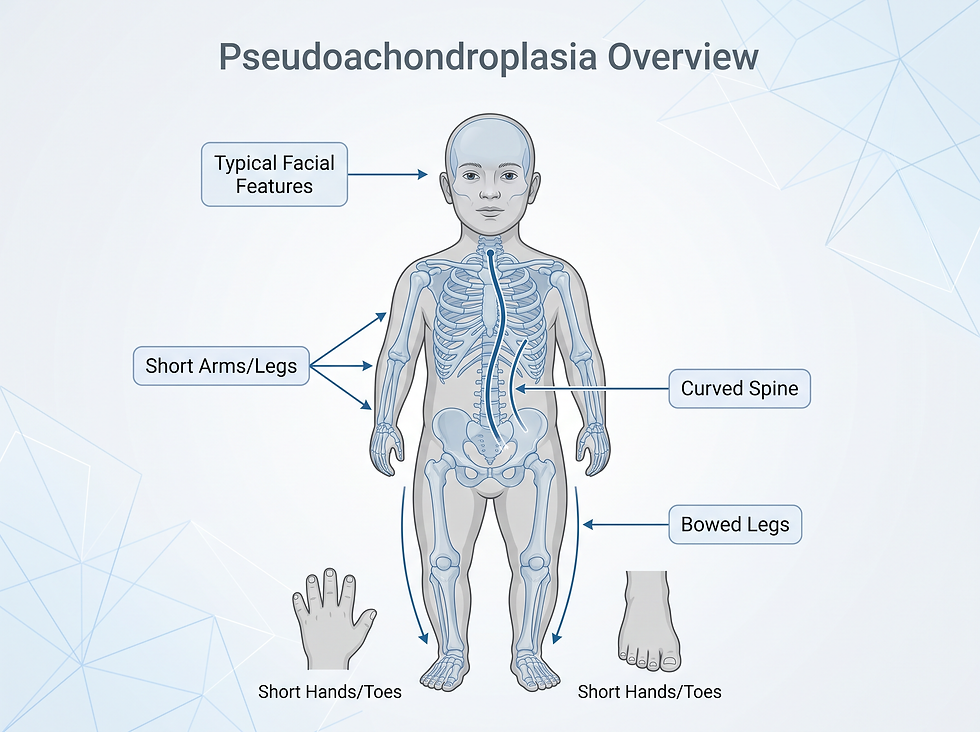
As skeletal abnormalities become more pronounced throughout childhood, several physical signs may emerge. These are primarily related to how the bones and joints develop under the influence of the genetic mutation. Common symptoms include bowed legs (genu varum), knock knees (genu valgum), or a combination known as windswept deformity.
Spinal health is also a significant concern, as many individuals develop curvatures such as scoliosis or kyphosis. Additionally, a condition called odontoid hypoplasia—underdevelopment at the top of the spine—can lead to neck instability. Joints are often characterized by excessive looseness (laxity), although the hips and elbows may eventually become stiff. Over time, the stress on these joints often progresses to osteoarthritis, causing chronic pain and a distinctive waddling gait.
Genetic Causes and Inheritance
The root cause of pseudoachondroplasia is a mutation in the cartilage oligomeric matrix protein (COMP) gene. This gene is essential for the health of chondrocytes, the cells responsible for creating cartilage. Cartilage plays a critical role during fetal development, where much of it eventually turns into bone, while the remainder protects the joints and ends of bones.
When a COMP mutation is present, abnormal proteins accumulate within the chondrocytes, causing them to die prematurely. This disruption prevents bones from growing to their full length and leads to the joint problems characteristic of the disorder. In terms of inheritance, pseudoachondroplasia follows an autosomal dominant pattern. This means a parent with the condition has a 50% chance of passing the mutated gene to their child. However, the majority of cases occur spontaneously due to a random genetic mutation in families with no prior history of the condition.
Diagnostic Procedures
Diagnosis is primarily achieved through a combination of physical examinations and imaging. Healthcare providers look for the characteristic signs of short stature and skeletal abnormalities that appear in early childhood. X-rays are the standard tool for visualizing the specific bone and joint structures associated with the disorder.
Diagnostic Method | Purpose |
Physical Exam | Evaluates growth patterns and skeletal alignment |
X-Rays | Provides detailed images of bone and joint abnormalities |
Genetic Testing | Confirms the COMP gene mutation via blood sample |
Prenatal Testing | Amniocentesis or CVS for high-risk pregnancies |

Management and Surgical Interventions
There is currently no way to prevent or reverse the genetic mutation that causes pseudoachondroplasia. Instead, treatment is highly individualized, focusing on managing symptoms and preventing complications. Regular monitoring is essential to ensure that skeletal issues are addressed before they cause significant pain or loss of mobility.
Management strategies often include:
Pain Relief: Use of analgesics to manage joint pain associated with early-onset osteoarthritis.
Supportive Therapies: Physical and occupational therapy to improve joint strength and daily functional abilities.
Orthopedic Support: Braces may be used to manage spinal curvature or joint instability.
Surgical Correction: In more severe cases, surgeries such as hip or knee replacements, knee osteotomies, or spinal fusions are performed to stabilize the body and reduce pain.

Lifestyle and Social Support
Living with pseudoachondroplasia requires certain lifestyle adjustments to protect the joints from excessive wear and tear. High-impact activities, such as contact sports or excessive jumping, should be avoided to minimize joint stress. Conversely, low-impact exercises like swimming and walking are highly recommended for maintaining cardiovascular health and muscle strength without straining the skeletal system.
For children, the visible nature of short stature can have psychosocial effects. Open communication within the family and school environment is crucial. Joining advocacy organizations or support groups can provide valuable connections for both the individual and their family, offering a community of people who share similar experiences.
Conclusion
Pseudoachondroplasia is a complex skeletal condition, but with proactive medical care and appropriate lifestyle modifications, individuals can lead full and active lives. While the physical challenges of joint pain and short stature are significant, they do not define a person’s intellectual potential or their ability to contribute meaningfully to their community. Early diagnosis and a supportive healthcare team are key to navigating the condition successfully.
When to Seek Medical Advice
If you notice that your child’s growth is falling behind standard charts or if they exhibit signs of joint pain and skeletal curvature, consult a pediatric specialist or a geneticist. Early evaluation and a tailored management plan are essential for supporting long-term bone health and mobility.
Frequently Asked Questions
Is pseudoachondroplasia the same as achondroplasia?
No. While both are forms of dwarfism, they are caused by different genetic mutations and have distinct physical features.
When does pseudoachondroplasia become noticeable?
It usually becomes apparent between the ages of 9 months and 3 years as the growth rate slows.
Does it affect intelligence?
No, pseudoachondroplasia does not impact intellectual development or brain function.
Is it always inherited?
No, many cases occur as spontaneous (random) mutations in families with no history of the condition.
What is the average height for an adult with this condition?
Men average 3′11″ and women average 3′9″.
Can it be detected before birth?
Yes, prenatal genetic testing like amniocentesis can identify the COMP mutation if there is a known family risk.
What is the most common complication?
Early-onset osteoarthritis due to joint laxity and skeletal abnormalities is very common.
Why is it called “pseudo” achondroplasia?
It was historically confused with achondroplasia because both cause short-limbed dwarfism, but they are genetically distinct.
Are facial features affected?
No, individuals with pseudoachondroplasia have typical facial features and head sizes.
What exercises are best for someone with this condition?
Low-impact activities like swimming and walking are ideal for protecting the joints.
Do most people need surgery?
Many individuals eventually require joint replacements or spinal surgery to manage pain and mobility issues.
Can it affect the neck?
Yes, underdevelopment of the top of the spine (odontoid hypoplasia) can cause neck instability.
Is the lifespan affected?
No, people with pseudoachondroplasia have a typical lifespan.
What gene is responsible?
The COMP (cartilage oligomeric matrix protein) gene.
How can I support a child with this condition?
Open communication, school support plans, and connecting with advocacy groups are vital for psychosocial health.
Medical Disclaimer: The information provided in this article is for educational purposes only and should not be used as a substitute for professional medical advice, diagnosis, or treatment. Always seek the advice of your physician or other qualified health provider with any questions you may have regarding a medical condition.
Comments