Understanding Oral Aversion: Why Your Baby May Resist Feeding

Updated: 2 days ago
Medically reviewed by Dr. Baraa Alnahhal, MD · Last reviewed: September 2026
TL;DR: Oral aversion is a learned response where a baby avoids or resists having anything near their mouth, including food. This condition typically develops after a baby associates mouth-related activities with negative or painful past experiences, such as medical procedures, intubation, or severe reflux. Common symptoms include pushing food away, refusing to latch, and tightly closing the mouth when feeding is attempted. While oral aversion can lead to serious complications like malnutrition or growth faltering, it is highly treatable through a multidisciplinary team approach involving pediatricians, speech-language pathologists, and occupational therapists. Early intervention is key to helping babies unlearn their fear and develop healthy feeding skills.
Medical Emergency Warning
Oral aversion can lead to severe health complications. Seek immediate medical care if your baby shows signs of:
Severe dehydration (fewer wet diapers, dry mouth, no tears when crying)
Significant weight loss or failure to gain weight (growth faltering)
Respiratory distress or persistent coughing during feeding (signs of aspiration pneumonia)
Complete refusal to take any fluids for more than 4 to 6 hours
Extreme lethargy or lack of responsiveness
Quick answer: Oral aversion is a behavioral response in which an infant consistently resists or avoids objects, including food and nipples, coming near their mouth. Unlike a specific food aversion, where a child might only dislike certain textures or tastes, oral aversion is a general fear-based reaction. It often stems from "negative mouth-related experiences" early in life, such as life-saving medical treatments (intubation, tube feeding) or painful conditions like GERD. The aversion is the baby's way of expressing fear of further unwanted experiences. While up to 50% of babies may experience minor versions of this, serious cases require professional intervention to ensure the baby receives adequate nutrition and develops proper swallowing coordination.
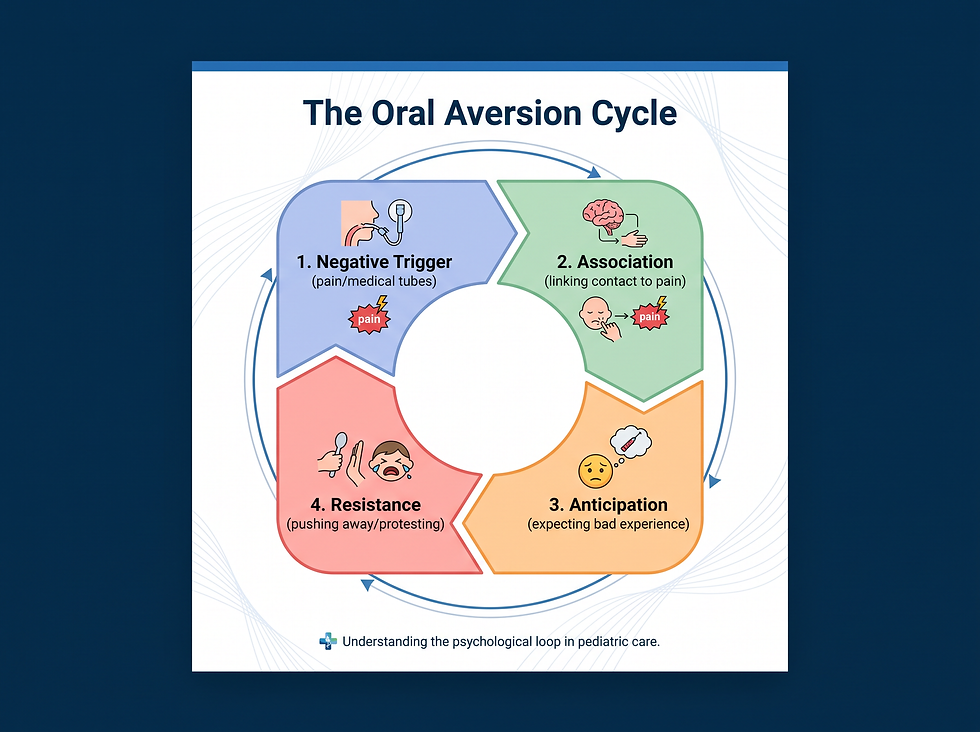
Understanding the Oral Aversion Cycle
Oral aversion is fundamentally a learned fear response. It develops in four stages:
Negative trigger: Baby experiences pain or discomfort near the mouth (e.g., medical tubes, reflux).
Association: Baby learns to link mouth-related contact with that negative experience.
Anticipation: Baby expects something "bad" to happen whenever something approaches their face.
Resistance: Baby actively pushes away, protests, or closes their mouth to prevent the contact.
Symptoms of Oral Aversion
Symptoms are more consistent than typical infant "picky eating" and often appear as active resistance.
Active protest: Turning the head away or crying when a bottle, breast, or spoon approaches.
Physical barriers: Sticking out the tongue to push objects away or tightly clenching the jaw.
Refusal to latch: Consistently refusing to feed from a nipple despite being hungry.
Selective feeding: A baby may feed themselves finger foods but refuse to let a caregiver feed them.
Hesitation: Showing extreme distress or fear even when the caregiver is just preparing to feed.
Causes and Risk Factors
Oral aversion is almost always linked to early life stressors that affect the mouth or throat.
Common Medical Causes
Advanced medical care: History of intubation, mechanical ventilation, or tracheostomy.
Tube feeding: Long-term use of nasogastric (NG) or gastrostomy (G) tubes, which can interfere with hunger cues.
Swallowing disorders: Difficulty (dysphagia) or pain (odynophagia) when swallowing.
Inflammatory conditions: Esophagus inflammation (esophagitis) or severe acid reflux (GERD).
Developmental and Sensory Factors
Neurodivergence: Conditions like autism can make a baby more sensitive to oral sensations.
Genetic disorders: Down syndrome or Moebius syndrome can affect mouth muscle control.
Cerebral palsy: May impact the coordination required for safe, comfortable feeding.
Sensory sensitivity: A sensitivity to specific tastes or the components of formula or breast milk.

Diagnosis and Testing
Pediatricians diagnose oral aversion by ruling out other underlying medical conditions through a variety of assessments.
Feeding observations: A provider watches a typical feeding session to see the baby's reaction.
Health history review: Asking questions about the baby's early medical procedures and home environment.
Imaging scans: Using MRI or fluoroscopy to check the physical structure of the mouth and throat.
Diagnostic procedures: Upper endoscopy (EGD) or esophageal manometry to check for inflammation or muscle issues.
Lab tests: Blood and thyroid tests to rule out metabolic causes for poor appetite.
Treatment and Management Strategies
Treating oral aversion requires a "team approach" to help the baby unlearn their fear and build new, positive associations.
The Care Team
Speech-language pathologist (SLP): Helps with the mechanics of swallowing and oral motor skills.
Occupational therapist (OT): Addresses sensory sensitivities and the mechanics of feeding.
Pediatrician: Manages underlying medical conditions like GERD or malnutrition.
Core Treatment Methods
Positive oral stimulation: Using toys or gentle touch to show the baby that not all mouth contact is medical or painful.
Skill building: Practicing the coordination needed to feed comfortably and safely.
Pleasant exposure: Finding tastes the baby enjoys to encourage voluntary feeding.
Routine building: Establishing predictable, low-stress feeding schedules.
Caregiver training: Teaching parents how to respond to resistance without increasing the baby's stress.

Potential Complications
If left untreated, oral aversion can lead to long-term health and developmental issues.
Growth faltering: Also known as "failure to thrive," where a baby doesn't gain weight or grow at a healthy rate.
Malnutrition: Deficiencies in essential vitamins and minerals needed for brain development.
Aspiration pneumonia: Occurs if a baby accidentally inhales food or liquid into their lungs due to poor coordination.
Future eating disorders: Increased risk of developing Avoidant/Restrictive Food Intake Disorder (ARFID) later in life.
Missed learning window: Research suggests there is a developmental "window" for learning to feed; missing it makes learning harder later.
Outlook and Prognosis
The outlook for babies with oral aversion is generally excellent, particularly when the condition is caught early. While it can be frustrating and disheartening for parents, it is a very common issue, affecting up to half of all infants to some degree. With the support of specialists and a consistent, positive feeding routine, most babies successfully unlearn their aversion and go on to have a healthy relationship with food.
When to See a Healthcare Provider
You should contact your pediatrician if your baby consistently resists feeding or shows signs of distress during mealtime. Watch for:
Consistent head turning or crying during feeding
Pushing the nipple or spoon away with the tongue
Failure to meet weight gain milestones
Signs of respiratory distress while eating
Questions to ask your provider:
Is this a typical phase or a true oral aversion?
Does my baby need a referral to an SLP or OT?
Could an underlying condition like GERD be the cause?
How can we make feeding a more positive experience?
A Note from the Care Team
Oral aversion is when your baby avoids or resists having things around their mouth, including food, as a learned response. Babies often develop this because they associate things around their mouths with unwanted or negative past events. The aversion is your baby expressing their fear of further unwanted experiences.
Frequently Asked Questions (FAQ)
Are oral aversions the same as food aversions?
No. Oral aversions are general and involve avoiding anything near the mouth. Food aversions are specific to certain textures, smells, or tastes.
Can oral aversion be prevented?
It isn't 100% preventable, especially if a baby needs life-saving medical care early on. However, providers can take steps to minimize negative mouth experiences.
Is oral aversion my fault?
No. It is a common learned response to early stressors. Up to 50% of babies experience some form of it.
How long does treatment take?
There is no set timeline. It depends on the severity of the aversion and how the baby responds to therapy from speech-language pathologists and occupational therapists.
What is the "learning window" for feeding?
It is a developmental period in infancy when babies naturally learn the skills to eat. If this window is missed due to aversion, learning those skills later can be more challenging.
Can tube feeding cause oral aversion?
Yes. Long-term tube feeding can make it harder for a baby to understand their own hunger cues and can lead to an aversion to oral feeding.
What does a speech-language pathologist do for feeding?
They help the baby develop the muscle coordination and safety skills needed to suck, swallow, and breathe correctly during feeding.
Is oral aversion related to autism?
Neurodivergent conditions like autism can make a baby more sensitive to sensory input, which may increase the risk of developing an oral aversion.
What is aspiration pneumonia?
It is a lung infection caused by accidentally inhaling food or liquid. It is a potential complication of the poor feeding coordination seen in oral aversion.
Can reflux cause oral aversion?
Yes. If a baby associates feeding with the pain of acid reflux (GERD), they may learn to avoid feeding to prevent that pain.
What is positive oral stimulation?
It involves using non-medical objects, like teething toys or a caregiver's finger, to create pleasant or neutral sensations in and around the mouth.
Will my baby grow out of it?
Most babies do not "grow out of it" on their own if it is a serious aversion. Professional intervention is usually needed to help them unlearn the fear.
Can oral aversion lead to ARFID?
Yes. Having an oral aversion as an infant may increase the risk of developing Avoidant/Restrictive Food Intake Disorder later in childhood.
What is fluoroscopy in diagnosis?
It is a type of imaging that acts like a "movie" of the inside of the body, allowing doctors to see how a baby swallows in real-time.
How can I bond with my baby if they won't feed?
Focus on other forms of positive contact, such as skin-to-skin time, play, and following the routines suggested by your care team.
References
Medical disclaimer: The information provided in this article is for educational purposes only and is not intended as a substitute for professional medical advice, diagnosis, or treatment. Always seek the advice of your physician or other qualified health provider with any questions you may have regarding a medical condition. If you are experiencing a medical emergency, call 911 or your local emergency services immediately.
Source date: May 8, 2025. This article is current based on the most recent available data from the primary source.
Comments