Understanding Optic Nerve Hypoplasia: A Guide for Parents and Caregivers

Updated: 2 days ago
Medically reviewed by Dr. Baraa Alnahhal, MD · Last reviewed: September 2026
TL;DR: Optic nerve hypoplasia (ONH) is a congenital condition characterized by an underdeveloped optic nerve, which can lead to varying degrees of vision loss and irregular eye movements. In many cases, ONH is associated with other brain development issues, including midline brain abnormalities and pituitary gland hypoplasia, a combination often referred to as septo-optic dysplasia (SOD). As the leading cause of blindness in children under age three in the United States, early diagnosis through imaging and eye exams is critical. While there is no cure, a multidisciplinary treatment approach involving vision therapy, hormone replacement, and developmental support can significantly improve a child's quality of life.
Medical Emergency Warning
Optic nerve hypoplasia can involve life-threatening complications related to the pituitary gland. Seek immediate medical attention if a child with ONH experiences:
Severe lethargy or inability to wake up
Extreme thirst or frequent urination (signs of diabetes insipidus)
Significant drops in blood sugar (hypoglycemia)
Inability to regulate body temperature (severe fever or hypothermia)
Seizures or sudden loss of consciousness
Quick answer: Optic nerve hypoplasia (ONH) is a birth defect where the optic nerves, the "cables" that send visual information from the eyes to the brain, are small or underdeveloped. This condition can affect one or both eyes and ranges in severity from mild vision impairment to total blindness. Beyond the eyes, ONH often impacts the midline structures of the brain and the pituitary gland, which regulates essential hormones. When these additional brain structures are involved, the condition is frequently called septo-optic dysplasia (SOD) or de Morsier syndrome. ONH is not progressive, meaning it does not get worse over time, and symptoms can often be managed with specialized medical care and therapeutic support.
Understanding ONH and Septo-Optic Dysplasia
While often discussed together, ONH and septo-optic dysplasia have a specific clinical relationship:
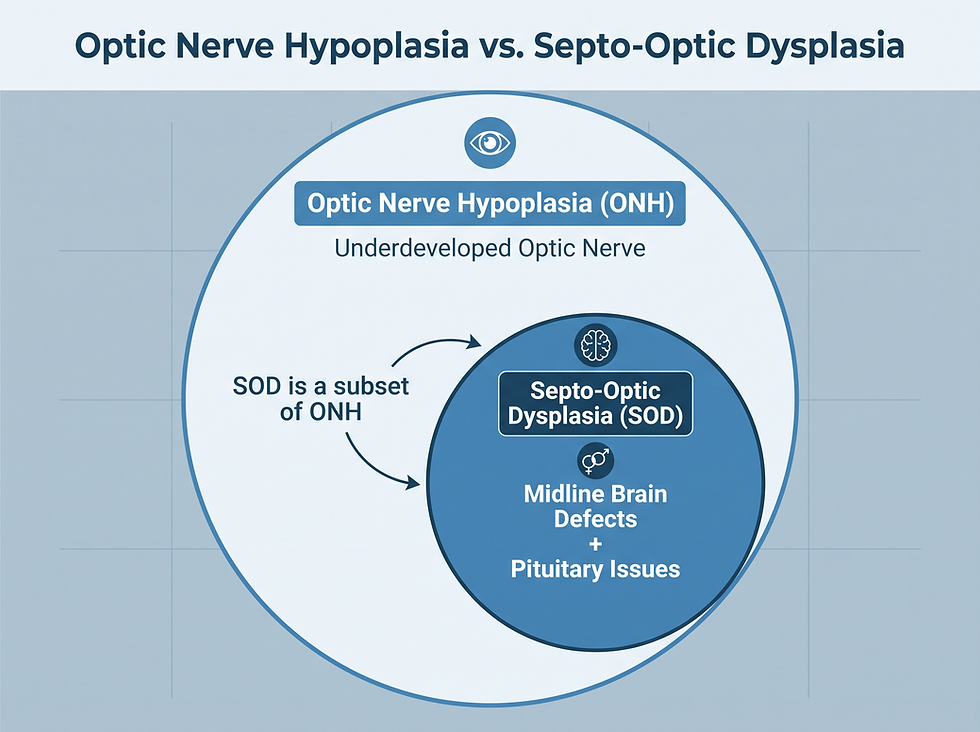
Optic nerve hypoplasia (ONH): Underdeveloped optic nerve; affects vision and eye movement.
Septo-optic dysplasia (SOD): A subset of ONH involving midline brain defects and pituitary issues.
Midline brain abnormalities: Issues with the septum pellucidum or corpus callosum.
Pituitary gland hypoplasia: Underdeveloped pituitary gland leading to hormonal deficiencies.
Symptoms of Optic Nerve Hypoplasia
Symptoms vary depending on whether the condition is limited to the optic nerve or involves other brain structures.
Visual and Ocular Symptoms
Vision impairment: Ranging from mild blurriness to complete blindness.
Nystagmus: Rapid, involuntary eye movements.
Strabismus/esotropia: Crossed eyes or general eye misalignment.
Focusing issues: Difficulty tracking or focusing on objects.
Hormonal and Brain-Related Symptoms
Growth delays: Slower-than-expected height gain and short stature.
Metabolic issues: Low blood glucose (hypoglycemia) and jaundice in newborns.
Regulation problems: Difficulty controlling thirst, hunger, sleep, and body temperature.
Developmental challenges: Seizures, intellectual disabilities, and delayed sexual maturation.
Causes and Risk Factors
Researchers believe ONH results from a combination of genetic mutations and environmental factors during fetal development.
Genetic mutations: Changes in genes such as HESX1, SOX2, SOX3, OTX2, and PROKR2.
Environmental factors: Association with fetal alcohol syndrome.
Maternal age: Increased risk for mothers under 19 years of age.
Pregnancy history: More common in a mother's first pregnancy.
Family history: A biological family history of the condition increases risk.

Diagnosis and Testing
Diagnosis typically begins when a parent or pediatrician notices abnormal eye movements in a child.
Eye examination: Performed by a pediatric ophthalmologist to assess nerve development and vision.
Imaging (MRI/CT): Used to confirm the diagnosis and check for midline brain or pituitary abnormalities.
Blood tests: Checking levels of serum cortisol and growth hormones to identify pituitary dysfunction.
Developmental screening: Assessing milestones like sitting up, crawling, and grabbing objects.
Treatment and Management Strategies
Because ONH is a congenital malformation, it cannot be cured or reversed. Treatment focuses on managing symptoms and supporting development.
Vision therapy: Use of magnifiers, glasses, and other low-vision aids.
Hormone replacement: Medications to correct deficiencies in growth hormone, cortisol, or thyroid hormones.
Developmental therapy: Physical (PT), occupational (OT), and speech therapy (ST).
Specialist care: Regular monitoring by endocrinologists and neurologists.
Potential Complications
The complications of ONH can be extensive, particularly when the pituitary gland is involved.
Metabolic disorders: Obesity (hyperphagia) or extreme food aversion (hypophagia).
Behavioral conditions: Increased risk for autism spectrum disorder (ASD).
Physical safety: Life-threatening issues with body temperature regulation.
Sleep disorders: Abnormal sleep/wake cycles due to hormonal imbalances.

Outlook and Prognosis
The outlook for children with ONH depends heavily on the severity of the condition and the involvement of the pituitary gland. While vision impairment is permanent, symptoms like nystagmus may improve slightly with age. ONH is not a progressive disease; it does not worsen over time. With early intervention and long-term monitoring by a dedicated care team, many children can lead fulfilling lives and meet significant developmental milestones.
When to See a Healthcare Provider
Proactive monitoring is essential for children diagnosed with or suspected of having ONH. Seek evaluation if your child:
Has eyes that don't follow movement
Exhibits crossing or rapid eye movements
Misses key developmental milestones
Shows signs of extreme thirst or hunger
Questions to ask your provider:
How severe is my child's vision loss?
Does my child have pituitary involvement?
What therapies will help my child the most?
How often do we need vision and hormone exams?
A Note from the Care Team
Optic nerve hypoplasia is a condition that affects the development of your child's optic nerve. It can also target the hormone-producing pituitary gland and the connection between the two halves of your brain. Severe cases may cause blindness or vision impairment. Treatment options are available to address your child's symptoms.
Frequently Asked Questions (FAQ)
Is optic nerve hypoplasia the same as septo-optic dysplasia?
Not exactly. Septo-optic dysplasia (SOD) is a specific diagnosis that includes optic nerve hypoplasia plus midline brain or pituitary issues. Only about 5% to 10% of ONH cases qualify as SOD.
Can ONH be detected before birth?
While some brain abnormalities might be seen on a prenatal ultrasound, ONH is typically diagnosed after birth when eye symptoms or hormonal issues become apparent.
Will my child's vision get worse over time?
No. ONH is a non-progressive condition, meaning the underdeveloped nerve does not deteriorate further as the child grows.
What is nystagmus?
Nystagmus refers to rapid, involuntary eye movements, which is often one of the first visible signs of ONH in infants.
How common is this condition?
It affects approximately 1 in 10,000 children in the United States and is a leading cause of childhood blindness.
Can surgery fix an underdeveloped optic nerve?
No. There is currently no surgical procedure or medication that can "grow" or repair an underdeveloped optic nerve.
Why does ONH cause growth problems?
If the pituitary gland is underdeveloped, it may not produce enough growth hormone, leading to short stature and delayed development.
What is the septum pellucidum?
It is a thin membrane in the midline of the brain that separates the two lateral ventricles. Its absence is a hallmark of septo-optic dysplasia.
Can children with ONH go to regular school?
Many children with ONH attend regular schools with the help of low-vision aids, specialized learning plans, and therapeutic support.
Is fetal alcohol syndrome related to ONH?
Yes, research suggests that fetal alcohol syndrome is an environmental risk factor that can contribute to the development of ONH.
What is hypoglycemia in the context of ONH?
It is low blood sugar, which can occur if the underdeveloped pituitary gland fails to regulate hormones correctly. It can be life-threatening if not managed.
Are there genetic tests for ONH?
Yes. Genetic testing can identify mutations in genes like HESX1 and SOX2 that are known to be associated with the condition.
How often should my child have an eye exam?
Children with ONH typically require vision exams at least once every year, along with regular checkups with an endocrinologist.
Can ONH affect only one eye?
Yes. It can be unilateral (affecting one eye) or bilateral (affecting both eyes).
What is de Morsier syndrome?
It is another name for septo-optic dysplasia, named after the doctor who first described the association between optic nerve and midline brain issues.
References
Medical disclaimer: The information provided in this article is for educational purposes only and is not intended as a substitute for professional medical advice, diagnosis, or treatment. Always seek the advice of your physician or other qualified health provider with any questions you may have regarding a medical condition. If you are experiencing a medical emergency, call 911 or your local emergency services immediately.
Source date: December 20, 2023. This article is current based on the most recent available data from the primary source.
Comments