Understanding Laryngeal Cleft: Symptoms, Types, and Care

Updated: 2 days ago
Medically reviewed by Dr. Baraa Alnahhal, MD · Last reviewed: September 2026
TL;DR: A laryngeal cleft is a rare congenital gap between the voice box and the food pipe that can lead to severe breathing and feeding issues. Ranging from mild to life-threatening, the condition requires specialized diagnosis through endoscopy and often necessitates surgical repair to prevent lung complications and ensure proper growth.
Quick Answer: A laryngeal cleft is an abnormal opening between the larynx and esophagus, allowing food or liquid to enter the lungs instead of the stomach. Symptoms include choking during feeding, raspy breathing, and frequent pneumonia. Diagnosis typically involves an endoscopic evaluation under anesthesia. While mild cases may be managed with medication, more severe types require surgical intervention. With early treatment, approximately 90% of children show significant improvement within weeks, ensuring a positive long-term outlook.
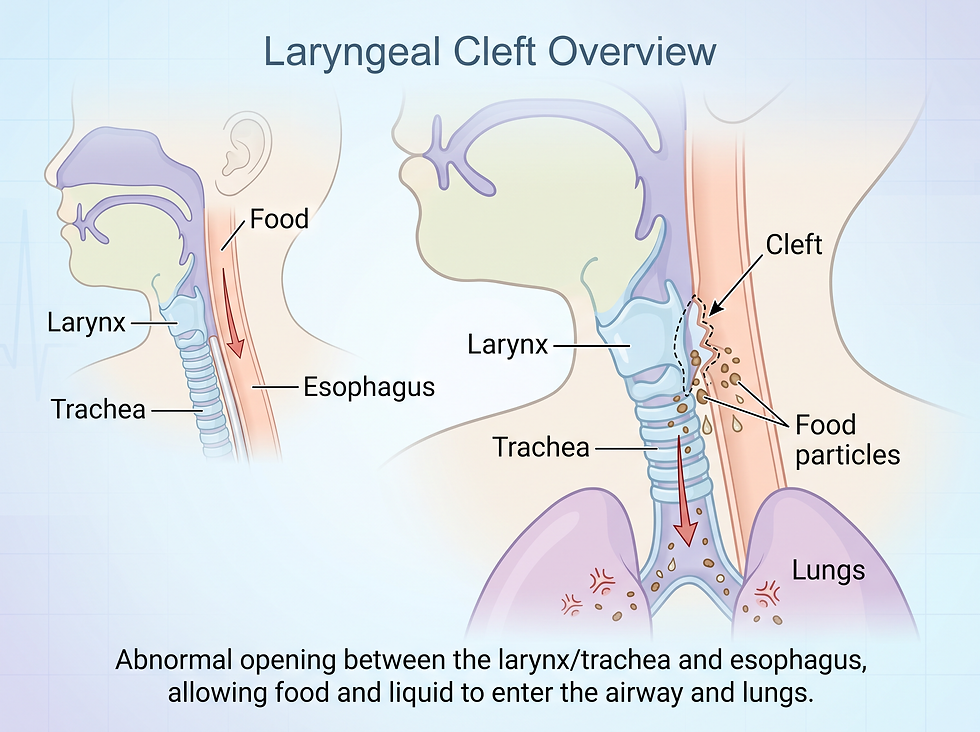
A laryngeal cleft is a rare birth defect characterized by an abnormal gap in the tissue wall that separates the larynx, or voice box, from the esophagus, the tube leading to the stomach. Under normal developmental conditions, these two structures are completely separate to ensure that air travels to the lungs while food and liquids are directed to the digestive system. When a cleft is present, this barrier is incomplete, creating a "shortcut" that allows foreign substances to enter the windpipe and lungs, a process known as aspiration.
This condition is exceptionally rare, occurring in approximately 1 in 10,000 to 20,000 live births, and is slightly more prevalent in male infants. Because the severity of the gap can vary significantly, the symptoms and the urgency of treatment depend heavily on the specific anatomical type of the cleft. Early recognition is vital, as chronic aspiration can lead to recurrent lung infections and long-term respiratory damage.
Clinical Classifications
Medical professionals categorize laryngeal clefts into four distinct types based on the location and extent of the opening. This classification system is essential for determining the most appropriate management strategy and predicting the child's clinical course.
Cleft Type | Anatomical Extent | Clinical Severity |
Type I | Opening is limited to the level of the vocal cords. | Mildest form; often diagnosed later in childhood. |
Type II | Opening extends below the vocal cords into the upper larynx. | Moderate; typically presents with clearer feeding issues. |
Type III | Cleft extends beyond the larynx and into the upper windpipe. | Severe; requires prompt surgical intervention. |
Type IV | Opening extends significantly down the windpipe. | Most severe; can be life-threatening and complex to repair. |
Recognizing the Symptoms
The symptoms of a laryngeal cleft are primarily related to the failure of the airway to remain protected during swallowing. In many cases, parents first notice issues during feeding, where the child may struggle to coordinate breathing and swallowing.
Aspiration occurs when food or liquid enters the windpipe instead of the esophagus, which can lead to chronic lung irritation and infections like pneumonia.
Common clinical signs include:
Feeding Difficulties: Choking, coughing, or gagging while eating or drinking.
Respiratory Distress: Harsh, raspy, or "wet" breathing sounds, known as stridor.
Physical Indicators: A bluish skin tone (cyanosis) during episodes of distress, particularly around the lips and nails.
Growth Issues: Failure to gain weight or meet developmental milestones due to constant hunger and energy expenditure.
Chronic Illness: Frequent bouts of pneumonia or persistent lung infections caused by repeated aspiration.
Causes and Associated Conditions
While the exact cause of a laryngeal cleft remains unknown, it is understood to be a developmental anomaly that occurs during the first few months of fetal growth. It may appear as an isolated condition or as part of a broader group of congenital issues.
Approximately half of all children diagnosed with a laryngeal cleft have other associated health conditions. These may include heart and blood vessel anomalies, cleft lip or palate, and other digestive tract issues such as esophageal atresia. In some instances, the cleft is a component of a specific genetic syndrome, including Opitz-Frias, VACTERL, Pallister-Hall, or CHARGE syndrome.
The Diagnostic Pathway
Diagnosing a laryngeal cleft requires a specialized evaluation by an otolaryngologist. Because milder forms (Type I and II) may present with subtle symptoms, they are sometimes not identified until the child is older. In contrast, severe types are usually diagnosed within the first few days of life.
Diagnostic Step | Description | Purpose |
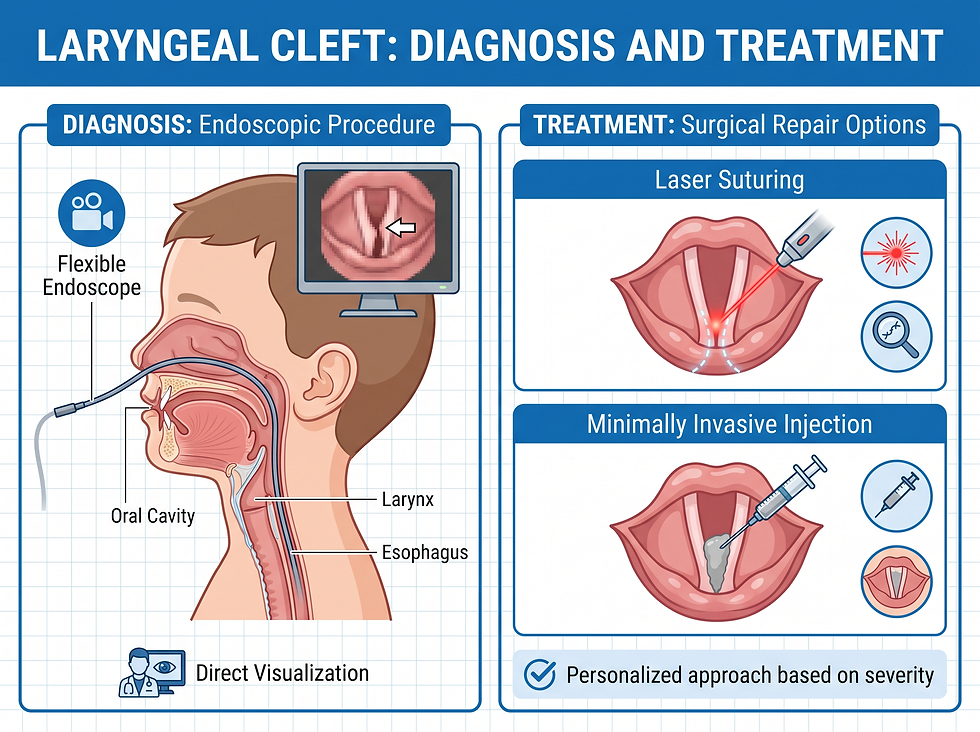
Endoscopy | A camera is inserted into the airway while the child is under anesthesia. | To visually confirm the presence and type of the cleft. |
Microlaryngoscopy | A detailed examination of the larynx using specialized tools. | To feel for the gap and assess the tissue structure. |
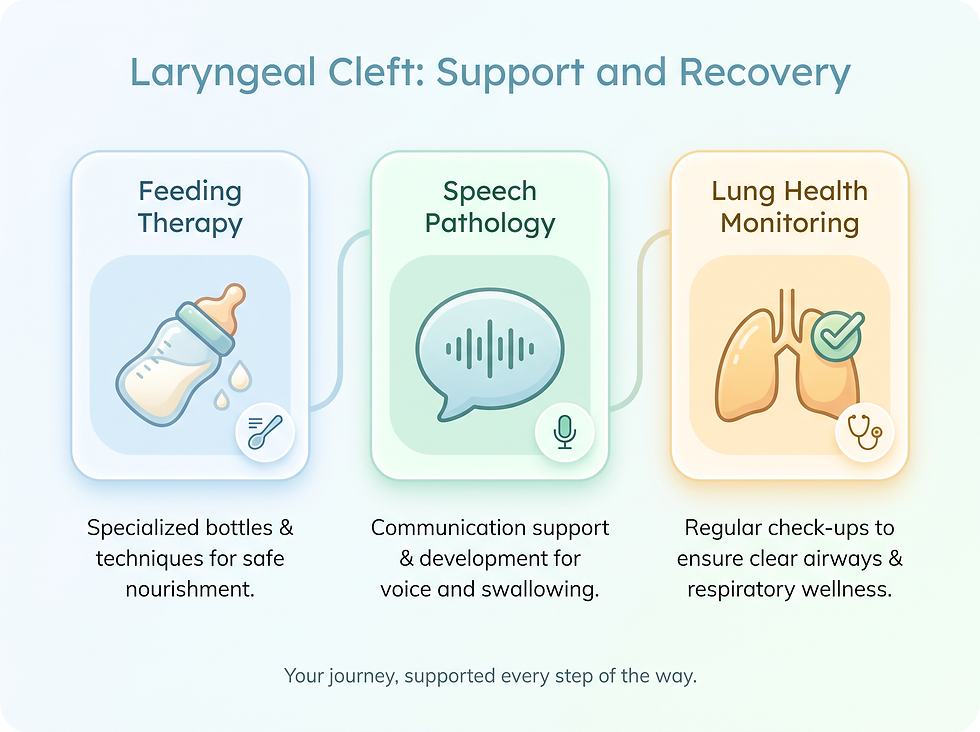
SLP Evaluation | Assessment by a speech-language pathologist. | To determine the impact on speaking and swallowing safety. |
Treatment and Management Strategies
The treatment for a laryngeal cleft is highly individualized. Children with Type I clefts may sometimes compensate for the gap as they grow, requiring only conservative management such as reflux medications and thickened feedings to reduce the risk of aspiration.
For more advanced types, surgical repair is typically necessary. Surgeons may utilize minimally invasive techniques, such as endoscopic laser surgery, to remove abnormal tissue and suture the gap closed. In temporary cases, a filler injection may be used to provide relief for several months. For the most severe cases, particularly Type IV, open surgery through an incision in the neck may be required to ensure a secure and functional closure.
Outlook and Long-Term Care
The prognosis for children with a laryngeal cleft is generally very positive when the condition is diagnosed and treated early. Research indicates that 9 out of 10 children experience significant clinical improvement within six weeks of surgical repair. While children with Type IV clefts may face a more complex recovery involving multiple procedures, the condition typically does not impact long-term life expectancy.
Conclusion
A laryngeal cleft is a challenging but treatable condition that requires specialized medical attention. By understanding the types and symptoms, parents and caregivers can advocate for the necessary diagnostic evaluations and treatments that protect a child's respiratory health and support their overall development.
Call to Action: If your child experiences frequent choking during feeding or persistent respiratory issues, consult a pediatric specialist for a comprehensive evaluation. Early intervention is the key to preventing complications and ensuring your child reaches their full potential.
Frequently Asked Questions
1. What is the primary difference between a laryngeal cleft and a normal airway?
A normal airway has a solid tissue wall separating the voice box from the food pipe, whereas a laryngeal cleft has a gap that allows food to enter the lungs.
2. Is a laryngeal cleft a common condition?
No, it is very rare, affecting only about 1 in 10,000 to 20,000 live births.
3. Can a laryngeal cleft be detected before birth?
It is rarely detected on prenatal ultrasounds and is typically diagnosed after birth based on symptoms.
4. Why does a laryngeal cleft cause a bluish skin tone?
This occurs when food or liquid blocks the airway or causes lung issues, leading to a temporary drop in oxygen levels.
5. Are boys or girls more likely to have this condition?
It is slightly more common in male babies.
6. What is "stridor" in the context of this condition?
Stridor is a harsh, raspy, or noisy sound made during breathing, often caused by the abnormal opening.
7. Do all children with a laryngeal cleft need surgery?
Not necessarily; some mild Type I cases can be managed with medication and feeding adjustments.
8. What are the risks of leaving a laryngeal cleft untreated?
Untreated clefts can lead to chronic aspiration, recurrent pneumonia, and permanent lung damage.
9. How long does the surgical repair take to heal?
While hospital stays are short, it can take several weeks to months for the surgical site to heal completely.
10. Can a laryngeal cleft affect a child's voice?
Yes, since the gap is near the vocal cords, it can sometimes impact the sound of the child's voice.
11. What is a microlaryngoscopy?
It is a diagnostic procedure where a doctor uses a microscope and a camera to examine the larynx in detail while the child is asleep.
12. Is the condition hereditary?
The exact cause is unknown, but it is sometimes associated with specific genetic syndromes.
13. What role does a speech-language pathologist play?
They help assess and manage the child's ability to swallow safely and develop speech.
14. Can a child with a laryngeal cleft live a normal life?
Yes, with successful treatment, most children grow up to have a typical quality of life and life expectancy.
15. What should I do if my baby coughs every time they eat?
You should consult a pediatrician or an ear, nose, and throat specialist to rule out conditions like a laryngeal cleft.
Related Reading
Medical Disclaimer: This content is for informational purposes only and does not constitute medical advice. Always seek the advice of a qualified healthcare provider with any questions regarding a medical condition.
Comments