Triple X Syndrome (47,XXX): What Parents Should Know

Updated: 2 days ago
Medically reviewed by Dr. Baraa Alnahhal, MD · Last reviewed: September 2026
Editor's note: This article is for general education only and is not medical advice. It was prepared from clinical reference material, and statistics cited below are dated with their sources so readers can assess freshness.
TL;DR
Triple X syndrome (also called trisomy X or 47,XXX) is a genetic condition in which a female has three X chromosomes instead of the usual two, occurring in about 1 in 1,000 girls. Most girls and women have no symptoms or only mild ones, and many are never diagnosed. When symptoms do appear, they typically involve delayed speech or motor skills, learning difficulties, and anxiety. There is no cure, but early intervention, educational support, therapy, and counseling help most affected girls lead full, happy lives.
Quick Answer: What Is Triple X Syndrome?
Triple X syndrome is a chromosome condition in which a female has three X chromosomes instead of the usual two, present in about 1 in 1,000 females. It results from a random error in cell division, is usually not inherited, and causes no symptoms in many girls and women. When symptoms occur, they most often include tall stature, speech or learning delays, and anxiety — and early support services can address them effectively. Most females with the condition have normal development, normal fertility, and a full life expectancy.
What Exactly Is Triple X Syndrome?
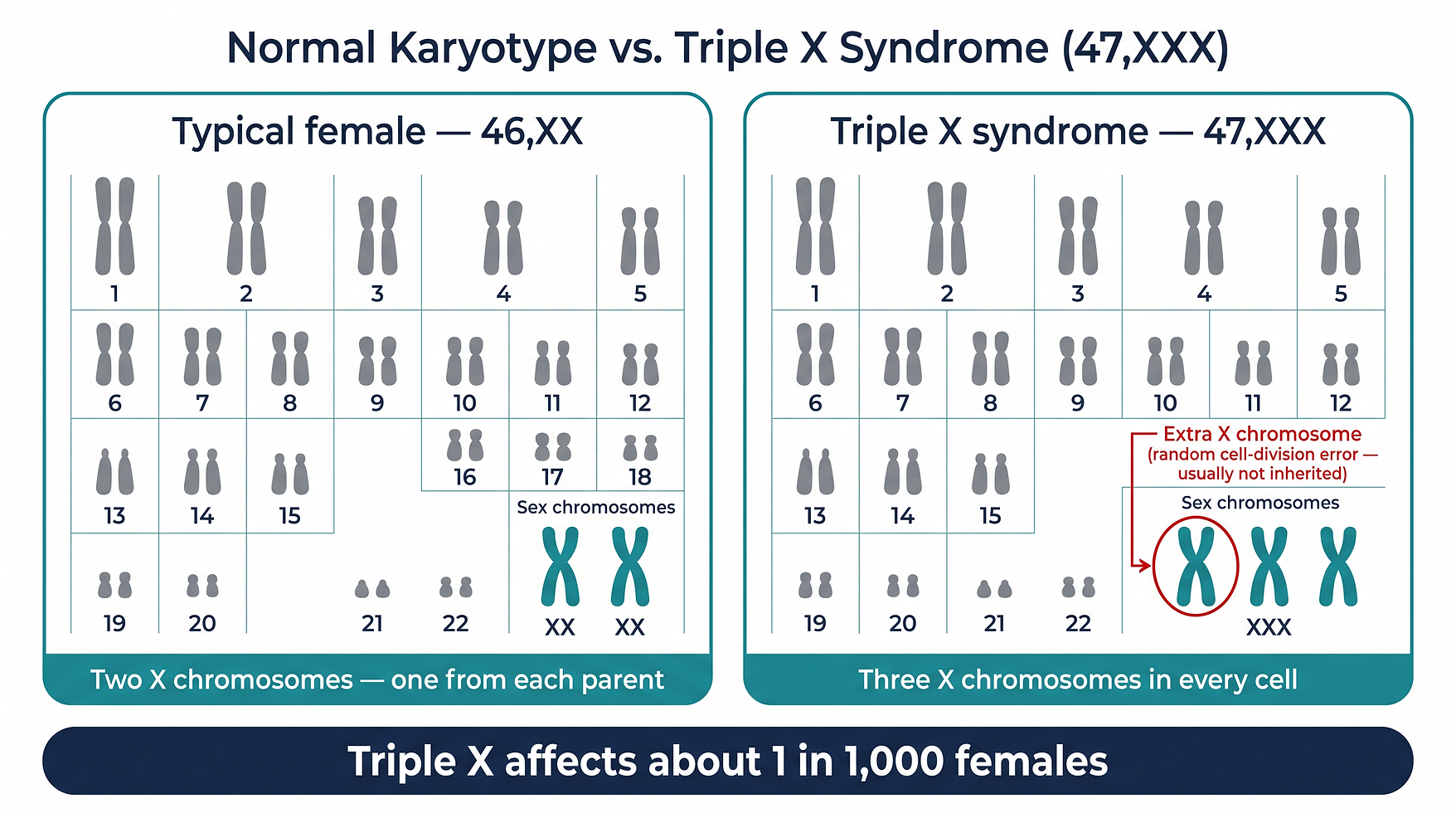
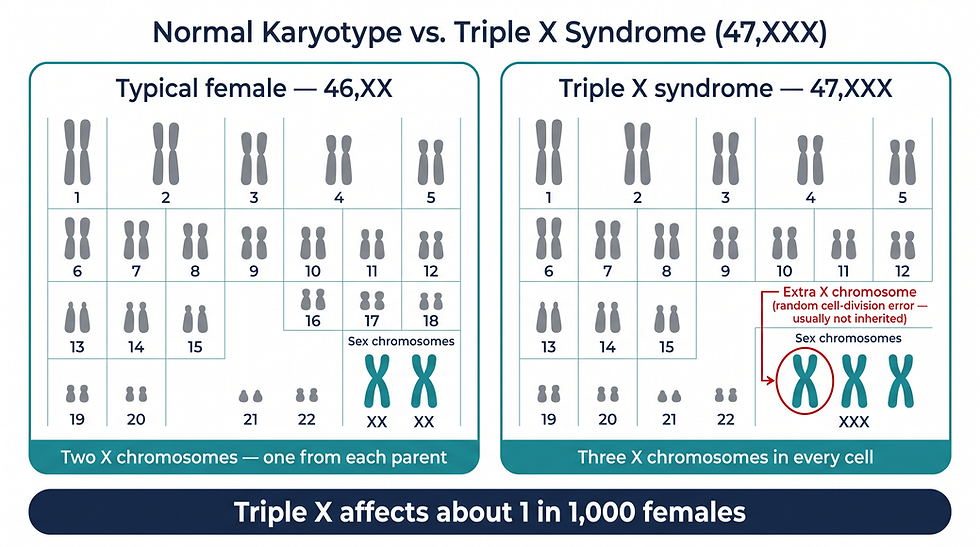
Triple X syndrome, also called trisomy X or 47,XXX, is a genetic condition that affects about 1 in 1,000 females [1][3]. Females normally have two X chromosomes in all cells — one from each parent. In triple X syndrome, a female has three X chromosomes, giving her cells 47 chromosomes instead of the usual 46 [1].
Many girls and women with triple X syndrome experience no symptoms or only mild symptoms. In others, symptoms may be more apparent — possibly including developmental delays and learning disabilities. Seizures and kidney problems occur in a small number of cases [1].
Because symptoms are often subtle or absent, the condition is frequently never diagnosed. One widely cited review estimates that only about 10% of girls and women with trisomy X are ever diagnosed [4].
How Does a Girl Get Three X Chromosomes?
Although triple X syndrome is genetic, it is usually not inherited — it results from a random genetic error [1].
Normally, people have 46 chromosomes in each cell, organized into 23 pairs. One set comes from the mother and one from the father. The pair of sex chromosomes — either XX or XY — determines a child's sex. A mother can pass on only an X chromosome, while a father can pass on an X or a Y chromosome: an XX pair makes a genetically female child, and an XY pair makes a genetically male child [1].
In triple X syndrome, a third X chromosome appears through a random error in cell division, which can happen before conception or early in the embryo's development [1]:
Form | How it happens | What it means |
|---|---|---|
Nondisjunction (most cases) | The mother's egg cell or the father's sperm cell divides incorrectly, adding an extra X chromosome | Every cell in the child's body carries the extra X |
Mosaic | The error occurs as a random event early in the embryo's development | Only some cells carry the extra X; symptoms may be less obvious |
Neither form is caused by anything parents did during pregnancy [1].
What Are the Signs and Symptoms of Triple X Syndrome?
Signs and symptoms vary greatly among girls and women with triple X syndrome. Many experience no noticeable effects or only mild symptoms [1].
Being taller than average height is the most typical physical feature. Most females experience normal sexual development and can become pregnant. Intelligence is usually in the normal range — possibly slightly lower compared with siblings — though some may have intellectual disabilities and, sometimes, behavioral problems [1].
Occasionally, more significant symptoms occur, and these vary among individuals:
Symptom area | What you may notice |
|---|---|
Speech and motor skills | Delayed development of speech and language; delayed motor skills such as sitting up and walking |
Learning | Difficulty with reading, understanding, or math |
Behavior | ADHD-like problems or autism-spectrum symptoms |
Emotional health | Anxiety and depression |
Thinking skills | Problems with fine and gross motor skills, memory, judgment, and information processing |
Some females also have physical features, though none of these is universal [1]:
Physical feature | Description |
|---|---|
Epicanthal folds | Vertical folds of skin covering the inner corners of the eyes |
Widely spaced eyes | Greater-than-usual distance between the eyes |
Curved pinky fingers | Fifth fingers that curve inward |
Flat feet | Reduced arches in the feet |
Breastbone shape | Inward-bowed (concave) sternum |
Hypotonia | Weak muscle tone |
Seizures | Occur in a small number of cases |
Kidney problems | Occur in a small number of cases |
Premature ovarian failure | Ovaries that don't work properly at a young age (uncommon) |
What Causes Triple X Syndrome, and Is It Inherited?
The extra X chromosome comes from a random cell-division error — most often nondisjunction, in which the mother's egg or the father's sperm divides incorrectly [1]. Less commonly, the error happens early in embryonic development, producing the mosaic form in which only some cells carry the extra X [1].
Key point for parents: triple X syndrome is genetic, but it is usually not inherited from either parent, and there are no major risk factors that parents can control [1].
Research adds reassuring context: reviews note that at birth, 47,XXX girls may have a slightly lower mean birth weight and smaller head circumference, but most grow up healthy [6].
What Happens If Triple X Syndrome Goes Untreated?
There is no cure, and "untreated" does not mean "dangerous" — but unaddressed developmental, psychological, and behavioral problems can create secondary challenges over time, including [1]:
Potential complication | What it can look like |
|---|---|
Daily-life challenges | Work, school, social, and relationship problems |
Emotional impact | Poor self-esteem |
Support needs | Additional help with learning, activities of daily living, school, or work |
Early identification and support substantially reduce these risks — which is why developmental monitoring matters [2].
How Is Triple X Syndrome Diagnosed?
Because many girls and women with triple X syndrome are healthy and show no outward signs, they may remain undiagnosed all their lives, or the diagnosis may be discovered while checking other issues [2].
During pregnancy
Prenatal testing can reveal the extra X before birth. During pregnancy, a sample of the mother's blood can be tested to check the baby's DNA. If the test shows an increased risk of triple X syndrome, a sample of fluid or tissue from inside the womb can be collected; genetic testing of that fluid or tissue will show whether there is an extra, third X chromosome [2].
After birth
If triple X syndrome is suspected after birth based on signs and symptoms, it is confirmed by genetic testing. Genetic counseling can also provide comprehensive information about the condition and what it means for the family [2].

How Is Triple X Syndrome Treated?
The chromosome error that causes triple X syndrome cannot be repaired, so the syndrome itself has no cure. Treatment is based on symptoms and individual needs [2]. Five support approaches cover most situations:
Support option | What it involves |
|---|---|
Periodic screenings | Regular check-ins throughout childhood and into adulthood; if developmental delays, learning disabilities, or health problems occur, prompt treatment follows |
Early intervention services | Speech, occupational, physical, or developmental therapy — starting in the early months of life or as soon as needs are identified |
Educational assistance | Help learning techniques and strategies for success in school and daily life |
Supportive environment and counseling | Psychological counseling for anxiety, behavioral, and emotional problems; guidance for families on encouragement and discouraging behaviors that hurt learning and social functioning |
Daily-functioning support | Help with activities of daily living, social opportunities, and employment when needed |

Can a Girl With Triple X Syndrome Live a Normal Life?
Yes — it is quite possible for girls and women with triple X syndrome to lead full and happy lives [2]. Most have normal sexual development and the ability to become pregnant, and many are never diagnosed at all because symptoms are absent or minimal [1].
Families who benefit most are those who build a support network early:
Support strategy | How it helps |
|---|---|
Connect with others | Support groups for X and Y chromosome disorders share coping advice and connection; organizations such as AXYS (the Association for X and Y Chromosome Variations) provide resources [2] |
Find disability support resources | Organizations such as the National Center for Learning Disabilities offer services and sources of support [2] |
Relieve stress | Talk with trusted friends or family, take personal time, and use outside caregivers for breaks [2] |
How Do I Prepare for My Child's Appointment?
Bringing the right information helps providers act faster. Before the appointment, make a list of the following [2]:
What to bring | Examples |
|---|---|
Signs and symptoms | Anything noticed in your child, including details that seem unrelated to the visit |
Developmental milestones | When your child said first words, sat up, or walked |
Pregnancy history | Significant illnesses or medications used during pregnancy |
Learning and behavior concerns | Any problems with learning, emotions, or behavior |
Your questions | A written list of what you want answered |
Helpful questions to ask the provider include: What's the most likely cause of my child's symptoms? What tests are needed, and do they require special preparation? How might this condition affect my child? What treatments are available, and which do you recommend? What services exist if my child has developmental delays or learning disabilities [2]?
Your provider will likely ask when you first noticed symptoms, what improves or worsens them, whether developmental milestones were met on time, and whether your child has had problems in school or other settings [2].
Conclusion: Most Girls Live Full Lives — Early Support Makes the Difference
Triple X syndrome sounds alarming, but the evidence paints a reassuring picture: about 1 in 1,000 girls are born with three X chromosomes, most show few or no symptoms, and only a small fraction are ever diagnosed [1][4]. There is no cure for the extra chromosome — but speech therapy, educational support, counseling, and routine screenings let girls with learning or developmental challenges thrive.
Your next steps: if your daughter shows speech, motor, or learning delays, talk with her pediatrician about developmental screening. If triple X is diagnosed, ask for referrals to early intervention services and genetic counseling, connect with a family support group, and build a support network for yourself — the same strategies that help your child work for you.
Frequently Asked Questions
Is triple X syndrome inherited from parents? No. Although it is a genetic condition, triple X syndrome is usually not inherited — it results from a random cell-division error in the egg, sperm, or early embryo. There are no major risk factors that parents can control.
How common is triple X syndrome? It affects about 1 in 1,000 females. Despite being relatively common, only around 10% of affected girls and women are ever diagnosed, because most have few or no symptoms.
Do all girls with triple X syndrome have symptoms? No. Many experience no noticeable effects or only mild symptoms. The most typical physical feature is taller-than-average height, and most females have normal sexual development and fertility.
Can triple X syndrome be cured? The extra chromosome cannot be repaired, so there is no cure for the syndrome itself. Treatment focuses on symptoms: early intervention therapies, educational assistance, counseling, periodic screenings, and daily-living support.
How is triple X syndrome diagnosed in babies? After birth, it is suspected from signs and symptoms and confirmed with genetic testing. It can also be detected prenatally through maternal blood DNA screening followed by testing of fluid or tissue from inside the womb.
Does triple X syndrome affect intelligence? Intelligence is usually in the normal range, possibly slightly lower than siblings. Some girls have learning disabilities (reading, math, understanding) or, less commonly, intellectual disabilities.
What physical features suggest triple X syndrome? None are universal, but possible features include tall stature, vertical skin folds at the inner eye corners, widely spaced eyes, curved pinky fingers, flat feet, an inward-bowed breastbone, and weak muscle tone. Seizures and kidney problems occur in only a small number of cases.
Should I be worried if my daughter is tall and a bit delayed with speech? Taller-than-average height with mild speech or motor delays is one pattern seen in triple X syndrome, but many things cause these findings. Discuss developmental concerns with your pediatrician — if triple X is a possibility, a simple genetic test can confirm or rule it out.
References
1. Triple X syndrome — Symptoms & causes — Mayo Clinic (updated January 15, 2025)
2. Triple X syndrome — Diagnosis & treatment — Mayo Clinic (updated January 15, 2025)
Comments