
Transposition of the Great Arteries (TGA): Symptoms, Causes, and Treatment in the First Days of Life

Updated: 2 days ago
Medically reviewed by Dr. Baraa Alnahhal, MD · Last reviewed: September 2026
Editorial note: This article is for general education only and is not a substitute for professional medical care. Transposition of the great arteries is a serious congenital heart defect that requires emergency treatment — always follow the guidance of your baby's medical team. Content is based on Mayo Clinic patient-education pages, CDC congenital heart defect statistics, and peer-reviewed outcomes research listed in the References section.
TL;DR
Transposition of the great arteries (TGA) is a rare heart defect present at birth in which the two main arteries leaving the heart — the aorta and the pulmonary artery — are switched. It affects about 1 in 3,846 U.S. newborns (~920 babies per year). In the most common form (d-TGA), surgery within the first days to weeks of life is required, and modern survival is excellent: roughly 97% of babies survive into adulthood after arterial switch surgery.
Quick Answer
What is transposition of the great arteries? TGA is a serious, rare congenital heart defect in which the aorta and pulmonary artery are switched, so oxygen-poor blood goes to the body instead of the lungs. In d-TGA, all babies need surgery within the first days to weeks after birth; the standard procedure is the arterial switch operation. With modern treatment, most children grow up to lead active lives [1][2].
What Is Transposition of the Great Arteries?
Transposition of the great arteries, also called TGA, is a serious and rare heart condition in which the two main arteries leaving the heart are switched, or transposed. The condition is present at birth, which makes it a congenital heart defect [1].
In a typical heart, the right side pumps blood to the lungs to pick up oxygen, and the left side pumps that oxygen-rich blood through the aorta to the rest of the body. In TGA, the connections are reversed. Where the oxygen-poor blood ends up going depends on the type of transposition.
How Common Is TGA?
Statistic | Figure | Source |
|---|---|---|
U.S. newborns with d-TGA each year | About 920 (1 in 3,846) | CDC [3] |
All TGA cases per year (estimate) | ~1,153 babies (about 1 in 3,413) | State surveillance data [4] |
Share of all congenital heart defects | 5–7% | AHA Circulation [5] |
Without treatment | ~90% do not survive the first year | Pediatric heart center data [6] |
Survival into adulthood (modern surgery) | ~97% | Peer-reviewed cohort data [7] |
These numbers carry an important message. TGA was once a death sentence without surgery. Today, because the condition is usually diagnosed before or very soon after birth — including through newborn pulse oximetry screening — and because the arterial switch operation has a mortality rate below 2%, the outlook has transformed [2][7][8].
What Does TGA Look Like? The Two Types
There are two types of transposition of the great arteries, and they behave very differently [1].
Feature | d-TGA (dextro-TGA) | ccTGA / l-TGA (congenitally corrected) |
|---|---|---|
What is switched | The two main arteries leaving the heart | The arteries and the two lower chambers (ventricles) |
How common | The usual form | Less common |
Blood flow | Oxygen-poor blood goes to the body; oxygen-rich blood recirculates to the lungs | Blood still flows the right way overall |
When it shows | Usually before or soon after birth | Symptoms may not appear for many years |
Urgency | Surgery needed in the first days to weeks of life | Depends on heart structure and other conditions; some never need surgery |
In d-TGA, the pulmonary artery connects to the left lower chamber and the aorta connects to the right lower chamber. Oxygen-poor blood from the right side of the heart goes out to the body instead of to the lungs, while oxygen-rich blood returns to the lungs without reaching the body. Unless there is also a hole in the heart — such as an atrial septal defect — that lets the blood mix, the body never receives oxygen-rich blood. This is life-threatening [1].
In congenitally corrected TGA (ccTGA, or l-TGA), the two lower chambers are reversed: the left ventricle sits on the right side of the heart, and the right ventricle sits on the left. Blood still flows the correct way through the heart and body, but the heart can develop long-term pumping trouble [1].
What Are the Symptoms of Transposition of the Great Arteries?
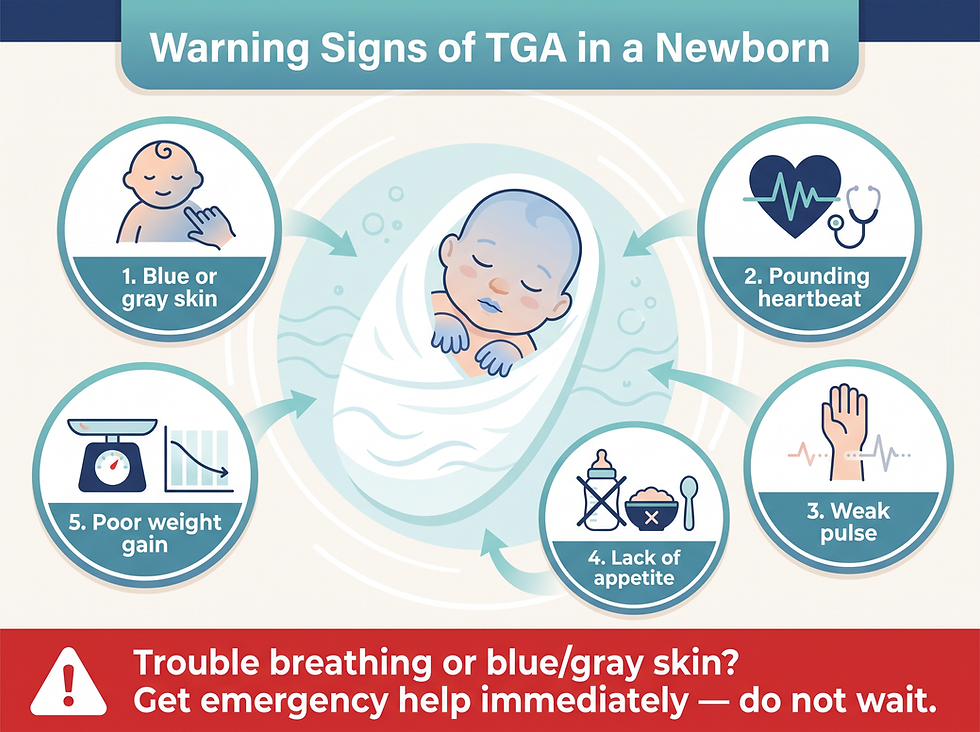
Symptoms of TGA are usually seen at birth or very soon after. They include [1]:
Symptom | What it means |
|---|---|
Blue or gray skin (cyanosis) | Low oxygen levels; may be harder or easier to see depending on skin color |
Pounding heartbeat | The heart working harder to compensate |
Weak pulse | Reduced circulation |
Lack of appetite | The baby tires or cannot feed well |
Poor weight gain | Ongoing low oxygen affects growth |
Two important caveats come with these symptoms. First, skin color changes may not be obvious right away if the baby has other heart changes that allow some oxygen-rich blood to mix into the circulation. The bluish color typically becomes more noticeable as the baby becomes more active and oxygen levels drop [1].
Second, some people with the congenitally corrected type (ccTGA) may have no symptoms for many years. That is why this form can go undetected into adolescence or adulthood [1].
When Should You Seek Emergency Care?
Serious congenital heart defects like TGA are usually diagnosed before or soon after a child is born — often on a routine pregnancy ultrasound or through newborn screening. But if you are home with a newborn, get help right away if a child has trouble breathing. Also get emergency medical help for anyone who has blue or gray skin or nails, because low oxygen levels cause these color changes [1].
What Causes Transposition of the Great Arteries?
TGA happens during pregnancy, while the unborn baby's heart is forming. In most cases, the cause is simply not known [1].
To understand how the defect forms, it helps to picture normal flow. The heart has four chambers: two upper chambers called the atria and two lower chambers called the ventricles. The pulmonary artery connects to the right ventricle and carries blood to the lungs; the aorta carries oxygen-rich blood from the left ventricle to the body.
What Increases the Risk?
Research has not found a single cause of TGA. Possible risk factors for congenital heart defects in general include [1]:
Possible risk factor | Details |
|---|---|
Rubella (German measles) during pregnancy | Can alter the baby's heart development; a blood test before pregnancy can check immunity, and a vaccine is available |
Certain medicines during pregnancy | Always tell your healthcare team about all medicines you take |
Alcohol use during pregnancy | Raises the risk of congenital heart defects |
Smoking during pregnancy | Harmful to the developing heart; quitting is the clear recommendation |
Diabetes | Careful blood sugar control before and during pregnancy reduces risk |
What Complications Can Occur?
Complications differ by type. In d-TGA, the central complication is that not enough oxygen reaches the body's tissues — without some mixing of oxygen-rich and oxygen-poor blood inside the heart, this complication causes death [1].
In ccTGA, the complications are longer-term [1]:
Complication (ccTGA) | What happens |
|---|---|
Complete heart block | The condition changes how electrical signals travel through the heart; a complete block stops all signals |
Heart valve disease | The tricuspid valve may not close fully, so blood flows backward (tricuspid regurgitation) |
Heart failure | The right ventricle pumps under higher pressure than usual; the strain can weaken it over time |
Pregnancy and TGA
If you had TGA and want to become pregnant, talk with your healthcare professional first. A healthy pregnancy may be possible, but special care may be needed, and complications such as heart-signaling changes can make pregnancy risky. Pregnancy is not recommended for people with severe TGA complications, even after corrective surgery [1].
How Is Transposition of the Great Arteries Diagnosed?
TGA is often diagnosed before birth during a routine pregnancy ultrasound. If not, it is diagnosed soon after birth. Immediately after delivery, a healthcare professional listens to the baby's heart and lungs; a whooshing sound called a murmur may be heard [2].

The diagnostic tests include [2]:
Test | What it shows |
|---|---|
Echocardiogram | Sound waves make images of the beating heart and show how blood moves through the heart and valves; it can confirm whether the two main arteries are in the correct position. Done on an unborn baby before birth, it is called a fetal echocardiogram |
Chest X-ray | Shows the condition of the heart and lungs and the heart's size; cannot diagnose TGA by itself |
Electrocardiogram (ECG or EKG) | A simple test with sticky sensor patches that shows how the heart is beating |
Pulse oximetry | A fingertip sensor records the amount of oxygen in the blood; too little may signal a heart or lung condition |
This last test matters. Pulse oximetry is part of the routine newborn screening done in most U.S. states precisely because a low oxygen reading can flag a hidden critical heart defect — including TGA — even when the baby otherwise looks well.
How Is Transposition of the Great Arteries Treated?
Treatment depends on the type of TGA. All babies with d-TGA need surgery soon after birth to fix the heart. Treatment for ccTGA depends on when the condition is diagnosed and what other heart conditions exist — some people with ccTGA never need surgery [2].
Medications
Before heart repair surgery, the baby may receive a medicine called prostaglandin (Prostin VR Pediatric). It increases blood flow and helps oxygen-poor and oxygen-rich blood mix better, buying time until surgery. After surgery, medicines may be needed to control the heartbeat, manage blood pressure, and help the body remove fluid [2].
Surgery and Procedures
Surgery is usually done within the first days to weeks after birth. The specific procedure depends on the type of TGA [2]:
Procedure | When it is used | What it does |
|---|---|---|
Atrial septostomy | Temporary fix before surgery | Thin tubes and small cuts widen a natural connection between the upper chambers, improving blood mixing and oxygen levels |
Arterial switch operation | The most common correction for d-TGA | The surgeon moves both main arteries to their correct positions and also moves the coronary arteries; other birth defects may be repaired at the same time |
Atrial switch operation | Older surgical approach | Blood flow is split between the upper chambers; the right ventricle then pumps blood to the body |
Rastelli operation | TGA with a ventricular septal defect (VSD) | The hole is patched, blood flow is redirected from the left ventricle to the aorta, and an artificial valve connects the right ventricle to the lung artery |
Double switch procedure | ccTGA | A complex surgery that switches the great artery connections so the left ventricle pumps oxygen-rich blood to the aorta |
Babies born with TGA often have other heart conditions, and additional surgeries may be needed. If TGA causes heartbeat changes, a pacemaker may be required. After surgery, regular health checkups are needed for life, and care is usually led by a doctor trained in heart conditions present at birth — a congenital cardiologist [2].

What Is the Long-Term Outlook?
Due to advances in surgery, most babies with transposition of the great arteries grow up to lead active lives [2]. Current research puts survival for babies with d-TGA who receive the arterial switch operation at roughly 97% into adulthood, and the operation itself carries a mortality rate below 2% [7][8]. Long-term follow-up still matters: 20-year transplant-free survival after arterial switch is around 82%, and adults repaired for TGA need lifelong monitoring with a congenital cardiologist [9].
What Can Parents Do at Home?
Caring for a baby with a serious heart condition can be challenging. The guidance from specialists is practical and supportive [2].
Support step | What it involves |
|---|---|
Get support | Ask family and friends for help; ask the care team about support groups and other assistance near you |
Keep notes on the baby's health history | Record the diagnosis, medicines, surgeries, other treatments, dates, and every provider's name and phone number — these notes help providers unfamiliar with the history |
Ask about activities and sports | After repair surgery, some high-energy activities might not be safe; ask a healthcare professional which exercises and activities are appropriate |
Preparing for Your Appointment
A life-threatening congenital heart defect is usually diagnosed soon after birth, and there may not be time to prepare. If you think your baby has symptoms of a heart condition, talk with a healthcare professional; you may be referred to a congenital cardiologist [2].
Preparation step | Details |
|---|---|
Bring a companion | Someone with you can remember details when it is hard to take it all in |
List the child's symptoms | Include symptoms that may seem unrelated, and note when each started |
Note personal and family information | Ask whether anyone in your family was born with a heart condition |
Write down your questions | See the question list below |
Questions worth asking the healthcare professional [2]:
Does my baby need surgery?
What other treatments are available, and which do you recommend?
How often does my baby need health checkups?
Are there any activity limits?
What information can I take home, and what websites do you recommend?
Expect the care team to ask you questions too, such as whether anyone in your family was born with a heart condition, whether there were pregnancy complications, and whether your child has been growing and meeting developmental milestones [2].
Conclusion and What to Do Next
Transposition of the great arteries is a rare and serious birth defect of the heart's plumbing — but it is also one of the great success stories of modern pediatric cardiology. Diagnosis happens early, often before birth. Surgery happens within days. And the overwhelming majority of children repaired today survive into adulthood and live active lives.
Here is what to do next:
During pregnancy: keep recommended prenatal care appointments, where routine ultrasounds may detect TGA before birth.
At birth: newborn pulse oximetry screening can flag low oxygen from a hidden heart defect even when a baby looks well.
If your baby shows trouble breathing, blue or gray skin or nails: get emergency medical help immediately — do not wait [1].
If your child was repaired for TGA: keep every lifelong follow-up appointment with a congenital cardiologist, and talk with them about which sports and activities are safe [2].
Planning a pregnancy with a heart defect history or family history: speak with your healthcare team and a genetic counselor before conceiving [1].
Frequently Asked Questions
Is transposition of the great arteries life-threatening? Without treatment, d-TGA is life-threatening: unless oxygen-rich and oxygen-poor blood can mix inside the heart, the body never receives the oxygen it needs, and roughly 90% of untreated babies do not survive the first year of life [1][6]. With modern surgery in the first weeks of life, survival into adulthood is around 97% [7].
Can TGA be fixed with surgery? Yes. The standard repair is the arterial switch operation, the most common surgery for d-TGA, in which the surgeon moves both main arteries — and the coronary arteries — back to their correct positions. Surgery is usually done within the first days to weeks after birth [2].
What are the first signs of TGA in a newborn? The main signs are blue or gray skin from low oxygen (visibility depends on skin color), a pounding heartbeat, weak pulse, lack of appetite, and poor weight gain. Some signs are subtle at first if other heart features allow partial blood mixing, and they become clearer as the baby becomes more active [1].
Can transposition of the great arteries go undiagnosed? d-TGA almost always announces itself at birth through low oxygen levels, which is why newborn pulse oximetry screening catches many cases. The rarer congenitally corrected type (ccTGA) is different: symptoms may not appear for many years, so it can be missed until adolescence or adulthood [1].
Does my child need lifelong care after TGA surgery? Yes. Even with an excellent outcome, repaired TGA requires regular health checkups for life with a doctor trained in congenital heart disease (a congenital cardiologist). Some children also need a pacemaker, and certain high-energy activities may need to be reviewed for safety [2].
Can TGA be prevented? Because the exact cause of most congenital heart defects is not known, TGA usually cannot be prevented. Steps that reduce overall congenital heart defect risk include rubella immunity before pregnancy, avoiding alcohol and smoking during pregnancy, careful diabetes control, and starting folic acid before conception [1].
Is pregnancy possible after TGA repair? Often, yes — with special care. But complications such as heart-signaling changes can make pregnancy risky, and pregnancy is not recommended for people with severe TGA complications even after corrective surgery. Discuss plans with your cardiologist and obstetric team before conceiving [1].
What is the difference between d-TGA and ccTGA? In d-TGA, only the two main arteries are switched, so oxygen-poor blood circulates to the body and urgent newborn surgery is required. In congenitally corrected TGA (ccTGA), the ventricles are also reversed, blood flows the right overall way, symptoms can be delayed for years, and some people never need surgery — though long-term problems such as heart block, valve disease, and heart failure can develop [1].
References
1. Transposition of the great arteries — Symptoms and causes — Mayo Clinic (updated June 12, 2025)
2. Transposition of the great arteries — Diagnosis and treatment — Mayo Clinic (updated June 12, 2025)
8. Arterial Switch Procedure — Cleveland Clinic (updated August 8, 2024)
Comments