Tonsil Cancer: Symptoms, Causes, Diagnosis, and Treatment

Updated: 2 days ago
Medically reviewed by Dr. Baraa Alnahhal, MD · Last reviewed: September 2026
Editorial note: This article is for general education only and is not a substitute for professional medical advice. Information reflects current published clinical sources as of August 2026. Always consult a qualified healthcare professional for diagnosis and treatment decisions.
TL;DR
Tonsil cancer is a growth of abnormal cells in one of the two oval pads at the back of the mouth, and it is a type of throat (oropharyngeal) cancer. Its five classic warning signs are difficulty swallowing, a feeling that something is caught in the throat, neck swelling or pain, earache, and jaw stiffness. HPV infection is a leading cause, and HPV-related tonsil cancer tends to appear at a younger age and respond better to treatment. Diagnosis involves an exam, a biopsy with HPV testing, and imaging, and treatment options range from transoral surgery to radiation, chemotherapy, targeted therapy, and immunotherapy.
Quick Answer: What is tonsil cancer and is it treatable?
Tonsil cancer starts in one of the tonsils — the two oval-shaped pads in the back of the mouth that help the immune system fight germs. It is a form of throat cancer called oropharyngeal cancer, and it is often diagnosed late because early symptoms mimic a sore throat. Roughly 60,000 Americans are diagnosed with oral cavity or oropharyngeal cancer each year, and most of the treatable cases cluster in the oropharynx. Treatment depends on the cancer's stage and HPV status, and HPV-related tonsil cancer generally has a better outlook, with researchers actively testing lower-dose treatments that cause fewer side effects.
What are tonsils, and what is tonsil cancer?
The tonsils are two oval-shaped pads of tissue in the back of the mouth. They belong to the body's germ-fighting immune system. When cells in a tonsil develop DNA changes that make them multiply faster than normal and live longer than they should, they can form a tumor — this is tonsil cancer.
Tonsil cancer is considered a kind of throat cancer. It occurs in the part of the throat behind the mouth, called the oropharynx, so it is sometimes called oropharyngeal cancer [1].
One important pattern: tonsil cancer is often diagnosed late. By the time it is found, the cancer has frequently spread to nearby areas, especially the lymph nodes in the neck. This is why persistent throat symptoms deserve attention rather than waiting [1].
Quick facts | Details |
|---|---|
What it is | A growth of abnormal cells starting in a tonsil |
Family | A type of throat (oropharyngeal) cancer |
Common first sign | Difficulty swallowing |
Often diagnosed | Late, sometimes after spreading to neck lymph nodes |
Annual U.S. cases (oral cavity + oropharynx) | About 60,480 new cases projected in 2026 [3] |
Main treatment approaches | Surgery, radiation therapy, chemotherapy; plus targeted therapy and immunotherapy in some cases |
What are the first signs of tonsil cancer?
The warning signs are easy to miss because they feel like a stubborn sore throat. Five signs stand out, and they typically affect one side of the throat rather than both [1].
Warning sign | What it feels like |
|---|---|
Difficulty swallowing | Trouble or pain when swallowing food or liquids |
Something caught in the throat | A persistent sensation that something is stuck in the back of the throat |
Swelling and pain in the neck | Enlarged, sometimes tender lymph nodes |
Earache | Pain in one ear without an ear infection |
Jaw stiffness | Reduced ability to open the mouth fully |
A single earache does not mean cancer — ear pain that travels from the throat is a well-known quirk of how throat nerves connect. What matters is persistence. If any of these symptoms last more than two weeks or keep coming back, they deserve an exam by a doctor or dentist [1].

What causes tonsil cancer?
Cancer starts when a cell's DNA changes its instructions. In healthy cells, DNA tells cells to grow and multiply at a set rate and to die at a set time. In cancer cells, the changes give different instructions — make many more cells quickly, and keep living when healthy cells would die. The extra cells can form a tumor that invades healthy tissue, and over time cancer cells can break away and spread to other parts of the body, which is called metastatic cancer [1].
For many tonsil cancers, human papillomavirus (HPV) is thought to have a part. HPV is a common infection passed through sexual contact. For most people it causes no problems and clears on its own. For others it causes cell changes that may one day lead to cancer — in the soft palate, tonsils, back of the tongue, and the side and back wall of the throat [1].
The HPV story has a genuinely encouraging side. Tonsil cancer caused by HPV tends to occur at a younger age and is more likely to respond well to available treatments [1]. It is not always clear what causes the DNA changes when HPV is not involved.
Cause factor | What the evidence says |
|---|---|
DNA changes in tonsil cells | The underlying mechanism of all tonsil cancers [1] |
HPV infection | Thought to play a part in many cases; linked to the tonsils, soft palate, back of tongue, and throat walls [1] |
HPV-related tonsil cancer | Tends to occur at a younger age and respond better to treatment [1] |
Unexplained cases | It is not always clear what causes the DNA changes [1] |
What raises the risk of tonsil cancer?
Three major risk factors are well established [1].
Risk factor | How it works |
|---|---|
Tobacco use — all forms | Cigarettes, cigars, pipes, chewing tobacco, and snuff all increase risk |
Heavy, frequent alcohol use | Increases risk on its own; combined with tobacco the risk rises even more |
HPV exposure | A common sexually transmitted virus; for some people it triggers cell changes that can lead to cancer |
The scale of the HPV shift is striking. HPV is thought to cause about 60–70% of oropharyngeal cancers, and oropharyngeal cancer is now the most common HPV-associated cancer in men, accounting for roughly 22,600 U.S. cases a year [6] [7]. Rates have been climbing for years: from 2012 to 2016, oropharyngeal cancer rates rose among men in every age group 40 and older, by roughly 0.8% to 4.0% per year depending on age [8]. Among women, oral HPV is much less common (about 3.6% vs. 10% of men) [6].
How is tonsil cancer staged, and what do the stages mean?
Staging runs from 0 to 4, and the system is different for cancers that test positive for HPV versus those that do not — which is why HPV testing is part of the diagnosis itself [2].
Stage | What it generally means |
|---|---|
Stage 0 | Very early, confined to the surface layer of the tonsil |
Stage 1 | Small cancer, limited to the tonsil or a few nearby lymph nodes |
Stage 2–3 | Larger tumor and/or more lymph nodes involved |
Stage 4 | Cancer has grown beyond the tonsil, spread to many lymph nodes, or spread to other parts of the body |
Lower numbers mean a smaller cancer. Higher numbers mean a bigger cancer or more spread [2]. Your own stage — and what it means for your outlook — should be discussed directly with your healthcare team, since HPV status changes the interpretation [2].
Survival statistics give a population-level picture, not an individual forecast. SEER-based five-year relative survival for oropharynx cancer is roughly 86% for localized cancer, 79% for regional spread, and 40% for distant spread — and these figures do not yet separate out HPV-positive cases, which generally do better [4] [5].
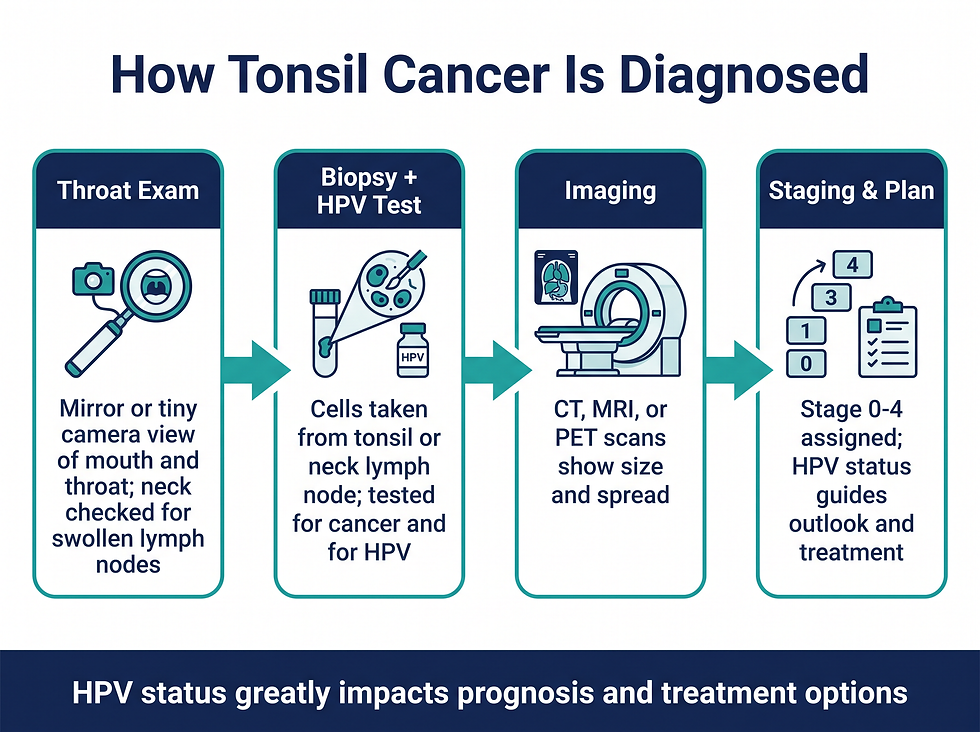
How is tonsil cancer diagnosed?
Diagnosis moves in three steps, all of them routine [2].
Diagnostic step | What happens |
|---|---|
Mouth and throat exam | A mirror or tiny camera examines the mouth and throat; the neck is felt for swollen lymph nodes |
Biopsy | A tissue sample is taken — either by cutting away cells from the tonsil or with a needle into a swollen neck lymph node; pathologists test the sample for cancer and for HPV, because HPV status greatly affects prognosis and treatment options |
Imaging | CT, MRI, and sometimes PET scans show the cancer's size and whether it has spread beyond the tonsils |
The practical takeaway: diagnosis is straightforward to start. A visual exam and a biopsy establish the answer, and imaging maps out the stage [2].
How is tonsil cancer treated?
Treatment depends on the cancer's location, how fast it is growing, whether it has spread, the cell test results, your overall health, your preferences, and — importantly — whether the cancer shows signs of HPV [2].
Treatment | When it is used |
|---|---|
Surgery (usually transoral) | Through the mouth with cutting tools or lasers, to remove as much cancer as possible; usable for all stages; sometimes requires a larger neck incision, with possible reconstructive surgery and rehabilitation |
Radiation therapy | Energy beams (X-rays, protons) alone for small cancers still within the tonsil; after surgery if removal was incomplete or lymph-node spread is a risk; combined with chemotherapy as a first treatment or after surgery |
Chemotherapy | Strong medicines usually combined with radiation (chemotherapy makes radiation work better); used alone to slow cancer that has returned or spread |
Targeted therapy | Medicines that attack specific parts of cancer cells; used when cancer spreads or returns |
Immunotherapy | Helps the immune system find and kill cancer cells; used when cancer spreads and other treatments haven't helped |
There is an important ongoing research theme here. Because HPV-related tonsil cancer responds so well, researchers are studying whether it can be treated with lower doses of radiation and chemotherapy. These less intense treatments cause fewer side effects, and studies so far have found them to seem as effective as higher doses. If your cancer is HPV-related, a clinical trial of de-escalated treatment may be worth discussing with your team [2] [12] [13].
If treatment affects your ability to speak and eat, rehabilitation services can help the recovery. The specialists involved include speech therapy, swallowing therapy, dietetics, physical therapy, and occupational therapy [2].

What can you do to prevent tonsil cancer?
Prevention focuses on healthy choices and regular checkups [1].
Prevention step | Detail |
|---|---|
Don't use tobacco | If you don't use tobacco, don't start; if you do, talk with your healthcare professional about quitting strategies |
Limit alcohol | If you drink, do so in moderation — up to one drink a day for women, up to two for men |
Regular health and dental exams | Your dentist or doctor can check your mouth for signs of cancer and precancerous changes |
Consider the HPV vaccine | Vaccination can prevent HPV infection, which raises the risk of tonsil cancer and other cancers; ask your healthcare professional whether it is right for you |
How do I prepare for a doctor's appointment about tonsil cancer?
If your symptoms worry you, start with an appointment with your doctor, dentist, or another healthcare professional. If cancer is suspected, you may be referred to a head-and-neck surgeon, a medical oncologist, or a radiation oncologist. Because appointments can be brief, preparation helps [2].
Before the appointment, be aware of any restrictions (for example, diet changes), write down all your symptoms including ones that seem unrelated, note key personal information and major stresses, list all medicines, vitamins, and supplements, consider bringing a family member or friend, and write your questions down ranked from most to least important [2].
Questions worth asking include: What is my stage? Can you explain the pathology report and can I have a copy? Will I need more tests? What are my treatment options, and the benefits and risks of each? Is one option recommended over others? What would you recommend to a loved one in my situation? Should I get a second opinion — and will insurance cover it? Are there brochures or recommended websites? [2]
Expect your doctor to ask when your symptoms began, whether they are ongoing or come and go, how severe they are, and what makes them better or worse [2].
Conclusion: Most sore throats are not cancer — but two weeks is the cutoff
Tonsil cancer can hide behind ordinary symptoms: a sore throat that won't quit, an earache, a neck lump. Most of the time those symptoms have a benign explanation. But the pattern to respect is persistence — and the one-sided pattern (one ear, one side of the throat) is worth extra attention.
The encouraging side is substantial. Tonsil cancer is among the more treatable head-and-neck cancers, HPV-related cases respond particularly well, and research is actively working to make treatment lighter on the body. Diagnosis is direct, staging is personalized, and rehabilitation teams exist to protect your ability to eat and speak.
Your next steps: if difficulty swallowing, a throat sensation, neck swelling, earache, or jaw stiffness lasts more than two weeks, book an exam with your doctor or dentist. If you don't use tobacco, keep it that way; if you drink, keep it moderate; keep up with dental checkups; and ask your healthcare professional whether the HPV vaccine is right for you or your children.
Frequently Asked Questions
1. What are the first signs of tonsil cancer? The five key signs are difficulty swallowing, a feeling that something is caught in the back of the throat, swelling and pain in the neck, an earache, and jaw stiffness. They usually affect one side. See a doctor or dentist if they persist beyond about two weeks [1].
2. Is tonsil cancer caused by HPV? HPV is thought to play a part in many tonsil cancers. It is a common virus passed through sexual contact; for most people it causes no problems, but for some it triggers cell changes that can lead to cancer [1] [6].
3. Does HPV-related tonsil cancer have a better outlook? Yes. Tonsil cancer caused by HPV tends to occur at a younger age and is more likely to respond well to available treatments. HPV status also changes how the cancer is staged [1] [2].
4. How is tonsil cancer diagnosed? With a mouth and throat exam (mirror or tiny camera plus feeling the neck), a biopsy of the tonsil or a neck lymph node, HPV testing of the tissue, and imaging such as CT, MRI, or PET scans [2].
5. How is tonsil cancer treated? Options include transoral surgery, radiation therapy, and chemotherapy — sometimes combined — plus targeted therapy and immunotherapy for cancer that spreads or returns. HPV-related cases may qualify for clinical trials using lower treatment doses [2].
6. Can tonsil cancer be cured? Many cases are curable, especially when found early. Five-year relative survival for oropharyngeal cancer is about 86% for localized cancer, 79% for regional spread, and 40% for distant spread, and HPV-positive cases generally do better than these averages [4] [5].
7. Can you prevent tonsil cancer? You can lower risk by not using tobacco, limiting alcohol, keeping regular dental and health checkups, and discussing the HPV vaccine with your healthcare professional [1] [6].
8. When should I see a doctor about throat symptoms? If any symptom — trouble swallowing, a stuck sensation, neck swelling, earache, or jaw stiffness — lasts more than about two weeks, keeps returning, or appears on one side only, get an exam from a doctor or dentist [1].
References
Tonsil cancer — Symptoms & causes — Mayo Clinic (updated November 27, 2024)
Tonsil cancer — Diagnosis & treatment — Mayo Clinic (updated November 27, 2024)
Key Statistics for Oral Cavity and Oropharyngeal Cancers — American Cancer Society (2026 estimates)
Survival Rates for Oral Cavity and Oropharyngeal Cancer — American Cancer Society
Cancer Stat Facts: Oral Cavity and Pharynx Cancer — SEER, National Cancer Institute
HPV and Oropharyngeal Cancer — CDC (updated September 17, 2024)
Cancers Linked with HPV Each Year — CDC (updated December 3, 2025)
Trends in Human Papillomavirus–Associated Cancers — CDC MMWR, Van Dyne et al., 2018
Epidemiological Trends of Head and Neck Cancer in the United States — Mourad et al., 2017
Oropharyngeal Cancer Treatment (PDQ) Patient Version — National Cancer Institute
Comments