Schwannomatosis: Complete Patient Guide to Symptoms, Causes, Diagnosis, and Treatment

Updated: 2 days ago
Medically reviewed by Dr. Baraa Alnahhal, MD · Last reviewed: September 2026
Schwannomatosis is a rare genetic condition that causes slow-growing, usually benign tumors called schwannomas to form on the nerve sheath. Pain is the most common symptom and can be long-lasting, severe, and disabling. There is no cure, but symptoms can be managed with surgery, stereotactic radiosurgery, pain medicines, and regular monitoring. Most gene changes happen spontaneously and are not inherited, and no lifestyle, diet, or environmental factors cause the condition.
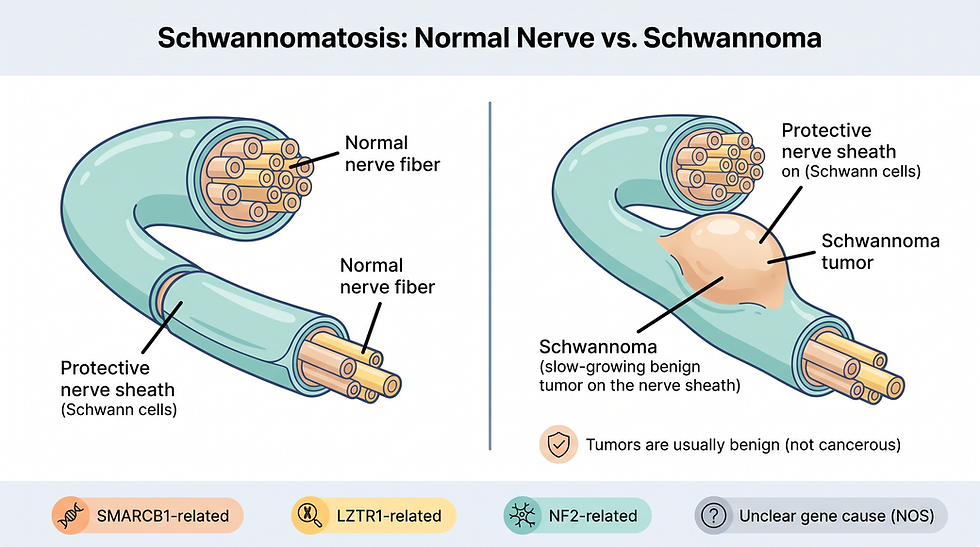
What Is Schwannomatosis?
Schwannomatosis is a rare condition that causes slow-growing tumors called schwannomas to form on the nerve sheath. A peripheral nerve sheath tumor starts in the covering on nerves outside the brain and spinal cord. When a tumor starts in Schwann cells, it is called a schwannoma.
These tumors are usually benign, which means they are not cancerous. They can form on nerves in the brain and spine, and on peripheral nerves throughout the body. Schwannomatosis often starts in early adulthood.
| Key Fact | Detail | | --- | --- | | Type of condition | Rare genetic condition causing nerve sheath tumors | | Tumor name | Schwannoma (starts in Schwann cells) | | Are tumors cancerous? | Usually benign (not cancerous) | | Tumor growth rate | Slow-growing | | Where tumors form | Brain, spine, and peripheral nerves throughout the body | | Typical onset | Early adulthood; symptoms usually appear between ages 25 and 30 | | Is there a cure? | No cure; symptoms can be managed |
The Four Types of Schwannomatosis
Types are named by the gene they are linked to. Most people have a type of schwannomatosis that is connected to a gene change.
SMARCB1-related and LZTR1-related schwannomatosis are the most common named types. These two genes are both tumor suppressor genes, which help keep cells from growing or dividing too fast.
NF2-related schwannomatosis was formerly called neurofibromatosis type 2. It behaves differently from the other types, particularly in how it affects hearing.
Types with an unclear gene cause are labeled schwannomatosis, not otherwise specified (NOS), or schwannomatosis, not elsewhere classified (NEC), when genetic testing does not show a clear cause.
| Type | Linked Gene | Typical Onset | Hearing Nerve Involvement | | --- | --- | --- | --- | | SMARCB1-related | SMARCB1 (tumor suppressor) | Usually ages 25–30 | Rare; usually one ear only | | LZTR1-related | LZTR1 (tumor suppressor) | Usually ages 25–30 | Rare; usually one ear only | | NF2-related | NF2 (formerly neurofibromatosis type 2) | Varies | Common; often both ears with greater hearing loss | | NOS / NEC | Not identified | Varies | Varies |

Schwannomatosis Symptoms
Symptoms depend on the type and develop slowly over time. They can vary widely from person to person.
The Most Common Symptom: Long-Lasting Pain
Pain is the most common symptom of schwannomatosis. It can occur anywhere in the body, last a long time, and may be disabling. Other symptoms depend on which nerves are affected.
SMARCB1- and LZTR1-Related Symptoms
These two types typically affect people after age 20. Symptoms usually appear between ages 25 and 30. The slow-growing nerve sheath tumors can develop on nerves in the brain, spine, and peripheral nerves throughout the body. Tumors also may affect cranial nerves that control vision or eye movement.
Common symptoms include long-lasting pain, numbness, tingling, or weakness in parts of the body, and muscle loss in areas where nerves are affected. Some people occasionally experience balance problems or hearing changes, depending on tumor location.
One important distinction: SMARCB1- and LZTR1-related schwannomatosis rarely affect the hearing nerve. When they do, tumors usually occur in one ear only. This differs from NF2-related schwannomatosis, which often causes tumors in both ears and greater hearing loss.
| Symptom | Description | Notes | | --- | --- | --- | | Long-lasting pain | Can occur anywhere in the body | Most common symptom; may be disabling | | Numbness, tingling, weakness | Felt in parts of the body where nerves are affected | Develops slowly over time | | Muscle loss | In areas where nerves are affected | Linked to nerve compression by tumors | | Balance problems | Occasional | Depends on tumor location | | Hearing changes | Occasional | Rare in SMARCB1/LZTR1 types; usually one ear only | | Vision or eye movement issues | Occasional | When cranial nerves are affected |
When to See a Doctor
See a healthcare professional if you have symptoms of schwannomatosis, such as ongoing pain, numbness, weakness, or new balance or hearing changes. Getting checked early can help find tumors when they are small and prevent nerve damage. There is no cure, but complications can be treated, and symptoms can often be managed.
What Causes Schwannomatosis?
Schwannomatosis is caused by a change in a gene, called a mutation, that helps control how cells grow. When these genes do not work as they should, tumors can form.
Changes in the SMARCB1 or LZTR1 genes can cause their related tumors. These genes are both tumor suppressor genes. A tumor suppressor gene helps keep cells from growing or dividing too fast.
Importantly, changes in these genes usually happen to someone for the first time in a family and are not inherited from a parent. Other types include 22q-related schwannomatosis, which is rare, and types where genetic testing does not show a clear cause.
| Question | Answer | | --- | --- | | Is schwannomatosis genetic? | Yes. It is caused by a mutation in a gene that controls how cells grow. | | Is it inherited? | Usually not. Gene changes typically happen spontaneously for the first time in a family. | | Can anything I did cause it? | No. There are no known lifestyle, diet, or environmental factors that cause schwannomatosis. | | Does it run in families? | Sometimes, but most cases happen by chance with no family history. |
Risk Factors and Inheritance
Schwannomatosis happens because of a mutation in certain genes. The gene that causes schwannomatosis is sometimes passed down from a parent. The risk of inheriting the gene differs based on the type.
In SMARCB1- and LZTR1-related schwannomatosis, the disease is less likely to be passed down from a parent. Most cases happen by chance, with no family history. Researchers estimate that the risk of inheriting the SMARCB1- and LZTR1-related schwannomatosis gene change from an affected parent is about 15%.
There are no known lifestyle, diet, or environmental factors that cause schwannomatosis. If you have a family history, genetic counseling and testing can help you understand your genetic risk and your family's options for monitoring.
Not everyone who has a gene change develops symptoms. Genetic counseling and testing can help you and your family understand risk.
Complications
Complications depend on the type and where the tumors grow. Pain from SMARCB1- and LZTR1-related schwannomatosis can be severe and may limit daily activities. Tumors that press on nerves can cause numbness, weakness, or loss of function in affected areas.
Some people need surgery or care from a pain specialist to help manage symptoms. Living with long-term pain also can affect emotional well-being. Support or counseling may help.
Is There Any Prevention?
There is currently no known way to prevent schwannomatosis. The gene changes that cause the condition can happen spontaneously or be inherited. They are not linked to lifestyle, diet, or environmental factors.
If schwannomatosis runs in your family, genetic counseling and testing can help identify your risk and help you plan for early care. Regular checkups and imaging may detect tumors early, when treatment can be easier and help protect nerve function.

How Is Schwannomatosis Diagnosed?
To diagnose schwannomatosis, a healthcare professional reviews your personal and family medical history and performs a physical exam. Diagnosis may also involve an imaging test such as an MRI, a biopsy of the tumor, and genetic testing to identify the type of schwannomatosis.
MRI is the main imaging tool for schwannomatosis. It can reveal tumors in the brain, spinal cord, or peripheral nerves and detect very small growths. X-rays or CT scans can help identify bone changes, tumors in the brain or spinal cord, and very small tumors. Imaging tests also are used to monitor the condition after diagnosis.
| Diagnostic Test | What It Checks | | --- | --- | | Medical and family history review | Personal and family history of symptoms and nerve tumors | | Physical exam | Signs of nerve compression, pain, weakness, or numbness | | MRI | Main imaging tool; reveals tumors in the brain, spinal cord, and peripheral nerves; detects very small growths | | X-ray or CT scan | Identifies bone changes and small tumors in the brain or spinal cord | | Genetic testing | Looks for changes in the SMARCB1, LZTR1, or NF2 genes to confirm the type | | Biopsy | Sample of the tumor to confirm schwannoma | | Eye exam | Checks for vision changes or cataracts, sometimes linked with nerve tumors | | Audiometry | Measures hearing | | Electronystagmography | Measures balance by recording eye movements | | Brainstem auditory evoked response | Measures electrical messages that carry sound from the inner ear to the brain |
Schwannomatosis Treatment Options
Treatment focuses on managing pain, preserving nerve function, and monitoring tumor growth. Care often involves a multidisciplinary team, including specialists in neurology, neurosurgery, pain medicine, and genetics. There is no cure, but many treatments can improve comfort and quality of life.
Surgery and Stereotactic Radiosurgery
Surgery may be recommended to remove tumors that cause pain or affect vital functions such as hearing or balance. While surgery can help ease symptoms, it does not cure schwannomatosis.
Stereotactic radiosurgery delivers radiation to the tumor without the need to cut into the body. It might be an option to control tumor growth linked to NF2-related schwannomatosis while helping to preserve hearing.
Pain Medicines
Managing pain is an important part of treatment for SMARCB1- and LZTR1-related schwannomatosis. Your healthcare professional might recommend medicines for nerve pain, tricyclic antidepressants, serotonin and norepinephrine reuptake inhibitors, or epilepsy medicines.
| Medicine Class | Example Medicines | | --- | --- | | Nerve-pain medicines | Gabapentin (Neurontin, Gralise), pregabalin (Lyrica) | | Tricyclic antidepressants | Amitriptyline | | Serotonin and norepinephrine reuptake inhibitors | Duloxetine (Cymbalta) | | Epilepsy medicines | Topiramate (Topamax, Qudexy XR), carbamazepine (Carbatrol, Tegretol) |
Researchers are studying medicines that can shrink noncancerous tumors that grow on the hearing and balance nerves in the ears.
Cancer Treatment
Tumors linked to schwannomatosis rarely turn into cancer. If they do, they are treated with standard cancer therapies, such as surgery, chemotherapy, and radiation therapy. Early diagnosis and treatment are the most important factors for a good outcome.
Monitoring and Long-Term Care
Regular MRI scans and exams help monitor tumor growth and nerve function. Some people join clinical trials studying new medicines that may slow tumor growth or relieve pain. Support groups, counseling, and integrative therapies also can help manage chronic pain and improve well-being.
Living With Schwannomatosis: Coping and Support
Learning you have schwannomatosis may cause a range of emotions. Joining a support group that meets in person or online may help you cope with the emotions you are feeling. It also may help to reach out to family members and friends for support.
Preparing for Your Appointment
You may be referred to a specialist in brain and nervous system conditions, known as a neurologist. When making the appointment, ask if there is anything you need to do in advance, such as fasting before a specific test.
Before your appointment, write down a list of concerns with a note of when you first noticed them, bring a complete medical and family history, write down key personal information including any major stresses or recent life changes, make a list of all medicines, vitamins, or supplements you are taking, and write down questions to ask your healthcare professional.
| Questions to Ask Your Doctor | What the Doctor Will Likely Ask | | --- | --- | | What type of schwannomatosis do I have? | When did you first notice symptoms? | | What tests do I need? | Have your symptoms changed over time? | | What treatments are available? | Is there a family history of schwannomatosis? | | How should the condition be monitored for changes? | — |
Conclusion
Schwannomatosis is a rare condition that causes slow-growing, usually benign tumors on the nerve sheath. Pain is the most common symptom and can be severe, long-lasting, and disabling. While there is no cure, a combination of surgery, stereotactic radiosurgery, pain medicines, and regular MRI monitoring can meaningfully improve comfort and quality of life. Because most gene changes happen spontaneously, a family history is not required for the condition to appear.
Take the next step: If you are experiencing ongoing pain, numbness, weakness, or new balance or hearing changes, talk to a healthcare professional early. Early evaluation can find tumors when they are small and protect nerve function.
Frequently Asked Questions
1. What is schwannomatosis?
Schwannomatosis is a rare condition that causes slow-growing tumors called schwannomas to form on the nerve sheath, the covering on nerves outside the brain and spinal cord. The tumors are usually benign (not cancerous).
2. Is schwannomatosis cancer?
No. Schwannomas are usually benign tumors, meaning they are not cancerous. Tumors linked to schwannomatosis rarely turn into cancer. If they do, they are treated with standard cancer therapies such as surgery, chemotherapy, and radiation therapy.
3. What is the most common symptom of schwannomatosis?
Pain is the most common symptom. It is long-lasting, can occur anywhere in the body, and may be disabling. Other symptoms include numbness, tingling, weakness, and muscle loss in areas where nerves are affected.
4. At what age do schwannomatosis symptoms appear?
Symptoms of SMARCB1- and LZTR1-related schwannomatosis typically affect people after age 20 and usually appear between ages 25 and 30. Symptoms develop slowly and vary widely from person to person.
5. Is schwannomatosis inherited?
Usually not. In SMARCB1- and LZTR1-related schwannomatosis, gene changes usually happen spontaneously for the first time in a family and are not inherited. The estimated risk of inheriting the gene change from an affected parent is about 15%.
6. How is schwannomatosis diagnosed?
Diagnosis involves a review of personal and family medical history, a physical exam, imaging such as MRI (the main imaging tool), possibly a biopsy, and genetic testing to identify the linked gene (SMARCB1, LZTR1, or NF2). Hearing, balance, and eye exams may also be performed.
7. Is there a cure for schwannomatosis?
There is no cure. However, treatment focuses on managing pain, preserving nerve function, and monitoring tumor growth. Options include surgery, stereotactic radiosurgery, pain medicines, and regular MRI monitoring, often through a multidisciplinary team.
8. What medicines treat schwannomatosis pain?
Your healthcare professional might recommend nerve-pain medicines such as gabapentin or pregabalin, tricyclic antidepressants such as amitriptyline, serotonin and norepinephrine reuptake inhibitors such as duloxetine, or epilepsy medicines such as topiramate or carbamazepine.
Trusted External Resources
Medical disclaimer: This article is for general informational purposes only and is not a substitute for professional medical advice, diagnosis, or treatment. Always consult a qualified healthcare professional about any medical condition or treatment decision.
Comments