
Scorpion Sting: Complete Guide to Symptoms, Causes, First Aid, and Treatment

Updated: 2 days ago
Medically reviewed by Dr. Baraa Alnahhal, MD · Last reviewed: September 2026
TL;DR
A scorpion sting is painful but rarely life-threatening, and most healthy adults don't need treatment. Local symptoms include intense pain, numbness, tingling, slight swelling, and warmth at the sting site. Young children and older adults face the highest risk of serious complications. Call Poison Help at 800-222-1222 if a child is stung, and seek emergency care for trouble breathing or whole-body symptoms. Home care includes cleaning the wound, applying a cool compress, resting the limb, and using over-the-counter ibuprofen for pain.
Quick Answer: What Should You Do for a Scorpion Sting?
A scorpion sting is caused by the stinger in a scorpion's tail, which releases venom containing neurotoxins that affect the nervous system. Most stings are painful but rarely life-threatening, and healthy adults usually don't need medical treatment. First steps: call Poison Help at 800-222-1222 (especially if a child is stung), clean the wound with mild soap and water, apply a cool compress, and take an over-the-counter pain reliever such as ibuprofen.
What Is a Scorpion Sting?
Scorpions use their tails to sting and deliver venom. Scorpion stings are painful but rarely life-threatening. Healthy adults usually don't need treatment for scorpion stings. Young children and older adults are most at risk of serious complications.
Scorpions are arthropods — relatives of insects, spiders, and crustaceans. Of more than 2,000 species of scorpions worldwide, about 100 produce venom serious enough to be fatal.
Key Fact | Detail |
|---|---|
What it is | A sting from a scorpion's tail that delivers venom |
Severity | Painful but rarely life-threatening |
Who is at highest risk | Young children and older adults |
Most venomous U.S. species | The bark scorpion, found mainly in the desert Southwest |
Bark scorpion size | About 1.6 to 3 inches (4 to 8 cm), including the tail |
Venom type | Neurotoxins that affect the nervous system |
Typical treatment | Often none needed for healthy adults |
Poison control | Poison Help: 800-222-1222 |

Scorpion Species to Know
The bark scorpion is the only scorpion species in the United States with venom strong enough to cause serious symptoms. It is generally about 1.6 to 3 inches (4 to 8 cm) long, including a segmented tail with a stinger that can deliver venom, and it is found mainly in the desert Southwest.
Scorpions have eight legs and a pair of lobster-like pinchers, plus a tail that curves up. They are generally more active at night. Importantly, they usually won't sting unless provoked or attacked. Most stings occur when scorpions are accidentally grabbed, stepped on, or brushed against the body.
Scorpion Sting Symptoms
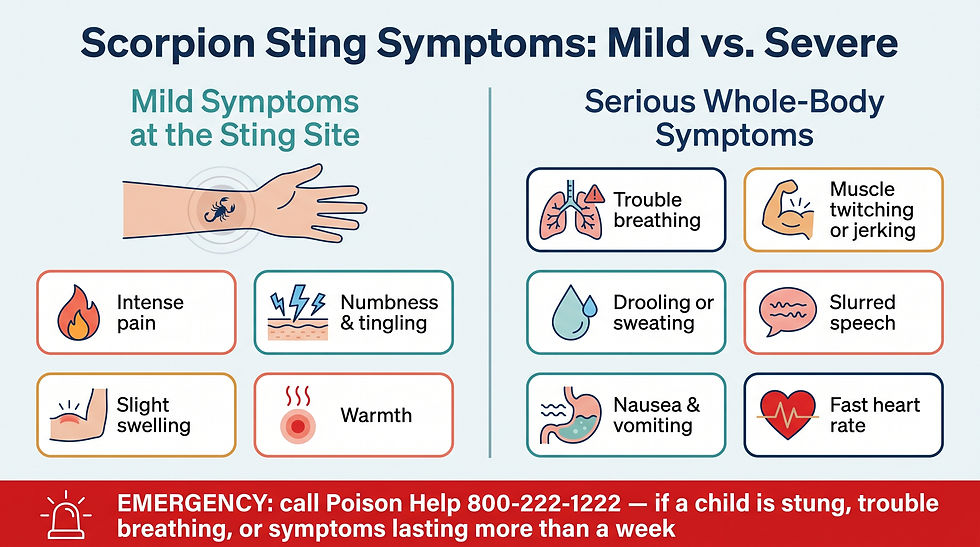
Symptoms at the site of a scorpion sting may include pain, which can be intense; numbness and tingling; slight swelling; and warmth.
Symptoms of a serious reaction that affects the whole body include trouble breathing, muscle twitching or jerking, unusual movements of the head, neck, or eyes, drooling, sweating, slurred speech, nausea and vomiting, high blood pressure (hypertension), and a fast heart rate (tachycardia). People may also be restless or hard to calm — young children may cry and be difficult to comfort.
Symptom Category | Symptoms |
|---|---|
At the sting site (mild) | Intense pain, numbness and tingling, slight swelling, warmth |
Serious whole-body | Trouble breathing, muscle twitching or jerking, unusual head/neck/eye movements, drooling, sweating, slurred speech, nausea and vomiting, high blood pressure, fast heart rate, restlessness or inconsolable crying in children |
Allergic Reactions and Anaphylaxis
Even if you had a mild allergic reaction to a sting before, a future sting could cause a severe allergic reaction called anaphylaxis. Anaphylaxis is life-threatening and needs emergency medical care. Its symptoms include hives, trouble breathing, and nausea and vomiting.
When to Seek Help
Contact your local poison control center at once if a child is stung by a scorpion. To reach a poison control center in the U.S., call Poison Help at 800-222-1222. Seek medical care if you've been stung and begin to have a hard time breathing or have other symptoms that continue for more than a week. If you're concerned about a scorpion sting, you can also call your local poison control center for advice.
What Causes a Scorpion Sting?
A scorpion sting is caused by the stinger in a scorpion's tail. When a scorpion stings, its stinger can release venom. The venom contains a complex mix of toxins that affect the nervous system. These are called neurotoxins.
Cause Element | Explanation |
|---|---|
Mechanism | The stinger in a scorpion's tail |
What happens | The stinger can release venom |
Venom contents | A complex mix of toxins that affect the nervous system |
Toxin name | Neurotoxins |
Risk Factors
Your risk of a scorpion sting rises if you live or travel where scorpions are, or if you work, hike, or camp where scorpions are.
In the U.S., scorpions mainly live in the desert Southwest, primarily Arizona, New Mexico, and parts of California. Worldwide, they're found most often in Mexico, North Africa, South America, the Middle East, and India. You might bring them home with you, because scorpions can hide in clothing, luggage, and shipping containers.
Bark scorpions live under rocks and logs, and also under tree bark — which is how they get their name. You're more likely to come into contact with one when working outside, hiking, or camping.
Risk Factor | Detail |
|---|---|
Living in scorpion areas | U.S.: desert Southwest — Arizona, New Mexico, parts of California |
Worldwide hotspots | Mexico, North Africa, South America, the Middle East, India |
Traveling | Scorpions can hide in clothing, luggage, and shipping containers |
Outdoor work and recreation | Working outside, hiking, and camping increase contact |
Common hiding spots | Under rocks, logs, and tree bark |
Possible Complications
Older adults and young children are most likely to die of untreated venomous scorpion stings. The cause is usually heart or lung failure that occurs some hours after the sting. Very few deaths from scorpion stings have been reported in the U.S.
Rarely, scorpion stings can cause a serious allergic reaction called anaphylaxis, which is life-threatening and requires emergency medical care.
How Is a Scorpion Sting Diagnosed?
Your doctor usually needs only your history and symptoms to make a diagnosis. If you have serious symptoms, you may have blood or imaging tests to check for the effects of the venom on your liver, heart, lungs, and other organs.
Diagnostic Step | What It Shows |
|---|---|
History and symptoms | Usually all that's needed for a diagnosis |
Blood tests | Check for venom effects on the liver, heart, lungs, and other organs |
Imaging tests | Used when symptoms are serious |
Treatment Options
Most scorpion stings don't need medical treatment. But if symptoms are serious, you may need to receive care in a hospital, where you may be given medicines through a vein to treat pain.
Scorpion antivenom may be given if a child or adult has severe symptoms after a scorpion sting.
Treatment Level | When Used | What's Given |
|---|---|---|
Home care | Mild symptoms in healthy adults | Soap and water, cool compress, over-the-counter pain reliever |
Hospital care | Serious symptoms | Medicines through a vein to treat pain |
Antivenom | Severe symptoms in a child or adult | Scorpion antivenom |
Lifestyle and Home Remedies
If a scorpion stings your child, first contact your local poison control center — Poison Help at 800-222-1222. Based on poison control's advice, you can follow these steps at home.
Clean the wound with mild soap and water. Apply a cool compress to the affected area, which may ease the pain. If stung on an arm or leg, rest the affected limb in a supportive position.
If you're having a hard time swallowing, limit yourself to sips of water. If this symptom does not resolve or gets worse over the next hour, seek medical attention. Don't take or give any medicines to make you sleep or to feel calm or less anxious.
Take a pain reliever available without a prescription as needed. You might try ibuprofen (Advil, Motrin IB, Children's Motrin, others) to ease pain. If you're healthy and not having any serious symptoms, you may not need to be treated by a doctor — you can simply follow the steps above.
Finally, check vaccination records to be sure tetanus vaccinations are up to date for you and your child.
Home Care Step | How to Do It |
|---|---|
Call poison control | First step, especially for children: 800-222-1222 |
Clean the wound | Mild soap and water |
Cool compress | Apply to the affected area to ease pain |
Rest the limb | Supportive position if the arm or leg was stung |
Swallowing trouble | Sips of water only; seek care if not improving within an hour |
Avoid | Any medicines that cause sleep or calmness |
Pain relief | Over-the-counter ibuprofen as needed |
Tetanus | Confirm vaccinations are up to date |

Prevention
Scorpions tend to avoid contact. If you live in an area where scorpions are common, consider these steps to prevent chance encounters.
Remove piles of rocks or lumber from around your house, and don't store firewood against the house or inside. Keep grass closely mowed, and prune bushes and overhanging tree branches that can provide scorpions with a path to your roof.
Caulk cracks, install weatherstripping around doors and windows, and repair torn screens. Inspect and shake out gardening gloves, clothing, and boots that haven't been used for a while.
Take steps when you're traveling. In areas where venomous scorpions are common — especially if camping or staying in rustic accommodations — wear shoes. Also, shake out your clothing, bedding, gear, and packages often.
Scorpions glow under a black light, so you might want to use one at night to look at what's around you. If you find a scorpion, use tongs to gently move it away from people.
Prevention Step | Why It Helps |
|---|---|
Remove rock and lumber piles | Removes hiding spots around the house |
Mow grass and prune branches | Removes paths to your roof |
Seal the house | Caulking cracks, weatherstripping, and fixing screens keep scorpions out |
Shake out unused gear | Finds scorpions hiding in gloves, clothing, and boots |
Wear shoes outdoors | Protects feet in scorpion areas |
Black light at night | Scorpions glow under a black light |
Conclusion
Scorpion stings are painful but rarely life-threatening, and most healthy adults recover with simple home care. The sting comes from the scorpion's tail stinger, which delivers venom containing neurotoxins that affect the nervous system. The bark scorpion — the only U.S. species with venom strong enough to cause serious symptoms — lives mainly in the desert Southwest, and young children and older adults face the highest risk. Knowing the first aid steps, the warning signs that call Poison Help at 800-222-1222, and a few prevention habits around the home makes most scorpion encounters safely manageable.
Take the next step: If you or a family member has been stung, start with home care — and call Poison Help at 800-222-1222 for guidance, especially when a child is stung or symptoms are severe.
Frequently Asked Questions
Is a scorpion sting dangerous?
Scorpion stings are painful but rarely life-threatening. Healthy adults usually don't need treatment. Young children and older adults are most at risk of serious complications.
What are the symptoms of a scorpion sting?
Symptoms at the sting site may include intense pain, numbness and tingling, slight swelling, and warmth. Serious whole-body symptoms include trouble breathing, muscle twitching, drooling, sweating, slurred speech, nausea and vomiting, high blood pressure, fast heart rate, and unusual movements of the head, neck, or eyes.
What should I do first after a scorpion sting?
Contact your local poison control center at once if a child is stung — call Poison Help at 800-222-1222. Clean the wound with mild soap and water, apply a cool compress, and rest the stung limb.
When should I go to the emergency room?
Seek emergency care for trouble breathing, muscle twitching or jerking, unusual movements of the head, neck, or eyes, slurred speech, signs of an allergic reaction (hives, nausea, vomiting), or symptoms that continue for more than a week.
What is the best pain relief for a scorpion sting?
An over-the-counter pain reliever such as ibuprofen (Advil, Motrin IB, Children's Motrin, others) can ease pain. Do not take or give any medicines that make you sleep or feel calm.
Is there an antivenom for scorpion stings?
Yes. Scorpion antivenom may be given if a child or adult has severe symptoms after a scorpion sting, and serious cases may receive medicines through a vein in the hospital to treat pain.
Where do scorpions live in the U.S.?
In the U.S., scorpions mainly live in the desert Southwest — primarily Arizona, New Mexico, and parts of California. The bark scorpion, the only U.S. species with venom strong enough to cause serious symptoms, is about 1.6 to 3 inches long and hides under rocks, logs, and tree bark.
How can I prevent scorpion stings at home?
Remove rock and lumber piles, keep grass mowed, prune branches, seal cracks and torn screens, shake out unused gloves, boots, and clothing, wear shoes outdoors in scorpion areas, and use a black light at night since scorpions glow under it.
Further Reading
Medical disclaimer: This article is for general informational purposes only and is not a substitute for professional medical advice, diagnosis, or treatment. Always consult a qualified healthcare professional about any medical condition or treatment decision. In a poisoning emergency, call Poison Help at 800-222-1222 (U.S.) or your local emergency number.
Comments