Pseudocholinesterase Deficiency: Complete Guide to Anesthesia Sensitivity, Causes, and Safe Surgery

Updated: 2 days ago
Medically reviewed by Dr. Baraa Alnahhal, MD · Last reviewed: September 2026
TL;DR
Pseudocholinesterase deficiency is a rare disorder that makes certain muscle relaxants used during general anesthesia — most commonly succinylcholine — keep the muscles relaxed for several hours longer than expected. For most people, there are no signs until anesthesia is given. The inherited form follows an autosomal recessive pattern (two affected BCHE genes required), while an acquired form can result from illness, pregnancy, or medications. There is no cure, but a diagnosis lets the anesthesia team simply avoid the triggering drugs, making future procedures safe.
Quick Answer
What is pseudocholinesterase deficiency? It is a rare condition in which the body lacks — or has too little of — the pseudocholinesterase enzyme that normally breaks down choline ester drugs such as the muscle relaxant succinylcholine. What happens? During general anesthesia, muscle paralysis lasts several hours longer than expected, leaving you unable to move or breathe on your own until a ventilator supports you. What causes it? Either an inherited change in the BCHE gene or conditions that lower enzyme production, such as kidney or liver disease, chronic infection, severe burns, cancer, pregnancy, or certain medications. Can it be treated? There is no cure, but the anesthesiologist can use other muscle relaxants — so with a diagnosis, safe anesthesia is possible every time.

Figure 1: How pseudocholinesterase breaks down the muscle relaxant succinylcholine. With the deficiency, the drug is not metabolized normally and paralysis lasts hours instead of minutes.
What Is Pseudocholinesterase Deficiency?
Pseudocholinesterase deficiency is a rare disorder that makes you sensitive to certain muscle relaxants — succinylcholine or mivacurium — used during general anesthesia. Mivacurium is no longer available in the United States but is sometimes used in other countries.
Succinylcholine is a drug designed to briefly relax your muscles during a medical procedure, such as surgery. With pseudocholinesterase deficiency, the body muscles stay relaxed for a longer time than expected.
This temporary loss of the ability to move your muscles — paralysis — makes you unable to breathe or move on your own. This can last for several hours. You may need help breathing with a mechanical ventilator until you can start breathing on your own.
Key fact: For most people with pseudocholinesterase deficiency, no signs or symptoms of the condition occur until the muscle relaxant succinylcholine is given as part of anesthesia.
There is no cure for pseudocholinesterase deficiency. But if you are diagnosed with the disorder, your healthcare provider can use other types of muscle relaxants that will not cause muscle paralysis that lasts longer than expected.
Pseudocholinesterase Deficiency: The Basics at a Glance
What is it? A rare disorder causing sensitivity to succinylcholine and mivacurium muscle relaxants used in anesthesia
When do symptoms appear? Only when the triggering muscle relaxant is given — usually during general anesthesia
Main symptom: Muscle paralysis lasting several hours longer than expected
Inherited form: Caused by BCHE gene change; autosomal recessive (two affected genes required)
Acquired form: Caused by illness, injury, pregnancy, or medications — not inherited
Diagnosis: Blood test for enzyme level; genetic testing for the inherited form
Cure: No cure — but other muscle relaxants avoid the problem
Signs and Symptoms of Pseudocholinesterase Deficiency
The Defining Symptom: Prolonged Paralysis
The hallmark sign and symptom of pseudocholinesterase deficiency is muscle relaxation or muscle paralysis that lasts several hours longer than expected after receiving succinylcholine. During that time, you cannot move or breathe on your own.
The length of time may vary widely among people with this disorder. Some recover sooner; others need breathing support for many hours.
Muscles stay relaxed far longer than expected after succinylcholine: The core defining sign — recovery takes hours instead of minutes
Unable to move on your own: Paralysis continues because the drug is not broken down normally
Unable to breathe on your own: The diaphragm stays relaxed; a ventilator takes over breathing
Recovery only with medical support: Mechanical ventilation and sedation are provided until breathing resumes
Why Most People Never Know They Have It
This is one of the most important features of the disorder for families and patients to understand: pseudocholinesterase deficiency often has no everyday signs at all. People do not feel it, notice it, or experience any health problem in normal life. It is discovered — sometimes unexpectedly — only when the specific trigger occurs during a medical procedure.
This is why family history matters so much. A prior anesthesia problem in a relative can be the first clue that the disorder runs in a family.
What Causes Pseudocholinesterase Deficiency?
The Enzyme Problem
If you have pseudocholinesterase deficiency, your body has no pseudocholinesterase or an amount that is too low. This enzyme is needed to break down (metabolize) drugs known as choline esters. Succinylcholine is used as part of anesthesia to relax the muscles during medical procedures.
Pseudocholinesterase deficiency causes the muscles to stay relaxed for too long after getting succinylcholine. This prevents you from moving or breathing on your own for a few hours longer than expected. How long it takes your body to metabolize the drug depends on how much pseudocholinesterase enzyme you produce and how well it functions.
Pseudocholinesterase deficiency can be inherited or acquired.

Figure 2: The two pathways to pseudocholinesterase deficiency — an inherited gene change versus conditions that reduce enzyme production.
Inherited Pseudocholinesterase Deficiency
Inherited pseudocholinesterase deficiency is caused by a change in the butyrylcholinesterase (BCHE) gene. This gene provides the instructions to make the pseudocholinesterase enzyme that is needed to break down choline esters. If you have this changed gene, either you do not produce this enzyme or the enzyme does not work well.
Genetic testing can show whether you have this gene change. To have pseudocholinesterase deficiency, you must inherit two affected genes — one from each of your parents (autosomal recessive inheritance). If you inherit only one affected gene, you will not have the disorder. But you may process choline esters at a slower rate than people who do not have an affected gene.
With one affected gene, you are a carrier and can pass the gene change to your children. But they will not develop the disorder unless they also inherit an affected gene from the other parent.
Gene involved: BCHE (butyrylcholinesterase)
Inheritance pattern: Autosomal recessive — two affected genes required, one from each parent
One affected gene: No disorder; you are a carrier, though choline esters may be processed more slowly
Carrier risk: Can pass the gene change to children, who develop the disorder only if they also inherit an affected gene from the other parent
Confirmation: Genetic testing
Acquired Pseudocholinesterase Deficiency
You can develop pseudocholinesterase deficiency as a result of conditions that cause you to make less of the pseudocholinesterase enzyme. These conditions include:
Chronic infections
Kidney disease
Liver disease
Malnutrition
Severe burns
Cancer
Pregnancy
Certain medications
None of these causes are inherited — the acquired form is not inherited and cannot be passed to your children.
Who Is at Risk?
Your risk of having pseudocholinesterase deficiency is higher if you or a first-degree relative, such as a parent, child, or sibling, has either of the following:
A gene change that causes the disorder
A history of a problem during anesthesia that is suspected to be caused by pseudocholinesterase deficiency
Because the inherited form is autosomal recessive, risk concentrates in families where both parents carry the gene change — even if no one in the family has ever shown symptoms. This is why a single past anesthesia complication in a relative deserves a conversation with your doctor.
Family history of pseudocholinesterase deficiency: The disorder is usually inherited and runs in families
A relative with anesthesia problems: An unexpectedly long recovery from a muscle relaxant can signal the disorder
Kidney or liver disease: Can lower enzyme production (acquired form)
Chronic infection, malnutrition, or severe burns: Can lower enzyme production (acquired form)
Pregnancy: Can lower enzyme production (acquired form, temporary)
Certain medications: Can reduce enzyme production (acquired form, reversible)
How Is Pseudocholinesterase Deficiency Diagnosed?
Pseudocholinesterase deficiency may be suspected when you have problems recovering muscle control and breathing after you get the muscle relaxant succinylcholine as part of anesthesia. A blood test can tell if you have enough of the pseudocholinesterase enzyme.
To diagnose inherited pseudocholinesterase deficiency, the gene change that causes the disorder is identified using genetic testing. A sample of your blood is collected and sent to a lab for analysis.
Ask your healthcare provider if family members should be tested before surgery as well. Because the disorder is inherited, one diagnosis in a family can protect many relatives — a single genetic test before an operation can prevent a frightening complication.
Blood test for pseudocholinesterase enzyme level: Whether the body has enough of the enzyme to metabolize choline esters normally
Genetic testing (BCHE gene): Whether the inherited gene change is present — confirms the inherited form
Clinical history review: Whether a prior anesthesia problem or family history suggests the disorder
Family member screening: Whether relatives should be tested before their own surgeries
Treatment and Management
Avoiding the Trigger Is the Treatment
There is no cure for pseudocholinesterase deficiency. Instead, treatment is about planning ahead.
If you have pseudocholinesterase deficiency, the healthcare provider who gives you anesthesia (anesthesiologist) can avoid succinylcholine that may trigger prolonged muscle relaxation. The anesthesiologist can choose other muscle relaxants instead.
If you have the disorder and you receive a muscle relaxant that prolongs your anesthesia recovery, you will likely need medical assistance. If needed, a machine that takes over the work of breathing (mechanical ventilation support) and sedation are provided while you recover and start breathing on your own. This may take several hours.
Sensitivity to Other Medications
With pseudocholinesterase deficiency, you may also be sensitive to other medications. These can include local numbing medications, also called local anesthetics. Examples are procaine, tetracaine, benzocaine, and cocaine. This broader sensitivity is why carrying the diagnosis with you to every care setting matters.
Avoid succinylcholine and mivacurium: Prevents prolonged paralysis entirely by using other muscle relaxants
Mechanical ventilation support if exposed: A machine takes over breathing while you recover — may take several hours
Avoid certain local anesthetics: Procaine, tetracaine, benzocaine, and cocaine may also be affected
Wear a medical alert bracelet or necklace: Tells healthcare professionals about your risk, especially in an emergency
Carry a wallet card: Provides the same alert in a written form emergency responders can read
Prevention and Staying Safe Before Surgery
Prevention for this disorder is about communication and preparation, not lifestyle changes.
If you have a family history of pseudocholinesterase deficiency or have a family member who had any problem with anesthesia, tell your healthcare provider before getting a medical procedure that requires anesthesia.
Evaluating your risk of pseudocholinesterase deficiency allows your healthcare provider to avoid certain muscle relaxants, if needed.
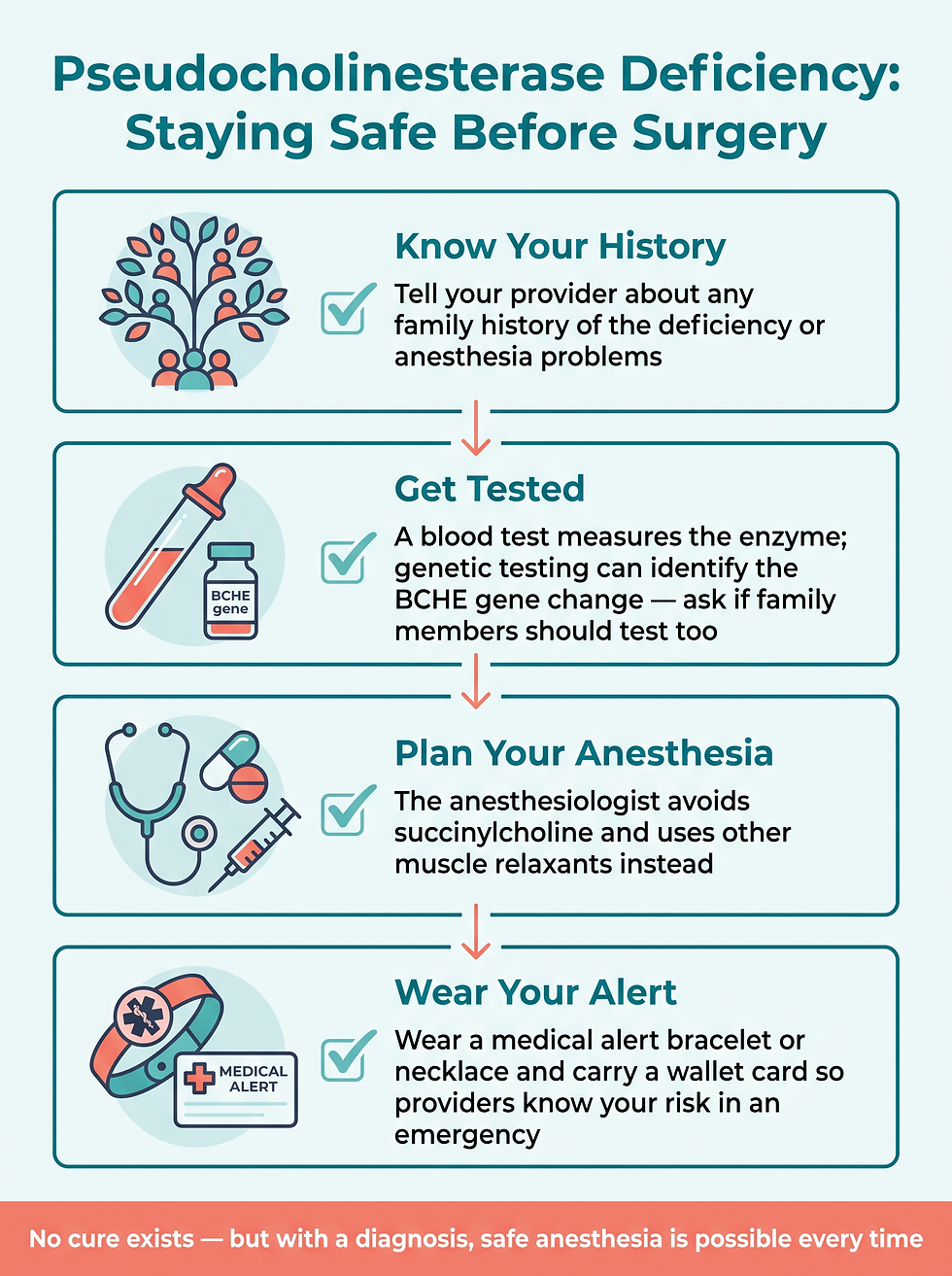
Figure 3: The four steps that keep surgery safe with pseudocholinesterase deficiency — from family history to wearing a medical alert bracelet.
Your Pre-Surgery Safety Checklist
Tell your provider about family history. Mention any family member with the deficiency or any anesthesia problem, even one that happened decades ago.
Ask about testing. A blood test measures the enzyme, and genetic testing can identify the BCHE gene change. Ask whether family members should be tested before their surgeries too.
Confirm the anesthesia plan. Once diagnosed, the anesthesiologist simply avoids succinylcholine and chooses other muscle relaxants.
Wear your alert. A medical alert bracelet or necklace and a wallet card let every healthcare professional know about your risk — especially in an emergency, when no one knows your history.
Questions to Ask Your Doctor Before a Procedure
Do I or my family have a history of problems with anesthesia?
Should I have a blood test or genetic test for pseudocholinesterase deficiency before this procedure?
Which muscle relaxants will be used in my anesthesia plan?
If I am diagnosed, should my parents, siblings, or children be tested before their own surgeries?
Are there local anesthetics I should avoid as well?
Frequently Asked Questions
What is pseudocholinesterase deficiency?
Pseudocholinesterase deficiency is a rare disorder that makes you sensitive to certain muscle relaxants — succinylcholine or mivacurium — used during general anesthesia. With the deficiency, the muscles stay relaxed and paralyzed for several hours longer than expected, so you cannot move or breathe on your own until the drug wears off, sometimes with a ventilator's help.
Is pseudocholinesterase deficiency genetic?
It can be. The inherited form is caused by a change in the BCHE gene and follows an autosomal recessive pattern — you must inherit two affected genes, one from each parent, to have the disorder. With only one affected gene, you are a carrier and do not have the disorder, though you may process choline esters more slowly. An acquired form can also develop from conditions such as kidney or liver disease, chronic infection, severe burns, cancer, pregnancy, or certain medications — and this form is not inherited.
What are the symptoms of pseudocholinesterase deficiency?
For most people, there are no symptoms at all in everyday life. The defining symptom appears only after the muscle relaxant succinylcholine is given as part of anesthesia: muscle relaxation or paralysis that lasts several hours longer than expected, during which you cannot move or breathe on your own.
Can you die from pseudocholinesterase deficiency?
When managed by an anesthesia team, the prolonged paralysis is temporary and survivable — patients are supported with a ventilator and sedation until they can breathe on their own. The danger lies in the disorder going unrecognized in an emergency or unmonitored setting, which is why carrying a medical alert bracelet, wallet card, and family history to every care setting is so important.
How is pseudocholinesterase deficiency diagnosed?
It may be suspected after an unexpectedly slow recovery of muscle control and breathing following succinylcholine. A blood test measures whether you have enough of the pseudocholinesterase enzyme, and genetic testing identifies the BCHE gene change to confirm the inherited form. Family members may also be tested before their own surgeries.
Is there a cure for pseudocholinesterase deficiency?
No, there is no cure. But treatment is rarely needed in the traditional sense: the anesthesiologist can simply avoid succinylcholine and other triggering muscle relaxants and use alternatives instead. With a diagnosis, safe anesthesia is possible for every future procedure.
What medications should I avoid with pseudocholinesterase deficiency?
The main drugs to avoid are the muscle relaxants succinylcholine and mivacurium (the latter is no longer available in the United States). You may also be sensitive to certain local numbing medications (local anesthetics), including procaine, tetracaine, benzocaine, and cocaine.
Can pregnancy cause pseudocholinesterase deficiency?
Yes, in its acquired form. Conditions that cause the body to make less of the enzyme — including chronic infections, kidney or liver disease, malnutrition, severe burns, cancer, and pregnancy — can produce pseudocholinesterase deficiency. Certain medications can also reduce enzyme production. The acquired form is not inherited and cannot be passed to your children.
Conclusion and Next Steps
Pseudocholinesterase deficiency is one of the rarest conditions covered on Rinnit — yet for the people it touches, the stakes are immediate and concrete. The disorder hides completely until a specific muscle relaxant is used during general anesthesia, at which point it turns a routine minutes-long recovery into hours of paralysis and breathing support.
The good news is equally clear. There is no cure — and no cure is needed for safe surgery. Once the deficiency is known, the anesthesiologist simply chooses different muscle relaxants, and future procedures proceed normally. The real work happens before the operating room: sharing family history, getting tested when risk exists, and wearing the medical alert bracelet that speaks for you in an emergency.
Your next step: If any family member has ever had an unexpected, unusually long recovery from anesthesia, mention it at your next appointment. A simple blood test before surgery can turn a frightening risk into a routine, fully preventable event — for you and for your relatives.
References
Authoritative external resources:
Medical disclaimer: This article is for general informational purposes only and does not constitute medical advice, diagnosis, or treatment. Always seek the advice of a qualified healthcare provider with any questions about a medical condition, anesthesia planning, or medication safety. Never disregard professional medical advice or delay seeking care based on information read here. In an emergency, contact emergency services immediately.
Comments