Premature Ejaculation Guide: Symptoms, Causes, Diagnosis, and Treatment

Updated: 2 days ago
Medically reviewed by Dr. Baraa Alnahhal, MD · Last reviewed: September 2026
Premature ejaculation occurs when semen leaves the body sooner than wanted during sex. It is one of the most common sexual complaints in men, reported by as many as 1 out of 3 men at some time. This guide explains how doctors define it, what causes it, the behavioral techniques and medications that help, and how to prepare for a conversation with a healthcare provider.

TL;DR
Premature ejaculation is ejaculation that happens sooner than wanted, and it is diagnosed when a man always or nearly always ejaculates within 1 to 3 minutes of penetration, cannot delay ejaculation during sex, and feels distressed by it. The average time from the start of intercourse to ejaculation is about five minutes. Causes involve a mix of psychological and biological factors, with erectile dysfunction and stress raising the risk. Treatment combines behavioral techniques such as Kegel exercises and the pause-squeeze method, topical numbing agents, oral medications like SSRIs, and counseling, and the condition is highly treatable.
Quick Answer
What it is. A condition in which semen leaves the body sooner than wanted during sex. It affects as many as 1 in 3 men at some time and is usually not a concern if it happens only occasionally.
The defining rule. You may be diagnosed with premature ejaculation if you always or nearly always ejaculate within 1 to 3 minutes of penetration, cannot delay ejaculation during sex all or nearly all the time, and feel distressed and frustrated as a result.
The benchmark. The average time from the beginning of intercourse to ejaculation is about five minutes.
What causes it. The exact cause is unknown. It involves a complex interaction of psychological factors (early sexual experiences, anxiety, depression, guilt) and biological factors (hormone or brain-chemical irregularities, prostate or urethra swelling or infection, inherited traits).
How it is treated. Behavioral techniques (Kegel exercises, the pause-squeeze and stop-start methods, climax-control condoms), topical numbing agents, oral medications such as SSRIs, tramadol, or erectile dysfunction drugs, and counseling. Behavioral treatment plus drug therapy may be the most effective combination.
This guide is based on specialist-reviewed hospital clinical guidance published December 23, 2025, and draws on urology and men's health references from Campbell-Walsh-Wein Urology (12th ed., 2021), the American Urological Association and SMSNA ejaculation guide (Journal of Urology, 2022), Ferri's Clinical Advisor (2022), the peer-reviewed International Journal of Reproductive Biomedicine (2021), and the DSM-5-TR (2022). See the full references at the end of this guide.
How do you know if it is premature ejaculation?
Premature ejaculation is not cause for concern if it does not happen often. It is typical to experience early ejaculation at times, and many people feel they have symptoms even though they do not meet the criteria for a diagnosis.
A diagnosis is considered when all three of the following apply: you always or nearly always ejaculate within 1 to 3 minutes of penetration, you are not able to delay ejaculation during sex all or nearly all the time, and you feel distressed and frustrated, and tend to avoid sexual intimacy as a result.
The main symptom is not being able to delay ejaculation for more than three minutes after penetration. The condition might occur in all sexual situations, even during masturbation.
Is it lifelong or did it develop later?
Premature ejaculation is classified into two types. Lifelong premature ejaculation occurs all or nearly all the time beginning with the first sexual encounter. Acquired premature ejaculation develops after having previous sexual experiences without problems with ejaculation.
Type | What it means |
|---|---|
Lifelong | Happens all or nearly all the time, starting with the first sexual encounter |
Acquired | Develops after previous sexual experiences without ejaculation problems |
The distinction matters because acquired premature ejaculation often points to a new physical or relationship factor, such as erectile dysfunction or relationship stress, while lifelong forms more often trace back to early experiences or biological traits.
What causes premature ejaculation?
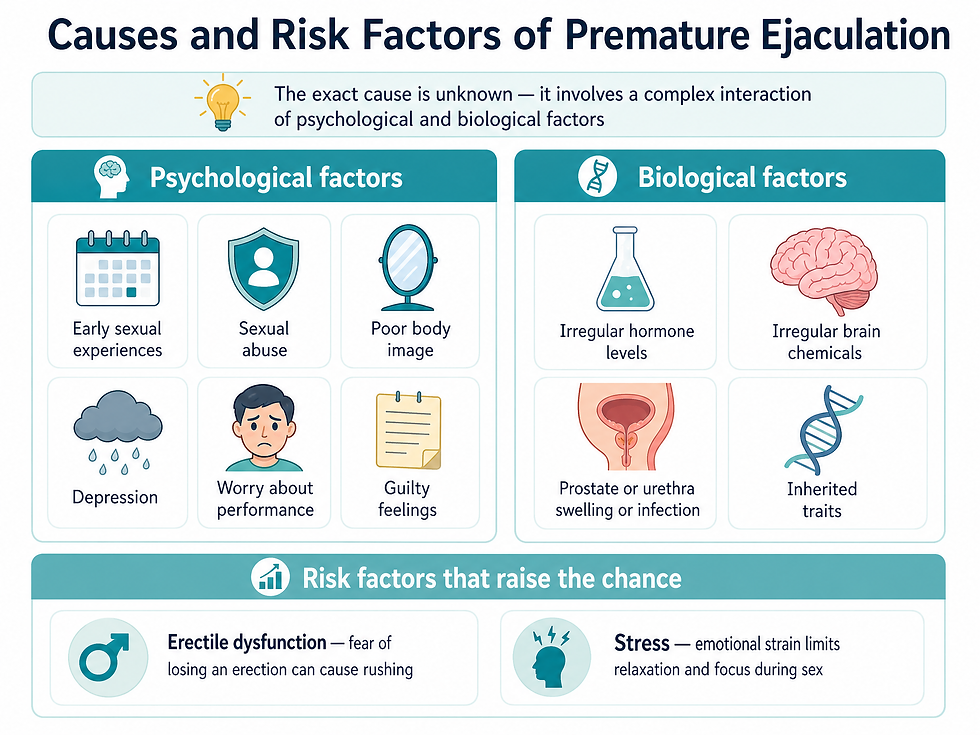
The exact cause is not known. It was once thought to be only psychological, but providers now know that premature ejaculation involves a complex interaction of psychological and biological factors.
Factor type | Examples |
|---|---|
Psychological | Early sexual experiences, sexual abuse, poor body image, depression, worrying about premature ejaculation, guilty feelings that cause rushing through sex |
Biological | Irregular hormone levels, irregular levels of brain chemicals, swelling and infection of the prostate or urethra, inherited traits |
Related conditions | Erectile dysfunction, which can form a hard-to-change pattern of rushing to ejaculate; anxiety, whether about performance or other issues; relationship problems, especially if the problem did not happen with other partners |
What raises the risk?
Two factors in particular increase the risk of premature ejaculation. Erectile dysfunction raises the chance because fear of losing an erection might cause a man to hurry through sex, and this can happen whether he is aware of it or not. Stress also plays a role, since emotional or mental strain in any area of life can limit the ability to relax and focus during sex.
What are the complications?
Premature ejaculation can cause issues in your personal life. A common complication is stress and relationship problems. It can also sometimes lead to fertility problems, because it may make it harder for a partner to get pregnant if ejaculation does not occur in the vagina. Beyond the physical consequences, people may feel they lose some of the closeness shared with a sexual partner, feel angry, ashamed, and upset, and turn away from their partner, while partners may feel less connected or hurt. Talking about the problem is an important step, and relationship counseling or sex therapy may help.
How is premature ejaculation diagnosed?
Your healthcare provider asks about your sex life and your health history, and might also do a physical exam. If you have both early ejaculation and trouble getting or keeping an erection, your provider might order blood tests to check your hormone levels. In some cases, your provider might suggest that you see a urologist or a mental health provider who specializes in sexual problems.
How is premature ejaculation treated?
Common treatment options include behavioral techniques, medications, and counseling. It might take time to find the treatment or combination that works for you, and behavioral treatment plus drug therapy might be the most effective.

Treatment | How it works |
|---|---|
Behavioral techniques | Simple steps such as masturbating an hour or two before intercourse to delay ejaculation, or temporarily avoiding intercourse and focusing on other types of sexual play to remove pressure |
Kegel (pelvic floor) exercises | Strengthen the muscles that affect sexual function: tighten the pelvic floor muscles, hold for 3 seconds, relax for 3 seconds, repeating at least 3 sets of 10 times a day |
Pause-squeeze technique | Begin sexual activity until almost ready to ejaculate, then squeeze the end of the penis where the head joins the shaft until the urge passes, repeating as needed until entering without ejaculating |
Stop-start technique | An alternative to pause-squeeze: stop stimulation just before ejaculation, wait until arousal diminishes, then start again |
Climax-control condoms | Over-the-counter condoms containing numbing agents such as benzocaine or lidocaine, or made of thicker latex, which reduce sensitivity and help delay ejaculation |
Topical numbing agents | Creams, gels, and sprays with benzocaine, lidocaine, or prilocaine applied to the penis 10 to 15 minutes before sex to reduce sensation; effective and well tolerated, though they may decrease feeling for both partners |
Antidepressants (SSRIs) | Certain antidepressants delay orgasm as a side effect; paroxetine appears most effective among U.S.-approved options. They usually take 5 to 10 days to begin working and 2 to 3 weeks for full effect; if SSRIs fail, the tricyclic clomipramine might be prescribed |
Tramadol | A pain reliever with a side effect that delays ejaculation, prescribed when SSRIs have not been effective; it cannot be used with an SSRI and can become habit-forming long-term |
Erectile dysfunction drugs | Phosphodiesterase-5 inhibitors such as sildenafil, tadalafil, avanafil, and vardenafil may help, and may be more effective when combined with an SSRI |
Counseling | Talking with a mental health provider about relationships and experiences reduces performance anxiety and improves coping with stress; most helpful combined with drug therapy, and relationship counseling or sex therapy may also help |
How do you perform Kegel exercises correctly?
Weak pelvic floor muscles might make it harder to delay ejaculation, and Kegel exercises can help strengthen them because these muscles support the bladder and bowel and affect sexual function.
To perform the exercises, first find the right muscles by stopping urination in midstream or tightening the muscles that keep you from passing gas. Once identified, the muscles can be exercised in any position, though lying down is easier at first. Next, perfect the technique: tighten the pelvic floor muscles, hold for three seconds, and relax for three seconds, trying it a few times in a row, and later practice while sitting, standing, or walking. Stay focused on tightening only the pelvic floor muscles, without flexing the abdomen, thighs, or buttocks, and breathe freely instead of holding your breath. Aim for at least three sets of 10 repetitions a day, repeated three times a day.
Are there other options being studied?
Research suggests several drugs might help, though more study is needed. These include modafinil, a treatment for the sleeping disorder narcolepsy, silodosin, a drug for prostate gland enlargement, and onabotulinumtoxinA (Botox), which researchers are studying as an injection into the muscles that help cause ejaculation. Several alternative medicine treatments, including yoga, meditation, and acupuncture, have also been studied, but more research is needed to determine their effectiveness.
How should you prepare for your appointment?
It is typical to feel embarrassed when talking about sexual problems, but you can trust that your provider has had similar conversations many times. Premature ejaculation is a very common condition, and one that can be treated.
Before the appointment, gather pre-appointment restrictions by asking when you schedule, how often you ejaculate sooner than you or your partner would wish and how long after intercourse begins you typically ejaculate, your sexual history since becoming sexually active including whether problems happened before and with whom, your medical history including mental health conditions and all current medicines with their names and strengths, and the questions you want to ask.
Useful questions for your provider include what may be causing the premature ejaculation, what tests are recommended, what treatment approach is recommended, how soon improvement can be expected and how much improvement is reasonable, whether the problem risks recurring, whether a generic alternative exists to any prescribed medicine, and what printed materials or websites are recommended. Expect your provider to ask very personal questions and possibly to talk with your partner, including how often the problem happens, when it was first experienced, and whether it occurs only with specific partners.
Conclusion
Premature ejaculation is common, understandable, and highly treatable. The single most important fact is the benchmark: the average time from the beginning of intercourse to ejaculation is about five minutes, and a diagnosis is only considered when finishing within 1 to 3 minutes happens nearly always, delay feels impossible, and it causes real distress. From Kegel exercises and the pause-squeeze technique to numbing agents, oral medications, and counseling, there are effective options at every level, and combining behavioral treatment with medication often works best. If it happens during most sexual encounters, talk to your healthcare provider; the embarrassment is normal, but so is the conversation they have had many times before.
This article is for general educational purposes only and is not medical advice. Always consult a qualified healthcare professional for diagnosis and treatment decisions.
FAQ
What is premature ejaculation?
Premature ejaculation is when semen leaves the body (ejaculates) sooner than wanted during sex. It is a common sexual complaint, with as many as 1 in 3 men reporting it at some time. It is not a concern if it does not happen often.
What is the time threshold for a diagnosis?
You may be diagnosed with premature ejaculation if you always or nearly always ejaculate within 1 to 3 minutes of penetration, cannot delay ejaculation during sex all or nearly all the time, and feel distressed and frustrated as a result. The average time from the start of intercourse to ejaculation is about five minutes.
Can it affect anyone, or does it develop later in life?
It can be lifelong or acquired. Lifelong premature ejaculation happens nearly always from the first sexual encounter. Acquired premature ejaculation develops after previous sexual experiences without ejaculation problems.
What causes premature ejaculation?
The exact cause is unknown. It involves a complex interaction of psychological factors, such as early sexual experiences, anxiety, depression, poor body image, and guilt, and biological factors, such as irregular hormone or brain-chemical levels, prostate or urethra swelling or infection, and inherited traits.
Do erectile dysfunction and stress make it more likely?
Yes. Erectile dysfunction raises the risk because fear of losing an erection can cause rushing through sex, often without awareness. Stress of any kind can limit the ability to relax and focus during sex.
Can premature ejaculation affect fertility or relationships?
Yes. It can cause relationship stress and, in some cases, make it harder for a partner to get pregnant if ejaculation does not occur in the vagina. It can also reduce closeness between partners, which is why talking about the problem matters.
What at-home techniques can help delay ejaculation?
Kegel exercises (3 sets of 10 repetitions a day), the pause-squeeze technique, the stop-start technique, masturbating an hour or two before intercourse, and climax-control condoms with numbing agents are all commonly recommended behavioral approaches.
Do medications work, and how fast?
Medications can help. SSRIs such as paroxetine usually take 5 to 10 days to begin working and 2 to 3 weeks for the full effect. Numbing creams and sprays work within 10 to 15 minutes of application. Behavioral treatment combined with drug therapy may be the most effective approach.
References
This guide is based on specialist-reviewed hospital clinical guidance published December 23, 2025, with underlying references accessed May 2022 from urology, endocrinology, psychiatry, and men's health literature.
Comments