Pityriasis Rosea: Herald Patch, Pine-Tree Rash, and What to Do About It

Updated: 2 days ago
Medically reviewed by Dr. Baraa Alnahhal, MD · Last reviewed: September 2026
TL;DR: Pityriasis rosea (pit-ih-RIE-uh-sis) is a common skin rash that typically begins with one large oval spot, called a herald patch, followed days or weeks later by smaller scaly spots spreading across the chest, back, and abdomen in a pattern that resembles drooping pine-tree branches. It most often affects people between ages 10 and 35, can be itchy, and usually clears on its own within 4 to 10 weeks without scarring. The condition is not contagious, seldom recurs, and often needs no treatment at all.
Quick Answer
What is it? A rash that starts with a single large oval patch (herald patch) and spreads into smaller spots in a pine-tree pattern.
Who gets it? Most common between ages 10 and 35, but it can occur at any age.
How long does it last? Usually 4 to 10 weeks, and it clears without scarring.
Is it contagious? No. Pityriasis rosea is not contagious.
What causes it? The exact cause is unclear, but it may be triggered by certain virus strains.
How is it treated? Often no treatment is needed; self-care and medications can relieve itching.
When should you see a doctor? If the rash worsens or has not cleared within three months.
What Is Pityriasis Rosea?
Pityriasis rosea is a rash that often begins as a single oval spot on the face, chest, abdomen, or back. This first spot is called a herald patch, and it may be up to 4 inches (10 centimeters) across.
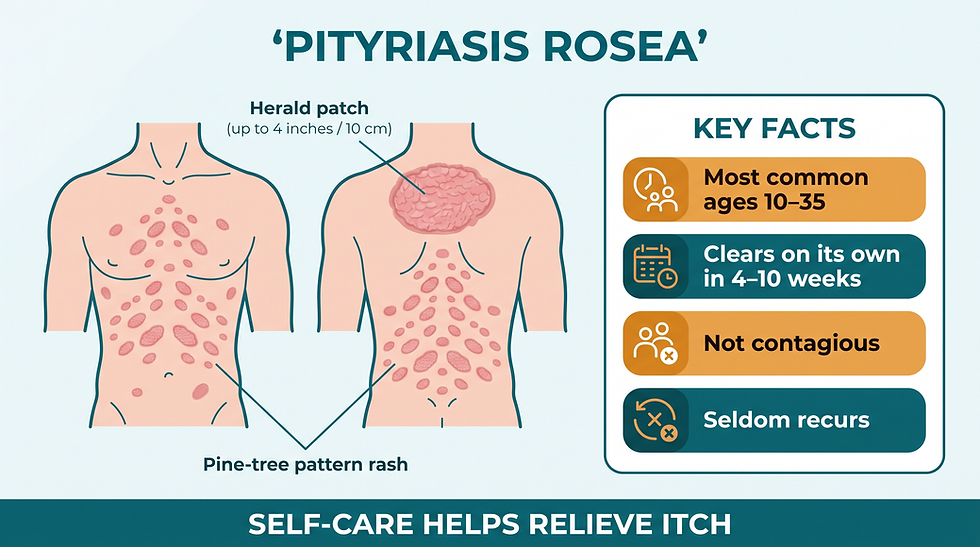
A few days to a few weeks after the herald patch appears, smaller bumps or scaly spots spread across the face, back, chest, or abdomen. These spots sweep outward from the middle of the body in a shape that looks like drooping pine-tree branches. The rash can be itchy.
The rash persists for several weeks but heals without scarring. Importantly, pityriasis rosea is not contagious, and it seldom comes back.
What Does Pityriasis Rosea Look Like?
The rash follows a recognizable two-phase pattern that helps distinguish it from other common rashes.
Phase | Timing | What You See |
Herald patch | First | One large, oval, slightly raised, scaly patch, up to 4 inches (10 cm) across, usually on the face, back, chest, or abdomen |
Pine-tree rash | Days to weeks later | Smaller bumps or scaly spots sweeping out from the middle of the body in a drooping-branch pattern |
Some people experience mild symptoms even before the herald patch appears, including headache, fatigue, fever, or a sore throat.
When Should You See a Doctor?
Pityriasis rosea usually resolves on its own, but it can look similar to other skin conditions that do need attention.
See your healthcare provider if the rash gets worse or has not cleared up within three months.
Symptom Pattern | What It Suggests |
Oval herald patch followed by a spreading pine-tree rash | Classic pityriasis rosea pattern |
Rash that worsens or lasts beyond 3 months | Needs evaluation to rule out other conditions |
Severe itching that disrupts daily life | Treatment can relieve symptoms |
Temporary dark or light skin spots after healing | A possible complication, more common in brown or Black skin |
What Causes Pityriasis Rosea?
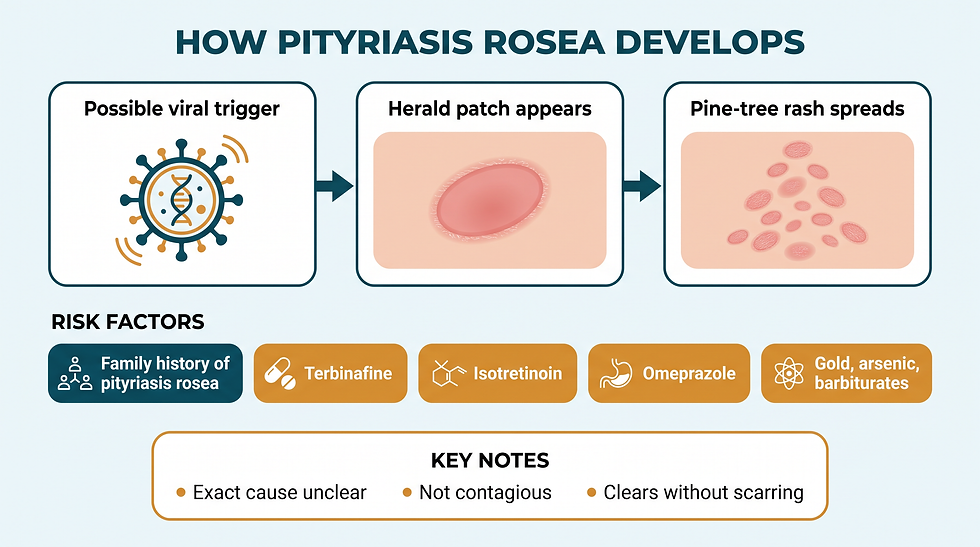
The exact cause of pityriasis rosea is unclear. It might be triggered by an infection with a virus, particularly by certain strains of the herpes virus. However, it is not related to the herpes virus that causes cold sores.
One reassuring point: pityriasis rosea is not contagious, so you cannot pass it to others.
Who Is at Higher Risk?
Two factors are associated with an increased chance of developing pityriasis rosea.
Risk Factor | Why It Matters |
Family history | Having family members with pityriasis rosea increases your risk |
Certain medicines | Terbinafine, isotretinoin, omeprazole, gold, arsenic, and barbiturates may raise risk |
What Are the Possible Complications?
Complications of pityriasis rosea are not likely. When they do occur, they are generally temporary.
Possible Complication | Details |
Severe itching | Can be uncomfortable enough to seek treatment |
Temporary skin color changes | Spots lasting weeks to months that are darker (hyperpigmentation) or lighter (hypopigmentation) than usual — more likely in people with brown or Black skin |
How Is Pityriasis Rosea Diagnosed?
In most cases, a healthcare provider can identify pityriasis rosea simply by looking at the rash.
If the rash is hard to distinguish from other similar rashes, your provider might use one of these tests.
Diagnostic Step | What It Involves |
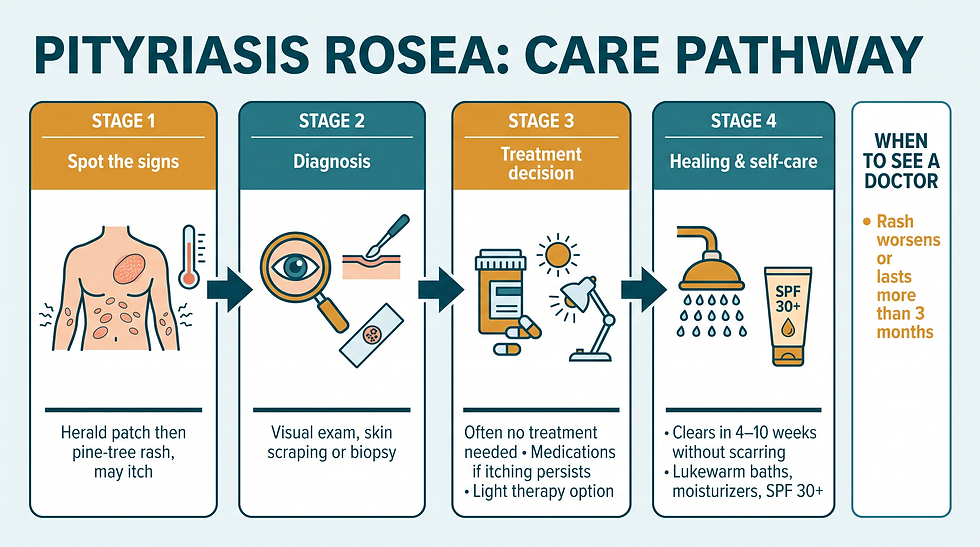
Visual examination | The rash's herald patch and pine-tree pattern often identify the condition |
Skin scraping | Gently collecting surface material from the rash for examination |
Skin biopsy | Taking a small piece of the rash for laboratory testing to rule out similar rashes |
How Is Pityriasis Rosea Treated?
Pityriasis rosea usually goes away on its own without treatment in 4 to 10 weeks. If the rash has not disappeared by then, or if the itching bothers you, talk with your healthcare provider about treatments. The condition clears up without scarring and usually does not come back.
Medications
If home remedies do not ease symptoms or shorten the duration of pityriasis rosea, your provider might prescribe medicine.
Medication Type | How It Helps |
Corticosteroids | Reduce inflammation and ease itching |
Antihistamines | Block itch signals; available both nonprescription and prescription |
Light Therapy
Your healthcare provider might also suggest light therapy. In this treatment, you are exposed to natural or artificial light that may ease your symptoms. One consideration: light therapy may cause lasting spots of skin that are darker than usual, even after the rash clears.
What Self-Care Helps the Most?
Simple home measures can significantly relieve the discomfort of pityriasis rosea.
Self-Care Step | How to Do It |
Nonprescription antihistamines | Over-the-counter allergy medicine such as diphenhydramine can reduce itching |
Lukewarm baths | Bathe or shower in lukewarm water; sprinkle bath water with an oatmeal-based bath product |
Moisturizers and lotions | Apply a moisturizer, calamine lotion, or a nonprescription corticosteroid cream |
Sun protection | Apply broad-spectrum sunscreen with SPF 30 or higher, even on cloudy days; reapply every two hours, or more often when swimming or perspiring |
Will It Go Away? What to Expect
The outlook for pityriasis rosea is very good. The rash clears on its own in 4 to 10 weeks for most people, leaves no scars, and usually does not recur. Treatment is aimed at comfort rather than cure, since the body heals the rash itself.
Conclusion
Pityriasis rosea is a self-limiting rash known for its distinctive herald patch and pine-tree pattern. Because it is not contagious and typically resolves within weeks, most people manage it comfortably with self-care alone. If the rash worsens, persists past three months, or the itching becomes severe, a healthcare provider can confirm the diagnosis and offer treatments that speed your relief.
Have an unexplained rash that is not clearing? Book an appointment with a dermatologist to confirm what it is and get a personalized care plan — starting with the self-care steps outlined above.
Frequently Asked Questions
How long does pityriasis rosea last?
Pityriasis rosea usually goes away on its own without treatment in 4 to 10 weeks, and it clears without scarring.
Is pityriasis rosea contagious?
No. Pityriasis rosea is not contagious, even though it may be triggered by a virus.
What is a herald patch?
The herald patch is the large, oval, slightly raised, scaly first spot of pityriasis rosea, often up to 4 inches (10 centimeters) across, appearing on the face, back, chest, or abdomen.
Why is the rash called a pine-tree pattern?
Smaller spots sweep outward from the middle of the body in a shape that resembles drooping pine-tree branches.
Can pityriasis rosea come back?
Recurrence is rare. The rash usually does not come back once it has cleared.
Does pityriasis rosea leave scars or permanent marks?
It heals without scarring. Some people, especially those with brown or Black skin, may notice temporary darker or lighter spots that can last weeks to months.
What medicines treat pityriasis rosea?
Healthcare providers may prescribe corticosteroids or antihistamines if home remedies do not ease symptoms, and light therapy is another option for persistent cases.
When should I see a doctor about the rash?
See your healthcare provider if the rash gets worse or has not cleared up in three months.
References
Disclaimer: This article is for general educational purposes only and is not a substitute for professional medical advice. Always consult a qualified health care provider for diagnosis and treatment.
Comments