Pilocytic Astrocytoma: Symptoms, Causes, Treatment

Updated: 2 days ago
Medically reviewed by Dr. Baraa Alnahhal, MD · Last reviewed: September 2026
TL;DR
Pilocytic astrocytoma (py-loh-SIT-ik as-troh-sih-TOH-muh) is a slow-growing, usually benign brain tumor that most often affects children and teens. It is a WHO grade 1 tumor — the least aggressive class of brain tumors — and it is the most common glioma (brain tumor starting in supportive glial cells) in children. Surgery to remove the tumor is usually the first and often the only treatment needed, and the overall outlook is usually very good, especially when the tumor is found early and fully removed.
Quick Answer
What is a pilocytic astrocytoma? It is a slow-growing brain tumor that usually develops in children and teens. Most are benign (noncancerous), classified as WHO grade 1, and often develop in the cerebellum — the part of the brain that controls movement and balance.
Symptoms develop gradually over weeks or months and depend on tumor location: morning headaches, nausea, balance problems, blurred or double vision, and behavior changes are most common.
The exact cause is unknown, but many tumors are linked to gene changes in the MAPK pathway, a system that controls how brain cells grow and divide.
Key risk factors include neurofibromatosis type 1 (NF1), rare inherited syndromes (Li-Fraumeni syndrome, tuberous sclerosis), childhood age, and radiation exposure to the head as a child.
Diagnosis centers on a brain MRI scan with contrast (the gold standard), with CT used when MRI isn't possible, and a biopsy to confirm and grade the tumor. These tumors are not staged like many cancers.
Surgery is the main treatment. When the tumor can be completely removed — which is often possible because it has clear, well-defined borders — no further treatment is usually needed.
For hard-to-reach tumors (near the brainstem, optic nerves, or hypothalamus), options include watchful waiting, chemotherapy, radiation therapy, and newer targeted drugs (BRAF/MEK inhibitors) for tumors with BRAF gene changes.
The prognosis is usually very good. Most people can live full, active lives with proper treatment and follow-up, though tumors can sometimes return and need ongoing monitoring.
What Is Pilocytic Astrocytoma?
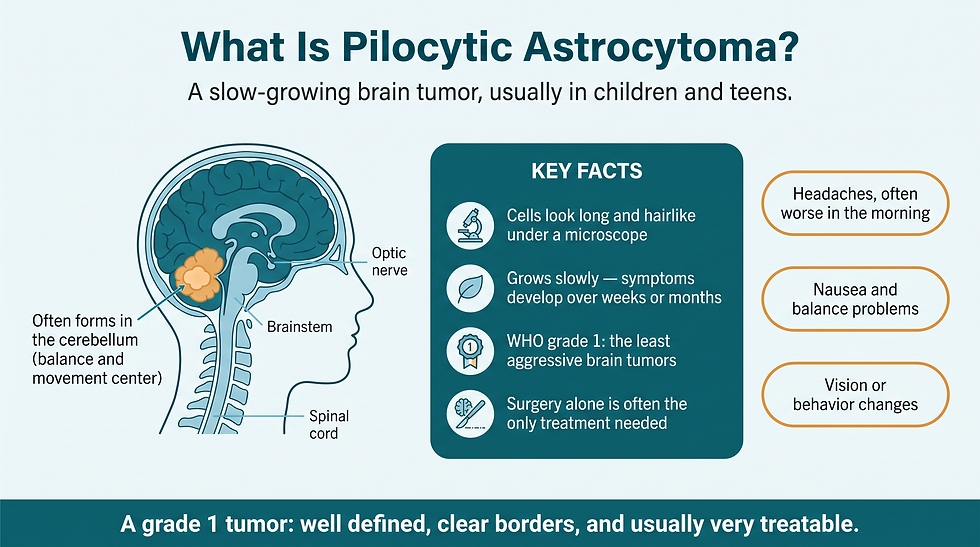
Pilocytic astrocytoma is a slow-growing brain tumor that usually affects children and teens. The name describes what the tumor looks like under a microscope. "Pilocytic" refers to the cells' long, hairlike shape, and "astrocytoma" means the tumor starts in astrocytes — star-shaped brain cells that support and protect nerve cells. Astrocytes help keep the brain working smoothly by managing chemicals, fluids, and waste, and by supporting communication between neurons.
These tumors belong to a broader group of brain tumors called gliomas, which begin in glial cells — the supportive cells of the brain. Pilocytic astrocytoma is the most common type of glioma in children.
The tumor most often develops in the cerebellum, the area at the back of the brain that controls movement and balance. However, it can also appear in the optic nerve, brainstem, spinal cord, and other parts of the brain.
Most pilocytic astrocytomas are noncancerous, also called benign. The World Health Organization (WHO) classifies them as grade 1 tumors — the least aggressive category of brain tumors. A grade 1 rating means the tumor grows slowly, is well defined with clear borders, has a low risk of spreading, and often responds well to surgery alone.
Grade 1 tumors: grow slowly, have clear borders, carry a low risk of spreading, and often respond well to just surgery without additional treatment.
You may see this tumor referred to by its older name, juvenile pilocytic astrocytoma (JPA), because it is more common in children. The current medical term, pilocytic astrocytoma, now applies to both adults and children.
Pilocytic Astrocytoma Symptoms
Symptoms vary depending on the tumor's size and where it is growing in the brain. Because these tumors grow slowly, symptoms may develop over weeks or months and gradually worsen over time. Most of the signs are caused by increased pressure in the brain or by the tumor pressing on nearby structures.
One important detail for families: symptoms in children are usually not different from symptoms in adults. The location of the tumor — not age — determines the type of symptoms. That said, children with tumors near the cerebellum or brainstem may show signs earlier, because those areas control balance, coordination, and vital functions.
Physical symptoms
Symptom | What to look for |
Headache | Often worse in the morning; may change with position |
Nausea and vomiting | Can occur alongside morning headaches |
Balance or coordination problems | Unsteadiness, clumsiness, stumbling |
Vision changes | Blurred vision or double vision |
Weakness | In the arms or legs |
Hormone-related symptoms
When the tumor sits near the hypothalamus or pituitary gland, it can disrupt hormone signals and affect growth or puberty:
Symptom | Description |
Hormone changes | Disrupted signals affecting growth or puberty |
Delayed or early puberty | Starting puberty earlier or later than expected |
Slowed growth | Failing to grow as expected |
Cognitive and mood-related symptoms
Behavioral and emotional changes are common, and in young children they are sometimes mistaken for behavioral or developmental issues:
Changes in behavior or personality
Difficulty with memory or thinking clearly
Mood swings or emotional changes, such as irritability or sadness
Other neurological symptoms
Symptom | Note |
Seizures | Less common with pilocytic astrocytomas than with other brain tumors |
Speech difficulties | Trouble with speech or understanding language |
New movement problems | Clumsiness or stumbling that is new for the person |
When to see a doctor
Persistent headaches — especially ones that are worse in the morning — deserve a medical evaluation. Seek care promptly if you or your child experiences any of the following lasting signs:
Headaches that worsen over weeks or months
Unexplained nausea or vomiting
New balance or coordination problems
Blurred or double vision
New weakness in the arms or legs
Changes in behavior, personality, mood, or school performance
Seizures
What Causes Pilocytic Astrocytoma?
The exact cause of pilocytic astrocytomas is not known, and most of these tumors happen without a known trigger. However, scientists have identified certain factors in genes and the environment that may play a role in how these tumors grow.
Many pilocytic astrocytomas are linked to changes in the mitogen-activated protein kinase (MAPK) pathway. This pathway is a cellular communication system that controls how cells grow and divide. When it changes, it can trigger growth signals in brain cells and lead to tumor growth.
It is worth knowing what does not appear to cause these tumors. At this time, there is no proven link between pilocytic astrocytomas and environmental factors such as cellphone use, diet, or chemical exposure.

Risk Factors
While experts don't know exactly what causes pilocytic astrocytoma, researchers have found several risk factors that may raise the chances of developing this kind of tumor.
Risk factor | What it means |
Neurofibromatosis type 1 (NF1) | The most well-known inherited risk factor; tumors more likely near the eyes and hypothalamus |
Li-Fraumeni syndrome | A rare inherited syndrome that raises risk |
Tuberous sclerosis | A rare inherited syndrome that raises risk |
Age | Most common in children and teens; rare in adults, and may be more aggressive in older people |
Childhood head radiation | Radiation exposure to the head during childhood cancer treatment may raise risk |
Occupational associations | Slightly higher rate among farming and petroleum workers, though this link is not well understood |
How Is Pilocytic Astrocytoma Diagnosed?
Pilocytic astrocytoma is usually diagnosed through a combination of methods. A healthcare professional typically starts by reviewing symptoms, performing a physical exam, and taking a medical history. Imaging tests then confirm the picture.
One distinctive feature of these tumors: they are not classified by stages the way many cancers are. Instead, a biopsy sample is graded (and pilocytic astrocytomas are grade 1), so staging is not part of the diagnosis.
Diagnostic step | What happens |
Symptom review, physical exam, and medical history | The starting point for any brain tumor evaluation |
Brain MRI with contrast | The gold standard — gives a clear picture of the tumor and its features |
CT scan | Used when an MRI scan isn't possible |
Biopsy | A surgical procedure removes a sample of the tumor, which is studied under a microscope in a lab to diagnose and grade it |
Diagnosis in children
In children, the tumor often develops in the cerebellum. If symptoms point to a brain tumor, a brain scan can quickly help confirm the diagnosis — especially when typical signs appear on MRI, such as a fluid-filled area with a small bump.
Diagnosis can be especially tricky in very young children, where early symptoms may be subtle or mistaken for behavioral or developmental issues.
Diagnosis in adults
In adults, pilocytic astrocytoma is relatively rare and harder to recognize. Adults are less likely to show the classic imaging features seen in children, and the tumor may be mistaken for a more aggressive brain tumor. Misdiagnosis is more likely to happen in adults than in children — a reason why seeing specialists who regularly treat brain tumors matters.
Treatment Options for Pilocytic Astrocytoma
Surgery is usually the first — and often the only — treatment needed for pilocytic astrocytoma, especially when the tumor can be completely removed. These tumors usually stay in one area, don't grow into the healthy brain around them, and have clearly defined edges, which makes them easier to remove surgically.
Sometimes the tumor grows in hard-to-reach areas, such as near the brainstem, optic nerves, or hypothalamus. In these cases, removing the entire tumor could cause damage and affect important brain functions. When that happens, the care team may suggest additional or alternative approaches.
Treatment | When it is used |
Surgery | First and often only treatment when the tumor can be completely removed |
Watching and waiting | When remaining tumor isn't growing or causing problems; monitored with regular MRI scans |
Chemotherapy | Medicines that stop or slow tumor growth; children may receive this instead of radiation when possible |
Targeted therapy | Used when testing shows a genetic change, such as a BRAF gene change; newer drugs block the tumor's growth signals |
Radiation therapy | Used if other treatments don't work, especially in older people; used more carefully in children because of long-term side effects |
Radiation therapy deserves special mention for families of young patients. It is used more carefully in children because it can cause long-term side effects, including memory problems, difficulty with attention or learning, and hormone changes that affect growth or puberty.
Even when surgery isn't possible or the tumor can't be fully removed, these other treatments often help manage symptoms, improve quality of life, and slow or stop tumor growth.
Targeted therapy: the newest option
Some pilocytic astrocytomas carry a genetic change in a gene called the BRAF gene, which helps control cell growth. When this gene is altered — especially in a form called BRAFV600E — it can cause tumors to grow. Newer drugs called BRAF or MEK inhibitors are designed to block this signal and may help slow or stop tumor growth.
Two of these drugs, dabrafenib and trametinib, are approved for children over age 1 with low-grade gliomas that have a BRAFV600E gene change. Pilocytic astrocytoma is one of the tumor types that may carry this alteration. These medicines are often used together as a combination therapy.
These drugs aren't usually the first treatment for pilocytic astrocytoma. They may be considered when surgery isn't possible or if the tumor grows back. As researchers continue to study how these tumors grow, targeted drugs may become a more common part of care in the future.

Prognosis and Long-Term Outlook
The outlook, called the prognosis, and survival rates for pilocytic astrocytoma are usually very good, especially when the tumor can be completely removed with surgery. These tumors grow slowly and usually don't spread to other parts of the brain or body.
If the entire tumor is removed, most people don't need any more treatment and remain healthy for years. Sometimes the tumor can return or start growing again — called tumor recurrence. Even when that happens, the tumor often grows slowly, and treatments such as chemotherapy, radiation therapy, or targeted drugs may help keep it under control.
Factor | How it affects the outlook |
Tumor location | Deep brain tumors are harder to remove and more likely to come back |
Age at diagnosis | Most children do very well; younger children may have a slightly higher risk of recurrence after surgery |
Genetic makeup | Tumors with BRAFV600E or KIAA1549-BRAF fusion changes may respond better to targeted therapies |
The prognosis is especially good in children when the tumor is in the cerebellum and can be completely removed. In adults, the tumors are less common, may be harder to diagnose early, and may behave differently — sometimes coming back or being more difficult to treat. Adults are also less likely to show the genetic features that help guide targeted therapy.
With proper treatment and follow-up, most people with pilocytic astrocytomas can live full, active lives.
Coping and Support
A brain tumor diagnosis can be overwhelming and frightening, and it is normal to feel like you have little control over your health. Three steps can help you cope:
Learn enough to make decisions about care. Ask your healthcare team about your specific type of brain tumor, your treatment options, and your prognosis if you want to know more. As you learn more about brain tumors, you may become more confident in making treatment decisions.
Keep friends and family close. Strong relationships provide practical support — such as help caring for your home during hospital stays — and emotional support when the diagnosis feels overwhelming.
Find someone to talk with. A good listener — a friend, family member, counselor, medical social worker, clergy member, or a cancer support group — can make a real difference. Ask your healthcare team about local support groups, or connect with others online through organizations such as the National Brain Tumor Society.
Preparing for Your Appointment
See your usual healthcare professional if you have any signs or symptoms that worry you. After a pilocytic astrocytoma diagnosis, you may be referred to specialists:
Specialist | Role |
Neurologist | Doctor who specializes in brain and nervous system conditions |
Neurosurgeon | Surgeon who operates on the brain and nervous system |
Neuro-oncologist | Doctor who specializes in nervous system cancers |
Medical oncologist | Doctor who treats cancer with medicines |
Radiation oncologist | Doctor who uses radiation to treat cancer |
Rehabilitation specialist | Helps restore function and quality of life |
Brain tumor treatment is complex, and few hospitals are used to caring for many people with brain tumors. If you don't feel comfortable with the care at your local facility, consider seeking a second opinion at a more experienced cancer center.
What you can do
Be aware of pre-appointment restrictions. Ask if there is anything you need to do in advance, such as restricting your diet.
Write down your symptoms and how long you have had them.
List your key medical information, including all conditions and every medicine you take — prescription and over-the-counter — plus vitamins and supplements with doses.
Take a family member or friend along. It can be hard to remember everything during an appointment, and a companion may catch details you miss.
Write down questions to ask your healthcare professional.
Questions to ask
At your first appointment: What may be causing my symptoms? Are there other possible causes? What tests do I need, and do they require special preparation? What are the next steps in learning about the diagnosis and treatment? Should I see a specialist?
At specialist appointments: What type of brain tumor do I have? Where is it located? How large is it? How aggressive is it? Is it cancerous? Will I need more tests? What are my treatment options? Can any treatments cure it?
Conclusion
Pilocytic astrocytoma is the most common glioma in children — and one of the most treatable brain tumors. It grows slowly, usually has clear borders, and in most cases surgery alone is enough. When the tumor sits in a hard-to-reach spot, today's options — from watchful waiting to chemotherapy, radiation, and BRAF-targeted drugs — offer real ways to keep it under control. If you or your child has persistent headaches, balance problems, vision changes, or unexplained behavioral changes, a brain MRI can help find out why.
Talk to your healthcare professional about any symptoms that concern you. Early evaluation is the single best step toward the very good outlook these tumors usually offer.
Frequently Asked Questions
Is pilocytic astrocytoma a type of brain cancer?
Most pilocytic astrocytomas are noncancerous (benign). They are classified as WHO grade 1 tumors — the least aggressive brain tumors — which grow slowly, have clear borders, and rarely spread.
Is pilocytic astrocytoma curable?
When the tumor can be completely removed with surgery, most people need no further treatment and remain healthy for years. While tumors can sometimes return, they usually grow slowly and can often be controlled with additional treatment.
What are the first symptoms of pilocytic astrocytoma?
The earliest signs often include headaches (especially worse in the morning), nausea, balance or coordination problems, blurred or double vision, and changes in behavior or personality. Symptoms develop gradually over weeks or months.
What age does pilocytic astrocytoma usually occur?
It most commonly affects children and teens, and it is the most common glioma in children. Adults can develop it, though this is rare, and tumors in older people may be more aggressive.
Can pilocytic astrocytoma cause seizures?
Yes, but seizures are less common with pilocytic astrocytomas than with other brain tumors. Other neurological symptoms can include speech difficulties and new problems with movement or coordination.
What does WHO grade 1 mean for a brain tumor?
Grade 1 means the tumor is the least aggressive type: it grows slowly, is well defined with clear borders, has a low risk of spreading, and often responds well to surgery alone.
How is pilocytic astrocytoma different from other brain tumors?
These tumors typically stay in one area, don't invade surrounding healthy brain tissue, have clearly defined edges that make surgery easier, and are not staged like many other cancers. They are graded (grade 1) through a biopsy instead.
What happens if the tumor can't be fully removed?
For tumors in hard-to-reach areas, options include watching and waiting with regular MRI scans, chemotherapy, radiation therapy, and targeted drugs. These treatments often help manage symptoms and slow or stop tumor growth.
Do children need radiation for pilocytic astrocytoma?
Chemotherapy may be used instead of radiation for children when possible. Radiation is used more carefully in children because it can cause long-term side effects affecting memory, attention, learning, and growth hormones.
Is pilocytic astrocytoma hereditary?
The tumor itself is not passed down, but certain inherited conditions raise the risk. Neurofibromatosis type 1 (NF1) is the most well-known risk factor, and rare syndromes like Li-Fraumeni syndrome and tuberous sclerosis also increase risk.
Sources
Symptoms & causes — Pilocytic astrocytoma: https://www.mayoclinic.org/diseases-conditions/pilocytic-astrocytoma/symptoms-causes/syc-20587366
Diagnosis & treatment — Pilocytic astrocytoma: https://www.mayoclinic.org/diseases-conditions/pilocytic-astrocytoma/diagnosis-treatment/drc-20587388
Childhood astrocytomas, other gliomas, and glioneuronal/neuronal tumors treatment (PDQ) — Health professional version: https://www.cancer.gov/types/brain/hp/child-astrocytoma-glioma-treatment-pdq
Astrocytoma tumors — American Association of Neurological Surgeons: https://www.aans.org/en/Patients/Neurosurgical-Conditions-and-Treatments/Astrocytoma-Tumors
FDA approval summary: Dabrafenib in combination with trametinib for BRAFV600E mutation-positive low-grade glioma — Clinical Cancer Research: https://doi.org/10.1158/1078-0432.CCR-23-1503
The 2021 WHO classification of tumors of the central nervous system: A summary — Neuro-Oncology: https://doi.org/10.1093/neuonc/noab106
Pilocytic astrocytoma: A review of general, clinical, and molecular characteristics — Journal of Child Neurology: https://doi.org/10.1177/0883073820937225
Disclaimer: This article is for educational purposes only and is not a substitute for professional medical advice, diagnosis, or treatment. Always seek the advice of a qualified healthcare provider with any questions about a medical condition.
Comments