Pemphigus: Symptoms, Causes & Treatment — A Clear Guide to a Rare Blistering Skin Disorder

Updated: 2 days ago
Medically reviewed by Dr. Baraa Alnahhal, MD · Last reviewed: September 2026
Pemphigus: Symptoms, Causes, and Treatment — A Clear Guide to a Rare Blistering Skin Disorder
TL;DR
Pemphigus is a group of rare autoimmune skin disorders that cause fragile blisters and sores on the skin or on mucous membranes such as the mouth and genitals. The most common type, pemphigus vulgaris, usually begins with painful mouth sores and spreads to the skin; a second type, pemphigus foliaceus, causes crusty blisters on the face, scalp, chest, and back. It most often affects people who are middle-aged or older and it is not contagious. Diagnosis requires a skin biopsy and antibody blood tests, usually through a dermatologist. Treatment centers on corticosteroids and immune-system-targeting medicines, and early treatment makes the condition much easier to control — though care often takes years and may require long-term medicine.
Quick Answer: What Is Pemphigus?
Pemphigus is a rare autoimmune disorder — the immune system mistakenly attacks healthy cells in the skin and mucous membranes, causing fragile blisters and open sores.
It is not contagious and cannot be passed from one person to another.
Pemphigus vulgaris, the most common type, typically starts with painful blisters in the mouth, then appears on the skin or genital mucous membranes.
Pemphigus foliaceus causes crusty, itchy, or painful blisters on the face, scalp, chest, back, and shoulders, and usually does not affect the mouth.
It most often affects people who are middle-aged or older, and is more common in people of Jewish, Indian, southeast European, or Middle Eastern ancestry.
Diagnosis is confirmed with a skin biopsy and blood tests that detect pemphigus antibodies; a dermatologist usually manages care.
Most people improve with treatment, especially when it is started early, but care may take years and often involves long-term medicine.
Figure 1: Pemphigus in one view — how the immune mistake creates fragile blisters, and who is most affected.
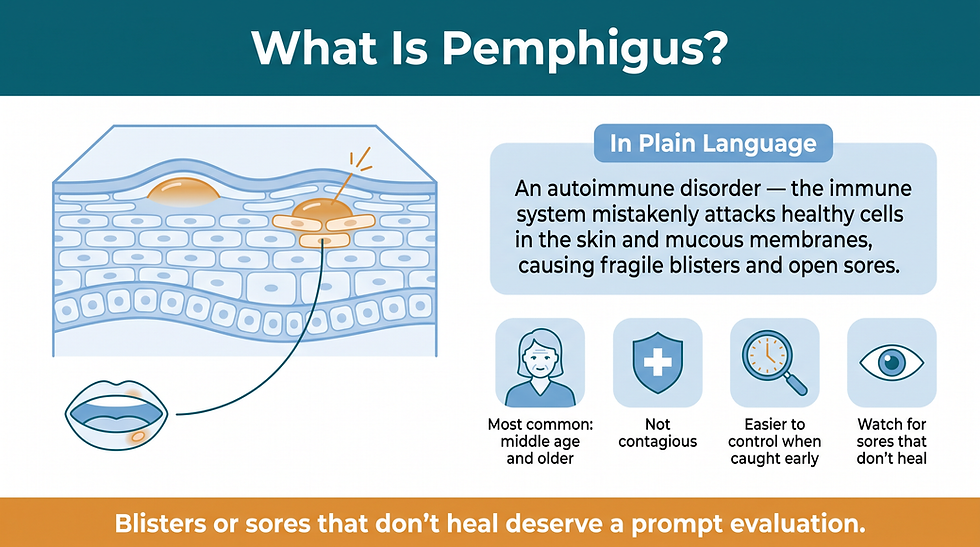
What Is Pemphigus?
Pemphigus (PEM-fig-us) is a group of rare skin disorders that cause blisters and sores on the skin or on mucous membranes — the moist inner linings of the body, including the mouth and the genitals. In every form of pemphigus, the problem is the same at its root: the immune system, which normally defends the body against germs, mistakenly attacks healthy cells in the skin and mucous membranes instead.
Because it is an autoimmune disorder — a condition in which the immune system targets the body's own tissues — pemphigus is a medical condition, not an allergy, infection, or hygiene problem. It is also not contagious. No one can catch it from another person, and no one gives it to anyone else.
Autoimmune disorder: a condition in which the immune system mistakenly attacks healthy cells and tissues instead of only attacking germs and foreign invaders.
There are two main types, and they behave quite differently:
| Type | Where it starts | How the sores behave | Mouth involvement | |---|---|---|---| | Pemphigus vulgaris (most common) | Usually begins with blisters in the mouth, then appears on the skin or genital mucous membranes | Sores are often painful but do not itch; mouth and throat blisters may make it hard to talk, drink, or eat | Yes — mouth blisters are usually the first sign | | Pemphigus foliaceus | Blisters usually begin on the face and scalp, later spreading to the chest and back | Blisters may be itchy or painful; they are crusty | No — does not usually affect mucous membranes |
Both types are seen most often in people who are middle-aged or older. The condition is easier to control when it is caught and treated early, and it is usually treated with long-term medicines. Sores may heal slowly, or in some cases may not heal at all, which is another reason early evaluation matters.
What Are the Symptoms of Pemphigus?
The hallmark symptom of every pemphigus type is blisters on the skin and mucous membranes. These blisters are fragile — they break easily, leaving open sores that may become infected and ooze. Because the sores are open wounds, they can become a doorway for infection, which is the complication that can make pemphigus life-threatening if left untreated.
The pattern of symptoms depends on the type:
| Symptom | Pemphigus vulgaris | Pemphigus foliaceus | |---|---|---| | Mouth sores | Usually the first sign; sores can make talking, drinking, and eating difficult | No — mouth is usually not affected | | Skin blisters | Appear after the mouth, or on the skin and genital mucous membranes | Begin on face and scalp, later spread to chest and back | | Pain or itch | Sores are often painful but do not itch | Blisters may be itchy or painful | | Appearance | Fragile blisters that break easily into open sores | Crusty sores |
Painful mouth blisters deserve special attention, because they can quietly interfere with eating and drinking long before anyone suspects a skin disorder.
When to See a Doctor
The guidance is simple: see a healthcare professional if blisters don't heal — in the mouth, on the skin, or on the genital mucous membranes. A blister that breaks, re-forms, and never fully heals is not a normal skin complaint, and it is the exact situation where prompt evaluation changes the outcome.
Because many mouth sores are harmless and short-lived, one sore that heals within a week or two is usually not a concern. The situation that warrants attention is persistence and recurrence.
What Causes Pemphigus?
Pemphigus is an autoimmune disorder. In plain terms, the immune system's antibodies — the proteins designed to attack germs — mistakenly target the body's own cells in the skin and mucous membranes instead. That attack weakens the connections between skin cells, and fragile blisters form and break open.
In most cases, the exact cause of that autoimmune onset is unknown — no lifestyle factor, diet, or environmental exposure has been shown to cause pemphigus.
There is one important exception to keep in mind: rarely, pemphigus develops as a side effect of certain medicines, most notably penicillamine and certain blood pressure drugs. When this happens, symptoms usually clear up once the medicine is stopped. This is why a complete medicine list — including prescriptions, over-the-counter drugs, and supplements — matters at the first appointment.
Figure 2: How antibodies attack healthy skin cells, and which factors raise the likelihood of pemphigus.

Who Is Most at Risk?
Pemphigus is rare, and the strongest risk factors relate to age and ancestry rather than behavior or lifestyle.
| Risk factor | What it means | |---|---| | Age | Most common in people who are middle-aged or older | | Ancestry | More common in people of Jewish, Indian, southeast European, or Middle Eastern ancestry | | Certain medicines (rare) | Penicillamine and certain blood pressure drugs can trigger pemphigus; symptoms usually clear when the medicine is stopped | | Unknown trigger | In most cases, what sets off the autoimmune attack is never identified |
What Complications Can Pemphigus Cause?
The most important thing to understand about pemphigus complications is that the open sores are the gateway. Broken skin and mouth sores let bacteria in, and an untreated skin infection can spread to the bloodstream — a life-threatening emergency called sepsis.
| Complication | What happens | |---|---| | Skin infection | Open sores may become infected and ooze | | Sepsis | An infection that spreads to the bloodstream — life-threatening | | Scarring and skin color changes | Healed sores may leave scars or dark areas (hyperpigmentation — skin darkens) or light areas (hypopigmentation — skin loses color); people with brown or Black skin face a higher long-term risk of skin color changes | | Malnutrition | Painful mouth sores can make eating difficult, leading to poor nutrition | | Medicine side effects | Treatment medicines can cause their own problems, including high blood pressure and an increased risk of infection | | Death (rare) | Certain types can be fatal if left untreated |
The honest picture is serious, but the practical takeaway is empowering: complications are mostly preventable with proper wound care, early treatment, and infection awareness.
How Is Pemphigus Diagnosed?
Diagnosis begins with a conversation — a healthcare professional reviews the medical history, discusses the symptoms, and examines the affected area. Because pemphigus is rare and its blisters can look like many common skin conditions, specialist involvement is the rule, not the exception: patients are typically referred to a dermatologist, a doctor who specializes in skin conditions.
Three pieces of evidence confirm the diagnosis:
| Diagnostic step | What it involves | What it shows | |---|---|---| | Medical history and exam | Discussion of symptoms, medicines, and their duration; examination of the affected area | Whether the blisters match a pemphigus pattern | | Skin biopsy | A small piece of the blister is removed and tested in a lab | The cell-level pattern that confirms which type of pemphigus | | Blood tests | A blood sample is tested in a lab | Antibodies known to be present with pemphigus are detected and identified |
The biopsy and antibody blood tests work together: the biopsy shows what the tissue damage looks like, and the blood tests identify the specific antibodies driving it. That combination is what separates pemphigus from look-alike conditions such as bullous pemphigoid — another blistering skin disorder that affects older adults and is a different disease.
How Is Pemphigus Treated?
Treatment starts with medicines to ease symptoms and prevent new blisters. The two workhorses are corticosteroids (steroids) and immune-system-targeting medicines. If symptoms were caused by a particular medicine, stopping that medicine may clear the symptoms entirely. Some people need a hospital stay for fluids, nutrition, or other treatments.
Corticosteroids
For mild disease, a cream or injections may be enough. The main treatment, however, is often an oral corticosteroid — most commonly prednisone pills.
Steroids are effective but demanding over the long run. Long-term use, or high doses, can cause severe side effects, including diabetes, bone loss, an increased risk of infection, stomach ulcers, and a fat shift that creates a round "moon face." For that reason, the usual strategy is to use steroids short-term for flare-ups, and to rely on other immune-targeting medicines for long-term control.
Immune-System-Targeting Medicines
These medicines stop the immune system from attacking healthy tissues, addressing the root mistake rather than just the symptoms. The main options include azathioprine (Imuran, Azasan), mycophenolate (CellCept), and cyclophosphamide. Their significant side effects include an increased risk of infection, which is why regular monitoring is part of care.
Other Medicines
If first-line treatment is not helping enough, other options exist: dapsone, intravenous immunoglobulin, and rituximab-pvvr (Ruxience). Antibiotics are added if any sores become infected.
How the Options Compare
| Situation | Typical approach | |---|---| | Mild disease | Cream or injections may be enough | | Standard case | Oral corticosteroids (e.g., prednisone) short-term for flare-ups | | Long-term control | Immune-system medicines (azathioprine, mycophenolate, or cyclophosphamide) | | First-line not helping | Dapsone, intravenous immunoglobulin, or rituximab | | Infected sores | Antibiotics | | Medicine-triggered pemphigus | Stop the triggering medicine — symptoms usually clear | | Severe cases | Hospital stay for fluids, nutrition, or other treatments |
The outlook is genuinely hopeful: many people get better, especially if treatment is started early. The trade-off is time — improvement may take years, and many people need long-term medicine.
Figure 3: The pemphigus pathway — from unhealing blisters through biopsy and antibody tests to medicines and daily skin protection.
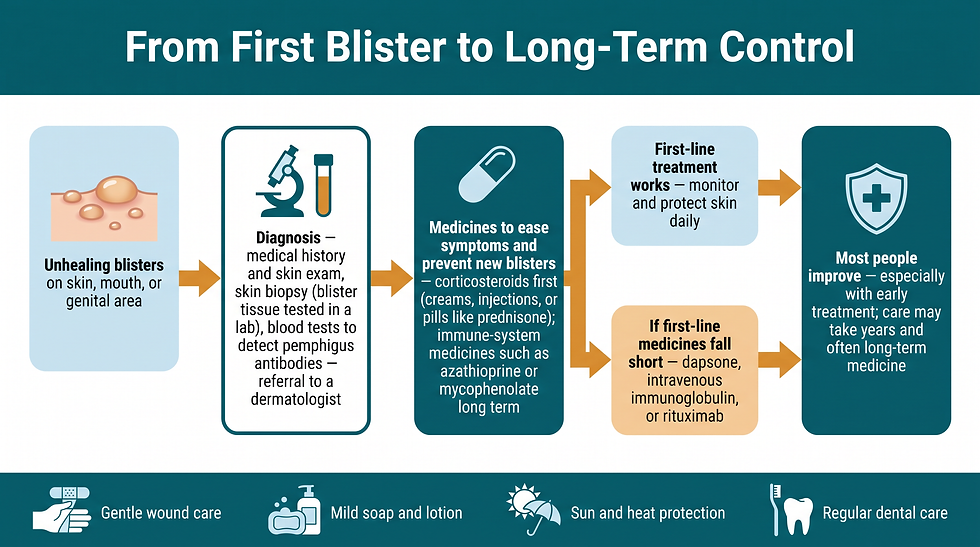
What Can People Do at Home?
Day-to-day skin care protects against the two most common complications: infection and scarring.
| Self-care step | Why it helps | |---|---| | Follow wound care instructions | Prevents infection and scarring — ask about wound care and pain control at the appointment | | Wash skin gently | Mild soap, rinse, then apply lotion keeps sores clean without irritation | | Protect the skin | Avoid activities that can hurt the skin; protect from heat and sun — even on cool, cloudy, or hazy days | | Avoid certain foods | Spicy, hot, and crunchy foods can worsen mouth blisters | | Keep up with dental care | See a dentist regularly; discuss how to care for teeth and gums with mouth sores |
Living with pemphigus can be difficult. Blisters and sores interfere with daily activities, cost sleep, and add stress. Support groups — in person or online — can help, and a healthcare professional can suggest options.
Preparing for a Pemphigus Appointment
People usually see their regular healthcare professional first, and are then referred to a dermatologist. Coming prepared makes the visit more productive.
Before the appointment, list all symptoms and how long they have lasted, note key personal information such as recent stresses or life changes, bring a list of every medicine, vitamin, and supplement with dosages, and write down questions.
Questions worth asking:
| Question | Why ask it | |---|---| | What is the most likely cause of these blisters? | Other conditions look similar — pemphigoid, drug reactions, infections | | What tests will be done, and do I need to prepare for them? | Biopsy and antibody blood tests are the standard | | What treatment do you recommend, and what are its side effects? | Sets expectations for steroids and immune medicines | | How long will healing take, and will there be scarring? | Skin color changes are common after healing, especially in brown or Black skin | | Will this come back after treatment? | Pemphigus often requires long-term management | | What can be done for pain? | Pain control is part of wound care | | How do I manage my other health conditions together with this? | Some medicines interact | | Are there generic alternatives to the prescribed medicines? | Treatment is long-term; cost matters | | Can you give me printed material or recommend websites? | Supports learning between visits |
The healthcare professional is likely to ask: when symptoms began; what seems to improve them; what self-treatment steps have been tried and whether they helped; what previous professional treatment involved, including prescription names and doses; and whether a skin biopsy has been done before.
Conclusion
Pemphigus is a rare disorder, and a rash of blisters is far more likely to be something ordinary — but blisters that refuse to heal are exactly the situation where prompt evaluation matters. Unchecked, pemphigus sores can become infected, interfere with eating, and, rarely, become life-threatening. Caught early, the condition is much easier to control, and many people improve substantially with treatment.
If you have blisters or sores in the mouth, on the skin, or on the genital area that do not heal, schedule an evaluation with a healthcare professional. Expect a skin biopsy, antibody blood tests, and a referral to a dermatologist — and expect a treatment plan built for the long term. With proper wound care, sun protection, dental follow-through, and honest conversation about medicines, most people with pemphigus regain comfortable, functional daily lives.
Frequently Asked Questions
What is pemphigus?
Pemphigus is a group of rare autoimmune skin disorders that cause fragile blisters and sores on the skin or mucous membranes such as the mouth and genitals. The immune system mistakenly attacks healthy cells in the skin, causing blisters that break easily and leave open sores.
Is pemphigus contagious?
No. Pemphigus is an autoimmune disorder, not an infection. It cannot be passed from one person to another.
What is the difference between pemphigus vulgaris and pemphigus foliaceus?
Pemphigus vulgaris, the most common type, usually begins with painful blisters in the mouth and spreads to the skin or genital mucous membranes. Pemphigus foliaceus causes crusty, itchy, or painful blisters that begin on the face and scalp and spread to the chest and back, and usually does not affect the mouth.
Is pemphigus the same as pemphigoid?
No. Pemphigoid (bullous pemphigoid) is a different blistering skin condition that also affects older adults. The two diseases are diagnosed and treated differently, which is why the skin biopsy and antibody blood tests matter.
Can pemphigus be cured?
Pemphigus is usually controlled rather than cured. Many people get better with treatment — especially when it is started early — but care often takes years, and long-term medicine is common.
What medicines treat pemphigus?
Treatment typically starts with corticosteroids (often oral prednisone), used short-term for flare-ups, combined with immune-system-targeting medicines such as azathioprine, mycophenolate, or cyclophosphamide for long-term control. If these fall short, dapsone, intravenous immunoglobulin, or rituximab may be used.
Can a medicine cause pemphigus?
Rarely, yes. Pemphigus can develop as a side effect of certain medicines, most notably penicillamine and some blood pressure drugs. In those cases, symptoms usually clear up when the medicine is stopped.
How dangerous is pemphigus?
If left untreated, certain types can be life-threatening, mainly because open sores can become infected, and infection can spread to the bloodstream (sepsis). With early diagnosis, proper wound care, and treatment, the risk drops substantially.
References
Pemphigus — Symptoms & Causes. Clinical reference page, last reviewed November 28, 2024. https://www.mayoclinic.org/diseases-conditions/pemphigus/symptoms-causes/syc-20350404
Pemphigus — Diagnosis & Treatment. Clinical reference page, last reviewed November 28, 2024. https://www.mayoclinic.org/diseases-conditions/pemphigus/diagnosis-treatment/drc-20350409
This article is for general informational purposes and is not a substitute for professional medical advice, diagnosis, or treatment. Always consult a qualified healthcare professional about any medical condition.
Comments