Pelger-Huët Anomaly: Symptoms, Causes, and Clinical Significance

Updated: 2 days ago
Medically reviewed by Dr. Baraa Alnahhal, MD · Last reviewed: September 2026
Quick Answer: What Is Pelger-Huët Anomaly?
Pelger-Huët anomaly is a rare genetic or acquired condition that changes the shape of neutrophil nuclei, often making them appear dumbbell-shaped instead of having multiple segments. The hereditary form is usually harmless and does not affect the cells' ability to fight infections. However, the acquired "pseudo" form may indicate underlying conditions like leukemia or medication side effects. Most individuals remain asymptomatic, and the condition is typically discovered during routine blood tests.
In short: Pelger-Huët Anomaly (PHA) is a rare condition affecting neutrophils, a type of white blood cell, characterized by abnormally shaped nuclei. While the hereditary form is typically harmless and asymptomatic, the acquired or "pseudo" version can signal underlying health issues like infections or bone marrow diseases. Diagnosis is made via a blood smear, and most cases require no direct treatment, though identifying the specific type is critical for overall health management.
Overview of Pelger-Huët Anomaly
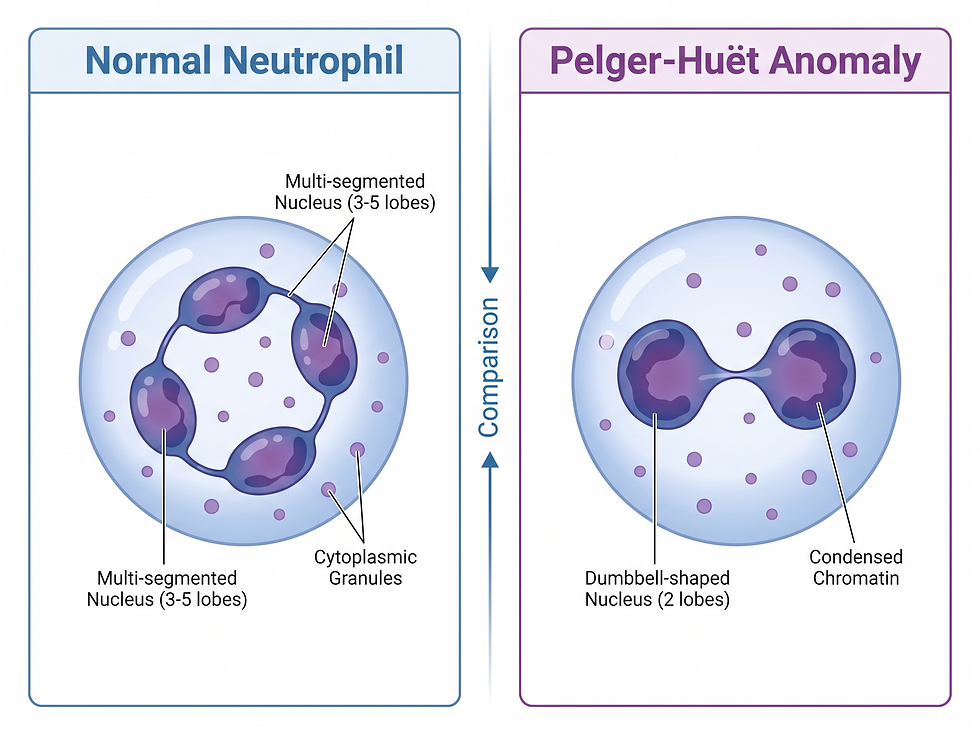
Pelger-Huët anomaly (PHA) is a rare disorder that specifically impacts neutrophils, which are essential white blood cells responsible for fighting infections. The condition is defined by a structural variation in the cell's control center, the nucleus. In a typical neutrophil, the nucleus contains three or more distinct segments. However, in those with Pelger-Huët anomaly, the nucleus usually consists of only two segments, often resembling a dumbbell or barbell.
This condition occurs due to a variation in the lamin B receptor (LBR) gene, which provides the necessary instructions for proper neutrophil development. While the structural change is distinct, the neutrophils in the hereditary form of the condition generally function normally, allowing the immune system to respond to threats effectively.
Types and Causes
The clinical significance of Pelger-Huët anomaly depends largely on whether the condition is inherited or acquired later in life.
Hereditary Pelger-Huët Anomaly (HPA)
Hereditary Pelger-Huët anomaly is a genetic condition caused by mutations in the LBR gene. This gene is responsible for proteins that maintain the shape and protection of neutrophils. When these genetic instructions are disrupted, the nuclei develop the characteristic two-segment shape. This form is inherited in an autosomal dominant pattern, meaning a child has a 50% chance of inheriting the condition if one biological parent carries the variation.
Pseudo Pelger-Huët Anomaly (PPHA)
The acquired form, known as pseudo Pelger-Huët anomaly, is not present at birth but develops due to external factors or other medical conditions. Identifying PPHA is crucial because it often serves as a clinical marker for more serious underlying issues.
Potential Causes of Pseudo Pelger-Huët Anomaly | Description |
Bone Marrow Diseases | Conditions such as myelodysplastic syndrome or acute myeloid leukemia (AML). |
Infections | Certain viral or bacterial infections, including tick-borne diseases. |
Medications | Side effects from specific drugs, particularly immunosuppressants. |
Environmental Factors | Exposure to significant levels of radiation. |
Symptoms and Complications
For the vast majority of individuals with the hereditary form, Pelger-Huët anomaly causes no symptoms. Most people are unaware they have the condition until it is incidentally discovered during blood work for unrelated health concerns. The cells continue to perform their immune functions without impairment.
However, complications can arise if the condition is the pseudo (acquired) type. In these cases, symptoms are not caused by the cell shape itself but by the underlying disease. For example, if PPHA is triggered by leukemia, the patient will experience symptoms and complications related to the cancer rather than the neutrophil structure.
Diagnosis and Medical Evaluation
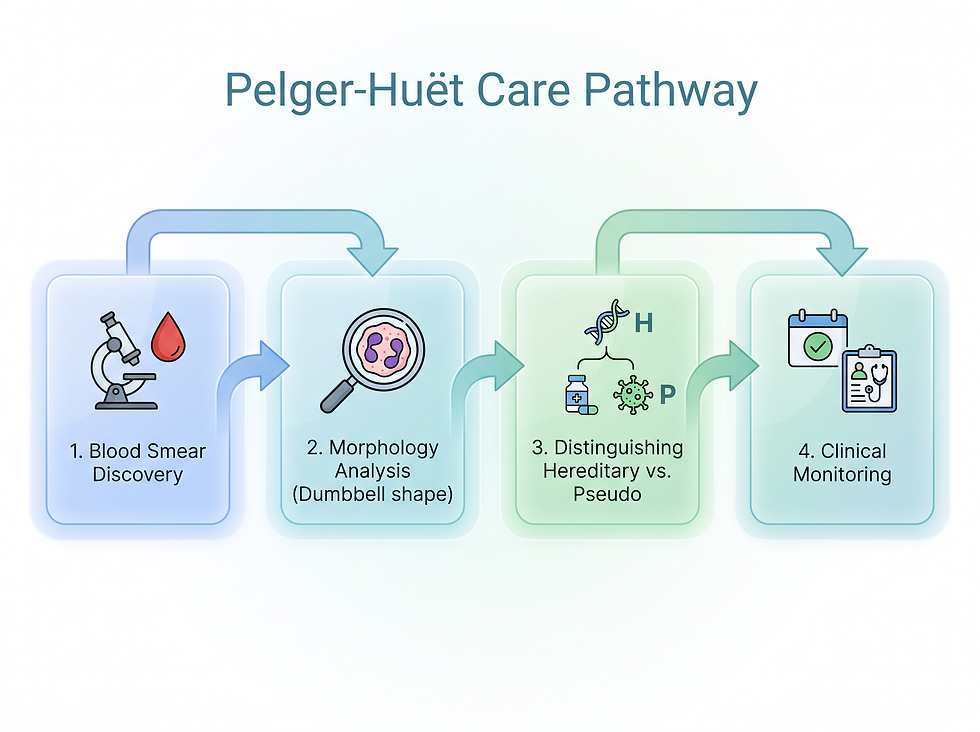
Healthcare providers typically diagnose Pelger-Huët anomaly through a peripheral blood smear. During this diagnostic procedure, a hematologist or pathologist examines a sample of white blood cells under a microscope. The diagnosis is confirmed when the characteristic dumbbell-shaped nuclei are observed in the neutrophils.
It is important for patients to provide a full list of medications to their healthcare provider during evaluation, as certain drugs can trigger the acquired form of the condition.
Management and Treatment
Because Pelger-Huët anomaly is generally asymptomatic and does not interfere with immune function, it usually requires no direct treatment. The primary focus of medical management is distinguishing between the hereditary and pseudo forms.
If a provider identifies pseudo Pelger-Huët anomaly, treatment will focus entirely on the underlying cause, such as managing an infection or treating a bone marrow disorder. Patients with the hereditary form can expect a normal outlook, as the condition is not painful and does not change daily life.

Conclusion
Pelger-Huët anomaly is a unique hematological finding that highlights the complexity of cellular development. While the "dumbbell" shape of the neutrophils may appear concerning under a microscope, the hereditary form is a benign variation that typically requires no intervention. However, the emergence of the pseudo form remains a vital diagnostic clue for clinicians to investigate potential underlying health conditions.
Frequently Asked Questions
What is Pelger-Huët Anomaly?
It is a rare condition where neutrophils (white blood cells) have abnormally shaped, two-segmented nuclei instead of the typical multi-segmented structure.
Is Pelger-Huët Anomaly a form of cancer?
No, the hereditary form is a benign genetic variation. However, the acquired "pseudo" form can sometimes be a sign of certain blood cancers like leukemia.
Does Pelger-Huët Anomaly weaken the immune system?
In the hereditary form, the neutrophils still function normally and help the body fight infections effectively.
How is it diagnosed?
It is diagnosed by examining a patient's blood under a microscope during a peripheral blood smear test.
What does a Pelger-Huët cell look like?
The nucleus of the cell typically looks like a dumbbell or a barbell, with two round segments connected by a thin strip.
Can you develop this condition later in life?
Yes, this is known as pseudo Pelger-Huët anomaly and can be caused by infections, medications, or other diseases.
Is there a cure for the hereditary form?
There is no cure, but since the condition is harmless and doesn't cause symptoms, treatment is not necessary.
What causes the hereditary type?
It is caused by a variation or mutation in the lamin B receptor (LBR) gene.
What is the difference between PHA and PPHA?
PHA is hereditary and usually harmless, while PPHA is acquired and may indicate an underlying medical issue.
Can medications cause this?
Yes, certain drugs, particularly immunosuppressants, can cause the acquired pseudo form of the condition.
Is it painful?
No, Pelger-Huët anomaly itself does not cause any pain or physical discomfort.
Should I be worried if I have it?
If it is the hereditary form, there is usually no cause for concern. If it is acquired, your doctor will investigate the underlying cause.
Can I pass it on to my children?
If you have the hereditary form, there is a 50% chance of passing the genetic variation to your children.
What underlying conditions cause the pseudo form?
Common causes include myelodysplastic syndrome, acute myeloid leukemia, and certain infections like tick-borne diseases.
What should I ask my doctor?
You should ask whether you have the hereditary or pseudo form and if any further testing is needed to rule out underlying conditions.
Source: Cleveland Clinic, "Pelger-Huet Anomaly," January 20, 2025.
Medical Disclaimer: This information is for educational purposes only and does not constitute medical advice. Consult a healthcare professional for diagnosis and treatment.
Comments