Oppositional Defiant Disorder (ODD): Signs, Causes, and What Helps

Updated: 2 days ago
Medically reviewed by Dr. Baraa Alnahhal, MD · Last reviewed: September 2026
Oppositional Defiant Disorder (ODD): Signs in Children, Causes, and What Actually Helps
TL;DR
Oppositional defiant disorder (ODD) is more than occasional pushback — it is a frequent and ongoing pattern of anger, irritability, arguing, and defiance toward parents and other authority figures, sometimes including spiteful or revengeful behavior. Symptoms usually start during the preschool years, last at least six months, and cause real problems at home, at school, and with friends. There is no single clear cause: a mix of inborn temperament and family environment (harsh or inconsistent discipline, lack of supervision, abuse or neglect) is believed to play a role. The good news is that ODD is highly treatable through family-based therapy — parenting skills training, parent-child interaction therapy, and skills work with the child — usually over several months. You do not have to manage it alone: a child psychologist or child psychiatrist can help, and earlier treatment leads to better results.
Quick Answer: What Parents Need to Know About ODD
ODD is a persistent pattern (six months or longer) of anger, irritability, arguing, and defiance toward adults and authority figures — not just a tough phase.
Symptoms usually begin during the preschool years and almost always appear before the early teen years.
Severity is rated by how many settings the behavior appears in: mild (one), moderate (two or more), severe (three or more).
There is no known single clear cause — genetics (temperament) and environment (parenting stress, discipline style, family instability) both contribute.
Treatment is primarily family-based therapy: parenting skills training, parent-child interaction therapy (PCIT), individual/family therapy, and problem-solving and social skills training.
Medicines alone generally are not used for ODD unless a related condition like ADHD, anxiety, or depression is present.
Earlier evaluation and treatment lead to better outcomes — if you are concerned, ask your pediatrician for a referral to a child psychologist or child psychiatrist.
What Is Oppositional Defiant Disorder?
Even the best-behaved children can be difficult and challenging at times. That is part of growing up. But when difficult behavior settles into a frequent and ongoing pattern — anger, irritability, arguing, and defiance directed at parents and other authority figures — it may be something more. If the child is also spiteful and seeks revenge, that pattern points toward oppositional defiant disorder (ODD).
ODD is a childhood behavioral condition in which the defiant behavior happens repeatedly, over a long stretch of time, and across daily life. These emotional and behavioral issues cause serious problems with family life, social activities, school, and work. The child struggles — and so do the parents and siblings around them.
Key point: A child with ODD is very unlikely to see their own behavior as the problem. They are more likely to complain that demands on them are unreasonable, or to blame others for what happens. That is why a parent's observation — not the child's self-report — is usually how ODD first comes to light.
One important reassurance: parents do not have to manage a child with ODD alone. Health care providers, mental health professionals, and child development experts can all help, and treatment works best when it starts early.
ODD at a Glance

| Fact | What It Means for Your Family | |------|-------------------------------| | Typical onset | Usually begins during the preschool years; almost always before the early teen years | | Required duration | Symptoms must be frequent, ongoing, and last at least six months | | Severity measure | Rated by how many settings the behavior occurs in: one (mild), two or more (moderate), three or more (severe) | | Main cause | No single clear cause — a combination of inborn temperament and environmental factors | | Main treatment | Family-based therapies lasting several months or longer; medicines only for related conditions |
What Does ODD Look Like? The Three Groups of Symptoms
It can be hard to tell the difference between a strong-willed, emotional child and a child with ODD. Oppositional behavior is normal at certain developmental stages. What separates ODD is frequency, duration, and impact: the behaviors happen often, have been going on for at least six months, and cause severe problems with relationships, social activities, school, and work — for the child and for the family.
Professional guidance groups the symptoms into three clusters: an angry and irritable mood, argumentative and defiant behavior, and hurtful or revengeful behavior.
Angry and Irritable Mood
| Symptom | What You Might See Day to Day | |---------|-------------------------------| | Often and easily loses temper | Explosive reactions to small frustrations, more often than other children the same age | | Frequently touchy and easily annoyed by others | Snaps at remarks that others would shrug off | | Often angry and resentful | Carries bitterness long after the moment has passed |
Argumentative and Defiant Behavior
| Symptom | What You Might See Day to Day | |---------|-------------------------------| | Often argues with adults or people in authority | Turns routine requests into debates with parents, teachers, or coaches | | Often actively defies or refuses requests or rules | Says no to instructions that other children follow | | Often annoys or upsets people on purpose | Pokes, teases, or provokes deliberately | | Often blames others for own mistakes or misbehavior | "He started it" or "It wasn't me" becomes a default |
Hurtful and Revengeful Behavior
| Symptom | What You Might See Day to Day | |---------|-------------------------------| | Says mean and hateful things when upset | Harsh words aimed at hurting feelings | | Tries to hurt others' feelings, seeks revenge | Gets back at people who upset them | | Vindictive behavior | This must occur at least twice within the past six months to count toward the pattern |
How Severity Is Rated
The severity of ODD depends on how many settings the symptoms appear in. For some children, symptoms show up only at home at first; over time, they can spread to school, social activities, and friendships.
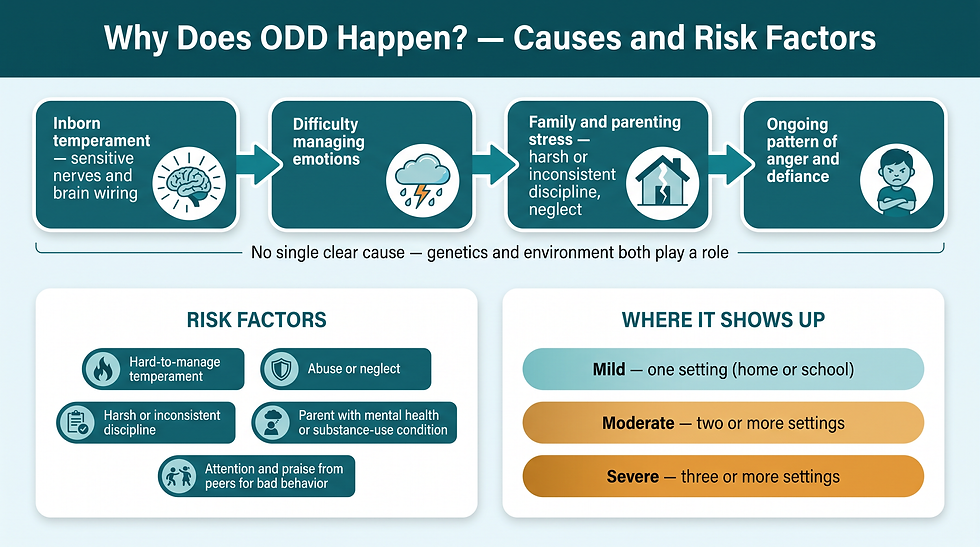
| Severity | Definition | What It Often Means | |----------|------------|---------------------| | Mild | Symptoms occur only in one setting (home, school, work, or with peers) | Usually contained; may be easier to address early | | Moderate | Symptoms occur in at least two settings | Behavior is generalizing beyond one relationship or place | | Severe | Symptoms occur in three or more settings | Wider impact on the child's life; coordinated support usually needed |
When to See a Doctor
A child with ODD is unlikely to see their own behavior as a problem — they will usually complain that demands are unreasonable or blame others. So the signal to act comes from the adults around the child. If you think your child may have ODD or another problem behavior, or if you are worried about your own ability to parent a challenging child, seek help from a child psychologist or child psychiatrist who specializes in behavior problems. Your pediatrician or other health care provider can make a referral.
The single most important takeaway: earlier management leads to better outcomes. You do not need to wait for a breaking point.
Why Does ODD Happen? Causes and Risk Factors
There is no known clear cause of ODD. Current understanding points to a combination of genetic and environmental factors. Children with ODD are thought to carry inborn differences in temperament — including differences in how their nerves and brain function — that interact with their environment, particularly problems with parenting such as lack of supervision, inconsistent or harsh discipline, or abuse and neglect.
The Four Contributing Factors
| Factor | Description | |--------|-------------| | Genetics | Inborn temperament and differences in the way nerves and the brain function | | Environment | Problems with parenting — lack of supervision, inconsistent or harsh discipline, abuse or neglect | | Emotional regulation | Difficulty managing emotions, strong emotional reactions, and trouble tolerating frustration | | Reinforcement | Problem behaviors that get attention from peers or inconsistent discipline from other authority figures, such as teachers |
Who Is at Higher Risk?
| Risk Factor | Why It Raises Risk | |-------------|--------------------| | A temperament that is hard to manage | Strong emotional reactions and low frustration tolerance set the stage for frequent conflict | | Abuse or neglect | Harsh early environments shape how a child responds to authority | | Harsh or inconsistent discipline | Unpredictable or severe responses make defiance more likely, not less | | A parent with a mental health condition or substance use disorder | Family instability reduces consistent support and structure | | Peer attention for bad behavior | When defiance gets noticed and rewarded by other children, it persists |
When ODD Goes Alongside Other Conditions
Many children and teens with ODD also have other mental health conditions — attention-deficit/hyperactivity disorder (ADHD), conduct disorder, depression, anxiety disorders, and learning and communication disorders. Treating those related conditions can help reduce ODD symptoms, and it is difficult to treat ODD effectively if the other conditions are not evaluated and treated too.
What ODD Can Lead to If Left Untreated
Untreated, the conflict pattern strains every relationship a child has and can set up longer-term problems.
| Possible Consequence | How It Develops | |----------------------|-----------------| | Trouble at home, school, and work | Constant conflict with parents, siblings, teachers, and later supervisors | | Struggle to make or keep friends | Arguing and spite push peers away | | Poor school and work performance | Ongoing friction undermines learning and effort | | Antisocial behavior and legal problems | Persistent defiance can escalate into rule-breaking beyond the family | | Impulse control problems | Poorly managed emotions harden into impulsive reactions | | Substance use disorder | Emotional pain and conflict can drive substance use in adolescence and adulthood | | Suicide | The distress of chronic conflict and poor relationships carries real mental health risk |
How Is ODD Diagnosed?
There is no blood test or scan for ODD. Diagnosis is made by a mental health provider through a thorough psychological exam. Because ODD frequently occurs alongside other behavioral and mental health problems, part of the exam is sorting out which symptoms belong to ODD and which belong to something else.
The evaluation typically covers:
| What the Exam Assesses | Why It Matters | |------------------------|----------------| | The child's overall health | Rules out medical issues that could affect behavior | | How often behaviors occur and how severe they are | Confirms the behavior is frequent and ongoing, not occasional | | Emotions and behavior across settings and relationships | Establishes mild, moderate, or severe severity | | Family situations and interactions | Identifies environmental factors contributing to the pattern | | Strategies that have or haven't helped | Guides what to build on in treatment | | Issues the child and family experience because of the behavior | Measures the real-world impact | | Other possible mental health, learning, or communication problems | Ensures related conditions such as ADHD or a learning disorder are not missed |
Can it be prevented? There is no sure way to prevent ODD. But positive parenting and early treatment can improve behavior and keep it from worsening. Positive treatment can restore a child's self-esteem and rebuild a positive parent-child relationship — and relationships with teachers and other care providers improve too.
ODD Treatment: What Works and How Long It Takes
Treatment for ODD is primarily family-based. It usually includes talk therapy and training for both the child and the parents, and it often lasts several months or longer. A crucial part of the plan is also treating any other problems — a mental health condition or a learning disorder — because leaving them untreated can cause or worsen ODD symptoms.
Medicines alone generally are not used to treat ODD. They may be considered only when another mental health condition is present, such as ADHD, anxiety, or depression.

The Main Treatment Approaches
| Treatment Approach | What It Involves | What It Aims to Change | |--------------------|------------------|------------------------| | Parenting skills training | Building consistent, positive, less frustrating parenting skills; the child may join; teachers and other authority figures may be involved | Reduces the family conflict that fuels the pattern | | Parent-child interaction therapy (PCIT) | A therapist coaches the parent in real time — often using a one-way mirror and an audio earpiece — to reinforce positive behavior | Improves parenting technique, the parent-child relationship, and reduces problem behaviors | | Individual and family therapy | The child learns to manage anger and express feelings in healthier ways; family therapy improves communication and how everyone works together | Healthier emotional expression; stronger family teamwork | | Problem-solving training | Cognitive problem-solving therapy to identify and change the thought patterns that lead to behavior problems; collaborative problem-solving brings parent and child together on solutions | Breaks the cycle between negative thinking and defiance | | Social skills training | Helps the child be more flexible and interact more positively and effectively with peers | Rebuilds friendships and social confidence | | Treatment for related conditions | Addressing ADHD, anxiety, depression, learning disorders, or other conditions | Removes causes and worseners of ODD symptoms |
As part of parent training, caregivers learn two core habits: give clear instructions and follow through with appropriate consequences, and recognize and praise good behaviors and positive traits. Learning these skills takes routine practice and patience — and it is especially hard when there are other stressors at home.
Most importantly: show your child consistent, unconditional love and acceptance, even during difficult and disruptive situations. And do not be too hard on yourself — this is hard work, and it gets easier with support.
What Parents Can Do at Home: Nine Strategies That Help
Alongside professional treatment, everyday routines make a real difference. These strategies come from clinical guidance for parents of children with ODD.
| # | Strategy | How to Put It Into Practice | |---|----------|-----------------------------| | 1 | Praise positive behavior immediately | Be specific and close to the moment: "I really liked the way you helped pick up your toys tonight." Rewards can help, especially with younger children | | 2 | Model the behavior you want to see | When your child watches you interact well with others, they pick up better social skills | | 3 | Pick your battles | Almost everything can turn into a power struggle if you let it — choose the ones that matter | | 4 | Set clear limits | Give clear instructions with consistent, reasonable consequences; discuss the limits during calm times, not in the middle of an argument | | 5 | Build a routine | A regular daily schedule brings predictability; ask your child to help develop it | | 6 | Schedule time together | Put a weekly parent-child activity on the calendar | | 7 | Work as a team with other adults | Coordinate discipline with your partner or household, and ask teachers, coaches, and other adults for support | | 8 | Assign one needed household chore | Start with easy tasks and gradually add challenging ones; give clear, easy-to-follow instructions and reinforce positive behavior | | 9 | Expect early resistance | Your child probably won't cooperate at first, and behavior may even worsen when new expectations arrive — staying consistent is the key to success |
Regular, consistent effort across these strategies leads to improved behavior and improved relationships.
Caring for Yourself While You Parent Through ODD
Being the parent of a child with ODD is genuinely challenging. Ask questions and tell your treatment team about your concerns and needs. Consider counseling for yourself and your family to build coping strategies. Work on supportive relationships and stress management skills. The better prepared you are for problem behaviors, the better the outcomes — for both you and your child.
Questions to Ask at the Appointment
Questions you can ask your provider:
| Question | Why It Helps | |----------|--------------| | What do you believe is causing my child's symptoms? | Grounds the treatment plan in your child's specific situation | | Are there other possible causes, such as other mental health conditions? | Ensures related conditions are not missed | | Is this condition likely temporary or long lasting? | Sets realistic expectations | | What issues might be contributing to my child's problem? | Surfaces home, school, and family factors to address | | What treatment approach do you recommend? | Clarifies the plan before you commit | | Is my child at increased risk of long-term complications? | Connects treatment to prevention | | What changes do you suggest at home or school? | Turns treatment into daily practice | | Should I tell my child's teachers about this diagnosis? | Coordinates support across settings | | What else can my family and I do to help? | Adds home strategies to the plan | | Do you recommend family therapy? | Opens the door to whole-family support |
Questions your doctor may ask you:
| Question | What the Provider Is Looking For | |----------|----------------------------------| | What are your concerns about your child's behavior? | Your firsthand observations | | When did you first notice these problems? | Onset timing | | Have teachers or other caregivers reported problem behaviors? | Behavior across settings | | How often over the last six months: angry or irritable mood, arguing with or defying authority, purposely hurting others' feelings? | Whether the six-month pattern requirement is met | | In what settings does your child show these behaviors? | Mild, moderate, or severe severity | | Do specific situations trigger problem behavior? | Patterns to work around or address | | How have you been handling the problem behavior? | What to build on or change | | How do you usually discipline your child? | Parenting style as a contributing factor | | How would you describe your child's home and family life? | Environmental stressors | | What kinds of stress has your family been dealing with? | Current family pressures | | Does your child have any other medical or mental health conditions? | Related conditions needing treatment |
Before the appointment, make a list of: your child's symptoms and how long they have been happening; key family information including stressors and changes such as separation, divorce, or differences in parenting style; school performance details including grades, strengths, weaknesses, and any learning disorder assessments or special education services; the issues your family and child have experienced because of the behavior; your child's key medical information; and all medicines, vitamins, herbal products, and supplements with doses. Both parents or caregivers should be present when possible, or bring a trusted family member or friend.
Conclusion: You Do Not Have to Manage This Alone
Oppositional defiant disorder is a real, pattern-based condition — not a parenting failure, and not a phase you have to simply survive. It usually begins in the preschool years, lasts at least six months, and affects home, school, and friendships. But it is also one of the most responsive childhood behavioral conditions to treatment when the whole family is involved. Parenting skills training, parent-child interaction therapy, individual and family work, and skills training — combined with everyday strategies like immediate praise, clear limits, and a predictable routine — can restore your child's self-esteem and rebuild your relationship.
The next step is simple: if the pattern of anger and defiance has been going on for months, ask your pediatrician for a referral to a child psychologist or child psychiatrist who specializes in behavior problems. Earlier help means better outcomes — for your child, and for your family.
Frequently Asked Questions
What is oppositional defiant disorder in simple terms?
ODD is a childhood behavioral condition where a child shows a frequent, ongoing pattern — lasting at least six months — of anger, irritability, arguing, and defiance toward parents and other authority figures. It often includes spiteful or revengeful behavior, and it causes serious problems at home, at school, and with friends.
How do I know if my child has ODD or is just strong-willed?
All children push back sometimes; oppositional behavior is normal at certain developmental stages. ODD is different in three ways: the behavior happens often, has gone on for at least six months, and causes severe problems with relationships, school, and social activities. If you are unsure, a child psychologist can make that distinction through a thorough psychological exam.
At what age does ODD usually start?
Symptoms generally begin during the preschool years. Sometimes they start later, but they almost always appear before the early teen years.
What causes oppositional defiant disorder?
There is no known clear cause. It is believed to come from a combination of genetic factors (inborn temperament and differences in how nerves and the brain function) and environmental factors (problems with parenting such as lack of supervision, inconsistent or harsh discipline, abuse, or neglect).
Can a child outgrow ODD?
There is no sure way to predict that, which is why the recommended path is positive parenting and early treatment. Earlier management improves behavior and prevents worsening, and treatment can restore a child's self-esteem and rebuild positive relationships.
Does ODD get worse if it is not treated?
It can. Untreated ODD can lead to poor school and work performance, trouble making friends, antisocial behavior, legal problems, impulse control problems, substance use disorder, and even suicide. Many children with ODD also have other conditions — ADHD, conduct disorder, depression, anxiety, or learning disorders — that make treatment harder if left unaddressed.
How is ODD treated?
Primarily through family-based therapy lasting several months or longer: parenting skills training, parent-child interaction therapy (PCIT), individual and family therapy, problem-solving training, and social skills training. Medicines alone generally are not used unless a related condition such as ADHD, anxiety, or depression is present.
What can parents do at home to help a child with ODD?
Praise positive behavior immediately and specifically, model the behavior you want to see, pick your battles, set clear limits with consistent consequences, build a predictable daily routine, schedule regular time together, coordinate discipline with other adults in the child's life, assign one household chore with clear instructions, and stay consistent even when behavior worsens at first — because early resistance is expected and consistency is the key to success.
References
Oppositional defiant disorder (ODD) — Symptoms and causes (dated Jan. 04, 2023)
Oppositional defiant disorder (ODD) — Diagnosis and treatment (dated Jan. 04, 2023)
Source-currency note: This article is based on the clinical sources listed above, both dated January 4, 2023. Always consult a qualified health care professional for diagnosis and treatment decisions.
Health information, not medical advice. This article is for general education and is not a substitute for professional diagnosis or treatment. Always consult a qualified healthcare provider about your own health, and seek emergency care for urgent symptoms.
Comments