Nasopharyngeal Carcinoma: Symptoms, Causes, and Treatment Guide

Updated: 2 days ago
Medically reviewed by Dr. Baraa Alnahhal, MD · Last reviewed: September 2026
TL;DR: Nasopharyngeal carcinoma is a rare cancer that starts in the nasopharynx, the upper part of the throat that sits behind the nose. It is most common in Southeast Asia and hard to detect early because the area is difficult to examine and may cause no symptoms at first. Diagnosis involves an endoscopic exam, a biopsy, and staging scans, and treatment most often combines radiation therapy with chemotherapy. This guide covers every symptom, risk factor, and treatment option in plain language.
Quick Answer
What is nasopharyngeal carcinoma? Nasopharyngeal carcinoma is cancer that starts as a growth of cells in the nasopharynx, the upper part of the throat behind the nose. It is rare in the United States and most common in Southeast Asia.
Nasopharyngeal carcinoma means cancer of the nasopharynx — the upper throat behind the nose.
It may cause no symptoms at first, which makes it hard to find early.
The most common symptoms include a lump in the neck, nose bleeding, bloody saliva, hearing loss, and ringing in the ears.
It is most often diagnosed in adults between ages 30 and 60.
Risk factors include certain ancestries (Chinese, Southeast Asian, northern African, Arctic), Epstein-Barr virus, salt-cured foods, family history, and tobacco or heavy alcohol use.
Doctors confirm the diagnosis with an endoscope exam and biopsy, then stage the cancer from 0 to 4 using CT, MRI, and PET scans.
Treatment most often starts with radiation therapy, alone or combined with chemotherapy; surgery is rarely a first treatment.
What Is Nasopharyngeal Carcinoma?
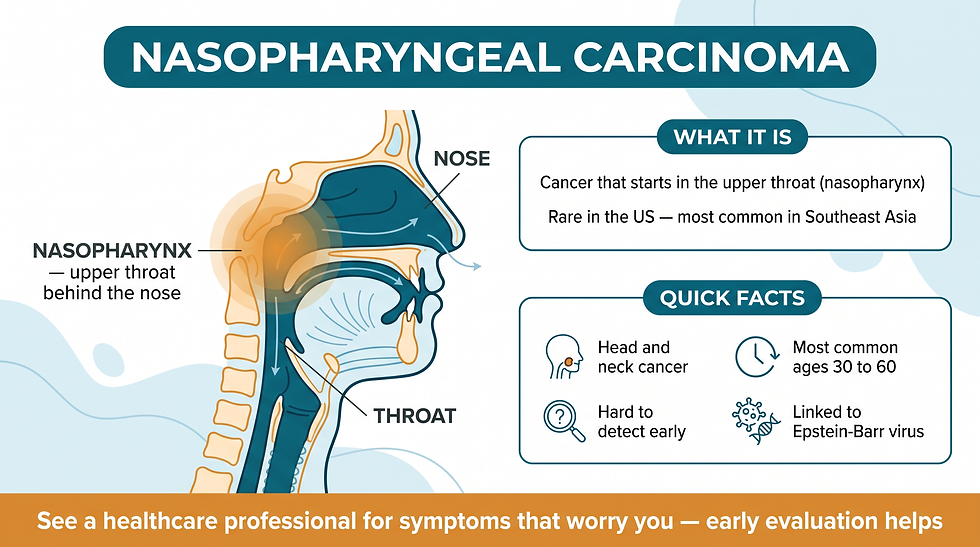
The throat is a muscular tube that runs from the back of the nose down into the neck. It is also called the pharynx and contains three sections: the nasopharynx, the oropharynx, and the laryngopharynx (also called the hypopharynx).
Nasopharyngeal (nay-zoh-fuh-RIN-jee-ul) carcinoma is cancer that starts as a growth of cells in the nasopharynx — the upper part of the throat that sits behind the nose.
This cancer is rare in the United States. It happens much more often in other parts of the world, mainly Southeast Asia.
Nasopharyngeal carcinoma is also hard to find early. That is most likely because the nasopharynx is not easy to examine, and there may be no symptoms at first.
Plain-language definition: Nasopharyngeal carcinoma is a head and neck cancer that begins in the upper throat behind the nose. Because the area is hidden and often silent, it is usually detected only after symptoms appear.
What Are the Symptoms of Nasopharyngeal Carcinoma?
This cancer may not cause any signs or symptoms at first. When it does cause symptoms, they can involve the nose, ears, throat, head, or vision — because the tumor sits near all of these areas.
Symptom | What it involves |
Lump in the neck | Caused by a swollen lymph node |
Bleeding from the nose | Nosebleeds |
Bloody saliva | Blood mixed with saliva |
Double vision | Seeing two images of one object |
Ear infections | Repeated infections in the ear |
Facial numbness | Loss of feeling in the face |
Headaches | Persistent head pain |
Hearing loss | Reduced ability to hear |
Nasal stuffiness | Blocked or congested nose |
Ringing in the ears (tinnitus) | Noise perception with no external sound |
Sore throat | Pain or irritation in the throat |
A neck lump is often the first noticeable sign, since this cancer typically spreads to the lymph nodes in the neck early.

When Should You See a Doctor?
Make an appointment with a doctor or other healthcare professional if you have any symptoms that worry you. There is no waiting period to observe — unexplained nose bleeding, bloody saliva, hearing loss, or a neck lump all deserve an evaluation.
What Causes Nasopharyngeal Carcinoma?
The exact cause is often not known.
This cancer happens when cells in the nasopharynx develop changes in their DNA. A cell's DNA holds the instructions that tell the cell what to do. In healthy cells, the DNA gives instructions to grow and multiply at a set rate and to die at a set time.
In cancer cells, the DNA changes give different instructions. The changes tell the cancer cells to make many more cells quickly, and cancer cells can keep living when healthy cells would die. This causes too many cells.
The cancer cells might form a growth called a tumor. The tumor can grow to invade and destroy healthy body tissue. In time, cancer cells can break away and spread to other parts of the body. When cancer spreads, it is called metastatic cancer.
What Are the Risk Factors for Nasopharyngeal Carcinoma?
Researchers have found factors that seem to raise the risk of this cancer. None of these factors cause the disease on their own, and many people with risk factors never develop it.
Risk factor | What the evidence says |
Certain ancestries | More common in parts of China, Southeast Asia, northern Africa, and the Arctic; people living in these areas or with ancestry from them have increased risk |
Middle age | Can occur at any age, but most often diagnosed in adults aged 30 to 60 |
Salt-cured foods | Chemicals released in steam when cooking salt-cured fish or preserved vegetables may raise risk; steam can enter the nose during cooking, and early-life exposure may raise risk further |
Epstein-Barr virus | A common virus that usually causes mild cold-like symptoms or mononucleosis; linked to some cancers including nasopharyngeal carcinoma |
Family history | Having a family member with nasopharyngeal carcinoma raises risk |
Alcohol and tobacco | Heavy alcohol intake and tobacco use can raise risk |
What Complications Can Nasopharyngeal Carcinoma Cause?
Two main complications define how this cancer progresses.
Cancer that grows into nearby structures. Advanced nasopharyngeal carcinoma can grow large enough to invade nearby structures, such as the throat, bones, and brain.
Cancer that spreads to other areas of the body. This cancer often spreads beyond the nasopharynx. It typically spreads to the lymph nodes in the neck first. When it spreads to other parts of the body, it most often goes to the bones, lungs, and liver.
How Can You Lower Your Risk?
There is no sure way to prevent nasopharyngeal carcinoma. But if you are worried about your risk, consider giving up habits linked with the disease. Do not use tobacco. You may also choose to cut back on or avoid salt-cured foods.
There is no routine screening in the United States or in other areas where the disease is rare. In places where it is much more common, such as some areas of China, people at high risk may have screening that involves blood tests to detect the Epstein-Barr virus.
How Is Nasopharyngeal Carcinoma Diagnosed?
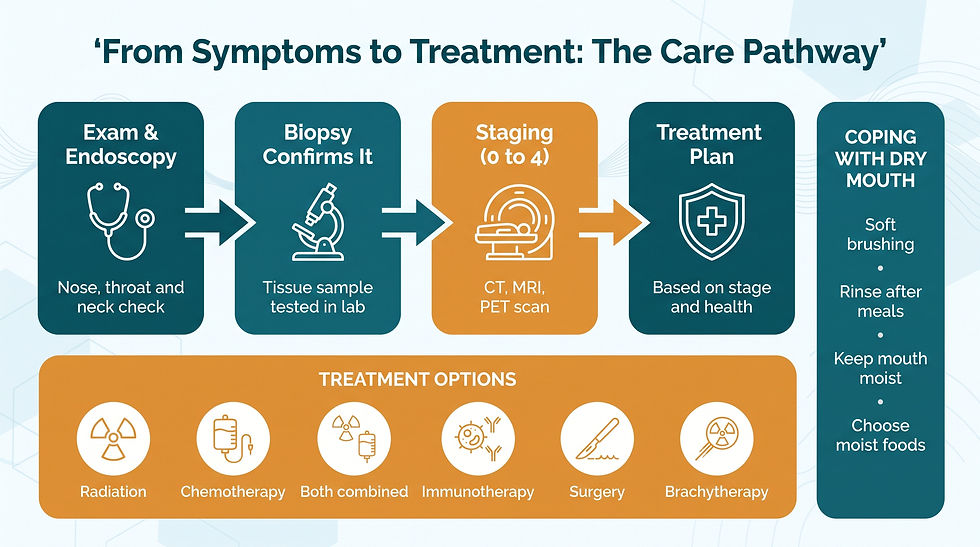
Diagnosis usually begins with an exam by a healthcare professional, who may use a special scope to look inside the nasopharynx and may remove a tissue sample for testing.
Diagnostic step | What happens |
Physical exam | The healthcare professional looks in the nose and throat, feels the neck for swollen lymph nodes, and asks about symptoms and habits |
Nasal endoscopy | A thin, flexible tube with a tiny camera (an endoscope) is passed through the nose — or through the opening in the back of the throat that leads up into the nasopharynx — to view the nasopharynx directly |
Biopsy | During the endoscopy, special tools remove a small tissue sample for lab testing; if lymph nodes in the neck are swollen, a needle may draw out cells instead |
Staging scans | CT scan, MRI scan, PET scan, or X-ray to find the extent (stage) of the cancer |
Staging explained. The stages range from 0 to 4. A lower number means the cancer is small and mostly confined to the nasopharynx. As the cancer grows larger or spreads, the stage goes up. Stage 4 can mean the cancer has grown into nearby structures, such as the area around the eye or the lower parts of the throat, or that it has spread to the lymph nodes or other parts of the body.
The healthcare team uses the stage and other factors to plan treatment and understand the likely course of the cancer, called the prognosis.
How Is Nasopharyngeal Carcinoma Treated?
Treatment most often begins with radiation therapy or a combination of radiation and chemotherapy. You and your healthcare team build a plan based on the cancer's stage, your treatment goals, your overall health, and the side effects you are willing to accept.
Radiation Therapy
Radiation therapy treats cancer with powerful energy beams from X-rays, protons, or other sources. For nasopharyngeal carcinoma, this most often involves external beam radiation: you lie on a table while a large machine sends radiation to the precise spot where it targets the cancer.
Scenario | Typical radiation approach |
Small cancer | Radiation therapy may be the only treatment needed |
Larger cancer or growth into nearby areas | Radiation is typically combined with chemotherapy |
Cancer that returns | Internal radiation (brachytherapy) — radioactive seeds or wires placed in or near the cancer |
Chemotherapy
Chemotherapy treats cancer with strong medicines, most often given through a vein, with some available as pills. It may be given at the same time as radiation therapy, before radiation, or after radiation.
Immunotherapy
Immunotherapy uses medicine that helps the body's immune system kill cancer cells. The immune system normally fights diseases by attacking germs and other cells that should not be in the body. Cancer cells survive by hiding from the immune system; immunotherapy helps immune cells find and kill the cancer cells.
For nasopharyngeal carcinoma, immunotherapy might be an option if the cancer comes back or spreads to other parts of the body.
Surgery
Surgery is not often used as a first treatment. Possible surgical roles include removing cancerous lymph nodes in the neck, removing cancer from the nasopharynx, or treating cancer that returns after radiation or chemotherapy. To reach the cancer, a surgeon may make a cut in the roof of the mouth or in the face near the nose, or may remove the cancer using special tools passed through the nose.
How Do You Cope with Dry Mouth After Treatment?
Radiation therapy for nasopharyngeal carcinoma often causes dry mouth. It may last a long time after treatment, and for some people it does not go away. Dry mouth can cause discomfort, lead to mouth infections, make eating, swallowing, and speaking difficult, and affect dental health. Ask your healthcare team about seeing a dentist if you develop dry mouth complications.
Step | How to do it |
Brush your teeth a few times each day | Use a soft-bristled toothbrush and brush gently; tell your team if gentle brushing hurts |
Rinse after meals | Ask your team what mouthwash solution to use |
Keep your mouth moist | Drink water throughout the day; try ice chips, sugarless gum, or sugarless candies to stimulate saliva |
Choose moist foods | Avoid dry foods; moisten food with sauce, gravy, broth, butter, or milk |
Avoid irritants | Skip acidic or spicy foods and drinks, caffeinated drinks, and alcohol |
Tell your healthcare team if you have dry mouth — treatments exist for more severe symptoms, and the team may refer you to a dietitian, an expert in nutrition, to help you find foods that are easier to eat.
How Do You Cope Emotionally?
People handle a cancer diagnosis in their own ways. With time, you will find what works for you. Until then, a few approaches tend to help.
Learn enough about the cancer to participate in care decisions. Write down questions before appointments, bring a friend or family member to take notes, and ask your healthcare team for additional information sources.
Find someone to talk to. This might be a close friend or family member, a social worker or psychologist, or a minister or spiritual leader. In the United States, the American Cancer Society can connect you with support groups.
Take time for yourself. Let people know when you want to be alone — quiet time and journaling can help you sort out your feelings.
Take care of your body. If you smoke, quit. Eat a variety of fruits and vegetables, exercise when you feel up to it (after checking with your team), find ways to ease stress, and get enough sleep. These choices make it easier for your body to cope with treatment side effects.
Preparing for Your Appointment
If your healthcare professional suspects nasopharyngeal carcinoma, you may be referred to a specialist — a doctor who treats cancer, called an oncologist, or a doctor who specializes in ear, nose, and throat issues, called an otolaryngologist.
Take a family member or friend with you if possible, and bring a notebook or recording device. Before the visit, make a list of your symptoms (including when they began), all medicines, vitamins, and supplements you take with doses, and the questions you want to ask.
Questions to ask your doctor | What your doctor may ask you |
What tests do I need? | How often do you have symptoms? |
Do I need to prepare for these tests? | How bad are your symptoms? |
Are there other possible causes for these symptoms? | Does anything make your symptoms better or worse? |
How will this affect my other health conditions? | Do you eat a lot of salt-cured foods, such as fish or preserved vegetables? |
What treatment do you suggest? | Have you ever been diagnosed with the Epstein-Barr virus or mononucleosis? |
Is my cancer likely to return? | — |
Are there clinical trials I might join? | — |
Where can I find out more about this cancer? | — |
Conclusion
Nasopharyngeal carcinoma is a rare cancer of the upper throat behind the nose — difficult to detect early, but treatable, most often with radiation therapy alone or combined with chemotherapy. The single most important action you can take is to get any persistent or worrying symptoms evaluated, especially a neck lump, unexplained nose bleeding, hearing changes, or ringing in the ears.
Talk to a healthcare professional today if you have symptoms that worry you. Early evaluation makes every treatment option more effective.
Related Articles on Rinnit
For a broader look at cancers in this region of the body, see our guide to Head and Neck Cancers.
Frequently Asked Questions
Is nasopharyngeal carcinoma curable?
For many people, yes — small cancers are often treated with radiation therapy alone, and treatment is most effective when started early. Your prognosis depends on the stage and other factors your healthcare team will assess.
What are the first signs of nasopharyngeal carcinoma?
There may be no symptoms at first. When symptoms appear, the most common early signs are a lump in the neck (from a swollen lymph node), bleeding from the nose, and bloody saliva.
Does a lump in the neck mean cancer?
Not necessarily — swollen lymph nodes have many causes, most of them infections. But a persistent, unexplained neck lump should always be evaluated by a healthcare professional.
Who is at highest risk for nasopharyngeal carcinoma?
People with ancestry from parts of China, Southeast Asia, northern Africa, or the Arctic, adults aged 30 to 60, people with a family history of the disease, people who eat salt-cured foods regularly, and people who use tobacco or heavy alcohol are at higher risk.
How is nasopharyngeal carcinoma diagnosed?
Diagnosis involves a physical exam of the nose and throat, a nasal endoscopy to view the nasopharynx, a biopsy to confirm cancer cells, and imaging scans (CT, MRI, PET) to determine the stage.
Does nasopharyngeal carcinoma spread?
Yes — it typically spreads to the lymph nodes in the neck first, and when it spreads further it most often reaches the bones, lungs, and liver.
Can Epstein-Barr virus cause cancer?
The virus usually causes mild cold-like symptoms or mononucleosis, but it is linked to some cancers, including nasopharyngeal carcinoma. Screening for the virus is used in high-incidence regions.
References
Nasopharyngeal carcinoma — Symptoms and causes (October 10, 2024)
Nasopharyngeal carcinoma — Diagnosis and treatment (October 10, 2024)
This article is based on the two referenced sources, last updated October 10, 2024. This content is for general information only and is not a substitute for professional medical advice, diagnosis, or treatment. Always consult a qualified healthcare provider about your individual health.
Comments