Hürthle Cell Cancer: Symptoms, Causes, Diagnosis, and Treatment Explained

Updated: 3 hours ago
Medically reviewed by Dr. Baraa Alnahhal, MD · Last reviewed: September 2026
Editorial note: This article is for educational purposes only. It is not medical advice and cannot replace professional diagnosis or treatment. If you have symptoms that concern you, see a healthcare professional. Last updated: August 2026.
TL;DR
Hürthle cell cancer is a rare form of thyroid cancer — only about 3% to 7% of all thyroid cancers — that tends to behave more aggressively than other thyroid cancer types. It often causes no symptoms and is found by accident during an exam or scan. When symptoms appear, they include a neck lump, voice changes, and swallowing trouble. Surgery to remove the thyroid is the main treatment, usually followed by lifelong thyroid hormone replacement. Overall thyroid cancer survival is very high (about 98%), but Hürthle cell cancer responds less easily to standard therapy, so follow-up matters.
Quick answer: Hürthle cell cancer is a rare thyroid cancer caused by DNA mutations that make thyroid cells grow uncontrollably. It accounts for roughly 3% to 7% of thyroid cancers, affects women more often, and usually appears as a painless neck lump or hoarseness. Doctors diagnose it with ultrasound, blood tests, and a needle biopsy. Treatment centers on surgical removal of the thyroid, sometimes followed by radioactive iodine, radiation, or targeted drugs, and lifelong thyroid hormone replacement afterward.
What is Hürthle cell cancer?

Hürthle (HEERT-luh) cell cancer is a rare cancer that affects the thyroid gland. The thyroid is a butterfly-shaped gland at the base of the neck, just below the Adam's apple. It releases hormones that control the body's metabolism.
The condition is also called Hürthle cell carcinoma or oxyphilic cell carcinoma. It is one of several types of cancer that affect the thyroid, and it is the aggressive-leaning member of the family — it can behave more aggressively than other, more common thyroid cancers.
The numbers put its rarity in context. Roughly 45,240 new cases of thyroid cancer are estimated in the United States in 2026, and Hürthle cell cancer makes up only a small slice of those.
Share of all thyroid cancers: about 3% to 7% (estimates range from 3–4% to 3–10% of differentiated thyroid cancers)
U.S. thyroid cancer cases expected in 2026: about 45,240 new cases; about 2,320 deaths
5-year relative survival (all thyroid cancers): about 98.3%
Who it affects most: women more than men; usually middle-aged adults (roughly 50–60)
Relative survival, Hürthle cell subtype: high overall, but lower than papillary thyroid cancer and weaker when the cancer has spread
How common is Hürthle cell cancer?
Thyroid cancer itself is relatively uncommon — it represents about 2.1% of all new cancer cases in the United States. The rate of new thyroid cancers is about 13.7 per 100,000 people per year, and the death rate is about 0.5 per 100,000.
Within that, Hürthle cell cancer is the rare subtype. Published estimates place it at roughly 3% to 7% of all thyroid cancers. Because each of its building blocks comes from a small pool of patients, few institutions have deep experience with it — another reason care at a specialized center is often advised.
Papillary (most common): about 80%
Follicular: about 10%
Medullary: about 3% to 5%
Anaplastic: rare (under 2%)
Hürthle cell (oxyphilic): about 3% to 7%
What are the symptoms of Hürthle cell cancer?
Hürthle cell cancer does not always cause symptoms. It is sometimes found by accident during a routine physical exam or an imaging test done for a completely different reason.
When symptoms do occur, they tend to center on the neck:
Neck lump: a growth just below the Adam's apple
Neck or throat pain: discomfort in the front of the neck
Voice changes: hoarseness or other shifts in your voice
Breathing trouble: shortness of breath
Swallowing trouble: difficulty getting food down
These signs do not automatically mean Hürthle cell cancer. The same symptoms can come from other, far more common conditions — such as inflammation of the thyroid gland or an enlarged thyroid (goiter).
When should you see a doctor?
Make an appointment with your healthcare provider if you have any signs or symptoms that worry you. A neck lump that persists, hoarseness that does not clear up, or unexplained trouble swallowing or breathing deserves a professional look — especially if it is new and does not go away.
The good news on urgency: most neck lumps are not cancer. But because Hürthle cell cancer can grow aggressively once it is present, getting checked promptly rather than waiting is the safest move.
What causes Hürthle cell cancer?
No one knows exactly what causes Hürthle cell cancer. What doctors understand is the mechanism at the cellular level.
The cancer begins when thyroid cells develop changes in their DNA. A cell's DNA holds the instructions that tell a cell what to do. When those instructions change — mutations, in medical terms — they can tell thyroid cells to grow and multiply too fast. The cells also gain the ability to keep living when normal cells would naturally die. Over time, the accumulating cells form a mass called a tumor that can invade and destroy nearby healthy tissue and spread (metastasize) to other parts of the body.
Researchers are learning that this subtype has its own molecular signature. It typically involves mutations in mitochondrial DNA (the cell's energy factories) and can include changes in nuclear genes such as BRAF, HRAS, and PTEN. In 2022, the World Health Organization reclassified it as a distinct subtype — no longer just a variant of follicular thyroid cancer — because of these unique features.
Who is at higher risk of Hürthle cell cancer?
Factors that raise the risk of developing thyroid cancer include:
Being female: thyroid cancers overall occur far more often in women (about 20 vs. 7.4 new cases per 100,000 per year)
Being older: most thyroid cancers are diagnosed in middle age and later; median age at diagnosis is about 51
Prior head and neck radiation: childhood exposure to ionizing radiation is a known risk factor for thyroid cancers including Hürthle cell
Family history of thyroid cancer: inherited conditions such as familial nonmedullary thyroid cancer raise risk
Environmental and health background also play a role. People from regions with endemic goiter or iodine deficiency show higher rates, and preexisting thyroid conditions such as adenomas or goiter may increase risk.
What complications can Hürthle cell cancer cause?
The cancer and its treatment can cause several complications:
Swallowing and breathing problems: the growing tumor can press on the food tube (esophagus) and windpipe (trachea)
Spread of the cancer (metastasis): Hürthle cell cancer can spread to other tissues and organs, making treatment and recovery harder; it has a higher tendency to spread to the lungs and bones than other differentiated thyroid cancers
Voice box nerve injury (from surgery): damage to the recurrent laryngeal nerve can cause temporary or permanent hoarseness or voice loss
Parathyroid gland damage (from surgery): can require lifelong medication to regulate blood calcium levels
Low thyroid hormone (from treatment): after the thyroid is removed, lifelong hormone replacement is required
How is Hürthle cell cancer diagnosed?
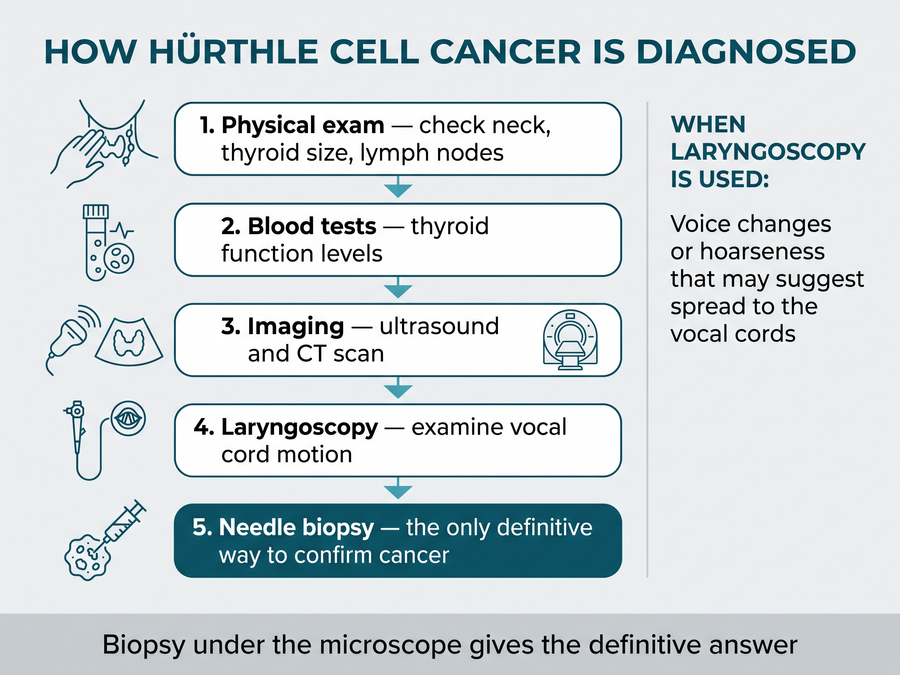
Tests and procedures used to diagnose Hürthle cell cancer include:
Physical exam: the provider examines the neck, checks the size of the thyroid, and feels for swollen lymph nodes
Blood tests: may reveal changes in thyroid function that add information about your condition
Imaging tests: ultrasound and CT help determine whether a growth is present in the thyroid
Vocal cord exam (laryngoscopy): a light and tiny mirror, or a flexible fiber-optic tube with a camera, checks vocal cord motion; recommended if voice changes suggest possible spread
Needle biopsy: a fine needle guided by ultrasound withdraws a sample of thyroid tissue; a pathologist examines it for cancer
The biopsy is the decisive step. Imaging and blood tests can raise suspicion, but only the tissue sample under the microscope confirms the diagnosis.
Because this subtype spreads to distant sites more readily than other differentiated thyroid cancers, staging scans may also be ordered to check for spread to the lungs or bones.
What treatments are available for Hürthle cell cancer?

Treatment for Hürthle cell cancer usually involves surgery to remove the thyroid. Other treatments may be added depending on your situation.
Surgery
Total or near-total removal of the thyroid (thyroidectomy) is the most common treatment. During the operation, the surgeon removes all or nearly all of the thyroid gland and leaves tiny edges of thyroid tissue near the small parathyroid glands to reduce the chance of injuring them — those glands regulate the body's calcium levels. Nearby lymph nodes may also be removed if spread is suspected.
Voice box nerve injury: damage to the recurrent laryngeal nerve can cause temporary or permanent hoarseness or loss of voice
Parathyroid gland damage: may require medication to keep blood calcium levels in range
Excessive bleeding: a surgical complication managed during and after the operation
After surgery, you will be prescribed levothyroxine (brand names such as Synthroid or Unithroid) to replace the hormone your thyroid produced. This is a pill you will take every day for the rest of your life.
Radioactive iodine therapy
Radioactive iodine involves swallowing a capsule containing a radioactive liquid. It may be used after surgery to destroy any remaining thyroid tissue that could harbor traces of cancer, or if the cancer has spread to other parts of the body. An important caveat for this subtype: Hürthle cell cancer takes up radioactive iodine less readily than other thyroid cancers, so it is not always an option here.
Temporary side effects can include dry mouth, a decrease in taste, neck tenderness, nausea, and fatigue.
Radiation therapy
Radiation therapy uses high-powered energy beams — X-rays or protons — to kill cancer cells. You lie on a table while a machine moves around you, delivering radiation to precise points. It may be an option if cancer cells remain after surgery and radioactive iodine, or if the cancer spreads.
Side effects may include a sore throat, a sunburn-like skin rash, and fatigue.
Targeted drug therapy
Targeted drug treatments use medications that attack specific weaknesses inside cancer cells. They may be an option if Hürthle cell cancer returns after other treatments or spreads to distant parts of the body. Depending on the drug, side effects can include diarrhea, fatigue, high blood pressure, and liver problems.
This is an active area of cancer research. Doctors are studying new targeted therapy drugs for people with thyroid cancer, including tyrosine kinase inhibitors for this subtype.
What is the prognosis for Hürthle cell cancer?
The outlook for thyroid cancer overall is excellent — about 98.3% of people are alive five years after diagnosis, and about 63% of thyroid cancers are caught at the localized stage, where 5-year survival is about 99.9%.
Hürthle cell cancer follows a different curve. Its prognosis is generally favorable with early diagnosis and treatment, but it is less favorable than papillary thyroid cancer and declines significantly with advanced disease, larger tumor size, or spread at diagnosis. In one large analysis, 10-year Hürthle cell carcinoma-specific survival was about 91.8%, reflecting the impact of this subtype's tendency to metastasize.
Localized (confined to thyroid): about 63% of cases; about 99.9% 5-year relative survival
Regional (spread to lymph nodes): about 31% of cases; about 98.1% 5-year relative survival
Distant (metastasized): about 3% of cases; about 48.3% 5-year relative survival
These are population-level numbers for thyroid cancer as a whole. Individual outcomes vary, and staging for Hürthle cell cancer is done case by case by your care team.
How do you cope with a Hürthle cell cancer diagnosis?
A cancer diagnosis can be challenging, and feeling stressed or anxious is normal. Practical ideas include finding someone to talk with — a friend, family member, or support group; letting people help you with treatment-day logistics; setting reasonable daily goals; conserving your energy for what matters most; and taking time for eating well, resting, and relaxing.
How do you prepare for your appointment?
Start by making an appointment if you have signs or symptoms that worry you. If Hürthle cell cancer is suspected, you may be referred to an endocrinologist (thyroid specialist) or an oncologist (cancer specialist).
A written symptom list, including anything that seems unrelated to the reason for the visit
Key medical information, including other conditions you have
A full medication list: prescriptions, over-the-counter medicines, vitamins, supplements
Family health history: thyroid diseases and other conditions that run in the family
A companion to help remember what the provider says
A question list to make the most of a short appointment
Questions you can ask your doctor include: What is the most likely cause of my symptoms? What tests do I need, and do they require special preparation? What treatments are available, and what side effects can I expect? What is my prognosis? How often will I need follow-up visits? How can my other health conditions be managed alongside treatment? What happens if I choose not to have treatment?
Expect questions from your doctor about when symptoms began, whether they are continuous or occasional, whether they have worsened, any personal or family history of cancer, and whether you have ever received radiation treatments to the head or neck.
The bottom line
Hürthle cell cancer is a rare, potentially aggressive form of thyroid cancer — roughly 3% to 7% of the total — that often announces itself with nothing more than a painless neck lump or a hoarse voice. Surgery to remove the thyroid is the mainstay of treatment, and most people who undergo it go on to live full lives with daily hormone replacement.
The practical rules are simple. Do not ignore a persistent neck lump, hoarseness, or swallowing trouble. Get checked promptly — the same symptoms usually turn out to be something far less serious, but early detection is what keeps outcomes excellent. If you are diagnosed, ask whether your team has deep experience with this subtype, because rarity makes expertise matter.
Frequently asked questions
What exactly is Hürthle cell cancer?
It is a rare type of thyroid cancer — also called Hürthle cell carcinoma or oxyphilic cell carcinoma — that can be more aggressive than other thyroid cancer types. It accounts for roughly 3% to 7% of all thyroid cancers.
What causes Hürthle cell cancer?
The exact cause is unknown. It starts when DNA mutations tell thyroid cells to grow and multiply too quickly and to survive when normal cells would die, forming a tumor that can invade nearby tissue and spread to other parts of the body.
What are the symptoms of Hürthle cell cancer?
Often there are none — it is sometimes found incidentally. When present, symptoms include a lump in the neck below the Adam's apple, neck or throat pain, hoarseness, shortness of breath, and difficulty swallowing.
Is Hürthle cell cancer more aggressive than other thyroid cancers?
It is generally considered more aggressive than papillary and follicular thyroid cancer, with a higher tendency to metastasize — particularly to the lungs and bones — and a lower uptake of radioactive iodine, which limits that treatment option in some patients.
How is Hürthle cell cancer diagnosed?
Through a combination of physical exam, blood tests, imaging (ultrasound and CT), a vocal cord exam (laryngoscopy) when voice changes raise concern, and — definitively — a needle biopsy of the thyroid guided by ultrasound.
What is the main treatment for Hürthle cell cancer?
Total or near-total removal of the thyroid (thyroidectomy), often followed by radioactive iodine therapy, external-beam radiation therapy, or targeted drug therapy depending on the situation. Lifelong thyroid hormone replacement (levothyroxine) is required after surgery.
Can you live a normal life after Hürthle cell cancer treatment?
Most people do. With the thyroid removed, daily levothyroxine replaces the missing hormone, and most daily activities can return to normal. Follow-up monitoring for recurrence is essential, since the cancer can come back.
Who is at higher risk of Hürthle cell cancer?
Women, older adults, people with a history of radiation treatment to the head and neck, and people with a family history of thyroid cancer have higher risk. Childhood radiation exposure and certain hereditary thyroid conditions also raise risk.
Comments