HUS: Symptoms, Causes & When It's an Emergency

Updated: 2 days ago
Medically reviewed by Dr. Baraa Alnahhal, MD · Last reviewed: September 2026
TL;DR: Hemolytic uremic syndrome (HUS) is a serious condition in which small blood vessels become damaged and inflamed, causing clots to form throughout the body and potentially damaging the kidneys. It most often follows an infection with certain E. coli strains, especially in children under age 5. It usually starts with bloody diarrhea, stomach pain, and fever, then progresses to signs of blood vessel damage like pale skin, extreme tiredness, and urinating less. HUS requires hospital treatment — and seeking care quickly leads to full recovery for most people. Seek emergency care if you or your child hasn't urinated in 12 hours or more.
Quick Answer
What it is — a condition where small blood vessels become damaged and inflamed, forming clots that can damage the kidneys and other organs.
Most common cause — infection with certain E. coli strains that make Shiga toxin (called STEC).
Who is affected most — young children, especially those under age 5.
First signs — diarrhea (often bloody), stomach pain, fever, and vomiting.
Later signs — blood vessel damage — pale skin, extreme tiredness, bruising, unusual bleeding, urinating less, and swelling.
Treatment — happens in the hospital: IV fluids, transfusions, and sometimes dialysis or plasma exchange.
Outlook — with timely treatment, most people — especially young children — fully recover.
What Is Hemolytic Uremic Syndrome (HUS)?
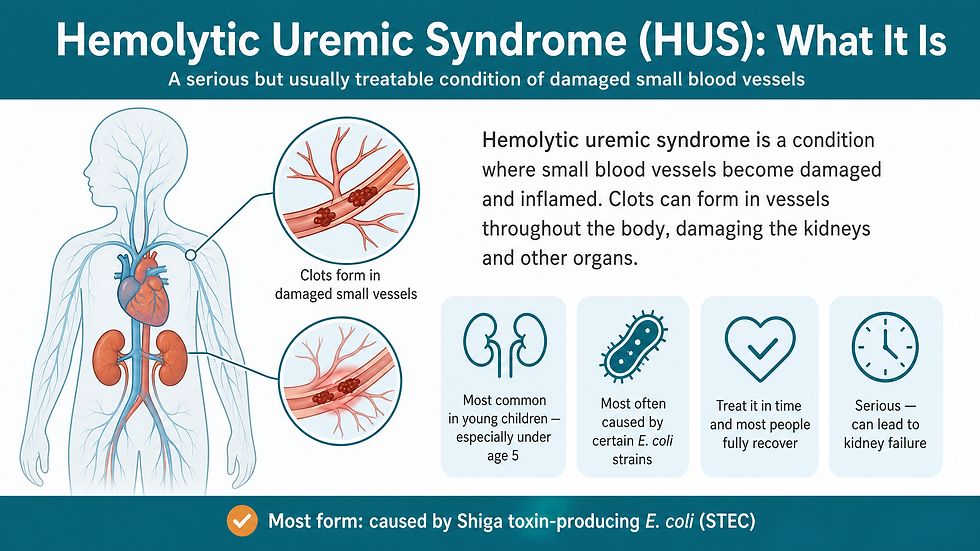
Hemolytic uremic syndrome, also called HUS, is a condition that happens when small blood vessels become damaged and inflamed. This damage can cause clots to form in the vessels all through the body, and those clots may damage the kidneys and other organs.
The condition can lead to kidney failure, which can be life-threatening. That is why HUS is taken seriously — but it is also highly treatable when caught early.
Anyone can get hemolytic uremic syndrome, but it is most common in young children. Most often, infection with certain strains of Escherichia coli (E. coli) bacteria is the cause. The word "uremic" refers to the way the condition affects the urinary system — the kidneys and urine output.
How Does HUS Develop? (The Two Phases)
Understanding the two phases of HUS helps you recognize the warning signs at each stage.
Phase 1 — Infection: harmful bacteria damage the stomach and intestines, causing diarrhea (often bloody), stomach pain, cramping, bloating, fever, and vomiting.
Phase 2 — Blood vessel damage: damaged vessels cause red blood cells to break down and clots to form, leading to pale skin, extreme tiredness, bruising, unusual bleeding, urinating less, and swelling.
The second phase is where the real danger lies. All forms of HUS damage blood vessels, which causes red blood cells to break down — a process called anemia. The condition also causes blood clots to form in the blood vessels, and these clots can damage the kidneys.
What Are the Symptoms of HUS?

Early Stomach Symptoms (E. coli Form)
The first symptoms of HUS caused by E. coli bacteria might include:
Diarrhea, which is often bloody
Pain, cramping or bloating in the stomach area
Fever
Vomiting
Signs of Blood Vessel Damage (All Forms)
Once blood vessel damage begins, the following symptoms may appear:
Loss of color in the skin (pale skin)
Extreme tiredness
Easy bruising
Unusual bleeding, such as bleeding from the nose and mouth
Decreased urinating or blood in the urine
Swelling, called edema, of the legs, feet or ankles — less often the face, hands, feet or entire body
Confusion, seizures or stroke
High blood pressure
When Should You See a Doctor?
See a member of your health care team right away if you or your child has bloody diarrhea or several days of diarrhea followed by any of these:
Urinating less
Swelling
Bruising
Unusual bleeding
Extreme tiredness
Emergency rule: Seek emergency care if you or your child doesn't urinate for 12 hours or more. This is the single most important warning sign to remember.
What Causes Hemolytic Uremic Syndrome?
The most common cause of HUS is infection with certain strains of E. coli bacteria — especially for children under age 5. Some of these E. coli strains make a toxin called Shiga toxin, so they are called Shiga toxin-producing E. coli, or STEC. It helps to know that most of the hundreds of types of E. coli are typical and harmless — but some strains can lead to HUS.
Other causes of hemolytic uremic syndrome can include:
Other infections — pneumococcal bacteria, human immunodeficiency virus (HIV), or a flu virus.
Certain medicines — some cancer medicines; some medicines that prevent organ transplant rejection.
Complications of other conditions (rare) — pregnancy, autoimmune disease, or cancer.
Atypical HUS: The Inherited Form
An uncommon type of the condition, called atypical hemolytic uremic syndrome, can be passed down through families. People who inherit the gene that causes this form don't always get the condition. However, an infection, the use of certain medicines, or ongoing health conditions can start HUS in people who carry the gene.
Who Is at Highest Risk?
HUS caused by E. coli can occur if you eat meat, fruit or vegetables with the bacteria, swim in pools or lakes contaminated with feces carrying the bacteria, or have close contact with an infected person.
The risk of getting HUS is highest for:
Children 5 or younger — developing bodies are most vulnerable to the E. coli strains that cause HUS.
People with weakened immune systems — the body has a harder time fighting the infection.
People with certain gene changes — inherited genes can trigger the atypical form.
What Are the Possible Complications?
HUS can cause life-threatening complications, including:
Kidney failure — sudden (acute) or developing over time (chronic)
High blood pressure
Stroke or seizures
Coma
Clotting issues, which can lead to bleeding
Heart issues
Digestive tract issues, such as problems with the intestines, gallbladder or pancreas
The good news is that treating HUS in time leads to a full recovery for most people, especially young children.
How Can You Prevent HUS?
Since most HUS cases begin with an E. coli infection, prevention focuses on food and hand hygiene. An important fact to remember: meat or produce that has E. coli won't always look, feel or smell bad.
Don't drink unpasteurized milk, juice or cider — pasteurization kills harmful bacteria.
Wash hands well before eating and after the restroom or changing diapers — removes bacteria before they can enter the body.
Clean utensils and food surfaces often — prevents cross-contamination.
Cook meat to an inside temperature of at least 160°F (71°C) — kills E. coli bacteria in meat.
Defrost meat in the microwave or refrigerator, not on the counter — prevents bacterial growth during thawing.
Keep raw foods separate from other foods — never put cooked meat on plates that held raw meat, to stop bacteria from spreading.
Store meat below produce in the refrigerator — prevents liquids such as blood from dripping onto produce.
Stay away from unclean swimming areas — and don't swim if you have diarrhea, to reduce waterborne and person-to-person spread.
How Is HUS Diagnosed?
A physical exam and lab tests can confirm a diagnosis of hemolytic uremic syndrome.
Blood tests — check whether red blood cells are damaged; low platelet count; low red blood cell count; higher-than-usual creatinine (a waste product normally removed by the kidneys).
Urine test — checks for unusual levels of protein and blood, and signs of infection in urine.
Stool sample — checks whether E. coli or other bacteria are present.
If the cause of HUS isn't clear, other tests might help find the cause.

How Is HUS Treated?
HUS needs treatment in the hospital. The core of treatment involves replacing lost fluids and minerals to make up for the kidneys not removing fluids and waste as well as usual, and it might also involve getting nutrition through a vein.
Hospital fluids & nutrition — replaces lost fluids, minerals and sometimes nutrition through a vein; used in all HUS cases as the first step.
Red blood cell transfusions — red blood cells through a vein reverse symptoms of anemia, used when anemia is significant.
Blood pressure medicines — lower blood pressure and may prevent or slow more kidney damage, used for lasting kidney damage.
Eculizumab (Soliris) / Ravulizumab (Ultomiris) — medicines that help prevent more damage to blood vessels; used for complications or the atypical form, and FDA-approved for atypical HUS.
Kidney dialysis — removes waste and extra fluid from the blood; often only until kidneys work again, though severe damage may need long-term dialysis.
Plasma exchange — a machine clears the blood of its own plasma and replaces it with fresh or frozen donor plasma, used for severe cases or complications.
Kidney transplant — replaces a severely damaged kidney, used for severe, lasting kidney damage.
Important note about atypical HUS medicines: Anyone taking eculizumab or ravulizumab needs to have a vaccination to prevent meningitis, which is a possible serious side effect of the medicine.
Living With HUS: What to Expect
For most people, especially young children, timely treatment leads to full recovery. If kidney dialysis is needed, it is often done only until the kidneys begin working well again. People with extensive kidney damage, however, might need long-term dialysis or a kidney transplant.
If you or your child has an illness that causes vomiting or diarrhea, try to replace lost fluids with an oral rehydrating solution — options such as Ceralyte, Pedialyte or Oralyte are commonly recommended.
Preparing for Your Appointment
If you or your child has diarrhea for several days, call someone on your care team right away. Be ready to answer these questions:
Questions your provider will likely ask:
Have you seen blood in the diarrhea?
Have you or your child had a fever, swelling or decreased urine output?
How long have you or your child been having these symptoms?
How long has it been since you or your child urinated?
Questions to ask your health care provider:
Could this diarrhea be a sign of hemolytic uremic syndrome?
What lab tests will confirm or rule out HUS?
Will my child need hospital treatment, and for how long?
What kidney function can we expect after recovery?
Are there any signs at home that mean we should return right away?
Conclusion and Next Steps
Hemolytic uremic syndrome is a serious condition in which small blood vessels become damaged, forming clots that can harm the kidneys and other organs. It most often begins as an E. coli infection — usually with bloody diarrhea, stomach pain, fever and vomiting — before progressing to signs of blood vessel damage like pale skin, extreme tiredness, and urinating less.
The single most important rule: if you or your child hasn't urinated in 12 hours or more, seek emergency care right away.
HUS is very treatable. With timely hospital treatment — IV fluids, transfusions, and when needed dialysis or specialized medicines — most people, especially young children, fully recover.
Your next step: At the next sign of bloody diarrhea in yourself or your child, contact your health care team immediately. Keep the 12-hour rule in mind, practice careful food and hand hygiene to reduce E. coli risk, and share this guide with other parents of young children.
Frequently Asked Questions
What is hemolytic uremic syndrome in simple terms?
HUS is a condition where small blood vessels become damaged and inflamed, causing clots to form throughout the body. The clots can damage the kidneys and other organs, and it most often follows an E. coli infection.
What causes hemolytic uremic syndrome?
Most often, it is caused by infection with certain E. coli strains that produce a toxin called Shiga toxin (called STEC). Other infections, certain medicines, pregnancy, cancer, autoimmune disease, or inherited gene changes can also cause it.
Who is most likely to get HUS?
HUS is most common in young children, especially those under age 5. People with weakened immune systems and those with certain inherited gene changes are also at higher risk.
What are the first signs of HUS?
The early signs are usually diarrhea (often bloody), stomach pain, cramping or bloating, fever, and vomiting. Later signs of blood vessel damage include pale skin, extreme tiredness, bruising, unusual bleeding, and urinating less.
When should I seek emergency care for HUS?
Seek emergency care if you or your child doesn't urinate for 12 hours or more. See a doctor right away if bloody diarrhea is followed by urinating less, swelling, bruising, unusual bleeding, or extreme tiredness.
Is HUS curable?
With timely treatment, most people — especially young children — fully recover from HUS. Some people with severe kidney damage may need long-term dialysis or a kidney transplant.
How is HUS treated?
Treatment happens in the hospital and involves replacing lost fluids and minerals through a vein, red blood cell transfusions, blood pressure medicines, and sometimes dialysis, plasma exchange, or specialized medicines such as eculizumab or ravulizumab for the atypical form.
How can I prevent hemolytic uremic syndrome?
Since most cases start with E. coli, prevention focuses on food and hand safety: cook meat to at least 160°F (71°C), avoid unpasteurized milk and juice, wash hands often, keep raw meat separate from other foods, and stay away from unclean swimming areas.
References
Health information, not medical advice. This article is for general education and is not a substitute for professional diagnosis or treatment. Always consult a qualified healthcare provider about your own health, and seek emergency care for urgent symptoms.
Comments