Gardner Syndrome: Symptoms, Causes, Diagnosis, Treatment, and Outlook — What You Need to Know

Updated: 2 days ago
Medically reviewed by Dr. Baraa Alnahhal, MD · Last reviewed: September 2026
MEDICAL EMERGENCY WARNING Call 911 or seek immediate emergency medical care if you experience any of the following symptoms of severe gastrointestinal complications or advanced colorectal disease: severe, persistent abdominal pain or cramping; uncontrolled rectal bleeding or large amounts of blood in the stool; a sudden, significant change in bowel habits (such as complete inability to pass gas or stool); fainting, dizziness, or signs of severe anemia (pale skin, extreme fatigue); or a rapid heart rate or difficulty breathing accompanied by severe abdominal distress.
TL;DR
Gardner syndrome is a rare, inherited genetic disorder characterized by the development of hundreds to thousands of colon polyps, which carry a nearly 100% risk of progressing to colorectal cancer if left untreated. Caused by a mutation in the APC gene, the syndrome also manifests through "extracolonic" symptoms, including extra teeth, noncancerous bone tumors (osteomas), and soft tissue growths like desmoid tumors and cysts. While there is no cure, the condition is manageable through rigorous screening and proactive surgical interventions, such as a colectomy, which can effectively eliminate the risk of colon cancer. Early diagnosis through genetic testing and dental evaluations is critical for improving long-term survival and quality of life.
Quick Answer: What Is Gardner Syndrome?
Gardner syndrome is a rare variant of Familial Adenomatous Polyposis (FAP), an inherited condition that causes numerous polyps to grow in the large intestine. It affects approximately 1 in 1 million people in the United States. The hallmark of Gardner syndrome is the presence of hundreds of colorectal polyps that inevitably become cancerous without surgical intervention. Beyond the colon, the syndrome causes unusual growths throughout the body, such as extra (supernumerary) teeth, benign bone tumors called osteomas, and various skin and soft tissue tumors like lipomas and fibromas. It is caused by an inherited mutation in the APC (adenomatous polyposis coli) gene, which normally regulates cell growth. Management focuses on early detection through genetic testing and regular screenings, followed by surgery to remove the colon when necessary.
What Is Gardner Syndrome?
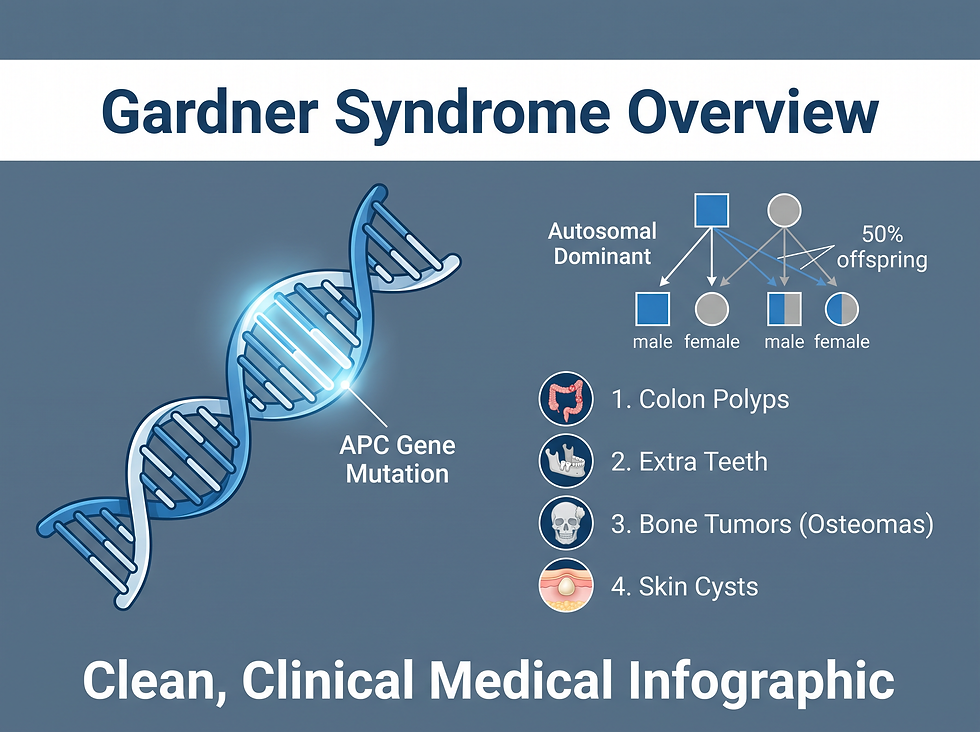
Gardner syndrome is a complex genetic disorder that places individuals at an extremely high risk for colorectal cancer. It is considered a subset of Familial Adenomatous Polyposis (FAP), but it is distinguished by the presence of symptoms outside the gastrointestinal tract. The condition is inherited in an autosomal dominant pattern, meaning a child has a 50% chance of inheriting the disorder if one parent carries the mutated gene.
The primary concern for those with Gardner syndrome is the development of adenomatous polyps in the colon and rectum. These polyps typically begin to appear during the teenage years. Without treatment, the transition from benign polyps to malignant cancer is virtually certain by age 40. However, the syndrome also involves a unique constellation of dental, skeletal, and dermatological findings that often appear before the colon polyps become symptomatic.
Genetic cause: Mutation in the APC tumor suppressor gene.
Inheritance pattern: Autosomal dominant (inherited from a biological parent).
Prevalence: Approximately 1 in 1,000,000 people in the U.S.
Primary risk: Nearly 100% lifetime risk of colon cancer without treatment.
Extracolonic signs: Extra teeth, osteomas (bone tumors), skin cysts, and desmoid tumors.
How Common Is Gardner Syndrome?
Gardner syndrome is classified as a rare disease. In the United States, it affects roughly one person in every million. Because it is an inherited disorder, it tends to run in families. Most individuals diagnosed with the condition have at least one biological parent who also has the syndrome, although new (de novo) mutations can occur in individuals without a family history.
Symptoms of Gardner Syndrome
The symptoms of Gardner syndrome are diverse and often develop in stages throughout a person's life. Some signs may be present in early childhood, while others, like colon polyps, may not be detected until adolescence or early adulthood.
Early and Extracolonic Symptoms
These symptoms often serve as the first clues for healthcare providers to investigate a potential diagnosis of Gardner syndrome.
Dental: Extra (supernumerary) teeth, impacted teeth, or missing teeth.
Skeletal: Osteomas (benign bone tumors), typically found on the jaw or skull.
Skin and soft tissue: Epidermoid cysts (cysts under the skin), lipomas, fibromas, and desmoid tumors.
Ocular: CHRPE (congenital hypertrophy of retinal pigment epithelium), which appears as dark spots on the retina.
Gastrointestinal Symptoms
While polyps are the most dangerous aspect of the syndrome, they often remain asymptomatic for years.
Multiple colon polyps: Hundreds to thousands of small growths in the lining of the large intestine.
Changes in bowel habits: Diarrhea or constipation (often occurring only when the condition is advanced).
Rectal bleeding: Blood in the stool or unexplained anemia.
Abdominal pain: Cramping or discomfort associated with large polyps or tumor growth.

Causes and Risk Factors
The underlying cause of Gardner syndrome is a mutation in the APC (adenomatous polyposis coli) gene. This gene is a tumor suppressor, meaning its normal function is to regulate cell division and prevent cells from multiplying too quickly. When the APC gene is mutated, cells—particularly those in the colon—can grow uncontrollably, leading to the formation of polyps and eventually cancer.
Family history: Having a parent with Gardner syndrome or FAP is the strongest risk factor.
APC gene mutation: Carrying the specific genetic marker confirms the risk of developing the syndrome.
Age: While the mutation is present at birth, polyps usually begin to appear in the teens.
Potential Complications
The most significant complication of Gardner syndrome is the development of cancer. While colon cancer is the most frequent, individuals are also at risk for several other malignancies and noncancerous but aggressive tumors.
Colorectal cancers: Colon cancer, rectal cancer.
Other cancers: Stomach cancer, liver cancer (hepatoblastoma), thyroid cancer.
Desmoid tumors: Aggressive, noncancerous tumors in soft tissues that can compress organs.
Gastrointestinal: Intestinal obstruction, severe bleeding, malabsorption.
Diagnosis of Gardner Syndrome
Early diagnosis is essential for preventing the progression to cancer. Healthcare providers use a combination of family history, clinical examinations, and specialized tests to confirm the condition.
Diagnostic Tools
Genetic testing: The most definitive method, involving a blood test to look for mutations in the APC gene.
Colonoscopy/sigmoidoscopy: Visual examination of the colon to count and evaluate polyps.
Endoscopy: Examination of the stomach and upper intestine to check for adenomas.
Dental X-rays: To identify extra teeth or osteomas in the jaw.
Eye exams: Specialized retinal exams to look for CHRPE.
Treatment and Management
There is no cure for the underlying genetic mutation in Gardner syndrome. Instead, treatment focuses on managing symptoms, removing polyps, and preventing cancer.
Surgical Interventions
Surgery is the only way to effectively eliminate the risk of colorectal cancer in individuals with hundreds of polyps.
Colectomy: Removal of part or all of the colon (large intestine).
Proctocolectomy: Removal of both the colon and the rectum.
Dental procedures: Removal of extra teeth and realignment of remaining teeth.
Medical and Supportive Care
Medications: Certain drugs may be used to slow the growth of polyps or desmoid tumors.
Chemotherapy: Used for aggressive desmoid tumors that cannot be surgically removed.
Regular monitoring: Frequent screenings (often annually) for various cancers.

Outlook and Prognosis
The outlook for individuals with Gardner syndrome has improved significantly with modern screening and surgical techniques. Without treatment, the life expectancy is shortened due to the inevitable development of colon cancer. However, for those who undergo proactive surgery (like a proctocolectomy), the risk of colon cancer can be virtually eliminated. Studies show that 100% of people who receive appropriate surgical intervention are alive five years after diagnosis. Life after surgery requires adaptations to changes in digestion and bowel habits, but many individuals lead full, active lives.
Prevention Strategies
Because Gardner syndrome is an inherited genetic condition, it cannot be prevented. However, the complications—specifically cancer—are highly preventable through:
Early genetic screening: Testing children of affected parents to identify the mutation before symptoms appear.
Proactive surveillance: Starting colonoscopies and endoscopies at a young age (often beginning at age 10-12).
Prophylactic surgery: Removing the colon before polyps have a chance to turn into cancer.
When to See a Healthcare Provider
If you have a family history of Gardner syndrome or FAP, you should consult a genetic counselor or healthcare provider as soon as possible. Additionally, seek medical attention if you notice any new or unusual symptoms.
Contact a provider if you notice:
Blood in your stool.
A new lump under your skin.
Changes in bowel habits lasting weeks.
Extra teeth or jaw lumps.
Seek emergency care if:
You have severe, unrelenting abdominal pain.
You experience uncontrolled rectal bleeding.
You feel faint or extremely weak.
You have a rapid heart rate and severe distress.
A Note from the Care Team
Gardner syndrome is a rare inherited condition that may affect you in many different ways. Gardner syndrome causes many symptoms, from having extra teeth and noncancerous bone tumors to developing hundreds of colon polyps that become colon cancer. If genetic tests show you have Gardner syndrome, you’ll need regular screening tests to catch cancer and other issues early on. If you have many colon polyps from Gardner syndrome, you may need surgery that can eliminate the risk of colon cancer but may also affect your lifestyle. Your healthcare providers can recommend screening tests to catch issues early on and treatments to reduce your risk of serious illness and support you throughout.
Frequently Asked Questions (FAQ)
What is the difference between FAP and Gardner syndrome?
Gardner syndrome is a variant of Familial Adenomatous Polyposis (FAP). While both cause hundreds of colon polyps, Gardner syndrome also includes symptoms outside the colon, such as bone tumors and extra teeth.
Is Gardner syndrome cancer?
No, Gardner syndrome itself is a genetic disorder, but it causes polyps that have a nearly 100% chance of becoming colon cancer if not treated.
At what age do symptoms usually start?
Extracolonic signs like extra teeth or bone tumors can appear in childhood. Colon polyps usually begin to develop during the teenage years.
Can I have Gardner syndrome if my parents don't?
Most cases are inherited, but about 20-30% of cases result from a new (de novo) mutation in the APC gene, meaning the parents are not affected.
What is an osteoma?
An osteoma is a noncancerous (benign) bone tumor. In Gardner syndrome, these are commonly found on the jaw (mandible) or skull.
How often should I get a colonoscopy?
For those with a confirmed APC mutation, screenings often begin between ages 10 and 12 and occur annually until surgery is performed.
What are desmoid tumors?
Desmoid tumors are noncancerous but aggressive growths in soft tissues. They can be difficult to treat because they tend to recur and can press on vital organs.
Does Gardner syndrome affect the eyes?
Yes, it can cause dark spots on the retina called CHRPE. These do not affect vision but are a clinical marker for the syndrome.
Can surgery cure Gardner syndrome?
Surgery cannot cure the genetic mutation, but removing the colon and rectum can prevent the development of colorectal cancer.
What is the APC gene?
The APC gene is a tumor suppressor gene. Its job is to keep cell growth in check. A mutation in this gene leads to the uncontrolled cell growth seen in Gardner syndrome.
Are the skin cysts in Gardner syndrome dangerous?
The epidermoid cysts themselves are usually noncancerous, but their presence is an important sign that helps in diagnosing the underlying syndrome.
Will I need a colostomy bag after surgery?
Not necessarily. Many modern surgeries allow for an internal "pouch" to be created, though some individuals may require a permanent or temporary ostomy.
Can Gardner syndrome affect my stomach?
Yes, individuals are at an increased risk for stomach and small intestine polyps (adenomas) and stomach cancer.
Should my children be tested?
Yes, if you have the APC mutation, your children have a 50% chance of inheriting it. Genetic counseling is highly recommended.
Is there a special diet for Gardner syndrome?
While diet cannot prevent polyps, a healthy, high-fiber diet is generally recommended for overall colon health, though surgical requirements may change dietary needs.
References
Medical Disclaimer: The information provided in this article is for educational purposes only and should not be considered medical advice. Always seek the advice of a qualified healthcare provider with any questions you may have regarding a medical condition. If you are experiencing a medical emergency, call 911 or your local emergency services immediately.
Comments