Facet Hypertrophy: Symptoms, Causes, Complications, Diagnosis, Treatment and Outlook — What You Need to Know

Updated: 2 days ago
Medically reviewed by Dr. Baraa Alnahhal, MD · Last reviewed: September 2026
Quick Answer
Facet hypertrophy is the thickening and inflammation of the small facet joints between your spine bones (vertebrae), usually caused by wear and tear. As the cartilage cushion wears away, bone rubs on bone, triggering joint overgrowth. It most often causes aching pain that worsens with standing, arching, leaning or twisting, along with stiffness, spasms and reduced motion, and it may not always cause symptoms. The joint changes can't be reversed, but physical therapy, medications, injections, radiofrequency ablation and — rarely — surgery can manage symptoms. Get urgent care for sudden arm or leg weakness, numbness, or bowel/bladder changes.
TL;DR: Facet Hypertrophy at a Glance
Facet hypertrophy (facet joint hypertrophy) happens when the small facet joints in your spine enlarge and become inflamed, most often due to wear and tear. Facet joints stabilize your spine and guide movement, and their ends are lined with smooth cartilage that aging or overuse can wear down. When cartilage wears away, bone rubs on bone and triggers joint overgrowth.
Not every case causes symptoms. When it does, expect aching pain that can radiate to the buttocks and thighs (but not below the knee), stiffness, spasms and pain that may feel worse after rest and better with gentle movement.
The enlargement can't be undone. Treatment focuses on managing pain — from heat and ice to physical therapy, medications, nerve procedures and, rarely, surgery.
Limitation statement: The referenced clinical source publishes no prevalence, incidence, or outcome statistics for facet hypertrophy. No statistics are invented in this article.
Seek urgent medical care: Get medical help right away if you notice sudden weakness or numbness in your arms or legs, or if you have changes in bowel or bladder function. These can be signs that an overgrown joint is pressing on nerves or your spinal cord.
Fact | What the source says |
What it is | Small facet joints in your spine enlarge and inflame |
Main driver | Wear and tear — cartilage wears away, bone rubs on bone, joint overgrowth |
Spinal levels | Cervical (neck), thoracic (mid-back), lumbar (lower back) |
Symptoms | Aching pain, stiffness, spasms, reduced range of motion — not all cases cause symptoms |
Pain pattern | May radiate to buttocks and thighs, but not below the knee; worse after rest, improves with gentle movement |
Reversibility | Cannot be reversed; changes from arthritis are usually permanent |
Symptom severity | Ranges from none to severe; treatment manages symptoms |
What Is Facet Hypertrophy?
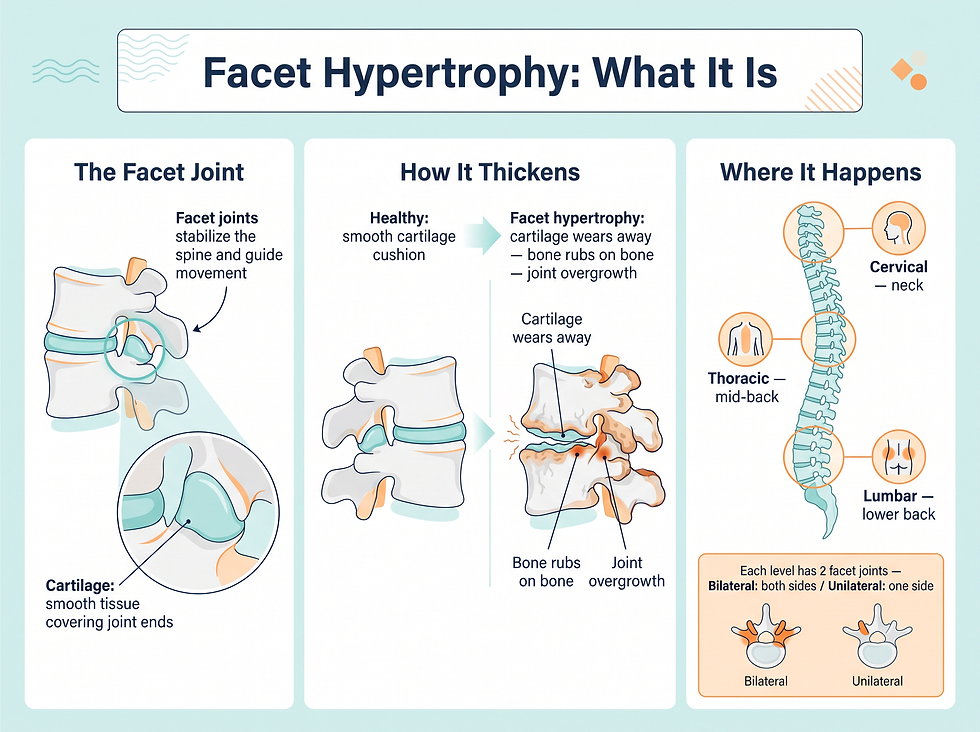
Facet hypertrophy, or facet joint hypertrophy, happens when the small joints called facets between your spine bones (vertebrae) enlarge and inflame. It's often due to wear and tear. These joints help stabilize your spine and guide movement.
Cartilage is the smooth tissue covering the ends of your facet joints. Aging or overuse can wear it down. This lets bone rub on bone and triggers joint overgrowth.
Facet hypertrophy can cause pain, stiffness or spasms. A healthcare provider can help you manage these issues so they interfere less with your daily routine.
Where does facet hypertrophy happen?
Facet joints run all along your spine. They're found in each segment, including your neck, mid-back and lower back. Each level of your spine has two facet joints, one on each side.
Your provider may describe the location as bilateral (affecting both sides) or unilateral (affecting one side).
Key Fact | Detail |
Facets | Small joints between your spine bones (vertebrae) |
Joint function | Stabilize the spine and guide movement |
Cartilage | Smooth tissue covering the ends of facet joints |
Breakdown sequence | Aging or overuse wear cartilage down → bone rubs on bone → joint overgrowth |
Facets per spinal level | Two — one on each side |
Location terms | Bilateral (both sides) or unilateral (one side) |
Common results | Pain, stiffness or spasms |
Spinal Region | Where the Facets Are |
Cervical spine | Neck |
Thoracic spine | Mid-back |
Lumbar spine | Lower back |
What Are the Symptoms of Facet Hypertrophy?
Not all cases of facet joint hypertrophy cause symptoms, but facet joint hypertrophy from wear and tear can be a source of pain. You may notice:
Aching, dull or throbbing pain at the joint.
Pain or discomfort when standing for a while, arching your back, leaning or twisting.
Reduced range of motion.
Spasms.
Stiffness.
Tenderness to the touch.
Pain from these joints may also appear in other areas of your body. This is called referred pain. It means you feel it somewhere different from where the pain starts. Pain can also radiate, or spread, from the joint itself. Pain from the facet joints can radiate to your butt and thighs. Keep in mind, this pain won't radiate below your knee.
Many people find the pain feels worse after rest, like first thing in the morning. But it may improve with gentle movement.
Symptom | What You May Experience |
Pain at the joint | Aching, dull or throbbing |
Pain triggers | Standing for a while, arching your back, leaning or twisting |
Movement | Reduced range of motion |
Muscles | Spasms |
Stiffness | Stiffness in the affected area |
Touch | Tenderness to the touch |
Referred pain | Pain appears somewhere different from where it starts |
Radiating pain | Spreads from the joint to the buttocks and thighs — but not below the knee |
Timing pattern | Worse after rest (e.g., first thing in the morning); may improve with gentle movement |
Note | Not all cases cause symptoms |
What Causes Facet Hypertrophy?
Facet hypertrophy happens when a facet joint breaks down. This occurs as the cartilage that lines and cushions your spinal bones wears away over time. Everyone's spine changes with age, but other factors can also play a role, including:
Overweight or obesity.
Poor posture.
Previous spine injuries.
Repetitive strain from heavy lifting.
Cause | How It Contributes |
Aging | Cartilage that lines and cushions spinal bones wears away over time; everyone's spine changes with age |
Overweight or obesity | Extra load on the facet joints |
Poor posture | Adds strain to the joints |
Previous spine injuries | Can accelerate joint breakdown |
Repetitive strain from heavy lifting | Repeated heavy lifting strains the joints |

What Are the Complications of Facet Hypertrophy?
Your spinal canal (the bony tunnel that holds your spinal cord) has limited space. If a facet joint grows too large, it may cause your spinal canal to narrow, and it can press on nearby nerves or your spinal cord. Fluid-filled cysts can also form near your joint. In some cases, joint degeneration can cause slippage of one vertebra over another (spondylolisthesis).
These changes can affect both movement and feeling. You may notice trouble walking, numbness or weakness in your arms and legs. In severe cases, it may also cause bowel or bladder problems. These symptoms are important to watch for, so let your provider know if they happen.
Complication | What It Is |
Spinal canal narrowing | An overgrown joint can narrow the bony tunnel that holds the spinal cord |
Nerve or spinal cord pressure | A large joint can press on nearby nerves or the spinal cord |
Fluid-filled cysts | Cysts can form near the joint |
Spondylolisthesis | Slippage of one vertebra over another caused by joint degeneration |
Movement effects | Trouble walking, numbness or weakness in arms and legs |
Severe cases | Bowel or bladder problems — tell your provider right away |
How Is Facet Hypertrophy Diagnosed?
A healthcare provider usually starts with a physical exam and a review of your medical history. They'll ask about your symptoms. They may gently press on your spine to check where the pain comes from or have you do different movements to see what creates the pain.
To get a better look at your joints, your provider may order imaging tests like x-rays, a CT scan or MRI. The imaging test helps your provider see the enlarged joint to confirm the diagnosis.
What are the stages of facet joint hypertrophy?
Imaging tests can show how much a facet joint thickens. Your provider may grade it as mild, moderate or severe. This grading helps guide treatment and track changes over time.
Keep in mind that a worse grade doesn't always mean worse pain. It's just describing how it looks in the images.
Diagnostic Step | What Happens |
Medical history | Your provider reviews your history and asks about your symptoms |
Physical exam | Gentle pressing on your spine to check where the pain comes from; movement tests to see what creates the pain |
X-rays | Imaging test to get a better look at the joints |
CT scan | Imaging test to get a better look at the joints |
MRI | Imaging test to get a better look at the joints |
Confirmation | Imaging shows the enlarged joint |
Grade | Meaning |
Mild | Joint thickening is minor |
Moderate | Joint thickening is in between |
Severe | Joint thickening is extensive |
Important note | A worse grade doesn't always mean worse pain — it only describes how the joint looks in the images |
What Is the Treatment for Facet Hypertrophy?
Treatment depends on how severe the condition is. Options may include:
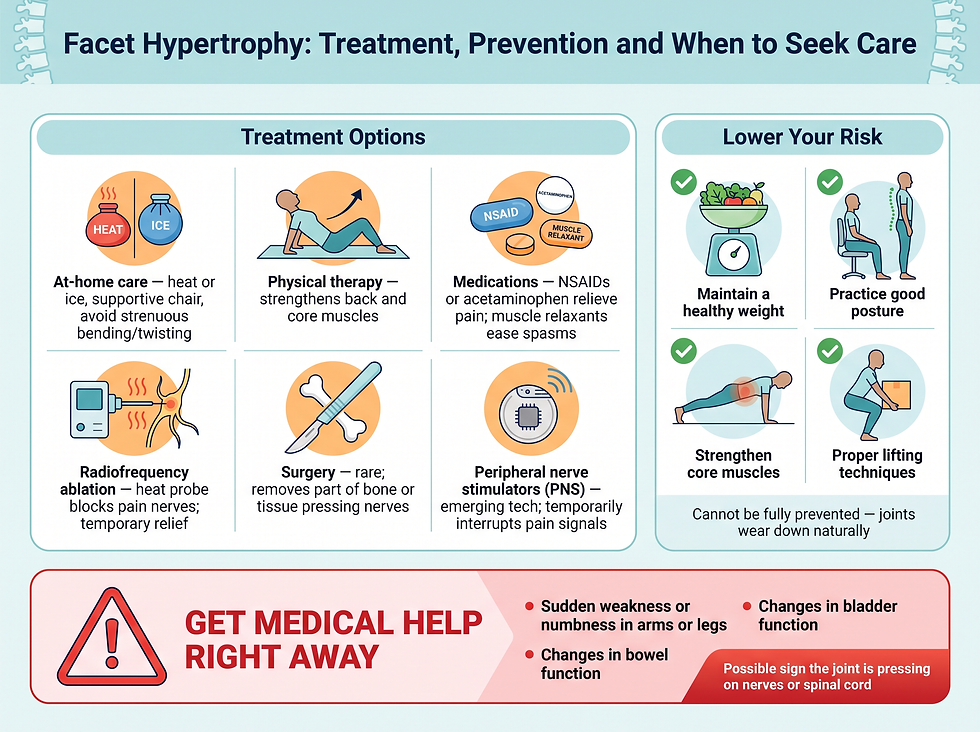
At-home care: You might try using heat or ice on the affected area for a short period, sitting in a supportive chair or avoiding strenuous activities that involve bending and twisting.
Physical therapy: Exercises strengthen the muscles around your back and core to support your spine.
Medications: NSAIDs (like ibuprofen or naproxen) or acetaminophen relieve pain. Muscle relaxants may ease spasms.
Radiofrequency ablation: A probe uses heat to block the nerves that carry pain signals from the joint. Relief is temporary.
Surgery: This option is rare but may help if other treatments don't work. A surgeon may decompress the affected area by removing part of the bone or tissue pressing on nerves.
Emerging technology: A provider may temporarily place peripheral nerve stimulators (PNS) next to the nerves that carry pain signals from your joints. This interrupts pain signals and reprograms how you feel the pain. Relief is temporary.
Treatment | How It Helps |
At-home care | Heat or ice for a short period; supportive chair; avoid strenuous bending and twisting |
Physical therapy | Exercises strengthen muscles around the back and core to support the spine |
NSAIDs (ibuprofen, naproxen) | Relieve pain |
Acetaminophen | Relieves pain |
Muscle relaxants | May ease spasms |
Radiofrequency ablation | Heat probe blocks the nerves carrying pain signals from the joint; relief is temporary |
Surgery | Rare option; decompresses the affected area by removing part of the bone or tissue pressing on nerves |
Peripheral nerve stimulators (PNS) | Emerging technology; temporarily placed next to pain nerves to interrupt signals and reprogram how you feel pain; relief is temporary |
What Can I Expect If I Have Facet Hypertrophy?
There isn't a single experience that fits everyone. You might not have any symptoms, only have mild symptoms or have severe ones that affect your daily routine.
Joint changes from arthritis are usually permanent. The condition may slowly get worse. Even though treatment can't reverse the damage, it can help manage symptoms if you have them. You may need small lifestyle adjustments and occasional treatments throughout the year to manage your symptoms.
A healthcare provider can help you find the treatment plan that works best for you.
Outlook Factor | What the Source Says |
Symptom experience | No single experience — no symptoms, mild, or severe enough to affect daily routine |
Permanence | Joint changes from arthritis are usually permanent |
Progression | May slowly get worse |
Treatment goal | Can't reverse the damage, but can help manage symptoms |
Ongoing care | Small lifestyle adjustments and occasional treatments throughout the year |
Can Facet Hypertrophy Be Prevented?
You can't fully prevent facet joint hypertrophy because your facet joints naturally wear down over time. But you can lower your risk by:
Maintaining a weight that's healthy for you.
Practicing good posture.
Strengthening your core muscles to support your spine.
Using proper lifting techniques for heavy objects.
Prevention Step | Detail |
Weight | Maintain a weight that's healthy for you |
Posture | Practice good posture |
Core strength | Strengthen your core muscles to support your spine |
Lifting | Use proper lifting techniques for heavy objects |
Limit | Cannot be fully prevented — facet joints naturally wear down over time |
When Should I See My Healthcare Provider?
See a healthcare provider if you have ongoing back or neck pain. Let them know if it doesn't improve or gets worse after home care, like rest or over-the-counter pain relievers.
Seek urgent medical care right away if you notice sudden weakness or numbness in your arms or legs, or if you have changes in bowel or bladder function.
Situation | Action |
Ongoing back or neck pain | See a healthcare provider |
Pain not improving or worsening after home care (rest, OTC pain relievers) | See a healthcare provider |
Sudden weakness or numbness in arms or legs | Get medical help right away |
Changes in bowel or bladder function | Get medical help right away |
What the care team says (verbatim): "Facet hypertrophy is one of those conditions that tends to sneak up on you. These joints aren't visible, so it's hard to notice the years of wear and tear that happen to them. But if you're constantly waking up stiff and uncomfortable when standing, it's time to talk to a healthcare provider. Even though changes from this condition can't be undone, there are ways to manage the pain and improve your movement. With the right support — from lifestyle changes and medications to a procedure — you can take steps to feel more comfortable."
Conclusion: Manageable, Even When It Can't Be Undone
Facet hypertrophy is the enlargement and inflammation of the small facet joints that stabilize your spine and guide its movement. When the cartilage covering these joints wears away through aging or overuse, bone rubs on bone and triggers joint overgrowth — most often in the neck, mid-back or lower back.
Not everyone develops symptoms. When pain occurs, it is typically aching, worsened by standing, arching, leaning or twisting, and it can radiate to the buttocks and thighs but not below the knee. Overgrowth can eventually narrow the spinal canal and press on nerves, which is why sudden weakness, numbness or bowel/bladder changes demand immediate medical attention.
The joint changes are permanent and can't be reversed, but they are highly manageable — through at-home care, physical therapy, medications, radiofrequency ablation and, when necessary, surgery.
Take these three steps:
Get an accurate diagnosis — if back or neck pain lingers or worsens despite rest and over-the-counter relievers, see a provider, who can confirm facet hypertrophy with an exam and imaging (x-rays, CT or MRI).
Start with conservative care — heat or ice, a supportive chair, activity changes, physical therapy and pain relievers often manage symptoms without procedures.
Protect your spine daily — maintain a healthy weight, practice good posture, strengthen your core and lift with proper technique, and report any new numbness, weakness or bowel/bladder changes right away.
This article provides general information and is not a substitute for professional medical advice. Always consult a qualified healthcare provider for diagnosis and treatment.
Frequently Asked Questions
What is facet hypertrophy?
Facet hypertrophy, or facet joint hypertrophy, happens when the small joints called facets between your spine bones (vertebrae) enlarge and inflame. It's often due to wear and tear.
What are facet joints?
Facets are the small joints between your spine bones (vertebrae). They help stabilize your spine and guide movement.
What is cartilage in the facet joints?
Cartilage is the smooth tissue covering the ends of your facet joints.
Why do facet joints enlarge?
Aging or overuse can wear cartilage down. This lets bone rub on bone and triggers joint overgrowth.
Does facet hypertrophy always cause symptoms?
No. Not all cases of facet joint hypertrophy cause symptoms.
What does facet hypertrophy pain feel like?
You may notice aching, dull or throbbing pain at the joint.
What movements trigger facet hypertrophy pain?
Pain or discomfort when standing for a while, arching your back, leaning or twisting.
Does facet hypertrophy cause stiffness?
Yes. Stiffness is one of the common symptoms.
Does facet hypertrophy cause spasms?
Yes. Spasms can occur along with pain and stiffness.
Is the joint tender to the touch?
Yes. Tenderness to the touch is one of the common symptoms.
Does facet hypertrophy reduce range of motion?
Yes. Reduced range of motion is one of the common symptoms.
What is referred pain in facet hypertrophy?
Referred pain means pain from the joints appears in other areas of your body — you feel it somewhere different from where the pain starts.
Where does facet hypertrophy pain radiate?
Pain from the facet joints can radiate to your butt and thighs.
Can facet hypertrophy pain go below the knee?
No. This pain won't radiate below your knee.
When does facet hypertrophy pain feel worse?
Many people find the pain feels worse after rest, like first thing in the morning. But it may improve with gentle movement.
What causes facet hypertrophy?
It happens when a facet joint breaks down, as the cartilage that lines and cushions your spinal bones wears away over time. Everyone's spine changes with age, but overweight or obesity, poor posture, previous spine injuries and repetitive strain from heavy lifting can also play a role.
Does extra weight raise facet hypertrophy risk?
Yes. Overweight or obesity is one of the factors that can play a role in facet joint breakdown.
Does posture affect facet hypertrophy?
Yes. Poor posture is one of the factors that can play a role.
Can a previous spine injury cause facet hypertrophy?
Yes. Previous spine injuries are one of the factors that can play a role.
Where in the spine does facet hypertrophy occur?
Facet joints run all along your spine — in the neck (cervical spine), mid-back (thoracic spine) and lower back (lumbar spine). Each level has two facet joints, one on each side.
What does bilateral mean?
Bilateral means the condition is affecting both sides.
What does unilateral mean?
Unilateral means the condition is affecting one side.
What complications can facet hypertrophy cause?
An overgrown joint may narrow the spinal canal and press on nearby nerves or the spinal cord. Fluid-filled cysts can form near the joint, and joint degeneration can cause one vertebra to slip over another (spondylolisthesis).
Can facet hypertrophy affect walking?
Yes. These changes can affect movement and feeling — you may notice trouble walking, numbness or weakness in your arms and legs.
Can facet hypertrophy cause bowel or bladder problems?
In severe cases, it may cause bowel or bladder problems. Let your provider know if this happens.
How is facet hypertrophy diagnosed?
A provider usually starts with a physical exam and a review of your medical history — asking about symptoms, gently pressing on your spine, and having you do different movements. Imaging tests like x-rays, a CT scan or MRI help confirm the diagnosis by showing the enlarged joint.
What are the stages of facet joint hypertrophy?
Imaging tests show how much a facet joint thickens. Your provider may grade it as mild, moderate or severe. This grading helps guide treatment and track changes over time.
Does a worse grade mean more pain?
No. A worse grade doesn't always mean worse pain. It's just describing how the joint looks in the images.
Can facet hypertrophy be treated at home?
Yes. At-home care includes using heat or ice on the affected area for a short period, sitting in a supportive chair and avoiding strenuous activities that involve bending and twisting.
Does physical therapy help facet hypertrophy?
Yes. Exercises strengthen the muscles around your back and core to support your spine.
What medications treat facet hypertrophy?
NSAIDs (like ibuprofen or naproxen) or acetaminophen relieve pain. Muscle relaxants may ease spasms.
What is radiofrequency ablation?
A probe uses heat to block the nerves that carry pain signals from the joint. Relief is temporary.
When is surgery used for facet hypertrophy?
Surgery is rare but may help if other treatments don't work. A surgeon may decompress the affected area by removing part of the bone or tissue pressing on nerves.
What are peripheral nerve stimulators?
An emerging technology in which a provider temporarily places stimulators next to the nerves that carry pain signals from your joints. This interrupts pain signals and reprograms how you feel the pain. Relief is temporary.
Can facet hypertrophy be prevented?
You can't fully prevent it because your facet joints naturally wear down over time. But you can lower your risk by maintaining a healthy weight, practicing good posture, strengthening your core muscles and using proper lifting techniques.
What can I expect if I have facet hypertrophy?
There isn't a single experience that fits everyone — you might not have any symptoms, only have mild symptoms or have severe ones that affect your daily routine. Joint changes from arthritis are usually permanent, the condition may slowly get worse, and treatment can help manage symptoms.
Is facet hypertrophy permanent?
Joint changes from arthritis are usually permanent. Treatment can't reverse the damage, but it can help manage symptoms.
When should I see my healthcare provider?
See a provider if you have ongoing back or neck pain, or if it doesn't improve or gets worse after home care, like rest or over-the-counter pain relievers.
When should I get urgent medical care?
Get medical help right away if you notice sudden weakness or numbness in your arms or legs, or if you have changes in bowel or bladder function.
Additional Resources
For further reading, these authoritative external references support the information above:
Comments