Facet Arthropathy: Symptoms, Causes, Complications, Diagnosis, Treatment and Outlook — What You Need to Know

Updated: 2 days ago
Medically reviewed by Dr. Baraa Alnahhal, MD · Last reviewed: September 2026
Quick Answer
Facet arthropathy is arthritis in the small joints of your spine called facet joints, which give your spine support and stability and guide bending and twisting. As the cartilage cushion wears away, bones rub together, causing back or neck pain that typically worsens with extension and rotation, along with stiffness and tenderness. It most often develops with age, injuries, overuse, excess weight or repetitive twisting. While the joint damage cannot be reversed, treatments range from physical therapy and pain relievers to facet joint injections, radiofrequency ablation and — when nerves are compressed — surgery. See a provider for chronic back pain that won't improve.
TL;DR: Facet Arthropathy at a Glance
Facet arthropathy is arthritis of the small facet joints in your spine. These joints support and stabilize the spine and guide its movement as you bend and twist. The ends of your spinal bones are covered with smooth cartilage that works like a cushion, and over time that cartilage can wear away, leaving bones to rub against each other.
The result is back or neck pain near the spine that often worsens with extension and rotation, plus stiffness and tenderness. Bone spurs and fluid-filled cysts can form as the damage progresses.
You cannot fully prevent facet arthropathy — everyone's facet joints wear down a bit with age — and once the joints start to degenerate, the damage cannot be reversed. But treatment can manage symptoms, from physical therapy and medications to injections, nerve-calming procedures and, in some cases, surgery.
Limitation statement: The referenced clinical source publishes no prevalence, incidence, or outcome statistics for facet arthropathy. No statistics are invented in this article.
Fact | What the source says |
What it is | Arthritis in the small facet joints of your spine |
Role of facet joints | Give spine support and stability; guide bending and twisting |
What breaks down | Cartilage — the smooth cushion tissue on the ends of spinal bones |
Main symptom | Pain near the spine, usually worse with extension and rotation |
Reversibility | Joint degeneration cannot be reversed once it starts |
Prevention | Cannot be fully prevented; risk can be lowered |
Prognosis | Usually worsens over time, but symptoms are manageable |

What Is Facet Arthropathy?
Facet arthropathy is a type of arthritis that affects the small joints in your spine. Facet joints give your spine support and stability. They also guide movement, allowing you to bend and twist.
The ends of your spinal bones are covered with a smooth tissue called cartilage. It works like a cushion for your joints. Over time, cartilage can wear away. This makes your bones rub against each other.
As a result, bone spurs (extra bone growths) and, sometimes, cysts (fluid-filled sacs) form.
If you have facet arthropathy, you might feel back or neck pain that gets worse when you make certain bending and twisting movements.
A healthcare provider can help you manage the chronic pain that this condition causes.
Key Fact | Detail |
Condition | Facet arthropathy — arthritis of the facet joints |
Facet joints | Small joints in your spine |
Joint function | Support and stability; guide bending and twisting |
Cartilage | Smooth tissue covering the ends of spinal bones; works like a cushion |
What happens | Cartilage wears away → bones rub together |
Resulting growths | Bone spurs (extra bone) and sometimes cysts (fluid-filled sacs) |
Typical pain pattern | Back or neck pain worse with certain bending and twisting movements |
Are there different types of facet arthropathy?
There aren't specific types. You may instead hear your provider use terms to describe the location of the affected joint.
Term | Location |
Cervical facet arthropathy | Located in your neck |
Thoracic facet arthropathy | Located in your mid back |
Lumbar facet arthropathy | Located in your lower back |
There are also two ways arthritis affects each joint.
Term | Meaning |
Bilateral | Targets both left and right sides |
Unilateral | Targets only one side |
What Are the Symptoms of Facet Arthropathy?
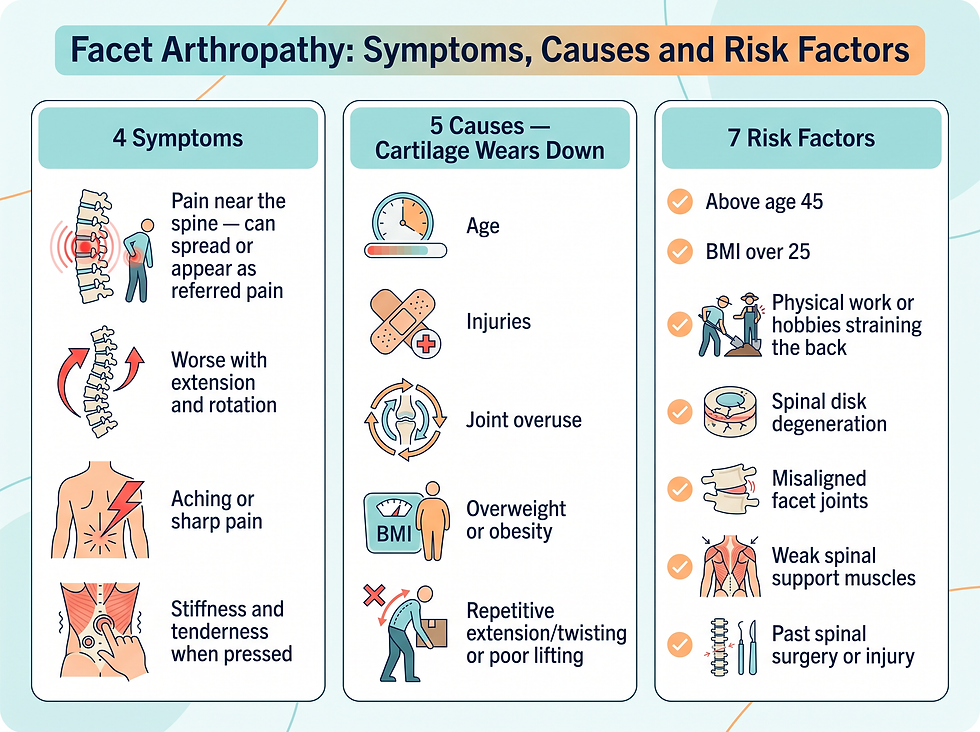
Pain near your spine is the main symptom. It usually affects the area around the joint but can spread to nearby areas. Sometimes, you may feel referred pain. This means the pain shows up in a different part of your body than where it starts.
When you have facet arthropathy, you might feel:
Aching or sharp pain.
Pain that gets worse with extension and rotation.
Stiffness.
Tenderness when pressed.
Symptom | What You May Experience |
Main symptom | Pain near your spine |
Pain location | Usually around the joint; can spread to nearby areas; may appear as referred pain in a different body part |
Pain quality | Aching or sharp |
Pain trigger | Gets worse with extension and rotation |
Stiffness | Stiffness in the affected area |
Tenderness | Tender when pressed |
What Causes Facet Arthropathy?
Facet arthropathy usually develops when the cartilage that cushions your facet joints wears down. This breakdown makes movement painful.
The most common reasons for this include:
Age.
Injuries.
Joint overuse.
Overweight or obesity.
Repetitive extension/twisting or poor lifting habits.
Cause | How It Contributes |
Age | Cartilage naturally wears down over time |
Injuries | Damage can accelerate cartilage breakdown |
Joint overuse | Repeated stress wears the cushion away |
Overweight or obesity | Extra load strains the facet joints |
Repetitive extension/twisting or poor lifting | Habits that repeatedly stress the joints speed wear |
What increases your risk?
You may have a higher risk of this condition if you:
Are above age 45.
Have a BMI over 25.
Do physical work or hobbies that strain your back.
Have spinal disk degeneration (loss of disk height).
Have misaligned facet joints (extra stress on the joint).
Have weak spinal support muscles.
Had a past spinal surgery or injury.
Risk Factor | Category |
Above age 45 | Age |
BMI over 25 | Weight |
Physical work or hobbies that strain your back | Lifestyle |
Spinal disk degeneration (loss of disk height) | Spine health |
Misaligned facet joints (extra stress on the joint) | Spine structure |
Weak spinal support muscles | Muscle strength |
Past spinal surgery or injury | Medical history |
What Are the Complications of Facet Arthropathy?
When the cartilage breaks down, your bones may rub against each other. This can lead to:
Bone spurs.
Fluid-filled cysts.
Limited mobility.
Muscle spasms.
Spinal canal narrowing (spinal stenosis).
Vertebra slipping forward (degenerative spondylolisthesis).
In rare cases, it may also cause spinal cord compression or cauda equina syndrome. Symptoms of these conditions can include arm or leg weakness or problems with bowel and bladder control.
Complication | What It Is |
Bone spurs | Extra bone growths |
Fluid-filled cysts | Cysts that form as joints degenerate |
Limited mobility | Reduced ability to move |
Muscle spasms | Involuntary muscle contractions |
Spinal stenosis | Spinal canal narrowing |
Degenerative spondylolisthesis | Vertebra slipping forward |
Rare: spinal cord compression (myelopathy) | Can cause arm or leg weakness or bowel/bladder control problems |
Rare: cauda equina syndrome | Can cause arm or leg weakness or bowel/bladder control problems |
How Is Facet Arthropathy Diagnosed?
A healthcare provider diagnoses facet arthropathy with a physical exam and tests. They'll ask about your symptoms and medical history. Then, they'll press gently on your spine to find the source of pain.
To see the joints more clearly, they may order imaging tests, like a CT scan or MRI.
To confirm the diagnosis, your provider may inject a numbing medication into the nerves that supply the affected joint. If your pain improves while the medication is active, it shows that facet arthropathy is the cause.
Diagnostic Step | What Happens |
Medical history | Your provider asks about your symptoms and medical history |
Physical exam | Your provider presses gently on your spine to find the source of pain |
CT scan | Imaging test that shows the joints more clearly |
MRI | Imaging test that shows the joints more clearly |
Confirming test | Numbing medication injected into the nerves supplying the affected joint; pain improvement while the medication is active confirms facet arthropathy |
How do providers grade the severity?
Your provider may use a grading system to describe how severe the condition is.
Grade | Description |
Grade 1 (normal) | No damage to your facet joint |
Grade 2 (mild) | Small, noticeable changes in your joint |
Grade 3 (moderate) | Some joint wear, thickening and possible bone spurs |
Grade 4 (severe) | A lot of joint damage with severe cartilage loss and bone spurs |
Different providers use different grading systems. Speak up if you're not sure what your diagnosis means.
What Is the Treatment for Facet Arthropathy?
Treatment for facet arthropathy may include physical therapy, medications, ergonomic adjustments and activity changes.
Physical therapy strengthens your core and back muscles to support your spine.
Medications include pain relievers like NSAIDs (ibuprofen or naproxen) or acetaminophen to reduce pain and inflammation. Some antidepressants, like tricyclics or SNRIs, can also help with chronic pain.
Ergonomic adjustments such as sitting in a supportive chair or using posture aids may help you feel more comfortable.
Activity changes include avoiding repetitive or twisting movements to prevent flare-ups. Low-impact aerobic exercise, like walking or swimming, may help.
If these don't provide enough relief, your provider may recommend:
Facet joint injections: Your provider will inject an anesthetic (like the dentist would use) around the nerves to your facet joint to reduce pain and inflammation. This helps determine if radiofrequency ablation would be an option for longer relief.
Radiofrequency ablation: Heat from a probe targets the nerves that carry pain signals from your joint. Relief usually lasts six to 12 months. You may need the procedure again.
Cryotherapy: This freezes the facet nerves to stop pain signals.
Chemical neurolysis: A chemical, like phenol, destroys nerve fibers that send pain signals.
Surgery: If structural damage compresses nerves, your surgeon may remove part or all of the joint to relieve pressure and pain.
Living with chronic pain isn't easy. You may benefit from speaking with a mental health provider. They can help you find coping strategies to manage day-to-day challenges.
Treatment | How It Helps |
Physical therapy | Strengthens core and back muscles to support the spine |
NSAIDs (ibuprofen, naproxen) | Reduce pain and inflammation |
Acetaminophen | Pain reliever |
Antidepressants (tricyclics, SNRIs) | Help with chronic pain |
Ergonomic adjustments | Supportive chair or posture aids improve comfort |
Activity changes | Avoid repetitive or twisting movements; low-impact aerobic exercise like walking or swimming |
Facet joint injections | Anesthetic around the nerves reduces pain and inflammation; helps determine if radiofrequency ablation is an option |
Radiofrequency ablation | Heat probe targets pain-signal nerves; relief usually lasts 6 to 12 months, may need repeating |
Cryotherapy | Freezes the facet nerves to stop pain signals |
Chemical neurolysis | A chemical like phenol destroys nerve fibers that send pain signals |
Surgery | Removes part or all of the joint when structural damage compresses nerves |

What Can I Expect If I Have Facet Arthropathy?
Facet arthropathy usually gets worse over time. Once the joints start to degenerate, you can't reverse the damage. Treatment can help manage symptoms. You might only notice pain with flare-ups after certain movements or when treatment wears off.
A healthcare provider will work with you, so pain doesn't take over your daily routine.
Outlook Factor | What the Source Says |
Progression | Usually gets worse over time |
Reversibility | Once joints start to degenerate, you can't reverse the damage |
Symptom pattern | Pain may appear with flare-ups after certain movements or when treatment wears off |
Role of treatment | Helps manage symptoms |
Goal of care | A provider works with you so pain doesn't take over your daily routine |
Can Facet Arthropathy Be Prevented?
You can't fully prevent this condition. Everyone's facet joints wear down a bit with age. But you can lower your risk by:
Not slouching or overstretching your back.
Maintaining a weight that's healthy for you.
Staying active to keep core muscles strong.
Using proper techniques when twisting, bending or lifting.
Prevention Step | Detail |
Posture | Don't slouch or overstretch your back |
Weight | Maintain a weight that's healthy for you |
Activity | Stay active to keep core muscles strong |
Body mechanics | Use proper techniques when twisting, bending or lifting |
What Is the Difference Between Facet Syndrome and Facet Arthropathy?
Facet syndrome and facet arthropathy are related but not the same. Facet syndrome refers to pain and other symptoms from a facet joint problem. Facet arthropathy is the degeneration, or breakdown, of the facet joint itself. Facet arthropathy can cause facet syndrome.
Condition | Definition | Relationship |
Facet syndrome | Pain and other symptoms from a facet joint problem | Can be caused by facet arthropathy |
Facet arthropathy | Degeneration, or breakdown, of the facet joint itself | Can cause facet syndrome |
When Should I See My Healthcare Provider?
See a healthcare provider if you have chronic back pain that doesn't improve with self-care, keeps getting worse or just won't go away.
Also seek care if you develop arm or leg weakness or problems with bowel and bladder control — symptoms that can occur with rare complications such as spinal cord compression or cauda equina syndrome.
What the care team says (verbatim): "Back pain that lasts longer than you'd like can feel frustrating and draining. Facet arthropathy is one possible cause, especially if twisting makes the pain worse. But living with pain doesn't have to be your norm. This condition is manageable, and you have options. From physical therapy to pain-relieving injections — and even treatments that calm the nerves sending pain signals — your provider can help you find a plan that fits your needs. If pain starts to affect your mood or daily routine, it's also OK to reach out for mental health support. You don't have to push through chronic pain without help. With the right care and small changes, you can keep moving and stay connected to what matters most to you."
Situation | Action |
Chronic back pain not improving with self-care | See a healthcare provider |
Back pain keeps getting worse or won't go away | See a healthcare provider |
Arm or leg weakness | Seek care — possible sign of spinal cord compression or cauda equina syndrome |
Bowel or bladder control problems | Seek care — possible sign of spinal cord compression or cauda equina syndrome |
Pain affecting mood or daily routine | Reach out for mental health support |
Conclusion: Manageable, Even When It Can't Be Reversed
Facet arthropathy is arthritis of the small facet joints that give your spine support, stability and the ability to bend and twist. When the cartilage cushion on the ends of your spinal bones wears away — most often with age, injury, overuse, excess weight or repetitive twisting — the bones rub together, causing back or neck pain that typically worsens with extension and rotation.
Bone spurs and cysts can form, and in some cases the damage progresses to limited mobility, muscle spasms, spinal stenosis or a vertebra slipping forward. The good news is that the condition is highly treatable. Physical therapy, pain relievers, ergonomic adjustments and activity changes form the first line; injections, radiofrequency ablation, cryotherapy, chemical neurolysis and, when necessary, surgery form the second.
You cannot fully prevent facet arthropathy or reverse its damage, but you can lower your risk and keep symptoms from taking over your daily routine.
Take these three steps:
Get an accurate diagnosis — if chronic back or neck pain doesn't improve with self-care or keeps worsening, see a provider, who can confirm facet arthropathy with an exam, imaging and a targeted numbing injection.
Start conservative treatment early — physical therapy, medications, ergonomic adjustments and low-impact exercise often provide meaningful relief before more involved procedures are needed.
Protect your spine daily — maintain a healthy weight, keep core muscles strong, use proper techniques when twisting, bending or lifting, and reach out for mental health support if pain affects your mood or routine.
This article provides general information and is not a substitute for professional medical advice. Always consult a qualified healthcare provider for diagnosis and treatment.
Frequently Asked Questions
What is facet arthropathy?
Facet arthropathy is a type of arthritis that affects the small joints in your spine. Facet joints give your spine support and stability and guide movement, allowing you to bend and twist.
What are facet joints?
Facet joints are the small joints in your spine. They give your spine support and stability and guide movement, allowing you to bend and twist.
What does cartilage do in the spine?
The ends of your spinal bones are covered with a smooth tissue called cartilage. It works like a cushion for your joints.
Why does facet arthropathy cause pain?
Over time, cartilage can wear away. This makes your bones rub against each other, causing pain and inflammation.
Can facet arthropathy be cured?
Once the joints start to degenerate, you can't reverse the damage. Treatment can help manage symptoms, but the condition usually gets worse over time.
Where does facet arthropathy cause pain?
Pain near your spine is the main symptom. It usually affects the area around the joint but can spread to nearby areas.
What is referred pain in facet arthropathy?
Referred pain means the pain shows up in a different part of your body than where it starts.
What does facet arthropathy pain feel like?
You might feel aching or sharp pain.
What makes facet arthropathy pain worse?
Pain gets worse with extension and rotation — certain bending and twisting movements.
Does facet arthropathy cause stiffness?
Yes. Stiffness is one of the common symptoms.
Does facet arthropathy cause tenderness?
Yes. The affected area can be tender when pressed.
What causes facet arthropathy?
It usually develops when the cartilage that cushions your facet joints wears down. The most common reasons include age, injuries, joint overuse, overweight or obesity, and repetitive extension/twisting or poor lifting habits.
Does facet arthropathy run with age?
Age is one of the most common reasons the cartilage wears down, and everyone's facet joints wear down a bit with age.
Does extra weight raise facet arthropathy risk?
Overweight or obesity is one of the most common reasons the cartilage wears down, and having a BMI over 25 is a listed risk factor.
Who is at higher risk of facet arthropathy?
You may have a higher risk if you are above age 45, have a BMI over 25, do physical work or hobbies that strain your back, have spinal disk degeneration (loss of disk height), have misaligned facet joints, have weak spinal support muscles, or had a past spinal surgery or injury.
What is cervical facet arthropathy?
Facet arthropathy located in your neck.
What is lumbar facet arthropathy?
Facet arthropathy located in your lower back.
What is thoracic facet arthropathy?
Facet arthropathy located in your mid back.
What does bilateral mean?
Bilateral means the arthritis targets both left and right sides of a facet joint.
What does unilateral mean?
Unilateral means the arthritis targets only one side of a facet joint.
What complications can facet arthropathy cause?
When cartilage breaks down, bones may rub together, leading to bone spurs, fluid-filled cysts, limited mobility, muscle spasms, spinal canal narrowing (spinal stenosis) and a vertebra slipping forward (degenerative spondylolisthesis).
Can facet arthropathy affect the spinal cord?
In rare cases, it may cause spinal cord compression or cauda equina syndrome. Symptoms can include arm or leg weakness or problems with bowel and bladder control.
How is facet arthropathy diagnosed?
A provider diagnoses it with a physical exam and tests — asking about symptoms and medical history, then pressing gently on your spine to find the source of pain. Imaging tests like a CT scan or MRI may follow.
What is a facet joint injection for diagnosis?
Your provider may inject a numbing medication into the nerves that supply the affected joint. If your pain improves while the medication is active, it shows that facet arthropathy is the cause.
What are the grades of facet arthropathy?
Grade 1 (normal) means no damage. Grade 2 (mild) means small, noticeable changes. Grade 3 (moderate) means some joint wear, thickening and possible bone spurs. Grade 4 (severe) means a lot of joint damage with severe cartilage loss and bone spurs.
Do all providers use the same grading system?
No. Different providers use different grading systems. Speak up if you're not sure what your diagnosis means.
What is the first-line treatment for facet arthropathy?
Physical therapy to strengthen core and back muscles, medications like NSAIDs (ibuprofen or naproxen) or acetaminophen, ergonomic adjustments like a supportive chair, and activity changes such as avoiding repetitive or twisting movements.
Does exercise help facet arthropathy?
Physical therapy strengthens your core and back muscles to support your spine, and low-impact aerobic exercise, like walking or swimming, may help.
Can antidepressants help facet arthropathy pain?
Yes. Some antidepressants, like tricyclics or SNRIs, can also help with chronic pain.
What is radiofrequency ablation for facet arthropathy?
Heat from a probe targets the nerves that carry pain signals from your joint. Relief usually lasts six to 12 months, and you may need the procedure again.
What is cryotherapy for facet arthropathy?
Cryotherapy freezes the facet nerves to stop pain signals.
What is chemical neurolysis?
A chemical, like phenol, destroys nerve fibers that send pain signals.
When is surgery used for facet arthropathy?
If structural damage compresses nerves, your surgeon may remove part or all of the joint to relieve pressure and pain.
What happens if facet joint injections help?
A facet joint injection of anesthetic reduces pain and inflammation and helps determine if radiofrequency ablation would be an option for longer relief.
Can facet arthropathy be prevented?
You can't fully prevent this condition — everyone's facet joints wear down a bit with age. But you can lower your risk by not slouching or overstretching your back, maintaining a healthy weight, staying active to keep core muscles strong and using proper techniques when twisting, bending or lifting.
What is the difference between facet syndrome and facet arthropathy?
Facet syndrome refers to pain and other symptoms from a facet joint problem. Facet arthropathy is the degeneration, or breakdown, of the facet joint itself. Facet arthropathy can cause facet syndrome.
Can facet arthropathy affect my mental health?
Living with chronic pain isn't easy. You may benefit from speaking with a mental health provider, who can help you find coping strategies to manage day-to-day challenges.
When should I see my healthcare provider?
See a provider if you have chronic back pain that doesn't improve with self-care, keeps getting worse or just won't go away.
When should I seek urgent care for back pain?
Seek care if you develop arm or leg weakness or problems with bowel and bladder control — these can be symptoms of rare complications like spinal cord compression or cauda equina syndrome.
Is facet arthropathy manageable?
Yes. Treatment can help manage symptoms, and a healthcare provider will work with you so pain doesn't take over your daily routine.
Additional Resources
For further reading, these authoritative external references support the information above:
Comments