Exploding Head Syndrome (EHS): Symptoms, Causes, Diagnosis, Management and Outlook — What You Need to Know

Updated: 2 days ago
Medically reviewed by Dr. Baraa Alnahhal, MD · Last reviewed: September 2026
Quick Answer: Exploding head syndrome (EHS) is a sleep disorder that makes you hear a sudden, incredibly loud noise — like an explosion, gunshot, thunderclap, cymbal crash, shattering glass or a car accident — as you fall asleep or wake during the night. The sound isn't real: it isn't caused by actual sound waves, nobody else can hear it, and it can't damage your ears or brain. Experts aren't sure what causes EHS; theories range from sudden electrical activity in sensory neurons and tiny temporal lobe seizures to abnormal sleep-wake transitions and sudden withdrawal from SSRIs or benzodiazepines. There is no specific treatment or FDA-approved medication, but a provider can help manage stress, anxiety and sleep trouble, and may suggest medications used for other parasomnias. EHS is painless, not dangerous, and usually improves once you understand that you aren't at risk.
TL;DR
Exploding head syndrome (EHS) is a type of parasomnia — a disruptive sleep disorder. During an episode, you hear an explosive or crashing sound in your head as you fall asleep or wake up at night. The noise sounds completely real, but it isn't.
The condition isn't dangerous, isn't painful, and won't harm your ears or brain. But the episodes can be frightening, frustrating and disruptive to sleep — especially the first time one happens.
Researchers don't know what causes EHS. Several theories exist, including sudden electrical activity in the brain's sensory neurons, inner ear problems, tiny rapid seizures in the temporal lobe, abnormal sleep-wake transitions, migraine auras, and sudden withdrawal from SSRIs or benzodiazepines. There is no specific treatment, but a provider can help you manage stress, anxiety and sleep difficulty, and some people benefit from medications used for other parasomnias.
Limitation statement: The referenced clinical source does not publish any prevalence or incidence statistics for exploding head syndrome. No statistics are invented in this article; frequency information is limited to the description that episodes can occur several times in one night, over several nights in a row, or be separated by weeks or even months.
What Is Exploding Head Syndrome (EHS)?
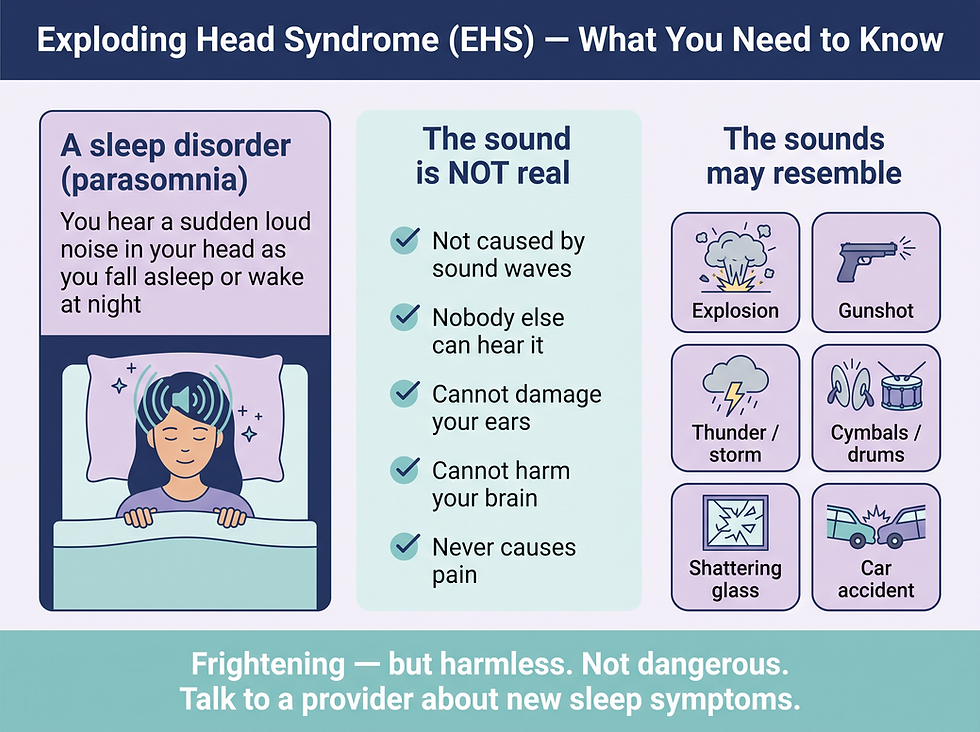
Exploding head syndrome (EHS) is a sleep disorder that makes you hear a loud noise or explosive crashing sound in your head. Healthcare providers also call it episodic cranial sensory shocks.
EHS is a parasomnia. The sound isn't real, and nobody else can hear it. But it can still be a scary, frustrating interruption to your sleep.
Key fact | Detail |
Medical name | Exploding head syndrome; also called episodic cranial sensory shocks |
Category | A parasomnia (disruptive sleep disorder) |
The sound | Sudden, loud, and experienced as completely real — but not caused by actual sound waves |
Who hears it | Only you; nobody else in the room can hear it |
Danger level | Not dangerous, not painful, and won't damage your ears or brain |
Specific treatment | None exists; no FDA-approved medications; symptoms are managed by a provider |
Exploding head syndrome isn't dangerous, but talk to a healthcare provider if you're experiencing any new symptoms that affect your sleep.
What Symptoms Does EHS Cause?
What do the sounds in EHS sound like?
The loud noise you hear is the most obvious exploding head syndrome symptom. The noise might sound like an explosion, gunshots, thunder or a storm, loud musical instruments like cymbals or drums, shattering glass, or another sudden loud bang, like a car accident.
Even though the exploding noise sounds incredibly real, it's not caused by actual sound waves. It won't damage your ears or cause pain.
What other symptoms happen during an EHS episode?
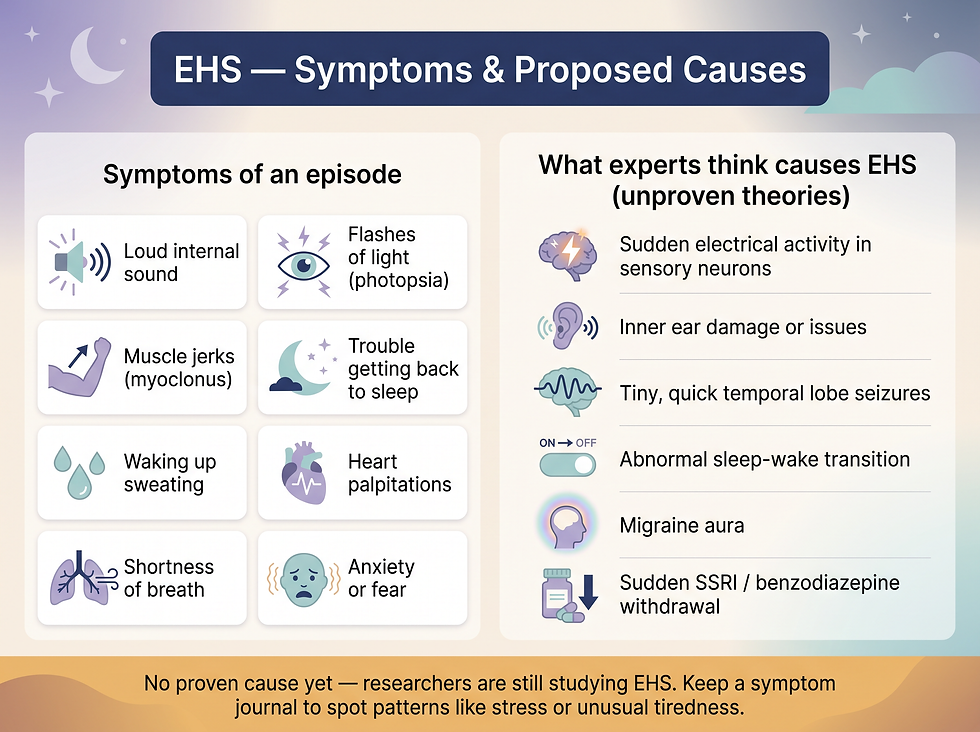
You might experience other symptoms during an episode, including seeing flashes of light (photopsia), muscle jerks (myoclonus), trouble getting back to sleep, waking up sweating, heart palpitations (feeling like your heart is racing), shortness of breath (dyspnea), and feeling anxious or frightened.
Symptom | What you experience |
Loud internal sound | Explosion, gunshot, thunder, storm, cymbal, drum, shattering glass, or car-accident-like bang |
Photopsia | Seeing flashes of light |
Myoclonus | Muscle jerks |
Sleep disruption | Trouble getting back to sleep |
Night sweats | Waking up sweating |
Heart palpitations | Feeling like your heart is racing |
Shortness of breath | Dyspnea during the episode |
Emotional response | Anxiety or fear |
How Frequent Are EHS Episodes?
How often you experience symptoms can vary. You might have several episodes in one night or for several nights in a row. Some people go weeks or even months between episodes.
What Causes Exploding Head Syndrome?
Experts aren't sure what causes exploding head syndrome. Researchers are still studying EHS and its causes. Several theories about why it happens exist.
Proposed cause theory | Explanation |
Sudden electrical activity | Unexpected electrical activity in the parts of your brain that process and create your senses (your sensory neurons) |
Inner ear issues | Damage or issues in your inner ear |
Tiny seizures | Tiny, quick seizures in your brain's temporal lobe |
Abnormal sleep-wake transition | Your brain mistakenly wakes you up when it shouldn't |
Migraine aura | An aura that occurs before a migraine headache |
Medication withdrawal | Side effects from suddenly stopping SSRIs (selective serotonin reuptake inhibitors) or benzodiazepines taken to treat depression and/or anxiety disorders |
Is exploding head syndrome genetic?
We don't know if exploding head syndrome is a genetic condition. It's possible that genetic variations passed through generations in your biological family can increase your risk. But experts haven't identified any exact genes or variations that may cause EHS.
What are the EHS triggers?
In most cases, researchers don't know what might trigger exploding head syndrome episodes. Some people report feeling stressed or unusually tired right before having symptoms. It might help to keep a journal of when you experience symptoms; this can help you identify patterns or changes to your routine that may trigger EHS that you might not have noticed otherwise.
How Is EHS Diagnosed?
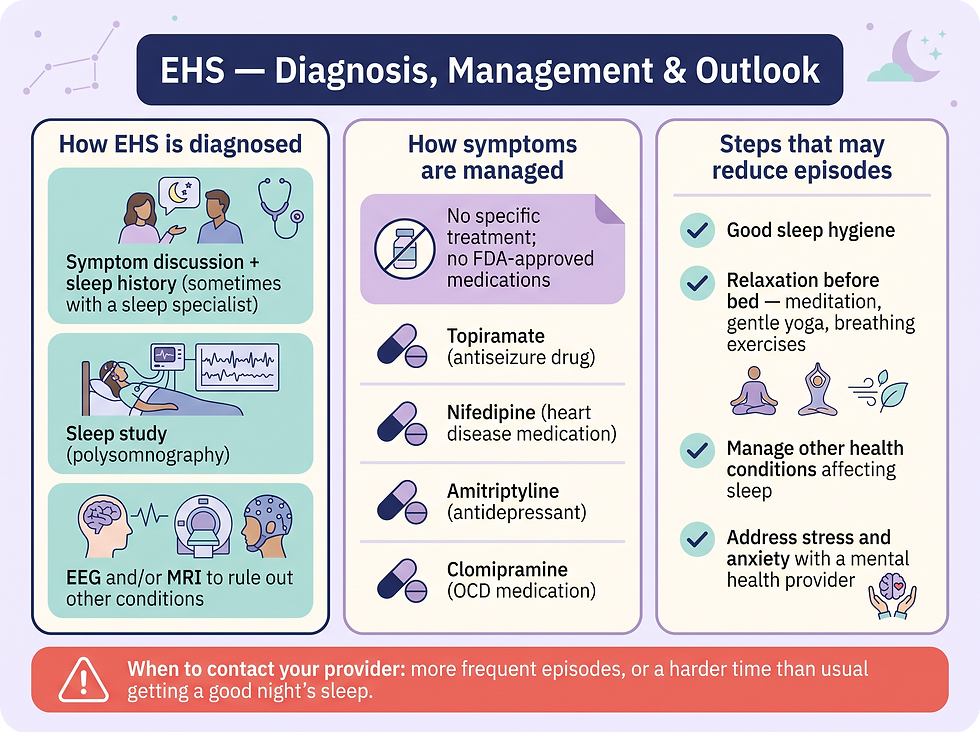
A healthcare provider will diagnose EHS by discussing the symptoms you've experienced and running some tests. You might need to visit a sleep specialist (a somnologist).
Tell your provider which symptoms you've experienced, how often they happen, and when they first started. Let them know if you've been feeling more stressed or anxious lately, or if you've ever had trouble sleeping before.
Some people experience symptoms or wake up without knowing it. If you sleep with a partner, your provider may ask them if they've noticed any changes in your sleep habits.
Which tests will be done to diagnose exploding head syndrome?
Your provider may use a few tests to rule out other conditions that can cause similar symptoms.
Test | Purpose |
Sleep study (polysomnography) | Records sleep patterns to rule out other sleep disorders |
EEG (electroencephalogram) | Measures the electrical activity of your brain |
MRI (magnetic resonance imaging) | Imaging to rule out other structural or neurological causes |
How Is EHS Treated?
There isn't any specific treatment for exploding head syndrome. Your provider can help you manage symptoms like stress, anxiety, or trouble sleeping.
The FDA hasn't approved any medications to treat exploding head syndrome. But your provider may suggest some medications used to treat other parasomnias.
Medication | Drug class |
Topiramate | An antiseizure drug |
Nifedipine | A medication that usually treats heart disease |
Amitriptyline | An antidepressant |
Clomipramine | An obsessive-compulsive disorder medication |
Is exploding head syndrome a seizure?
Exploding head syndrome isn't a seizure. Seizures are unusual electrical activity in your brain that affect how you can control your body. Some experts think the same kind of abnormal electrical activity may cause EHS, but that hasn't been proven yet.
Because they can have some similar symptoms, your provider may test you for conditions that can cause seizures before they diagnose EHS.
Is Exploding Head Syndrome Dangerous?
No, exploding head syndrome isn't dangerous. It can be shocking to hear an explosion or experience other symptoms, especially when they wake you up. Learning to live with symptoms can be frustrating and annoying. But it may be easier to adjust to having EHS once you know you're not in any danger. It will never cause pain and doesn't mean something is harming your brain.
Having EHS may increase your risk of having other parasomnia conditions. Talk to your provider if you notice any other symptoms or changes that affect your sleep.
Can EHS Be Prevented?
Because experts aren't sure what causes it, you may not be able to prevent EHS. But you may be able to reduce symptoms from coming back (recurring) by managing factors that might trigger episodes.
Prevention step | How it helps |
Practice good sleep hygiene | Supports consistent, healthy sleep patterns |
Relaxation techniques before bed | Meditation, gentle yoga stretches, or breathing exercises right before bedtime |
Manage other health conditions | Especially if they affect your sleep |
Address stress and anxiety | Talk to a mental health provider if you feel stressed or anxious |
Keep a symptom journal | Helps identify patterns or routine changes that may trigger episodes |
When should I see my healthcare provider?
Talk to your provider if it feels like you're having more EHS episodes or if you're having a harder time than usual getting a good night's sleep.
PROVIDER ALERT — CONTACT YOUR PROVIDER IF: you feel like you're having more EHS episodes; you're having a harder time than usual getting a good night's sleep; or you notice any other symptoms or changes that affect your sleep (EHS may raise the risk of other parasomnias). Even though no one knows what causes EHS, your provider can help you manage symptoms and protect your sleep. Don't suffer in silence — the noises you hear aren't real, but the condition is, and it deserves proper attention.
A note from your care team: "Exploding head syndrome's name sounds scary, and there's nothing quite as shocking as hearing an explosion in the middle of the night. As frightening as it can be (especially the first time you experience it), EHS is painless and won't hurt your brain or body. Don't feel embarrassed to talk about symptoms. The noises you hear aren't real, but the condition is. There isn't any specific treatment to make the noises stop, but your provider will help you find ways to manage symptoms, get the rest you need and hopefully experience fewer episodes."
Which questions should I ask my provider?
Question | Why it matters |
How can I manage EHS symptoms? | Builds a personalized plan for stress, anxiety, and sleep trouble |
Which tests will I need? | Clarifies whether you need a sleep study, EEG, or MRI |
Do you suggest any medications? | Explores off-label options used for other parasomnias |
Which changes in my sleep or the symptoms I experience should I watch out for? | Helps you spot signs of other parasomnias early |
Conclusion
Exploding head syndrome is a frightening-sounding but harmless parasomnia. You hear explosions, gunshots, thunder, cymbal crashes, or shattering glass as you drift off or wake at night — sounds that feel entirely real but are created by your brain, not by sound waves. EHS can't damage your ears or brain, and it never causes pain.
Researchers haven't pinned down a cause — proposed theories include sudden electrical activity in sensory neurons, tiny temporal lobe seizures, abnormal sleep-wake transitions, migraine auras, and sudden SSRI or benzodiazepine withdrawal. There's no specific treatment and no FDA-approved medication, but good sleep hygiene, relaxation before bed, stress management, and (when needed) off-label parasomnia medications can help most people sleep more peacefully.
If you're waking to loud bangs, having more episodes, or struggling to sleep, don't write it off as just a bad dream. Talk to a healthcare provider or a sleep specialist about whether EHS testing — possibly including a sleep study, EEG, or MRI — is right for you.
Disclaimer: This article is for general informational purposes only and is not a substitute for professional medical advice, diagnosis or treatment. Always seek the advice of your physician or other qualified health provider with any questions you may have regarding a medical condition.
Additional Resources
FAQ
What is exploding head syndrome (EHS)?
A sleep disorder that makes you hear a loud noise or explosive crashing sound in your head during sleep.
What is another name for exploding head syndrome?
Episodic cranial sensory shocks.
Is exploding head syndrome a parasomnia?
Yes; EHS is classified as a parasomnia, a disruptive sleep disorder.
Are the sounds in EHS real?
No; the noises aren't real, aren't caused by actual sound waves, and nobody else can hear them.
Can exploding head syndrome damage my ears or brain?
No; the sounds won't damage your ears or brain and the condition never causes pain.
What do EHS episodes sound like?
Explosions, gunshots, thunder or storms, loud cymbals or drums, shattering glass, or sudden loud bangs like a car accident.
What other symptoms happen during an EHS episode?
Flashes of light (photopsia), muscle jerks (myoclonus), waking up sweating, heart palpitations, shortness of breath, anxiety or fear, and trouble getting back to sleep.
How often do EHS episodes happen?
It varies: several episodes in one night, several nights in a row, or weeks to months between episodes.
What causes exploding head syndrome?
Experts aren't sure; researchers are still studying it. Theories include sudden electrical activity in sensory neurons, inner ear issues, tiny temporal lobe seizures, abnormal sleep-wake transitions, migraine auras, and sudden SSRI or benzodiazepine withdrawal.
Can electrical activity in the brain cause EHS?
That's one theory: sudden, unexpected electrical activity in the sensory neurons that process and create your senses.
Can tiny seizures cause exploding head syndrome?
Some experts think tiny, quick seizures in the temporal lobe may be responsible, but this hasn't been proven.
Is exploding head syndrome a seizure?
No. Seizures are unusual electrical activity that affects how you control your body. Some experts suspect a similar abnormal electrical activity may cause EHS, but it hasn't been proven.
Can an abnormal sleep-wake transition cause EHS?
Yes, that's one theory: your brain mistakenly wakes you up when it shouldn't.
Can stopping antidepressants cause exploding head syndrome?
Sudden withdrawal from SSRIs or benzodiazepines used for depression and/or anxiety can cause EHS-like symptoms, according to one theory.
Can a migraine cause exploding head syndrome?
An aura before a migraine headache is one proposed cause theory.
Can inner ear problems cause EHS?
Damage or issues in the inner ear is another theory being studied.
Is exploding head syndrome genetic?
It's unknown. Family genetic variations may raise risk, but no exact genes or variations have been identified.
What triggers an EHS episode?
In most cases the triggers are unknown; some people report stress or unusual tiredness right before symptoms, and a symptom journal can help spot patterns.
How is exploding head syndrome diagnosed?
By discussing your symptoms, their frequency, when they started, and your stress/sleep history — sometimes with a sleep specialist — plus tests to rule out similar conditions.
Does EHS require a sleep study?
A provider may order a sleep study (polysomnography) to rule out other conditions.
Will I need an EEG or MRI for EHS?
You might; providers use an EEG and/or MRI to rule out other conditions that can cause similar symptoms, and may test for seizure-causing conditions before diagnosing EHS.
Is there a cure or specific treatment for EHS?
No; there isn't any specific treatment, and the FDA hasn't approved any medications to treat EHS.
What medications are used for EHS?
None are approved specifically for EHS, but providers may suggest medications used for other parasomnias: topiramate, nifedipine, amitriptyline, and clomipramine.
Can providers still help with EHS?
Yes; providers can help you manage stress, anxiety, and trouble sleeping.
Is exploding head syndrome dangerous?
No; it isn't dangerous or painful, and it doesn't mean something is harming your brain.
Does EHS increase the risk of other conditions?
Having EHS may increase your risk of having other parasomnia conditions.
Can you prevent exploding head syndrome?
Not completely, since causes are unknown, but you may reduce recurrence through sleep hygiene, relaxation before bed, managing health conditions, and addressing stress or anxiety.
What relaxation techniques help with EHS?
Meditation, gentle yoga stretches, and breathing exercises right before bedtime.
When should I see my healthcare provider about EHS?
If you're having more EHS episodes or a harder time than usual getting a good night's sleep.
Should I be embarrassed about hearing explosions at night?
No; don't feel embarrassed to talk about your symptoms. The noises aren't real, but the condition is, and your provider can help you manage it and get the rest you need.
Comments