Erythema Nodosum: Symptoms, Causes, Diagnosis, Treatment and Outlook — What You Need to Know

Updated: 2 days ago
Medically reviewed by Dr. Baraa Alnahhal, MD · Last reviewed: September 2026
Quick Answer:
Erythema nodosum is a skin condition in which the fat within the skin becomes inflamed, producing tender, painful bumps (nodules) that are warm to the touch and red to purple, like a bruise. The bumps most often appear on the front of the shins but can form on the legs, calves, ankles, thighs and buttocks. An infection, an underlying condition or a medication can trigger it — and in some cases the cause is never found. It affects an estimated 1 to 5 out of every 100,000 people, most often women aged 20 to 30. The bumps typically resolve on their own within weeks to months, and treatment focuses on addressing the cause and easing symptoms.
TL;DR: Erythema Nodosum at a Glance
Erythema nodosum is inflamed fat under the skin that forms painful, bruise-like bumps — usually on the shins. It is a reaction to an infection, an underlying condition or a medication, and sometimes no cause is ever identified. The bumps usually heal within weeks to months, often changing color from red to purple to brown along the way.
Limitation statement: All statistics in this article come directly from the source's stated estimates (1 to 5 out of every 100,000 people; most often women aged 20 to 30). No additional or external figures are provided.
Fact | What the source says |
What it is | Inflammation of the fat within the skin; bumps (nodules) characteristically on the shins |
How it happens | A reactive process to an underlying cause (infection, condition or medication); some cases are idiopathic |
How common | Affects an estimated 1 to 5 out of every 100,000 people |
Who it affects | Anyone at any age; most often women between 20 and 30 |
Main symptoms | Tender, painful, warm-to-the-touch bumps; red to purple like a bruise |
Main location | Front of the shins; also legs, buttocks, calves, ankles, thighs |
Typical duration | Bumps resolve on their own within weeks to months |
Life-threatening? | No — the bumps are a temporary symptom, though an underlying cause could be serious |
What Is Erythema Nodosum?

Erythema nodosum is a condition in which the fat within your skin becomes inflamed. It's characterized by bumps (nodules) on your shins. This can be a reactive process to an underlying cause.
Erythema nodosum causes red to purple, painful bumps to form on your skin. These bumps can form anywhere on your body, but most often affect the front of your shins. An infection, underlying condition or medication can cause erythema nodosum as a symptom. The bumps can resolve on their own within weeks to months.
Who does erythema nodosum affect?
Studies show that the condition can affect anyone at any age, but it most often affects women between the ages of 20 and 30. You're more at risk of getting erythema nodosum if you have an infection, have inflammatory bowel disease or are on certain medications.
How common is erythema nodosum?
Erythema nodosum affects an estimated 1 to 5 out of every 100,000 people.
How does erythema nodosum affect your body?
Erythema nodosum causes bumps to form on your skin. These bumps can be tender, painful and warm to the touch, which can make the affected area of your skin feel uncomfortable. You might notice your skin change color from a red to a purple or brown as your skin heals before it returns to your natural skin tone.
What Are the Symptoms of Erythema Nodosum?
Symptoms of erythema nodosum range in severity for each person. The characteristic signs are bumps (nodules) on your skin that are warm to the touch and red to purple, similar to a bruise, tender and painful, and that fade into a flat, purple to brown patch after several weeks.
Additional symptoms could include fever, feeling sick (malaise), fatigue and joint pain.
Erythema nodosum usually targets the front of your shins, but it can affect other parts of your body, including your legs, buttocks, calves, ankles and thighs.
Symptom | Details |
Bumps (nodules) on skin | Most characteristic sign of the condition |
Bump appearance | Warm to the touch; red to purple, similar to a bruise |
Pain and tenderness | Bumps are tender and painful |
Healing color change | Bumps fade into a flat, purple to brown patch after several weeks, then return to natural skin tone |
Fever | Additional symptom in some people |
Malaise (feeling sick) | Additional symptom in some people |
Fatigue | Additional symptom in some people |
Joint pain | Additional symptom in some people |
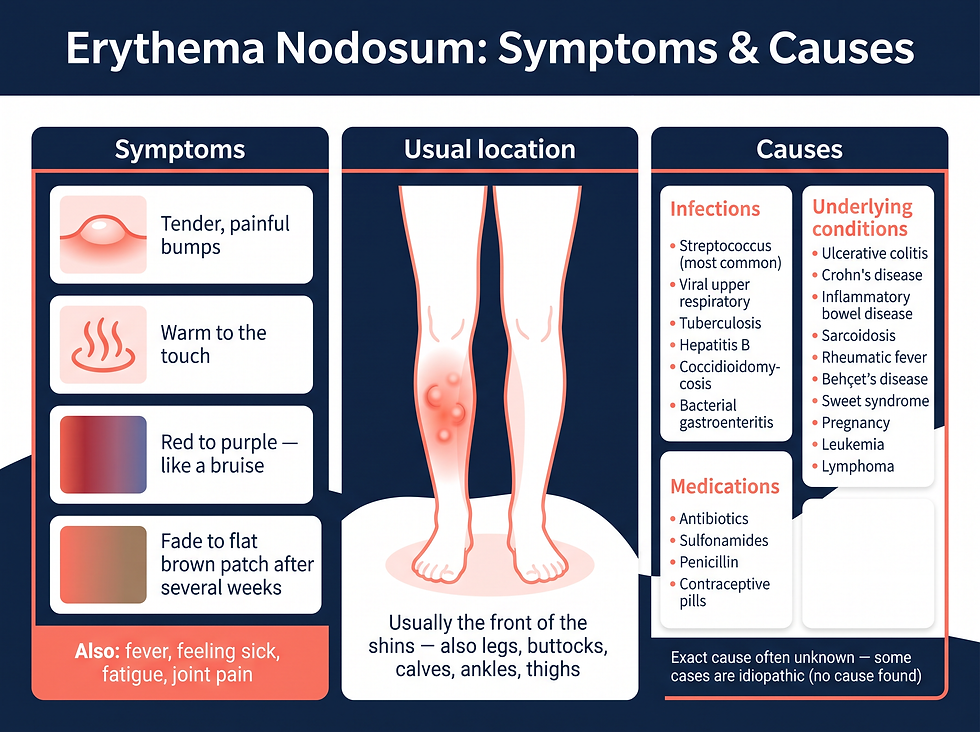
Where do symptoms of erythema nodosum appear?
Erythema nodosum usually targets the front of your shins, but it can affect other parts of your body, including your legs, buttocks, calves, ankles and thighs.
What Causes Erythema Nodosum?
The exact cause of erythema nodosum is unknown, but many cases occur in reaction to an infection, an underlying condition or a medication. Some cases of erythema nodosum are idiopathic, which means an underlying cause is never identified.
Which infections can trigger erythema nodosum?
Several infections can cause erythema nodosum. The most common infections include streptococcus infections, viral upper respiratory infections, tuberculosis, hepatitis B, coccidioidomycosis and bacterial gastroenteritis.
Which underlying conditions are linked to erythema nodosum?
Some cases of erythema nodosum are a symptom of an underlying condition, which could include ulcerative colitis, Crohn's disease, inflammatory bowel disease, sarcoidosis, rheumatic fever, Behçet's disease, Sweet syndrome, pregnancy, leukemia or lymphoma.
Can medications cause erythema nodosum?
Erythema nodosum could be a side effect of a medicine you take. Medicines that can cause this condition include antibiotics, sulfonamides, penicillin and contraceptive pills.
Cause category | Triggers listed by the source |
Infections | Streptococcus infections (most common), viral upper respiratory infections, tuberculosis, hepatitis B, coccidioidomycosis, bacterial gastroenteritis |
Underlying conditions | Ulcerative colitis, Crohn's disease, inflammatory bowel disease, sarcoidosis, rheumatic fever, Behçet's disease, Sweet syndrome, pregnancy, leukemia, lymphoma |
Medications | Antibiotics, sulfonamides, penicillin, contraceptive pills |
Unknown (idiopathic) | In some cases, an underlying cause is never identified |
Is erythema nodosum an autoimmune disorder?
Erythema nodosum isn't an autoimmune condition. A healthcare provider classifies an autoimmune condition if your body's immune system attacks normal parts of your body (for example, forming antibodies to attack proteins inside your cells). This isn't the case in erythema nodosum.
How Is Erythema Nodosum Diagnosed?
A healthcare provider will diagnose erythema nodosum after a physical exam to learn more about your symptoms, along with learning more about your complete medical history. To confirm your diagnosis, they'll offer tests that could include culture tests or blood tests to identify infections, a chest X-ray to look for signs of an infection, and a skin biopsy, where your provider will remove a small sample of tissue from the affected area of your skin to examine it under a microscope.
Diagnostic step | Purpose |
Physical exam | Learn more about your symptoms |
Complete medical history | Understand your health background and medication use |
Culture tests or blood tests | Identify infections |
Chest X-ray | Look for signs of an infection |
Skin biopsy | A small tissue sample from the affected area examined under a microscope |
How Is Erythema Nodosum Treated?

Treatment varies for each person diagnosed with erythema nodosum and depends on what caused your symptoms. Erythema nodosum can resolve on its own after a few weeks to months and doesn't always need treatment.
When treatment is recommended, it could include managing or treating any underlying conditions or infections, and stopping the medicine that caused your symptoms — don't stop taking a medication unless your provider tells you it's safe to do so. Treatment could also involve taking medicine to reduce symptoms, elevating the affected part of your body (like placing your leg on a pillow when lying down), and resting and avoiding strenuous activity.
What medications treat erythema nodosum?
Treatment could involve taking medications to manage your symptoms, including nonsteroidal anti-inflammatory drugs (NSAIDs) for swelling and pain, anti-inflammatory medicine (corticosteroids) to reduce swelling, potassium iodide solution to reduce inflammation, and analgesics for pain.
What foods should I avoid if I have erythema nodosum?
Studies are ongoing to learn more about how certain foods in your diet can help or reduce symptoms. Eating a healthy, well-balanced diet is usually recommended.
How soon after treatment will I feel better?
After treatment begins, you could see your symptoms of pain and swelling reduce. The bumps (nodules) and visible signs of the condition will still be on your skin for several weeks to months. During this time, your skin might change color, from red and purple to brown, before returning to your natural skin color. This is normal.
Once your skin heals, it's possible that symptoms could return in the future.
Treatment approach | Details |
Treat the cause | Managing or treating underlying conditions or infections |
Medication changes | Stop taking medicine that caused symptoms — only if your provider says it's safe |
NSAIDs | Nonsteroidal anti-inflammatory drugs for swelling and pain |
Corticosteroids | Anti-inflammatory medicine to reduce swelling |
Potassium iodide solution | To reduce inflammation |
Analgesics | For pain |
Elevation | Elevate the affected part of your body, like placing your leg on a pillow when lying down |
Rest | Resting and avoiding strenuous activity |
Natural resolution | Can resolve on its own after a few weeks to months; doesn't always need treatment |
What Can I Expect If I Have Erythema Nodosum?
Erythema nodosum can return throughout your life after it goes away. If you manage or treat the underlying condition that caused your symptoms or you stop taking medicine that caused your symptoms, you reduce your risk of having an erythema nodosum flare.
At home, you can take over-the-counter NSAIDs for pain as directed by your healthcare provider. Elevating the affected area of your body helps minimize swelling. For example, if you experience symptoms on your shin, you can put your leg on a pillow when lying down. If your symptoms are severe and prevent you from going about your day normally, talk to your healthcare provider.
Is erythema nodosum life-threatening?
Erythema nodosum isn't a life-threatening condition. The bumps on your skin, along with the symptoms associated with the condition, typically go away in weeks to months. If your diagnosis of erythema nodosum is the result of an underlying condition, the underlying cause could be life-threatening, but the bumps on your skin are only a temporary symptom.
How Can I Prevent Erythema Nodosum?
You can't prevent all cases of erythema nodosum, but you can reduce your risk of having a flare of symptoms by avoiding medicines that cause erythema nodosum, treating or managing any underlying medical conditions, and staying away from other people who are sick with a viral or bacterial infection.
Prevention step | How it reduces flare risk |
Avoid causative medicines | Avoiding medicines that cause erythema nodosum |
Manage underlying conditions | Treating or managing any underlying medical conditions |
Limit infection exposure | Staying away from other people who are sick with a viral or bacterial infection |
When Should I See My Healthcare Provider?
Visit a healthcare provider if you experience symptoms of erythema nodosum, especially when visible symptoms on your skin combine with a fever or you feel ill (malaise). Your healthcare provider will diagnose your condition and locate the cause of your symptoms to offer treatment so you can feel better sooner.
Don't ignore your symptoms: some cases of erythema nodosum can be a sign of an underlying condition that needs treatment. Contact your provider if your symptoms are severe.
What Questions Should I Ask My Doctor?
Consider asking your provider: What caused my symptoms? How often should I take NSAIDs for pain? How do I manage the underlying condition that caused my symptoms? How do I prevent this condition from returning in the future?
Clinical care-team note (verbatim from the source): "Symptoms of erythema nodosum can be painful and bothersome. They can last weeks to months. During this time, you can reduce your symptoms by getting a lot of rest and elevating the affected part of your body. Don't ignore your symptoms because some cases of erythema nodosum can be a sign of an underlying condition that needs treatment. Contact your provider if your symptoms are severe."
Conclusion: A Treatable Skin Condition With a Reassuring Outlook
Erythema nodosum is an inflammatory condition of the fat within the skin that produces tender, bruise-like bumps — most often on the front of the shins. It typically signals an infection, an underlying condition or a medication reaction, and in some cases no cause is ever identified. The good news: it is not life-threatening, and the bumps generally resolve on their own within weeks to months, sometimes with help from NSAIDs, corticosteroids, potassium iodide or analgesics alongside rest and elevation. Because the bumps can occasionally point to a condition that needs treatment, seeing a provider — especially when skin symptoms pair with fever or malaise — is the most important step you can take.
Take these three steps:
See a provider promptly — skin bumps paired with fever or feeling unwell deserve evaluation to locate the underlying cause.
Follow the treatment plan — take prescribed medications as directed, elevate the affected area, rest, and never stop a medication without your provider's guidance.
Protect against flares — avoid known causative medicines, manage underlying conditions, and limit exposure to sick contacts.
This article provides general information and is not a substitute for professional medical advice. Always consult a qualified healthcare provider for diagnosis and treatment.
Frequently Asked Questions
What is erythema nodosum?
Erythema nodosum is a condition in which the fat within your skin becomes inflamed. It's characterized by bumps (nodules) on your shins. This can be a reactive process to an underlying cause.
What does erythema nodosum look like?
It causes red to purple, painful bumps to form on your skin. The bumps are warm to the touch and red to purple, similar to a bruise, and they fade into a flat, purple to brown patch after several weeks.
Why does erythema nodosum happen?
The exact cause is unknown, but many cases occur in reaction to an infection, an underlying condition or a medication. Some cases are idiopathic, which means an underlying cause is never identified.
Is erythema nodosum serious?
Erythema nodosum isn't a life-threatening condition. The bumps and associated symptoms typically go away in weeks to months. However, if it's the result of an underlying condition, that underlying cause could be life-threatening — the bumps themselves are only a temporary symptom.
How common is erythema nodosum?
It affects an estimated 1 to 5 out of every 100,000 people.
Who gets erythema nodosum?
The condition can affect anyone at any age, but it most often affects women between the ages of 20 and 30. You're more at risk if you have an infection, have inflammatory bowel disease or are on certain medications.
Where do the bumps usually appear?
Erythema nodosum usually targets the front of your shins, but it can also affect your legs, buttocks, calves, ankles and thighs.
Do the bumps hurt?
Yes. The bumps are tender, painful and warm to the touch, which can make the affected area of your skin feel uncomfortable.
Do the bumps leave scars?
The bumps fade into a flat, purple to brown patch after several weeks as your skin heals, before returning to your natural skin tone.
Can erythema nodosum cause fever?
Yes. Additional symptoms could include fever, feeling sick (malaise), fatigue and joint pain.
Can erythema nodosum cause joint pain?
Yes. Joint pain is listed among the additional symptoms.
Can erythema nodosum cause fatigue?
Yes. Fatigue and malaise (feeling sick) are among the additional symptoms.
What infections cause erythema nodosum?
The most common infections include streptococcus infections, viral upper respiratory infections, tuberculosis, hepatitis B, coccidioidomycosis and bacterial gastroenteritis.
Can strep throat cause erythema nodosum?
Streptococcus infections are the most common infection that can cause erythema nodosum.
Can tuberculosis cause erythema nodosum?
Yes. Tuberculosis is among the infections that can cause erythema nodosum.
What conditions cause erythema nodosum?
Underlying conditions could include ulcerative colitis, Crohn's disease, inflammatory bowel disease, sarcoidosis, rheumatic fever, Behçet's disease, Sweet syndrome, pregnancy, leukemia or lymphoma.
Can inflammatory bowel disease cause erythema nodosum?
Yes. Both ulcerative colitis and Crohn's disease, as well as inflammatory bowel disease generally, are listed as underlying conditions.
Can pregnancy cause erythema nodosum?
Yes. Pregnancy is listed among the underlying conditions that can be associated with erythema nodosum.
Can medicines cause erythema nodosum?
Yes. Erythema nodosum could be a side effect of a medicine you take. Medicines that can cause this condition include antibiotics, sulfonamides, penicillin and contraceptive pills.
What medications cause erythema nodosum?
Antibiotics, sulfonamides, penicillin and contraceptive pills are listed as medicines that can cause the condition.
Is erythema nodosum an autoimmune disease?
No. Erythema nodosum isn't an autoimmune condition. An autoimmune condition is one where your body's immune system attacks normal parts of your body — this isn't the case in erythema nodosum.
How is erythema nodosum diagnosed?
A provider diagnoses it after a physical exam and learning your complete medical history. To confirm the diagnosis, they may offer culture tests or blood tests to identify infections, a chest X-ray to look for signs of infection, and a skin biopsy.
What is a skin biopsy for erythema nodosum?
Your provider removes a small sample of tissue from the affected area of your skin to examine it under a microscope.
How is erythema nodosum treated?
Treatment varies for each person and depends on what caused your symptoms. It could include managing or treating underlying conditions or infections, stopping the medicine that caused your symptoms (only if your provider says it's safe), taking medicine to reduce symptoms, elevating the affected area, and resting.
What medications treat erythema nodosum?
Treatment could involve NSAIDs for swelling and pain, corticosteroids to reduce swelling, potassium iodide solution to reduce inflammation, and analgesics for pain.
Does erythema nodosum go away on its own?
Yes. It can resolve on its own after a few weeks to months and doesn't always need treatment.
What foods should I avoid if I have erythema nodosum?
Studies are ongoing to learn more about how certain foods in your diet can help or reduce symptoms. Eating a healthy, well-balanced diet is usually recommended.
How long do the bumps last?
The bumps (nodules) and visible signs of the condition remain on your skin for several weeks to months. Your skin might change color from red and purple to brown before returning to your natural skin color — this is normal.
Can erythema nodosum come back?
Yes. It can return throughout your life after it goes away. If you manage or treat the underlying condition, or stop the medicine that caused your symptoms, you reduce your risk of a flare.
When should I see my healthcare provider?
Visit a healthcare provider if you experience symptoms of erythema nodosum, especially when visible symptoms on your skin combine with a fever or you feel ill (malaise). Contact your provider if your symptoms are severe.
How do I prevent erythema nodosum flares?
You can't prevent all cases, but you can reduce your risk of a flare by avoiding medicines that cause erythema nodosum, treating or managing any underlying medical conditions, and staying away from other people who are sick with a viral or bacterial infection.
Additional Resources
For further reading, these authoritative external references support the information above:
Content reviewed and produced following the Rinnit editorial framework. Last updated: September 28, 2026.
Comments