Erdheim-Chester Disease (ECD): Symptoms, Causes, Diagnosis, Treatment and Outlook — What You Need to Know

Updated: 2 days ago
Medically reviewed by Dr. Baraa Alnahhal, MD · Last reviewed: September 2026
Quick Answer:
Erdheim-Chester disease (ECD) is a very rare blood cancer that occurs when the body makes too many histiocytes, a type of white blood cell that builds up in tissues. Affecting an estimated 1 in 1 million people in the U.S. each year, ECD can involve many organs — bones, kidneys, heart, brain, pituitary gland and eyes — with bone pain in both legs as the most common symptom. More than half of patients carry a changed BRAF gene. There is no cure, but targeted therapy, immunotherapy and chemotherapy are helping people live longer: one recent study estimates 8 out of 10 people are alive five years after diagnosis.
TL;DR: Erdheim-Chester Disease at a Glance
ECD is a rare histiocytosis — a cancer in which abnormal white blood cells multiply and spread through the body, inflaming and damaging organs. Bone pain in both legs is the most common warning sign, and more than half of patients have a BRAF gene change. Diagnosis combines biopsy, imaging and blood tests, and while there is no cure, modern treatments including targeted therapy are extending lives.
Limitation statement: All statistics in this article come directly from the source's stated research estimates (only 1,500 reported cases since 1930; about 1 in 1 million people in the U.S. each year; men account for 7 out of 10 cases; 8 out of 10 alive at five years per one recent study). No additional or external figures are provided.
Fact | What the source says |
What it is | A very rare blood cancer; a type of histiocytosis (histiocytes build up in tissues) |
How rare | ~1,500 cases reported since 1930; estimated 1 in 1 million people in the U.S. each year |
Who it affects | Adults mostly in their 40s–50s (children may have it); men = 7 out of 10 cases |
Root problem | Abnormal histiocytes multiply uncontrollably, cause inflammation that damages organs, may form tumors |
Most common symptom | Bone pain in both legs, often starting in the knees |
Key gene | More than half of patients have a changed BRAF gene; MEK gene changes may also play a role |
Cure | None — but treatments are helping people live longer |
5-year outlook | Recent study estimates 8 out of 10 people alive five years after diagnosis |
What Is Erdheim-Chester Disease?

Erdheim-Chester disease (ECD) is a very rare blood cancer that can affect several parts of your body. It can cause many different symptoms depending on the organs it affects. ECD is a type of histiocytosis, a condition that causes histiocytes to build up in your tissues. Histiocytes are white blood cells (immune cells) that typically don't circulate in your blood like other blood cells.
With ECD, abnormal histiocytes multiply uncontrollably and spread to different parts of your body. The abnormal cells cause inflammation that damages your organs. The cells may clump together to form tumors. Without treatment, the disease can cause life-threatening organ failure.
How rare is Erdheim-Chester disease?
Only 1,500 cases of ECD have been reported since 1930, when healthcare providers first diagnosed it. Experts don't know the exact number of cases. But, based on recent studies, they estimate that ECD may affect 1 out of 1 million people in the U.S. each year.
Who does Erdheim-Chester disease affect?
The disease is most common in adults in their 40s and 50s, but children may have it. Erdheim-Chester disease is more common in men, who account for 7 out of 10 cases.
What Are the Symptoms of Erdheim-Chester Disease?
This disease can cause a wide range of symptoms. Some typical ones are:
Bone pain: Pain in both legs is the most common symptom. The pain often starts in your knees.
Abdominal pain: ECD in your kidneys or the back of your belly may also cause lower back pain, painful urination, fatigue, muscle cramps and swelling in your ankles, feet and face.
Balance issues: This disease can damage tissue in the parts of your brain that manage balance and coordination. Damage to your nervous system can affect the muscles that control speech, so you slur your words.
Excessive thirst and urination: These are symptoms of diabetes insipidus, which can happen if ECD damages your pituitary gland. ECD can also affect other glands and cause symptoms like feeling cold all the time and gaining weight.
Fatigue and shortness of breath: ECD may affect your heart, including the fluid-filled sac that surrounds your heart. It can cause swelling in your lower legs, ankles and feet.
Eye pain and vision issues: This disease may also cause bulging eyeballs, double vision and yellowish growths on your eyelids.
Some people don't have symptoms. They learn they have ECD when X-rays, CT scans or other imaging tests detect a mass or group of abnormal cells.
Symptom | Affected area and details |
Bone pain | Most common symptom; pain in both legs, often starting in the knees |
Abdominal pain | Kidneys or back of belly; may also cause lower back pain, painful urination, fatigue, muscle cramps, swelling in ankles/feet/face |
Balance issues | Brain tissue damage to balance/coordination areas; nervous system damage can cause slurred speech |
Excessive thirst and urination | Diabetes insipidus from pituitary gland damage; other gland effects include feeling cold and weight gain |
Fatigue and shortness of breath | Heart, including the fluid-filled sac around it; swelling in lower legs, ankles and feet |
Eye pain and vision issues | Bulging eyeballs, double vision, yellowish growths on eyelids |
No symptoms | Some people learn they have ECD only when imaging detects a mass |

What Causes Erdheim-Chester Disease?
Scientists believe certain genetic variations (changes) may be one cause. More than half of people with Erdheim-Chester disease have a changed BRAF gene. Changes in the MEK gene may also play a role. These genes manage how fast cells multiply and spread.
With ECD, the genetic changes turn normal histiocytes into abnormal ones that multiply and spread. Researchers continue to look for other genetic variations that may drive this disease.
How Is Erdheim-Chester Disease Diagnosed?
A healthcare provider will ask about your symptoms and health history. They may do several tests, including a biopsy, imaging tests and blood tests.
Biopsy: Your provider may take a small tissue sample to check under a microscope. They'll check for ECD signs and test tissue cells for specific changed genes.
Imaging tests: Certain tests can detect damage in your bones and in soft tissues in organs, like your brain. Your provider may do a bone scan, X-ray, CT scan, PET scan and/or MRI scan.
Blood tests: Your provider may check your blood for signs of kidney issues, inflammation or changes in hormone levels.
It may take time for your healthcare provider to diagnose ECD. The disease can develop throughout your body and cause many different symptoms. Also, because ECD is a very rare condition, providers may not have much experience with it. This means they may not immediately recognize ECD as the source of your symptoms.
Diagnostic test | What it detects |
Biopsy | ECD signs under the microscope; tissue cells tested for specific changed genes |
Bone scan, X-ray, CT scan | Damage in bones |
PET scan, MRI scan | Damage in soft tissues in organs, like the brain |
Blood tests | Signs of kidney issues, inflammation or changes in hormone levels |
How Is Erdheim-Chester Disease Treated?
There's no cure for this disease. But new medications are helping people live longer. Healthcare providers may use common cancer treatments, like targeted therapy, immunotherapy and chemotherapy. Healthcare providers sometimes recommend treatments to help ease symptoms. Those include corticosteroids and surgery.
What is targeted therapy for ECD?
Targeted therapy is medication that focuses on the specific genetic variations that cause ECD. For example, vemurafenib (Zelboraf) treats ECD involving BRAF gene variations. Cobimetinib (Cotellic) treats ECD involving MEK gene variations. Both medications slow or stop how fast cancer spreads.
What immunotherapy and chemotherapy options exist?
Immunotherapy helps your immune system identify and fight cancer cells more effectively. Interferon-alpha is a common immunotherapy medication for ECD. Chemotherapy medications keep abnormal cells from spreading. Cladribine (Mavenclad) is the most common type of chemotherapy to treat ECD.
Are there treatments to ease symptoms?
Corticosteroids can ease inflammation. ECD can cause tissue damage and inflammation that affect your organs — for example, inflammation and damaged tissue can block the tubes (ureters) that carry urine from your bladder. You may need surgery to correct this or other issues. Your provider may recommend a clinical trial if they think you could benefit from newer treatments that are still being studied.
If ECD doesn't cause symptoms, your provider may recommend active surveillance — regular checkups and tests to check on your health.
Treatment category | Examples | What it does |
Targeted therapy | Vemurafenib (Zelboraf) for BRAF variations; cobimetinib (Cotellic) for MEK variations | Focuses on the specific gene variations that cause ECD; slows or stops how fast cancer spreads |
Immunotherapy | Interferon-alpha | Helps the immune system identify and fight cancer cells more effectively |
Chemotherapy | Cladribine (Mavenclad) — most common | Keeps abnormal cells from spreading |
Symptom relief | Corticosteroids | Eases inflammation |
Surgery | Corrects blocked ureters or other organ issues | Addresses tissue damage and inflammation affecting organs |
Clinical trials | Newer treatments still being studied | May benefit some patients |
Active surveillance | Regular checkups and tests | For people whose ECD causes no symptoms |
How Long Can You Live with Erdheim-Chester Disease?
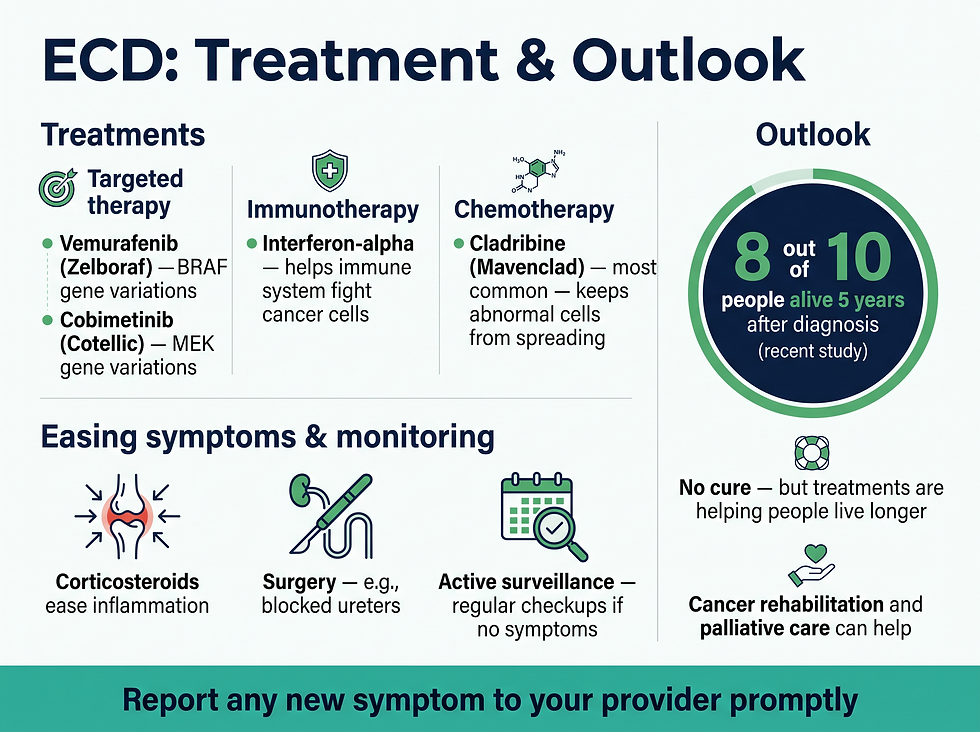
People are living longer with ECD, thanks to cancer treatments like targeted therapy and immunotherapy. One recent study estimates that, overall, 8 out of 10 people with ECD are alive five years after diagnosis.
ECD is a complicated disease. It can affect your body in many ways. Ask your healthcare provider to explain what you can expect. They're your best source of information.
Is there anything I can do to feel better?
Treatments like cancer rehabilitation and palliative care may help you manage issues that ECD can cause. Cancer rehabilitation specialists can help you prepare to start treatment. Palliative care specialists provide support to help you manage ECD symptoms and treatment side effects. Your providers can also connect you with resources for people who have a rare disease.
When Should I Talk to a Doctor?
You'll have regular follow-up visits so your healthcare provider can check on your progress. They'll let you know how often you can expect checkups and tests.
Stay alert to changes: ECD can cause different symptoms if it spreads through your body. Let your provider know about any changes you notice — new pain, breathing trouble, vision changes or swelling — promptly.
Because ECD is rare and can develop throughout the body, diagnosis can take time and symptoms may be mistaken for other conditions. If you have unexplained pain in both legs, thirst and urination changes, or balance problems, a discussion with a provider is a reasonable first step.
What Questions Should I Ask My Doctor?
Consider asking about how often you can expect checkups and tests, what treatment approach fits your gene profile (BRAF vs. MEK), whether clinical trials are available, how cancer rehabilitation or palliative care could help, and what symptoms to report between visits.
Clinical care-team note (verbatim from the source): "Erdheim-Chester disease is a very rare and incurable blood cancer. It's not easy to have a disease that few people may know about and for which there is no cure. You may feel uncomfortable or anxious talking about your situation. But you don't have to go it alone. Your healthcare team will understand the challenges that come with living with a rare disease. Don't hesitate to ask for help, including ways you can share your story with friends and family so they know how to support you."
Conclusion: A Rare Cancer with Growing Treatment Options
Erdheim-Chester disease is an exceptionally rare blood cancer — roughly 1 in 1 million people in the U.S. each year — in which abnormal histiocytes multiply, inflame and damage organs throughout the body. The most common warning sign, bone pain in both legs, deserves attention, and more than half of patients carry a BRAF gene change that guides treatment. While no cure exists, targeted therapy, immunotherapy and chemotherapy are helping people live longer, with one recent study estimating 8 out of 10 patients alive five years after diagnosis. Because the disease is so uncommon, finding an experienced care team and reporting any new symptom promptly are among the most important steps you can take.
Take these three steps:
Report every change — ECD can affect many organs, so tell your provider about any new or worsening symptom between visits.
Ask about your gene profile — whether a BRAF or MEK variation drives your ECD determines which targeted therapy fits your case.
Lean on support resources — cancer rehabilitation, palliative care and rare-disease networks can help you manage symptoms and treatment side effects.
This article provides general information and is not a substitute for professional medical advice. Always consult a qualified healthcare provider for diagnosis and treatment.
Frequently Asked Questions
What is Erdheim-Chester disease?
Erdheim-Chester disease (ECD) is a very rare blood cancer that occurs when your body makes too many histiocytes, a type of white blood cell. ECD can affect multiple organs and cause various symptoms.
Is Erdheim-Chester disease a cancer?
Yes — it's a very rare blood cancer and a type of histiocytosis, a condition that causes histiocytes to build up in your tissues.
What is a histiocyte?
Histiocytes are white blood cells (immune cells) that typically don't circulate in your blood like other blood cells. With ECD, they build up in your tissues.
Is Erdheim-Chester disease the same as histiocytosis?
ECD is a type of histiocytosis — a condition that causes histiocytes to build up in your tissues.
How rare is Erdheim-Chester disease?
Only 1,500 cases have been reported since 1930, when it was first diagnosed. Experts don't know the exact number of cases, but recent studies estimate ECD may affect 1 out of 1 million people in the U.S. each year.
Who gets Erdheim-Chester disease?
The disease is most common in adults in their 40s and 50s, but children may have it. It is more common in men, who account for 7 out of 10 cases.
What causes Erdheim-Chester disease?
Scientists believe certain genetic variations (changes) may be one cause. These genetic changes turn normal histiocytes into abnormal ones that multiply and spread.
What gene is linked to Erdheim-Chester disease?
More than half of people with ECD have a changed BRAF gene. Changes in the MEK gene may also play a role. These genes manage how fast cells multiply and spread.
What happens in your body with ECD?
Abnormal histiocytes multiply uncontrollably and spread to different parts of your body. The abnormal cells cause inflammation that damages your organs. The cells may clump together to form tumors.
Can ECD cause organ failure?
Without treatment, the disease can cause life-threatening organ failure.
What is the most common symptom of ECD?
Bone pain. Pain in both legs is the most common symptom, and the pain often starts in your knees.
Can ECD cause abdominal pain?
Yes. ECD in your kidneys or the back of your belly may also cause lower back pain, painful urination, fatigue, muscle cramps and swelling in your ankles, feet and face.
Can ECD affect your balance?
Yes. The disease can damage tissue in the parts of your brain that manage balance and coordination.
Can ECD affect your speech?
Yes. Damage to your nervous system can affect the muscles that control speech, so you slur your words.
Can ECD cause diabetes insipidus?
Yes. Excessive thirst and urination are symptoms of diabetes insipidus, which can happen if ECD damages your pituitary gland.
Can ECD cause weight gain and feeling cold?
Yes. ECD can affect other glands and cause symptoms like feeling cold all the time and gaining weight.
Can ECD affect your heart?
Yes. ECD may affect your heart, including the fluid-filled sac that surrounds your heart. It can cause fatigue, shortness of breath and swelling in your lower legs, ankles and feet.
Can ECD affect your eyes?
Yes. The disease may cause eye pain, bulging eyeballs, double vision and yellowish growths on your eyelids.
Can you have ECD without symptoms?
Yes. Some people don't have symptoms and learn they have ECD when X-rays, CT scans or other imaging tests detect a mass or group of abnormal cells.
How is Erdheim-Chester disease diagnosed?
A provider reviews your symptoms and health history, and may perform a biopsy, imaging tests and blood tests. Diagnosis can take time because ECD is very rare and causes many different symptoms.
What does a biopsy show for ECD?
A tissue sample is checked under a microscope for ECD signs, and tissue cells are tested for specific changed genes.
What imaging tests detect ECD?
A bone scan, X-ray, CT scan, PET scan and/or MRI scan can detect damage in your bones and in soft tissues in organs, like your brain.
What do blood tests look for in ECD?
Signs of kidney issues, inflammation or changes in hormone levels.
Is there a cure for Erdheim-Chester disease?
No. But new medications are helping people live longer.
What targeted therapies treat ECD?
Vemurafenib (Zelboraf) treats ECD involving BRAF gene variations, and cobimetinib (Cotellic) treats ECD involving MEK gene variations. Both medications slow or stop how fast cancer spreads.
What immunotherapy is used for ECD?
Immunotherapy helps your immune system identify and fight cancer cells more effectively. Interferon-alpha is a common immunotherapy medication for ECD.
What chemotherapy is used for ECD?
Chemotherapy medications keep abnormal cells from spreading. Cladribine (Mavenclad) is the most common type of chemotherapy to treat ECD.
Can surgery treat ECD problems?
Sometimes. For example, inflammation and damaged tissue can block the ureters (tubes that carry urine from your bladder), and you may need surgery to correct this or other issues. Corticosteroids can also ease inflammation.
How long can you live with Erdheim-Chester disease?
People are living longer with ECD thanks to targeted therapy and immunotherapy. One recent study estimates that, overall, 8 out of 10 people with ECD are alive five years after diagnosis.
Can cancer rehabilitation and palliative care help?
Yes. Cancer rehabilitation specialists can help you prepare to start treatment, and palliative care specialists provide support to help you manage ECD symptoms and treatment side effects.
Additional Resources
For further reading, these authoritative external references support the information above:
Content reviewed and produced following the Rinnit editorial framework. Last updated: September 28, 2026.
Comments