Epithelioid Hemangioendothelioma (EHE): Symptoms, Causes, Diagnosis, Treatment and Outlook — What You Need to Know

Updated: 2 days ago
Medically reviewed by Dr. Baraa Alnahhal, MD · Last reviewed: September 2026
Quick Answer: Epithelioid hemangioendothelioma (EHE) is a very rare cancerous tumor that forms in the cells lining your blood vessels. It affects fewer than 1 in every 1 million people each year and most often starts in the liver, lungs or bones — though it can form anywhere blood vessels exist. Many people have no symptoms at all; when symptoms occur, pain is the most common, along with location-specific signs like fatigue and weight loss (liver), coughing up blood and breathing trouble (lungs), or bone pain and fractures (bones). EHE is driven by gene fusion errors, most commonly WWTR1-CAMTA1, that are not inherited. Because the condition is so rare, care is tailored by sarcoma-experienced specialists and may range from watchful waiting to surgery, radiation, embolization, transplant or targeted therapy.
TL;DR: Epithelioid Hemangioendothelioma at a Glance
EHE is a rare vascular sarcoma — a cancer growing from blood vessel lining cells — that behaves unpredictably. Some tumors are aggressive and spread fast; others grow slowly and rarely even shrink without treatment. Most people are diagnosed in their early 50s, and the tumors most often appear in the liver, lungs or bones.
Limitation statement: EHE is extremely rare — fewer than 1 in 1 million people per year — so much remains unknown. All figures in this article come directly from the source and its cited research, including the note that very little life-expectancy data exists and that several studies show most people with EHE survive beyond three, five and even ten years. No additional statistics are provided or given here.
Fact | What the source says |
What it is | A malignant (cancerous) tumor of the cells lining blood vessels — a rare vascular sarcoma |
How rare | Affects less than 1 in every 1 million people each year |
Most common sites | Liver, lungs and bones (can form almost anywhere) |
Main cause | Gene fusion errors (usually WWTR1-CAMTA1) that are not inherited |
Most common symptom | Pain (when symptoms occur); many people have none |
Main treatment paths | Active surveillance, surgery, radiation, embolization, liver transplant, chemotherapy, targeted therapy |
Prognosis factors | Better when there are no symptoms, a small single tumor (<3 cm), and no lung involvement |
Life expectancy data | Very little exists; several studies show most survive beyond 3, 5 and even 10 years |
What Is Epithelioid Hemangioendothelioma (EHE)?

Epithelioid hemangioendothelioma (EHE) is a malignant tumor that forms from the cells that line blood vessels. It's a very rare vascular cancer (sarcoma) that affects less than 1 in every 1 million people each year. While it can form almost anywhere in your body, it often starts in your liver, lungs or bones.
These tumors show up in different ways. EHE may present as a single tumor. Sometimes, there are lots of tumors in a single organ or in many organs. In some people, tumors are aggressive and spread fast. In others, they grow slowly and (rarely) even shrink without treatment.
Since there are so many unknowns, it's crucial to work with healthcare providers who can tailor a treatment plan for you. This often means finding a provider with experience treating rare sarcomas.
What Are the Symptoms of Epithelioid Hemangioendothelioma?
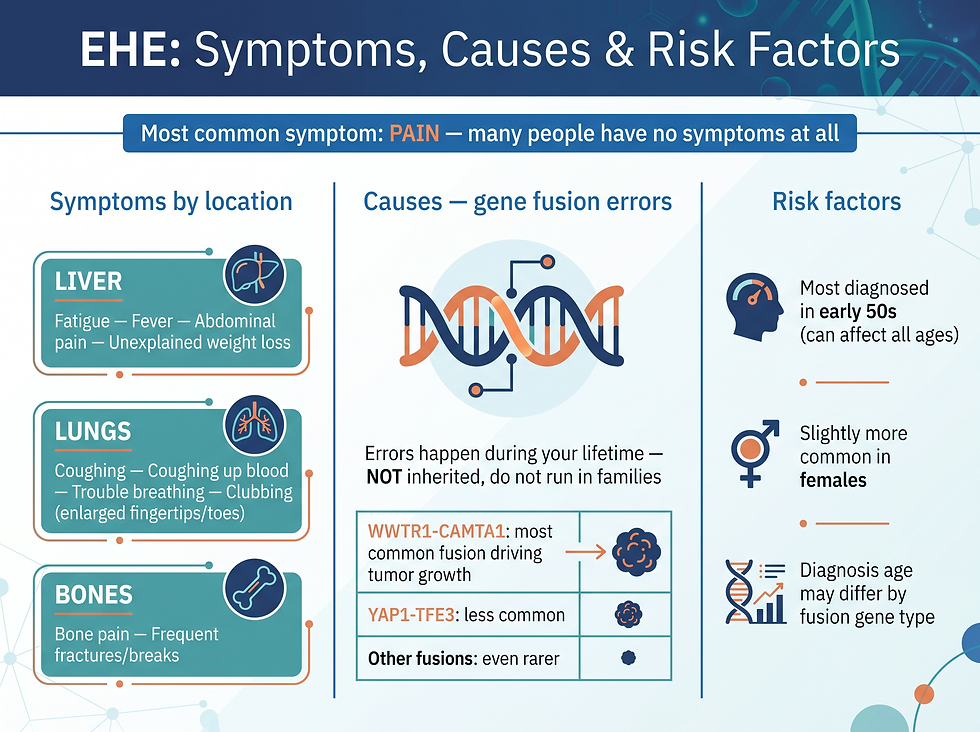
Many people with EHE don't have symptoms. When they do, the most common one is pain. Other symptoms depend on where the tumor is. The most common sites are your liver, lungs and bones. But tumors can form wherever blood vessels are.
Location | Possible symptoms |
Liver | Fatigue, fever, pain in your abdomen, unexplained weight loss |
Lungs | Coughing, coughing up blood, trouble breathing, enlarged fingertips or toes (called "clubbing") |
Bones | Bone pain, frequent fractures or breaks |
Why is EHE often found by accident?
Since EHE doesn't often cause symptoms, many people learn they have a "suspicious" growth during an imaging procedure unrelated to EHE. Or you may see your healthcare provider because you have general symptoms like losing weight without trying or a cough that doesn't get better.
What Causes Epithelioid Hemangioendothelioma?
Medical experts have found certain gene errors that lead to EHE. You don't inherit them, so they don't run in families. Instead, the errors happen during your lifetime. Experts aren't sure why.
With EHE, one gene joins with another gene when it shouldn't. The known fusion gene combinations are:
Fusion gene | How common | Role |
WWTR1-CAMTA1 | Usual (most common) | Creates the fusion gene that drives tumor growth |
YAP1-TFE3 | Less common | A less common fusion gene combo that leads to EHE |
Other fusions | Even rarer | Other, even rarer gene fusions can happen too |
Knowing about these abnormal gene changes helps researchers find treatments that target them.
What are the risk factors for EHE?
Most people diagnosed are in their early 50s. But it can affect people of all ages. Medical experts have found that the common age of diagnosis for epithelioid hemangioendothelioma may be different depending on the type of fusion gene. It's slightly more common in females.
How Is EHE Diagnosed?
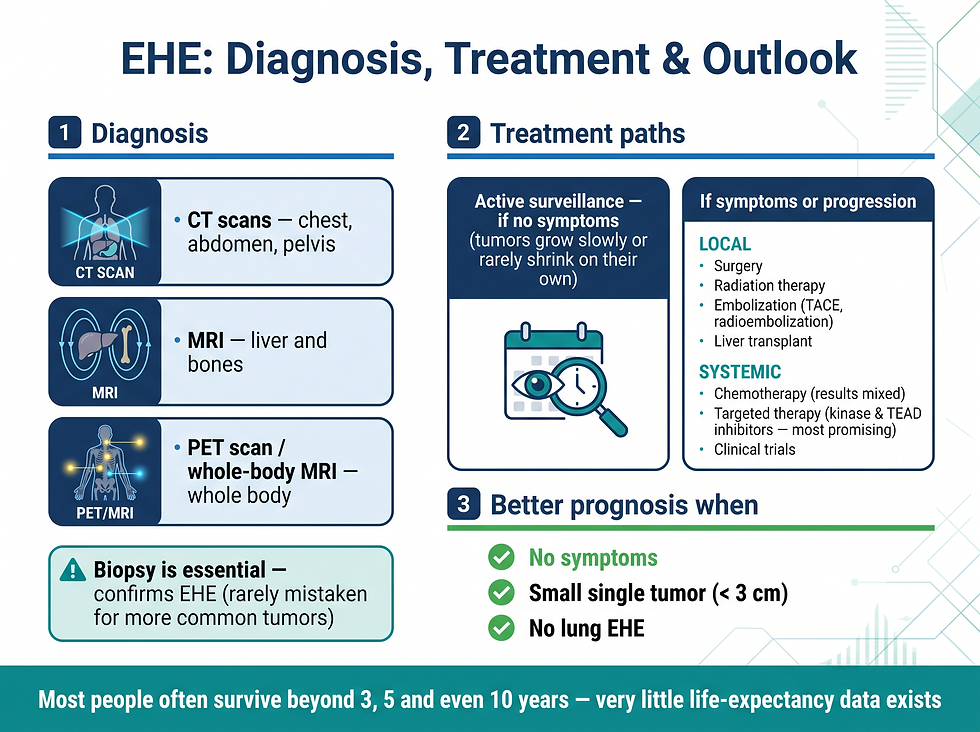
Tests you may need include:
Test | What it checks for |
CT scans | Tumors in your chest, abdomen and pelvis |
MRI | Tumors in your liver and bones |
PET scan or whole-body MRI | EHE throughout your body |
You'll need a biopsy to confirm that the tumor is EHE. This step is essential since these tumors are so rare. Healthcare providers sometimes assume they're more common tumors at first.
How Is Epithelioid Hemangioendothelioma Treated?
This condition is so rare that there aren't standard treatment guidelines. Instead, you'll likely work with several specialists with experience in treating sarcomas. They'll help you decide which treatments you need and when.
Since these tumors sometimes grow slowly (or even get better on their own), you may not need treatment if you don't have symptoms. Instead, your provider may monitor you for changes. This is called active surveillance.
If you have symptoms or your provider sees signs that your condition will get worse, they'll recommend treatments based on your situation.
What are local treatments for EHE?
Local treatments remove or destroy tumors that are in just one part of an organ:
Local treatment | Details |
Surgery | Providers usually remove single tumors. Sometimes they can remove several tumors if they're in the same region |
Radiation therapy | May be given after surgery to kill remaining cancer cells; may be the main treatment if you can't have surgery safely |
Vascular embolization | Cuts off the tumor's blood supply; standalone or to shrink a tumor before surgery; types for liver EHE include transarterial chemoembolization (TACE) and radioembolization |
Transplant | A liver transplant may be needed when EHE is only in your liver but surgery isn't an option (e.g., tumors too spread out to remove safely) |
What are systemic therapies for EHE?
You may need treatments that can kill cancer cells throughout your body if EHE is in more than one organ. This helps manage EHE that's advanced, progressing or that's come back after surgery:
Systemic therapy | Details |
Chemotherapy | May be recommended alone or with other treatments for advanced EHE; uses drugs to destroy cancer cells; results are mixed on how effective it is for EHE |
Targeted therapy | Drugs that keep tumors from getting the nutrients they need to grow; includes small molecule inhibitors/kinase inhibitors and TEAD inhibitors; some of the most promising treatments being tested for EHE |
Research on epithelioid hemangioendothelioma is ongoing. Experts are constantly testing new treatments in clinical trials. Depending on your condition, your provider may recommend you take part in one.
What Is the Outlook for EHE?
It's hard to pin down a prognosis (outlook) that makes sense for everyone with EHE. A tumor may be curable if your healthcare provider removes all of it during surgery. When it's not curable, it can be slow-growing or aggressive. It varies.
Factor | Effect on prognosis |
No symptoms | Generally better |
Small tumor | Usually less than 3 centimeters (a little over an inch), in only one place — better |
No lung EHE | Better — lung EHE often involves a worse prognosis than liver EHE |
How long can you live with epithelioid hemangioendothelioma?
Very little information exists about life expectancy with EHE. First, this condition is so rare that researchers are still collecting this data. Also, the severity of EHE varies from person to person.
Several studies show that most people with EHE often survive beyond three, five and even ten years.
Still, your healthcare provider is your best resource when it comes to explaining how your diagnosis may impact your lifespan.
When Should You See Your Healthcare Provider?
Because EHE often causes no symptoms, general warning signs matter. See a healthcare provider for unexplained weight loss, a cough that doesn't get better, persistent pain in your abdomen, chest or bones, coughing up blood, or frequent fractures without clear cause. These symptoms have many possible explanations, but they deserve evaluation — especially if they persist.
Clinical care-team note (verbatim from the source): "It's always important to get care from medical professionals you trust. But it's essential with an epithelioid hemangioendothelioma diagnosis. So much is still unknown about these rare vascular sarcomas. Working with providers who have experience treating rare sarcomas can make all the difference when it comes to your health. Don't hesitate to ask questions about which treatments are best for you and why. Your care team is there to help you understand and to guide you."
Conclusion: A Rare Cancer Where Experience Makes the Difference
Epithelioid hemangioendothelioma is among the rarest cancers known — striking fewer than 1 in 1 million people each year — and its behavior is famously unpredictable, ranging from fast-spreading disease to tumors that grow so slowly they may never need treatment. That unpredictability is precisely why the source emphasizes working with providers experienced in rare sarcomas: there are no standard treatment guidelines, so care must be tailored, whether that means active surveillance, surgery, radiation, embolization, transplant or the newest targeted therapies. If unexplained symptoms like weight loss, persistent cough or bone pain linger, seeking evaluation is the single most important step — early, expert involvement is what shapes outcomes with this condition.
Take these three steps:
Don't ignore lingering symptoms — unexplained weight loss, a cough that won't clear, or pain in your abdomen, chest or bones all warrant a professional evaluation.
Seek sarcoma-experienced specialists — with a rare vascular sarcoma, providers who regularly treat rare sarcomas can make all the difference in your treatment plan.
Ask about clinical trials — research on EHE is ongoing, and new treatments, especially targeted therapies, are constantly being tested.
This article provides general information and is not a substitute for professional medical advice. Always consult a qualified healthcare provider for diagnosis and treatment.
Frequently Asked Questions
What is epithelioid hemangioendothelioma?
Epithelioid hemangioendothelioma (EHE) is a malignant tumor that forms from the cells that line blood vessels. It's a very rare vascular cancer (sarcoma).
Is EHE a cancer?
Yes. EHE is a malignant (cancerous) tumor — a rare type of vascular sarcoma.
How rare is epithelioid hemangioendothelioma?
It affects less than 1 in every 1 million people each year.
Where does EHE usually form?
While it can form almost anywhere in your body, it often starts in your liver, lungs or bones. Tumors can form wherever blood vessels are.
Can EHE form as more than one tumor?
Yes. EHE may present as a single tumor, or there can be lots of tumors in a single organ or in many organs.
Does epithelioid hemangioendothelioma grow fast?
It varies. In some people, tumors are aggressive and spread fast. In others, they grow slowly and (rarely) even shrink without treatment.
What are the symptoms of EHE?
Many people have no symptoms. When they do occur, pain is the most common, with other symptoms depending on tumor location.
What symptoms suggest EHE in the liver?
Fatigue, fever, pain in your abdomen and unexplained weight loss.
What symptoms suggest EHE in the lungs?
Coughing, coughing up blood, trouble breathing or enlarged fingertips or toes (called "clubbing").
What is clubbing?
Enlarged fingertips or toes — a sign that can occur with lung EHE.
What symptoms suggest EHE in the bones?
Bone pain and frequent fractures or breaks.
What causes epithelioid hemangioendothelioma?
Medical experts have found certain gene errors that lead to EHE. They happen during your lifetime — you don't inherit them, so they don't run in families. Experts aren't sure why the errors happen.
What is the WWTR1-CAMTA1 fusion gene?
With EHE, one gene joins with another gene when it shouldn't. Usually the genes are WWTR1 and CAMTA1, creating the fusion gene WWTR1-CAMTA1 that drives tumor growth.
Are there other gene fusions that cause EHE?
Yes. A less common fusion gene combo is YAP1-TFE3, and other, even rarer gene fusions can happen too.
Is EHE inherited?
No. The gene errors that cause EHE happen during your lifetime and are not inherited, so it doesn't run in families.
Who is most likely to get EHE?
Most people diagnosed are in their early 50s, though it can affect people of all ages. It's slightly more common in females. The common age of diagnosis may differ depending on the type of fusion gene.
How is epithelioid hemangioendothelioma diagnosed?
Often, people learn they have a "suspicious" growth during imaging unrelated to EHE. Tests include CT scans (chest, abdomen, pelvis), MRI (liver and bones), and a PET scan or whole-body MRI. A biopsy is needed to confirm the diagnosis.
Why is a biopsy essential for EHE?
Because these tumors are so rare, healthcare providers sometimes assume they're more common tumors at first. A biopsy confirms that the tumor is EHE.
Is there a standard treatment for EHE?
No. The condition is so rare that there aren't standard treatment guidelines. You'll likely work with several specialists experienced in treating sarcomas who tailor the plan to your situation.
What is active surveillance for EHE?
Since tumors sometimes grow slowly or even get better on their own, you may not need treatment if you don't have symptoms. Your provider monitors you for changes instead.
Can surgery cure EHE?
A tumor may be curable if your healthcare provider removes all of it during surgery. Providers usually remove single tumors, and sometimes several tumors in the same region.
What is vascular embolization for EHE?
A procedure that cuts off the tumor's blood supply. It can be a standalone procedure or a way to shrink a tumor before surgery. Types for liver EHE include transarterial chemoembolization (TACE) and radioembolization.
When is a liver transplant used for EHE?
When EHE is only in your liver but surgery isn't an option — for instance, if the tumors are too spread out to remove safely.
Does chemotherapy work for EHE?
Your provider may recommend chemotherapy alone or with other treatments for advanced EHE. Results are mixed when it comes to how effective it is for EHE.
What is targeted therapy for EHE?
Treatment that uses drugs to keep tumors from getting the nutrients they need to grow. It includes small molecule inhibitors/kinase inhibitors and TEAD inhibitors — some of the most promising treatments being tested for EHE.
Are there clinical trials for EHE?
Yes. Research is ongoing and experts are constantly testing new treatments in clinical trials. Depending on your condition, your provider may recommend you take part in one.
What is the prognosis for epithelioid hemangioendothelioma?
It's hard to pin down a prognosis that fits everyone. It's generally better when you don't have symptoms, have a small tumor (usually less than 3 centimeters) in only one place, and don't have lung EHE.
Which is worse — liver EHE or lung EHE?
Lung EHE often involves a worse prognosis than liver EHE.
How long can you live with EHE?
Very little information exists about life expectancy because the condition is so rare and its severity varies person to person. Several studies show that most people with EHE often survive beyond three, five and even ten years. Your healthcare provider is your best resource for how your diagnosis may impact your lifespan.
When should I see a healthcare provider about possible EHE symptoms?
See a provider for unexplained weight loss, a cough that doesn't improve, persistent abdominal/chest/bone pain, coughing up blood, or frequent unexplained fractures — especially if symptoms persist.
Why is it important to see a sarcoma specialist for EHE?
So much is still unknown about these rare vascular sarcomas. Working with providers who have experience treating rare sarcomas can make all the difference, since there are no standard treatment guidelines.
Additional Resources
For further reading, these authoritative external references support the information above:
Content reviewed and produced following the Rinnit editorial framework. Last updated: September 28, 2026.
Comments