Epiploic Appendagitis: Symptoms, Causes, Diagnosis, Treatment and Outlook — What You Need to Know

Updated: 2 days ago
Medically reviewed by Dr. Baraa Alnahhal, MD · Last reviewed: September 2026
Quick Answer: Epiploic appendagitis is inflammation of an epiploic appendage — one of the small knobs of fatty tissue that hang from the outside of your colon. It usually starts when an appendage twists and cuts off its own blood supply, causing sudden, sharp, intense abdominal pain you can pinpoint to one spot. Although it mimics serious conditions like appendicitis, cholecystitis and diverticulitis, epiploic appendagitis itself is not serious and is not related to cancer or eating habits. Doctors diagnose it with an abdominal ultrasound or CT scan and treat it conservatively with NSAID pain relief. Most people improve within days, and even without treatment symptoms rarely last longer than a week.
TL;DR: Epiploic Appendagitis at a Glance
Epiploic appendagitis is a rare cause of sudden abdominal pain that sounds alarming but is usually self-limiting. The inflammation is confined to a small fatty appendage on the outside of the colon — unlike your appendix, gallbladder or diverticula, it has no risk of rupturing. Treatment is simple pain relief, and surgery is rarely necessary.
Limitation statement: The source states that exactly how common this condition is "we don't know" because it is likely underdiagnosed. The only figures available are researcher estimates published by the source — roughly 1% of hospital visits for acute abdominal pain and about 5% of people diagnosed with diverticulitis or appendicitis. No other statistics are provided or given here.
Fact | What the source says |
What it is | Inflammation of an epiploic appendage — a small knob of fatty tissue on the outside of the colon |
Main cause | Torsion (twisting) of the appendage, which cuts off its own blood supply |
Seriousness | Not serious; usually resolves on its own |
Rupture risk | None — unlike the appendix, gallbladder or diverticula |
Typical treatment | Pain relief (NSAIDs); surgery extremely rare |
Usual healing | Within a week even without treatment; days with medication |
Cancer or food link | No known connection with cancer or eating habits |
What Is Epiploic Appendagitis?

Epiploic appendagitis is a rare cause of sudden abdominal pain. The name means "inflammation of an epiploic appendage." Epiploic appendages are small pieces of fat that attach to and hang from the outside of your large intestine (colon). If one of them gets twisted, it can cut off its own blood supply.
This causes inflammation in the appendage and abdominal pain for you. Typically, the pain comes on abruptly and you can pinpoint the spot. But because it's relatively uncommon, epiploic appendagitis is often misdiagnosed as one of the more common causes of acute, focal abdominal pain.
What conditions does it mimic?
Look-alike condition | What it is |
Appendicitis | Inflamed appendix |
Cholecystitis | Inflamed gallbladder |
Diverticulitis | Inflamed pocket in your colon lining |
How common is epiploic appendagitis?
We don't know exactly how common it is because it's likely underdiagnosed. Researchers estimate that 1% of hospital visits for acute abdominal pain are due to epiploic appendagitis. About 5% of people diagnosed with diverticulitis or appendicitis have been found to have epiploic appendagitis instead.
How serious is epiploic appendagitis?
Epiploic appendagitis itself isn't serious, although it may be mistaken for other, more serious conditions. Unlike these other conditions, epiploic appendagitis usually goes away by itself. The affected epiploic appendage will eventually calcify and break off, which stops the inflammation and pain.

What Causes Epiploic Appendagitis?
Causes of epiploic appendagitis can be primary or secondary. Primary causes happen in the appendage itself. Secondary causes start somewhere else and spread to your appendage. This is less common.
Type of cause | Mechanism |
Primary — torsion | Most of the time (75%), the appendage gets bent or twisted, cutting off blood flow and causing an infarction |
Primary — thrombosis | Rarely, a blood clot might obstruct a vein in one of the appendages |
Secondary — infection | Infection that spreads from somewhere else |
Secondary — compression | Compression of the appendage from swelling in the tissues around it |
What are the risk factors for epiploic appendagitis?
Some research indicates that epiploic appendagitis might be more common with certain factors:
Risk factor | Details |
Obesity | Higher body weight is associated in some research |
Hernias | Presence of a hernia may raise risk |
Diverticulosis | Small pouches in the colon wall |
Strenuous exercise | Intense physical activity |
Middle age | 40s to 50s |
Sex | More common in males |
What Are the Symptoms of Epiploic Appendagitis?
The primary symptom is abdominal pain, usually in one spot. It comes on suddenly and may last several weeks. Since there are more appendages on the lower parts of your colon, epiploic appendagitis usually occurs there. Three in 4 people describe lower abdominal pain, and more than half say it's on the left side.
People also describe the pain as:
Pain characteristic | Details |
Sharp | Pointed, piercing quality |
Constant | Doesn't come and go |
Intense | Strong severity |
It might feel worse when you cough, stretch or breathe deeply.
What other signs may appear?
Sign | Details |
Guarding | Reflexively protecting that area, like being stiff, flinching or bracing |
Rebound tenderness | Your pain worsens when your provider removes pressure from the area |
A palpable mass | Sometimes the appendage is swollen enough to feel from the outside |
How is it different from appendicitis or diverticulitis?
These symptoms resemble several other, more common conditions. But appendicitis, cholecystitis and diverticulitis often include other symptoms, as well — like fever, nausea and vomiting. Your provider might suspect epiploic appendagitis if you have this type of abdominal pain but don't have other symptoms.
How Is Epiploic Appendagitis Diagnosed?
A radiologist can spot epiploic appendagitis on an abdominal ultrasound or CT scan (computed tomography scan). A healthy epiploic appendage usually won't show up in these images, but an inflamed one stands out due to the fluid inside, which makes it brighter. It looks like an oval-shaped mass located right at the source of the pain.
Diagnostic step | Details |
Who diagnoses it | A radiologist |
Abdominal ultrasound | Imaging that can reveal the inflamed appendage |
CT scan | Imaging that can reveal the inflamed appendage |
What shows up | An oval-shaped, brighter mass right at the source of the pain |
What Is the Best Treatment for Epiploic Appendagitis?
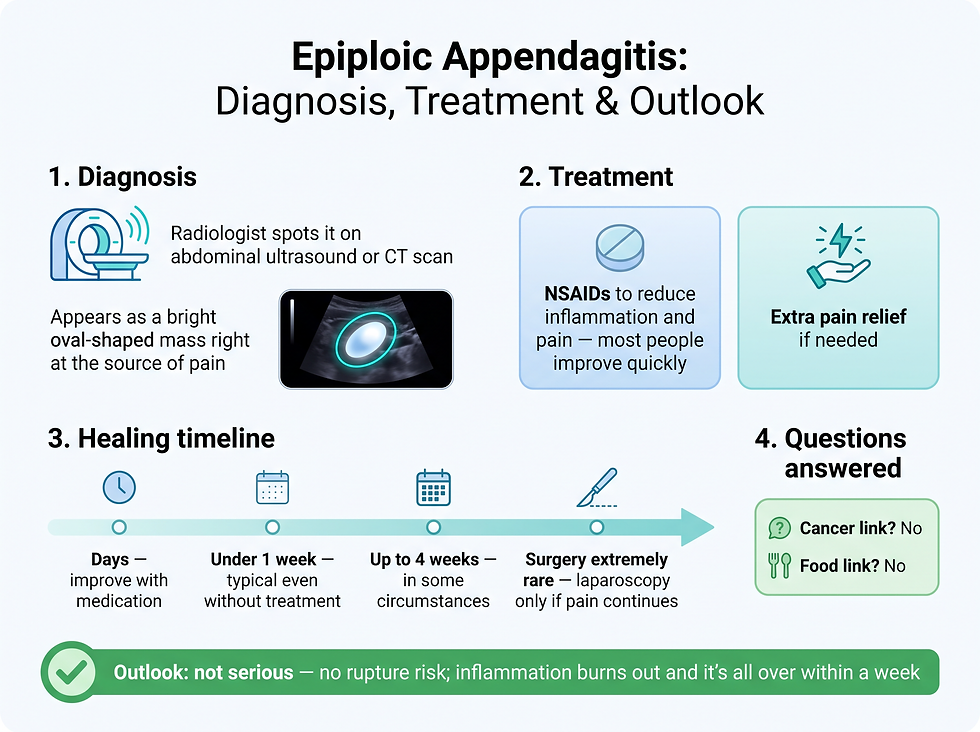
Healthcare providers begin by offering nonsteroidal anti-inflammatory drugs (NSAIDs) to reduce inflammation and pain. They'll offer additional pain relief if you need it. Most people improve quickly with medication. If you don't, rarely, your provider might need to remove the appendage in surgery.
When does treatment require surgery?
Surgery for epiploic appendagitis is extremely rare. But if your symptoms don't improve, or if your diagnosis is still in doubt, your provider might need to look inside your abdomen for the cause of your ongoing pain. They can do this through a minimally invasive surgical procedure called a laparoscopy.
A surgeon makes three or four small (half an inch) scattered incisions in your abdomen and inserts a tiny camera called a laparoscope. The laparoscope projects images to a screen. A laparoscopic surgeon uses these small incisions to operate, using long, narrow tools. They can remove the appendage this way.
How long does epiploic appendagitis usually take to heal?
Scenario | Expected timeline |
Without treatment | Symptoms rarely last longer than a week; might last up to four weeks in some circumstances |
With medication | Symptoms often improve within days |
What Is the Outlook for Epiploic Appendagitis?
Epiploic appendagitis can be painful and alarming, but in general, it isn't anything to worry about. Unlike your appendix, gallbladder or diverticula, an epiploic appendage has no risk of rupturing from inflammation. Usually, the inflammation burns out, the appendage dies, and it's all over within a week.
Is epiploic appendagitis related to cancer?
There's no known connection between epiploic appendagitis and cancer.
Is it related to food or diet?
There's no known connection between epiploic appendagitis and your eating habits.
When Should You See Your Provider?
Because epiploic appendagitis mimics serious conditions like appendicitis, cholecystitis and diverticulitis, sudden, sharp abdominal pain always deserves a professional evaluation. You cannot tell at home which condition is causing the pain.
See a healthcare provider promptly for sudden abdominal pain you can pinpoint to one spot — especially if it's sharp, constant and intense. Seek urgent evaluation if you develop fever, nausea or vomiting, or if the pain worsens or doesn't improve, since those can point to a more serious condition that needs timely treatment.
Clinical care-team note (verbatim from the source): "If epiploic appendagitis ever happens to you, it'll likely be the first and last time you hear about it. The sudden pain can be scary, and you might head to the emergency room expecting surgery for something more serious. But treatment for epiploic appendagitis is simple, and surgery is rarely necessary. You'll come home with an oddity of a healthcare story to share with everyone else who's never heard of it."
Conclusion: A Frightening Pain That Almost Always Ends Well
Epiploic appendagitis sounds like a rare, alarming diagnosis, but the evidence points to a reassuring reality: the pain is real and intense, yet the condition is not dangerous and almost never requires surgery. The inflammation is limited to a tiny fatty appendage that cannot rupture, and it burns out on its own within days to a week. The real value of knowing about this condition lies in its misdiagnosis risk — it imitates appendicitis, cholecystitis and diverticulitis, so accurate imaging is what separates a week of pain medication from an unnecessary operation.
Take these three steps:
Don't self-diagnose sudden abdominal pain — sudden, sharp, pinpointed pain needs a professional evaluation, because serious conditions can look identical at first.
Ask about imaging if pain persists — an abdominal ultrasound or CT scan read by a radiologist can identify an epiploic appendage and spare you from invasive treatment.
Expect quick improvement — with pain medication, symptoms typically ease within days, and even untreated cases rarely last more than a week.
This article provides general information and is not a substitute for professional medical advice. Always consult a qualified healthcare provider for diagnosis and treatment.
Frequently Asked Questions
What is epiploic appendagitis?
Epiploic appendagitis is a rare cause of sudden abdominal pain. The name means "inflammation of an epiploic appendage" — one of the small pieces of fat that attach to and hang from the outside of your large intestine (colon).
What are epiploic appendages?
Epiploic appendages are small pieces of fat that attach to and hang from the outside of your large intestine (colon).
What does epiploic appendagitis mean?
Epiploic appendagitis means "inflammation of an epiploic appendage."
What causes epiploic appendagitis?
Causes can be primary or secondary. The most common primary cause is torsion — the appendage gets bent or twisted, cutting off blood flow and causing an infarction. Rarely, a blood clot might obstruct a vein. Secondary causes include infection spreading from elsewhere and compression from swelling in nearby tissues.
How does torsion cause epiploic appendagitis?
Most of the time (75%), primary epiploic appendagitis happens when an appendage gets bent or twisted. This torsion is enough to cut off blood flow and cause an infarction — the blood can't get to the part of your body that needs it.
What is thrombosis in epiploic appendagitis?
Rarely, a blood clot might obstruct a vein in one of the appendages.
What are secondary causes of epiploic appendagitis?
Secondary causes include infection that spreads from somewhere else, and compression of the appendage from swelling in the tissues around it. This is less common than primary causes.
Who is at risk for epiploic appendagitis?
Some research indicates it might be more common with obesity, hernias, diverticulosis, strenuous exercise, middle age (40s to 50s) and in males.
What does epiploic appendagitis pain feel like?
The primary symptom is abdominal pain, usually in one spot. It comes on suddenly, and people describe it as sharp, constant and intense. It might feel worse when you cough, stretch or breathe deeply.
Where does epiploic appendagitis hurt?
Three in 4 people describe lower abdominal pain, and more than half say it's on the left side. This happens because there are more appendages on the lower parts of your colon.
Does epiploic appendagitis hurt when you move?
The pain might feel worse when you cough, stretch or breathe deeply.
What is guarding in epiploic appendagitis?
Guarding is reflexively protecting the painful area, like being stiff, flinching or bracing.
What is rebound tenderness?
Your pain worsens when your provider removes pressure from the area.
Can you feel epiploic appendagitis from the outside?
Sometimes. A palpable mass can appear when the appendage is swollen enough to feel from the outside.
Does epiploic appendagitis cause fever, nausea or vomiting?
Typically not. Appendicitis, cholecystitis and diverticulitis often include fever, nausea and vomiting — your provider might suspect epiploic appendagitis if you have this type of abdominal pain but don't have those other symptoms.
How is epiploic appendagitis diagnosed?
A radiologist can spot it on an abdominal ultrasound or CT scan. A healthy epiploic appendage usually won't show up in these images, but an inflamed one stands out due to the fluid inside, which makes it brighter.
What does epiploic appendagitis look like on a CT scan?
It looks like an oval-shaped mass located right at the source of the pain, made brighter by the fluid inside.
What is the best treatment for epiploic appendagitis?
Healthcare providers begin by offering nonsteroidal anti-inflammatory drugs (NSAIDs) to reduce inflammation and pain. They'll offer additional pain relief if you need it. Most people improve quickly with medication.
Does epiploic appendagitis need surgery?
Rarely. Surgery is extremely rare. If symptoms don't improve or the diagnosis is still in doubt, a provider might remove the appendage during a laparoscopy.
What is a laparoscopy for epiploic appendagitis?
A surgeon makes three or four small (half an inch) scattered incisions in your abdomen and inserts a tiny camera called a laparoscope. The laparoscope projects images to a screen, and the surgeon removes the appendage using long, narrow tools.
How long does epiploic appendagitis take to heal?
Even without treatment, symptoms rarely last longer than a week. They might last up to four weeks in some circumstances. With medication, symptoms often improve within days.
Can epiploic appendagitis go away on its own?
Yes. Epiploic appendagitis usually goes away by itself. The affected appendage will eventually calcify and break off, which stops the inflammation and pain.
Is epiploic appendagitis serious?
No. Epiploic appendagitis itself isn't serious, although it may be mistaken for other, more serious conditions.
Can an epiploic appendage rupture?
No. Unlike your appendix, gallbladder or diverticula, an epiploic appendage has no risk of rupturing from inflammation.
Is epiploic appendagitis related to cancer?
No. There's no known connection between epiploic appendagitis and cancer.
What foods cause epiploic appendagitis?
There's no known connection between epiploic appendagitis and your eating habits.
How common is epiploic appendagitis?
We don't know exactly because it's likely underdiagnosed. Researchers estimate that 1% of hospital visits for acute abdominal pain are due to epiploic appendagitis, and about 5% of people diagnosed with diverticulitis or appendicitis have been found to have it instead.
How is epiploic appendagitis different from appendicitis?
Appendicitis involves an inflamed appendix and often includes fever, nausea and vomiting, and can rupture. Epiploic appendagitis involves a fatty appendage on the outside of the colon, lacks those systemic symptoms, and cannot rupture.
How is epiploic appendagitis different from diverticulitis?
Diverticulitis is an inflamed pocket in your colon lining and often includes fever, nausea and vomiting. Epiploic appendagitis is inflammation of a fatty appendage outside the colon, typically without those symptoms.
Will epiploic appendagitis happen again?
The care team notes it will likely be "the first and last time you hear about it" — the condition resolves, and recurrence is not discussed by the source.
When should I see a provider for abdominal pain?
See a provider promptly for sudden, sharp, intense abdominal pain you can pinpoint to one spot. Seek urgent evaluation if you develop fever, nausea or vomiting, or if the pain worsens or doesn't improve.
Additional Resources
For further reading, these authoritative external references support the information above:
Content reviewed and produced following the Rinnit editorial framework. Last updated: September 28, 2026.
Comments