Eczema on the Lips (Eczematous Cheilitis): Symptoms, Causes, Diagnosis, Treatment, Prevention and When to Seek Emergency Care — What You Need to Know

Updated: 2 days ago
Medically reviewed by Dr. Baraa Alnahhal, MD · Last reviewed: September 2026
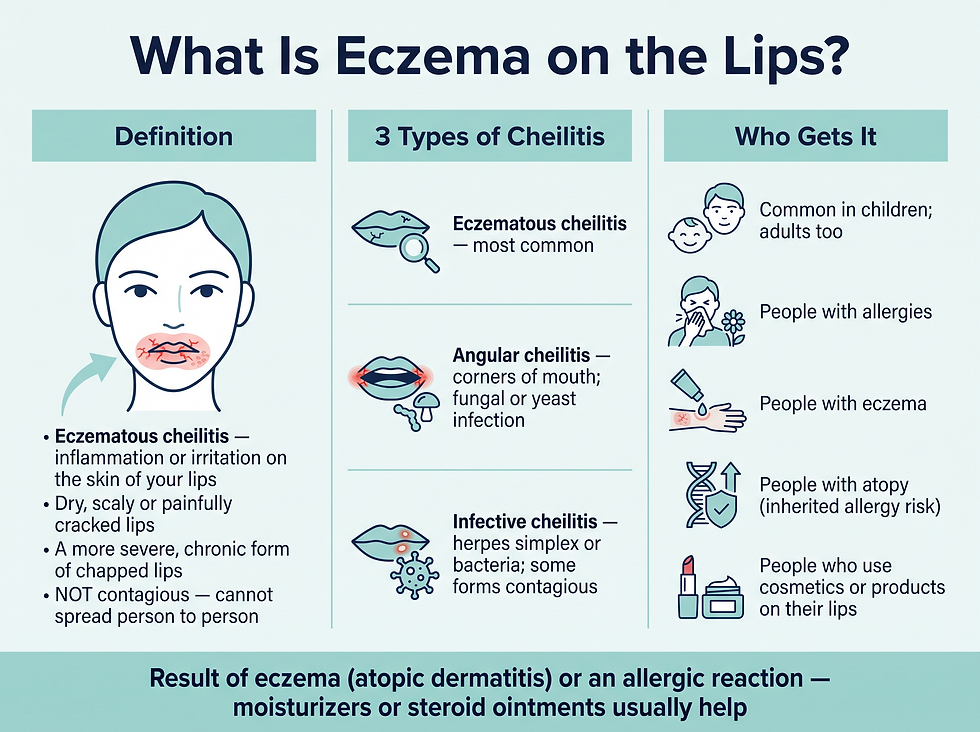
Quick Answer: What Is Eczema on the Lips and How Is It Treated?
Eczema on the lips, also known as eczematous cheilitis, is inflammation or irritation on the skin of your lips that makes them red, dry, itchy, scaly, cracked and painful. It is a more severe, long-term (chronic) form of chapped lips, sometimes linked to atopic dermatitis or an allergic reaction, and it is not contagious. Treatment usually works: petroleum jelly or unscented moisturizers, steroid ointments to reduce inflammation, stopping habits like lip licking or biting, and avoiding irritating lip products, with oral steroids or prescription immune-calming creams reserved for rare, severe cases.
TL;DR
Eczema on the lips (eczematous cheilitis) is inflammation or irritation on the skin of your lips that can lead to dry, scaly or painfully cracked lips. It is a more severe form of chapped lips. While chapped lips are usually temporary, eczema on the lips tends to be long term (chronic). The condition can result from eczema (atopic dermatitis) or an allergic reaction, and moisturizers or ointments containing steroids usually help. It is not contagious, so it cannot spread from person to person.
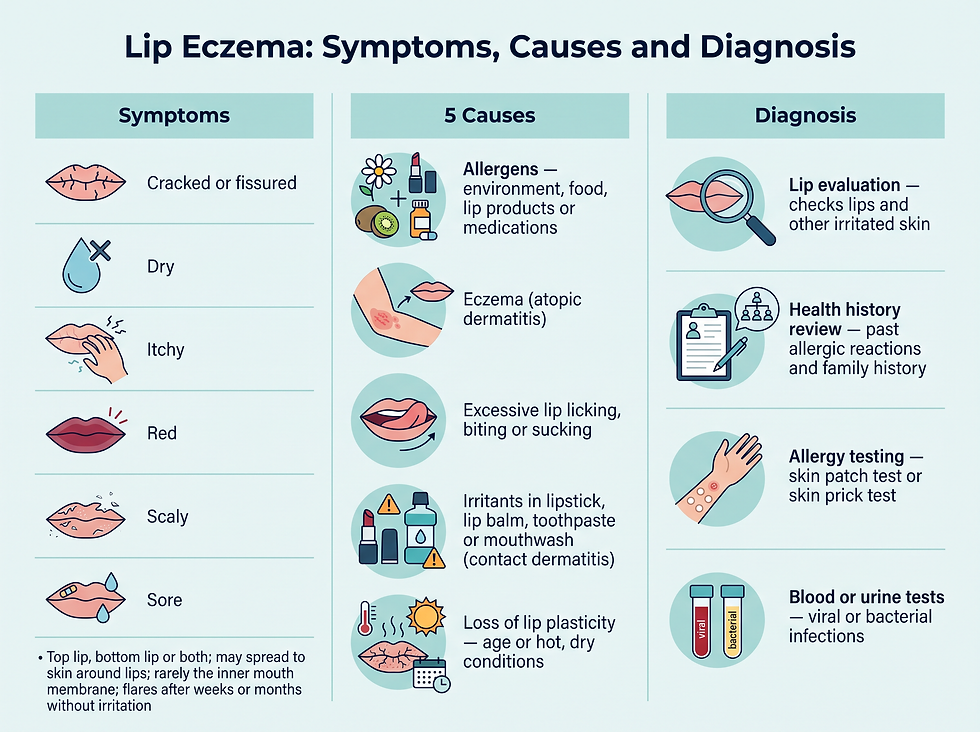
Lip eczema can affect your top lip, bottom lip or both, and may spread to the skin around your lips; rarely, it involves the inner mucous membrane of your mouth. Symptoms (cracked or fissured, dry, itchy, red, scaly and sore lips) can flare up and worsen after weeks or months without any irritation. Causes include allergens in the environment, food, lip products or medications, irritants in lipstick, lip balm, toothpaste or mouthwash, excessive lip licking, biting or sucking, and loss of lip hydration and elasticity from age or hot, dry conditions.
Because eczema on the lips is chronic like atopic dermatitis, it can come and go. Your lips may stay clear for a long time before a flare-up, and in children the condition tends to improve as they get older. You cannot prevent all cases, but avoiding fragranced or dyed lip products, staying hydrated, moisturizing with petroleum jelly, skipping alcohol-containing mouthwash and very salty or spicy foods, and not licking or biting your lips reduces your risk.
When to seek help: Contact your provider for severe lip sores that are open, bleed or do not improve, or hives and swelling around your face, lips or eyes. Call 911 immediately for shortness of breath or trouble swallowing, possible signs of anaphylaxis.
This article uses no invented statistics; the cited source provides no prevalence figures for eczema on the lips.
Key fact | What the evidence shows |
Definition | Inflammation or irritation on the skin of your lips (eczematous cheilitis) |
Relationship to chapped lips | A more severe, chronic form; chapped lips are usually temporary |
Underlying drivers | Eczema (atopic dermatitis) or an allergic reaction |
Contagious? | No. It cannot spread from person to person |
Usual relief | Moisturizers or ointments containing steroids |
Course | Chronic; can come and go with flares after weeks or months |
Children's outlook | Tends to improve as they get older |
What Is Eczema on the Lips?
Eczema on the lips, also known as eczematous cheilitis, is inflammation or irritation on the skin of your lips [1].
It is sometimes associated with atopic dermatitis. It can lead to dry, scaly or painfully cracked lips [1].
It is a more severe form of chapped lips. Chapped lips are usually temporary, but eczema on the lips tends to be long term (chronic) [1].
You can get lip dermatitis if you have an allergic reaction to a substance, such as toothpaste or lotion. People with lip eczema may also have atopic dermatitis elsewhere on their bodies [1].
It is not contagious, so it cannot spread from person to person [1].
Are There Different Types of Cheilitis?
The term "cheilitis" describes general lip irritation. Eczematous cheilitis is the most common form, but other common types include angular cheilitis and infective cheilitis [1].
Type | Key characteristic |
Eczematous cheilitis | The most common form of cheilitis; inflammation of lip skin linked to eczema or allergy |
Usually affects the corners of the mouth; often the result of a fungal or yeast infection | |
Infective cheilitis | Can result from the herpes simplex virus or bacterial infections such as group A streptococcal infections; some forms are contagious |
Who Gets Eczema on Their Lips?
Eczema on the lips tends to be a common skin problem in children, but adults can get it, too [1].
It may affect people who have allergies, who have eczema, who have atopy (an inherited risk of developing allergies), or who use cosmetics or other products on their lips [1].
Risk factor | Detail |
Allergies | People with allergies are more susceptible |
Eczema | Existing eczema elsewhere raises the risk |
Atopy | An inherited risk of developing allergies |
Lip products | Using cosmetics or other products on your lips |
What Causes Lip Eczema?
Potential causes of eczema on the lips include allergens in the environment, food, lip products or medications; eczema (atopic dermatitis); excessive lip licking, biting or sucking; irritants such as those found in lipstick, lip balm, toothpaste or mouthwash (contact dermatitis); and loss of lip plasticity (hydration and elasticity), often due to age or exposure to hot, dry conditions [1].
Cause | Detail |
Allergens | In the environment, food, lip products or medications |
Eczema (atopic dermatitis) | The underlying eczema condition itself |
Lip habits | Excessive lip licking, biting or sucking |
Irritants | Found in lipstick, lip balm, toothpaste or mouthwash (contact dermatitis) |
Loss of lip plasticity | Hydration and elasticity decline, often due to age or hot, dry conditions |
What Are the Symptoms of Lip Dermatitis?
Lip eczema can affect your top lip, bottom lip or both. It may also spread to the skin around your lips. Rarely, it invades the inner mucous membrane of your mouth. Some people do not have lip irritation for weeks or months, then symptoms flare up and get worse [1].
Lip dermatitis can make your lips cracked or fissured, dry, itchy, red, scaly and sore [1].
Symptom | Detail |
Cracked or fissured | Deep splits in the lip skin |
Dry | Loss of moisture in the lip skin |
Itchy | Persistent itch on the lips |
Red | Visible redness |
Scaly | Flaky, scaly texture |
Sore | Painful, tender lips |
How Is Eczema on the Lips Diagnosed?
Your healthcare provider evaluates your lips and checks for other areas of skin irritation or inflammation. They also review your health history, including any allergic reactions you have had in the past. Be sure to let them know if anyone in your family has a history of atopic dermatitis or other allergic skin conditions [1].
Your healthcare provider may perform tests to confirm a diagnosis of eczema on the lips, such as allergy testing (a skin patch test or skin prick test) to find out if a specific substance is causing your lip irritation, and blood or urine tests to check for viral or bacterial infections [1].
Diagnostic step | Purpose |
Lip evaluation | Examines your lips and checks other areas of skin irritation or inflammation |
Health history review | Includes past allergic reactions and family history of atopic dermatitis or allergic skin conditions |
Allergy testing | Skin patch test or skin prick test to find a specific substance causing the irritation |
Blood or urine tests | Check for viral or bacterial infections |

How Is Lip Eczema Treated?
If you have lip dermatitis, try to stop habits such as licking, biting or sucking your lips. You should also avoid irritants such as lip balms or lipsticks [1].
Your healthcare provider may recommend petroleum jelly or unscented, hypoallergenic moisturizer to soothe dry, cracked lips, and steroid ointment to reduce inflammation [1].
In rare cases, people with severe lip eczema need oral steroids (taken by mouth) or a special prescription skin cream or ointment that prevents your immune system from overreacting to allergens [1].
Treatment | Purpose |
Stop lip habits | Stop licking, biting or sucking your lips |
Avoid irritants | Lip balms, lipsticks and other irritating products |
Petroleum jelly or unscented, hypoallergenic moisturizer | Soothe dry, cracked lips |
Steroid ointment | Reduce inflammation |
Oral steroids (rare, severe cases) | Taken by mouth for severe lip eczema |
Prescription immune-calming cream/ointment (rare, severe cases) | Prevents your immune system from overreacting to allergens |
What's the Prognosis for People with Eczema on the Lips?
Eczema on the lips, like atopic dermatitis, tends to be a chronic condition. It can come and go, so your lips might be clear for a long time before you have a flare-up. In children, the condition tends to improve as they get older [1].
How Can I Prevent Eczema on the Lips?
You may not be able to prevent eczema from developing on your lips if you have atopic dermatitis elsewhere on your body, but you can reduce your risk by avoiding lipstick, lip balm or other cosmetics that contain fragrances or dyes; cutting down on alcohol consumption; drinking plenty of water; keeping your lips moisturized with petroleum jelly; not licking, scratching, biting or sucking your lips; selecting mouthwash and toothpaste without alcohol or harsh antiseptics; and skipping very salty or spicy foods [1].
Prevention step | Detail |
Avoid fragranced/dyed cosmetics | Lipstick, lip balm or other products with fragrances or dyes |
Cut down on alcohol | Reduces overall risk |
Drink plenty of water | Keeps lips hydrated |
Moisturize with petroleum jelly | Protects dry lip skin |
Don't lick, scratch, bite or suck your lips | Breaks the irritation cycle |
Choose gentle oral care | Mouthwash and toothpaste without alcohol or harsh antiseptics |
Skip very salty or spicy foods | Known lip irritants |
When Should You Contact Your Healthcare Provider?
Contact your healthcare provider if you have severe lip sores that are open, bleed or do not improve with treatment, or hives (urticaria) and swelling (angioedema) around your face, lips or eyes [1].
Emergency: Call 911 immediately. If you or someone else has shortness of breath (dyspnea) or trouble swallowing, these could be signs of anaphylaxis, a life-threatening allergic reaction. Call 911 immediately [1].
What Questions Should You Ask Your Doctor?
Question | Why it matters |
Is my lip irritation eczema or an allergic reaction? | Directs the right treatment path |
Which of my lip products is triggering the flares? | Helps you eliminate the culprit |
Should I use petroleum jelly or a medicated ointment? | Matches soothing care to your skin |
Is a steroid ointment appropriate for my case? | Reduces inflammation safely under guidance |
Could an allergy test identify the cause? | Skin patch or prick testing finds the specific substance |
What should I avoid in toothpaste and mouthwash? | Alcohol and harsh antiseptics can trigger flares |
Will this condition improve as my child gets older? | The source says it tends to improve in children |
Managing Lip Eczema for the Long Term
Lip eczema is a chronic condition that tends to come and go, but the source is equally clear that everyday care makes a real difference. The foundation is protection and elimination: keep your lips moisturized with petroleum jelly or an unscented, hypoallergenic moisturizer, drink plenty of water, and systematically remove the irritants that feed the cycle: fragranced and dyed lip cosmetics, alcohol-containing toothpaste and mouthwash, very salty or spicy foods, and the habits of licking, scratching, biting or sucking your lips. When flares occur, steroid ointments reduce inflammation, and in rare severe cases oral steroids or prescription immune-calming creams step in. Because lip dermatitis can reflect an allergy, testing matters: report any family history of atopic dermatitis, and expect patch or prick testing if a specific substance is suspected. Two safety signals deserve special attention. Hives and swelling around the face, lips or eyes warrant a provider visit, and shortness of breath or trouble swallowing is an anaphylaxis emergency requiring an immediate 911 call. With consistent care and trigger avoidance, most people find real relief, and children tend to improve as they get older.
Eczema on the lips is a skin condition that can make them red, dry and cracked. Talk to your healthcare provider if your lip irritation doesn't go away in a few days. They can make sure you don't have an illness or infection. Lip ointment, moisturizers or steroids usually helps lip eczema. Clinical note from the source's care team
Take the next step. Today, switch to a fragrance-free, dye-free lip care routine built on petroleum jelly, replace alcohol-based toothpaste and mouthwash with gentler options, and stop licking, biting or sucking your lips. See your provider if your lip irritation does not go away in a few days, so they can rule out illness or infection, and contact them promptly for open, bleeding sores that do not improve or hives and swelling around your face, lips or eyes. Call 911 immediately for shortness of breath or trouble swallowing. This article is educational only and is not a substitute for professional medical advice, diagnosis or treatment. Always consult a qualified healthcare provider about your individual condition.
Frequently Asked Questions About Eczema on the Lips
What is eczema on the lips?
Eczema on the lips, also known as eczematous cheilitis, is inflammation or irritation on the skin of your lips.
What is another name for lip eczema?
Eczematous cheilitis.
How does lip eczema differ from chapped lips?
Eczema on the lips is a more severe form of chapped lips. Chapped lips are usually temporary, but eczema on the lips tends to be long term (chronic).
What can lip eczema lead to?
Dry, scaly or painfully cracked lips.
Is eczema on the lips contagious?
No. It is not contagious, so it cannot spread from person to person.
What is cheilitis?
The term "cheilitis" describes general lip irritation.
What is the most common form of cheilitis?
Eczematous cheilitis.
What is angular cheilitis?
A type of cheilitis that usually affects the corners of the mouth and is often the result of a fungal or yeast infection.
What is infective cheilitis?
Cheilitis that can be the result of the herpes simplex virus or bacterial infections such as group A streptococcal infections; some forms are contagious.
Is lip eczema caused by allergies?
The condition might be the result of eczema or an allergic reaction, for example an allergic reaction to toothpaste or lotion.
Who gets eczema on their lips?
It tends to be a common skin problem in children, but adults can get it, too; it may affect people with allergies, eczema, atopy or who use cosmetics or other products on their lips.
What is atopy?
An inherited risk of developing allergies.
What causes lip eczema?
Allergens in the environment, food, lip products or medications; eczema (atopic dermatitis); excessive lip licking, biting or sucking; irritants in lipstick, lip balm, toothpaste or mouthwash; and loss of lip plasticity (hydration and elasticity), often due to age or hot, dry conditions.
What does contact dermatitis have to do with lip eczema?
Irritants in lipstick, lip balm, toothpaste or mouthwash cause a contact dermatitis reaction on the lips.
What are the symptoms of lip dermatitis?
Lips that are cracked or fissured, dry, itchy, red, scaly and sore.
Which lips does lip eczema affect?
It can affect your top lip, bottom lip or both.
Can lip eczema spread beyond the lips?
It may spread to the skin around your lips; rarely, it invades the inner mucous membrane of your mouth.
Can lip eczema flare after long quiet periods?
Yes. Some people do not have lip irritation for weeks or months, then symptoms flare up and get worse.
How is eczema on the lips diagnosed?
Your provider evaluates your lips, checks for other areas of skin irritation or inflammation, and reviews your health history, including past allergic reactions and family history of atopic dermatitis or other allergic skin conditions.
What is a skin patch test or skin prick test for?
Allergy testing to find out if a specific substance is causing your lip irritation.
Why are blood or urine tests ordered?
To check for viral or bacterial infections.
How is lip eczema treated?
By stopping habits like licking, biting or sucking your lips, avoiding irritants such as lip balms or lipsticks, and using petroleum jelly or unscented, hypoallergenic moisturizer to soothe dry, cracked lips plus steroid ointment to reduce inflammation.
When are oral steroids or prescription creams used?
In rare cases, people with severe lip eczema need oral steroids (taken by mouth) or a special prescription skin cream or ointment that prevents your immune system from overreacting to allergens.
What do moisturizers or ointments containing steroids do?
They usually help treat lip eczema. Moisturizers soothe and steroid ointments reduce inflammation.
What is the prognosis for lip eczema?
It tends to be a chronic condition like atopic dermatitis; it can come and go, so your lips might be clear for a long time before a flare-up. In children, the condition tends to improve as they get older.
Can you prevent eczema on the lips?
You may not be able to prevent it if you have atopic dermatitis elsewhere on your body, but you can reduce your risk by avoiding fragranced or dyed lip cosmetics, cutting down on alcohol, drinking plenty of water, moisturizing with petroleum jelly, not licking/scratching/biting/sucking your lips, selecting mouthwash and toothpaste without alcohol or harsh antiseptics, and skipping very salty or spicy foods.
When should I contact my healthcare provider?
For severe lip sores that are open, bleed or do not improve with treatment, or hives (urticaria) and swelling (angioedema) around your face, lips or eyes.
When should I call 911?
Immediately if you or someone else has shortness of breath (dyspnea) or trouble swallowing, which could be signs of anaphylaxis, a life-threatening allergic reaction.
References
Last reviewed against the source page last updated April 18, 2022. This article contains no information beyond the cited source.
Comments