Eagle Syndrome: Symptoms, Causes, Diagnosis, Surgery Options and When to Seek Emergency Care — What You Need to Know

Updated: 2 days ago
Medically reviewed by Dr. Baraa Alnahhal, MD · Last reviewed: September 2026
Quick answer: What is Eagle syndrome and how is it treated?
Eagle syndrome is a rare pain condition caused by an elongated styloid process (a needlelike bone beneath the ear) or a hardened stylohyoid ligament that presses on nerves or blood vessels in the head and neck, producing facial, throat or neck pain that often worsens with chewing, yawning, talking or turning the head. Diagnosis relies on a physical exam and CT imaging, often with CT angiography when blood vessels are involved. Treatment ranges from pain medications — analgesics, antidepressants, steroid or lidocaine injections and NSAIDs — to surgery (styloidectomy), which cures the syndrome in approximately 80% of cases.
TL;DR
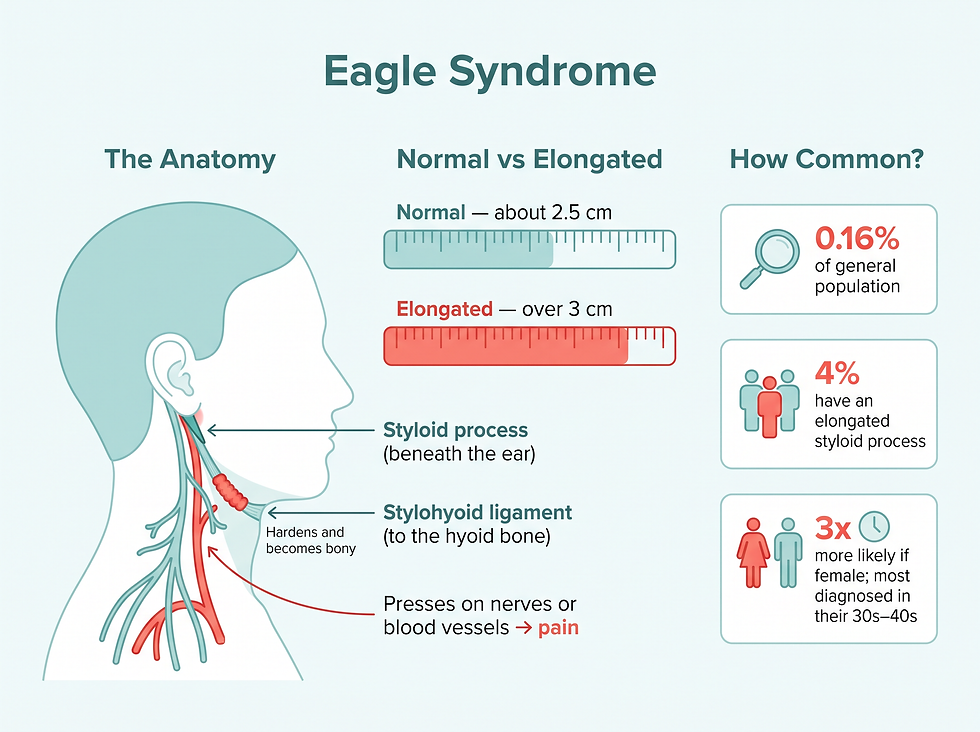
Eagle syndrome happens when atypical structures in the head or neck cause facial or throat pain. An elongated styloid process or a hardened stylohyoid ligament is to blame. The styloid process is a small, needlelike bone beneath each ear, and the stylohyoid ligament runs from it to the hyoid bone at the front of the neck. Unlike most ligaments, which stay stretchy, it becomes hard and bony in this condition.
People experience symptoms when the bone or hardened ligament presses on nearby nerves or blood vessels. Surgery can get rid of symptoms, and the outlook is excellent for most surgical patients.
Limitation statement: Eagle syndrome is rare, and published prevalence figures come from small studies cited by the source page. All statistics in this article reflect only what the source page reports; no additional numbers are included.
Key fact | What the evidence shows |
Prevalence | As few as 0.16% of people in the general population have this rare pain syndrome |
Elongated styloid process | Only about 4% of people have one; but only a small percentage of them develop Eagle syndrome |
Normal vs elongated | A typical styloid process is about 2.5 centimeters long; an elongated one is over 3 centimeters |
Who is affected | You're three times more likely to have it if you're female; most diagnoses come in the 30s or 40s |
Surgical outcome | Approximately 80% of people who get a styloidectomy no longer experience symptoms |
What is Eagle syndrome?
In Eagle syndrome, an elongated styloid process or a rigid stylohyoid ligament causes pain in the face, neck or throat. Your styloid process is a small, needlelike bone beneath each ear. The stylohyoid ligament extends from the styloid process to the hyoid bone at the front of the neck. Like most ligaments, it is supposed to be stretchy. But with Eagle syndrome, it is often hard and bony.
People experience symptoms when the bone or hardened ligament presses on nearby nerves or blood vessels.
How common is Eagle syndrome?
As few as 0.16% of people in the general population have this rare pain syndrome. Only about 4% of people have an elongated styloid process. A typical styloid process is about 2.5 centimeters long (just under an inch). An elongated styloid process is over 3 centimeters (just over an inch). But only a small percentage of people with an elongated styloid process have symptoms of Eagle syndrome.
You are three times more likely to have Eagle syndrome if you are female. Most people receive a diagnosis when they are in their 30s or 40s.
What are the symptoms of Eagle syndrome?
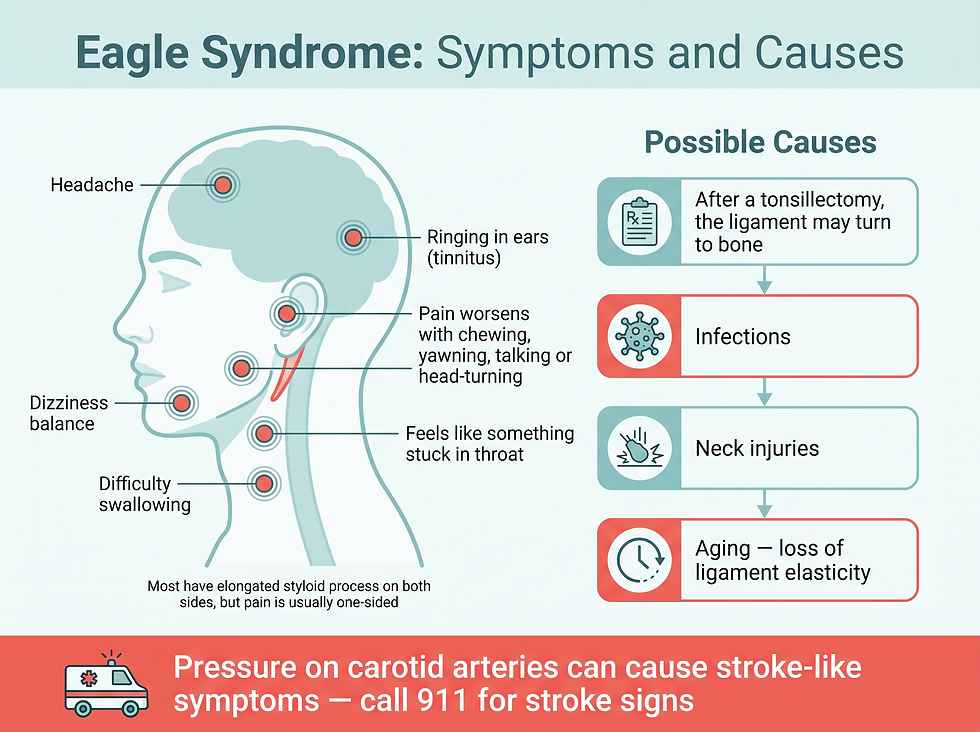
Symptoms depend on which nerves or blood vessels come into contact with the styloid process or stylohyoid ligament. Recognized symptoms include:
Symptom | Details |
Pain in face, neck or throat | Often worsens when you chew, yawn, talk or turn your head |
Something stuck in the throat | A feeling like something is stuck in your throat |
Difficulty swallowing (dysphagia) | Trouble swallowing food or liquids |
Ringing in the ears (tinnitus) | Ringing or buzzing sounds in the ear |
Recurring head pain | |
Feeling unsteady or lightheaded |
Most people with Eagle syndrome have an elongated styloid process on both sides of the head, but the majority only experience pain on one side.
What does Eagle syndrome feel like?
Pain symptoms are often similar to those in glossopharyngeal neuralgia. A styloid process that squeezes the glossopharyngeal nerve — a major nerve deep in the neck — can cause sharp or shooting pain near the tonsils or the back of the tongue. The pain may radiate to the ear. Others describe the nerve pain associated with Eagle syndrome as recurrent, dull and throbbing.
What causes Eagle syndrome?
Symptoms occur when an elongated styloid process or a bony stylohyoid ligament places pressure on sensitive nerves or blood vessels in the head and neck. But experts continue to debate what causes the atypical structures in the first place.
In 1937, the syndrome's namesake, Dr. Watt Eagle, proposed that sometimes the stylohyoid ligament ossifies (turns to bone) after a tonsillectomy. Other potential causes include infections, neck injuries, or a decline in ligament elasticity due to aging.
What are the complications of Eagle syndrome?
Although it is rare, an elongated styloid process can place pressure on nearby blood vessels, like the carotid arteries. When this happens, you may notice pain beneath your eyes or experience symptoms of a transient ischemic attack (TIA) or stroke, including numbness on one side of the face (hemiparesis), dizziness, blurred vision, passing out or fainting (syncope), and changes in speech such as slurring words.
In Eagle syndrome, these symptoms are often episodic, which means they eventually go away. But sometimes, they signal a medical emergency, such as a cut or damaged artery.
Call 911 (or your local emergency service number) or get to the ER immediately if you're experiencing symptoms of a stroke.
If left untreated
Without treatment, symptoms continue. Eagle syndrome is not a condition that improves on its own.
How is Eagle syndrome diagnosed?
A healthcare provider will review the medical history, including whether you have had surgery or an injury to the head and neck, and perform a physical exam. Sometimes, the provider can feel an abnormal styloid process when touching the neck. Or, they may feel in the area of the tonsils inside the mouth and ask if it causes pain.
Imaging can show an abnormal styloid process or stylohyoid ligament. The tests used are:
Imaging test | What it does |
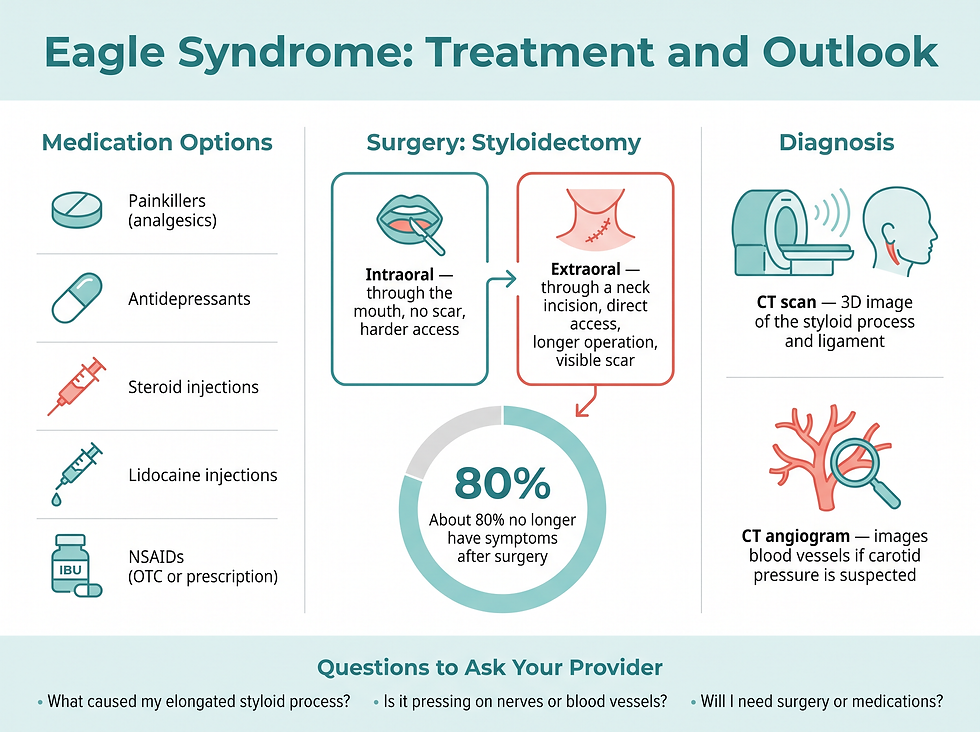
Computed tomography (CT) scan | Uses a series of X-rays to picture the styloid process and stylohyoid ligament; recreates a three-dimensional (3D) image so the provider can see if the styloid process is elongated |
CT angiogram | Takes X-ray images of blood vessels; used if the provider suspects the styloid process or ligament is placing pressure on the carotid arteries |
What can be mistaken for Eagle syndrome?
An important part of diagnosis involves excluding conditions that can also cause Eagle syndrome symptoms. A provider may run tests to rule out inflammatory head and neck conditions (sinusitis, tonsillitis, insertion tendinitis), temporomandibular joint (TMJ) disorders, glossopharyngeal neuralgia, myofascial pain syndrome, head and neck cancer, migraine headaches and dental problems.
How is Eagle syndrome treated?
A provider may recommend medications to manage the pain or surgery to shorten the styloid process (styloidectomy). Treatment depends on how severe the symptoms are and whether you are a good candidate for surgery. Medication options include:
Medication type | Purpose |
Painkillers (analgesics) | Manage the pain |
Antidepressants | Help manage nerve-related pain |
Steroid injections | Reduce inflammation around the affected structures |
Lidocaine injections | Numb the painful area |
NSAIDs (OTC or prescription) | Nonsteroidal anti-inflammatory drugs for pain and inflammation |
When is surgery recommended?
Surgery to shorten the styloid process — a styloidectomy — can cure Eagle syndrome. Surgeons use one of two approaches:
Approach | How it works | Pros and cons |
Intraoral (transoral) | Surgeon accesses the styloid process through the mouth | Won't leave behind a scar; harder to access the area |
Extraoral (transcervical) | Surgeon accesses the styloid process through a neck incision | Direct access to the tissue; longer operating time and a scar afterward |
The provider can explain which approach is best according to your diagnosis.
What are the risks of a styloidectomy?
No surgery is without risks. Trauma to tissue during surgery can lead to scarring and deep infections in the throat that can be serious without treatment. Seeing a surgeon with extensive experience performing head and neck surgeries can reduce the risk of these complications.
What is the outlook for Eagle syndrome?
The outlook is excellent. Approximately 80% of people who get a styloidectomy no longer experience symptoms. For many people, over-the-counter and prescription pain relievers are enough to keep the pain and discomfort at bay.
Can surgery fail?
Just because a styloid process is calcified or elongated does not mean you have Eagle syndrome. There are also people who have an elongated styloid process with symptoms who get surgery to shorten it, but their symptoms do not improve. This is why it is important to see a healthcare provider with experience in diagnosing and managing this condition — it can be difficult to judge who will benefit from surgery.
Can Eagle syndrome be prevented?
There is nothing you can do to prevent Eagle syndrome. But surgery to shorten the styloid process can eliminate symptoms for good.
What questions should I ask my healthcare provider?
What likely caused my elongated styloid process?
Is my styloid process pressing against major nerves or blood vessels?
What symptoms should I expect based on the nerves involved?
Will I need surgery or medications?
What will surgery involve?
Why Eagle syndrome shouldn't be dismissed as just a sore throat
Eagle syndrome is a rare but real anatomical cause of chronic face, neck and throat pain — one that will not resolve on its own and is frequently confused with tonsillitis, TMJ disorders, dental problems or glossopharyngeal neuralgia. The distinguishing pattern is mechanical: pain that reliably worsens when chewing, yawning, talking or turning the head. Because CT imaging can directly visualize the elongated styloid process or calcified ligament, the condition is diagnosable rather than speculative, and surgical treatment carries an excellent prognosis, with roughly 80% of styloidectomy patients becoming symptom-free. The critical safety consideration is vascular: pressure on the carotid arteries can produce stroke-like symptoms that occasionally signal a genuine emergency, making prompt specialist evaluation the right move for persistent, unexplained head and neck pain.
In Eagle syndrome, even a few extra centimeters of hardened tissue can cause pain that makes you wary of turning your head or making facial movements. The good news is that living with Eagle syndrome symptoms doesn't have to be your new normal. Eagle syndrome is treatable. Your healthcare provider can advise you on whether you need medications or surgery. — Clinical note from the source's care team
Take the next step. If throat, neck or facial pain reliably worsens when you turn your head, chew or yawn, see a healthcare provider experienced with head and neck conditions. Expect a history review, a physical exam and likely a CT scan, and ask whether your styloid process or stylohyoid ligament is pressing on nerves or blood vessels.
Frequently asked questions (FAQ)
What is Eagle syndrome? Eagle syndrome is a condition in which an elongated styloid process or a hardened stylohyoid ligament causes pain in the face, neck or throat by pressing on nearby nerves or blood vessels.
Where is the styloid process? The styloid process is a small, needlelike bone located beneath each ear.
What is the stylohyoid ligament? It is a band of tissue that extends from the styloid process to the hyoid bone at the front of the neck. Unlike most ligaments, which are stretchy, it becomes hard and bony in Eagle syndrome.
How long is a normal styloid process? A typical styloid process is about 2.5 centimeters long (just under an inch). An elongated one is over 3 centimeters (just over an inch).
How common is Eagle syndrome? It is rare — as few as 0.16% of people in the general population have it.
How many people have an elongated styloid process? Only about 4% of people do, and only a small percentage of them develop Eagle syndrome symptoms.
Who is most likely to get Eagle syndrome? You are three times more likely to have it if you are female, and most people receive a diagnosis in their 30s or 40s.
What does Eagle syndrome feel like? Pain in the face, neck or throat that often worsens when chewing, yawning, talking or turning the head; a feeling like something is stuck in the throat; and sometimes sharp or shooting pain near the tonsils or back of the tongue that may radiate to the ear.
Is the pain one-sided or both-sided? Most people have an elongated styloid process on both sides of the head, but the majority only experience pain on one side.
Can the pain feel like nerve pain? Yes. Pain can resemble glossopharyngeal neuralgia — sharp or shooting near the tonsils or back of the tongue — or be recurrent, dull and throbbing.
Why does Eagle syndrome develop? Symptoms occur when the abnormal bone or ligament presses on nerves or blood vessels, but experts still debate what causes the structures to become atypical in the first place.
Can a tonsillectomy cause it? In 1937, Dr. Watt Eagle proposed that the stylohyoid ligament sometimes ossifies (turns to bone) after a tonsillectomy. Other potential causes include infections, neck injuries and aging-related loss of ligament elasticity.
Can Eagle syndrome cause stroke-like symptoms? Yes, though rarely. Pressure on the carotid arteries can produce pain beneath the eyes plus TIA or stroke symptoms such as one-sided facial numbness, dizziness, blurred vision, fainting and slurred speech.
Is throat pain with swallowing difficulty a symptom? Yes. Difficulty swallowing (dysphagia) is one of the recognized symptoms, along with tinnitus, headaches and dizziness.
Is there a test for Eagle syndrome? There is no single test, but a physical exam plus CT imaging confirm it. A CT scan creates a 3D image of the styloid process and ligament, and a CT angiogram images blood vessels if carotid artery pressure is suspected.
Can doctors feel it during an exam? Sometimes. A provider may feel an abnormal styloid process by touching the neck or by feeling near the tonsils inside the mouth and asking if it causes pain.
What conditions mimic Eagle syndrome? Sinusitis, tonsillitis, insertion tendinitis, TMJ disorders, glossopharyngeal neuralgia, myofascial pain syndrome, head and neck cancer, migraine headaches and dental problems.
Can medications treat Eagle syndrome? Yes. Options include painkillers (analgesics), antidepressants, steroid injections, lidocaine injections and over-the-counter or prescription NSAIDs.
What is a styloidectomy? Surgery to shorten the styloid process, which can cure Eagle syndrome.
What surgical approaches exist? Intraoral (through the mouth — no scar, harder access) and extraoral (through a neck incision — direct access, longer operation, visible scar).
Is styloidectomy surgery safe? No surgery is without risks; tissue trauma can lead to scarring and serious deep throat infections. Choosing a surgeon experienced in head and neck surgery reduces the risk.
Does surgery always work? No. Some people with an elongated styloid process and symptoms do not improve after surgery, which is why diagnosis by an experienced provider matters.
What is the outlook? Excellent. Approximately 80% of people who get a styloidectomy no longer experience symptoms, and many people manage well with pain relievers alone.
Can Eagle syndrome go away on its own? No. Without treatment, symptoms continue; it is not a condition that improves on its own.
Can it be prevented? No — there is nothing you can do to prevent it, but surgery can eliminate symptoms for good.
When should I call 911? Call 911 (or your local emergency service number) or get to the ER immediately if you are experiencing symptoms of a stroke, such as one-sided numbness, slurred speech or blurred vision.
What questions should I ask my provider? Ask what likely caused your elongated styloid process, whether it is pressing on major nerves or blood vessels, what symptoms to expect, whether you need surgery or medications, and what surgery would involve.
References
Disclaimer: This article is educational only and is not a substitute for professional medical advice, diagnosis or treatment. Always consult a qualified healthcare provider about your individual condition. If you have symptoms of a stroke, call 911 or your local emergency number immediately.
Comments