Dense Deposit Disease (DDD): What It Is, Symptoms, Causes, Diagnosis, Treatment and Outlook — What You Need to Know

Updated: 2 days ago
Medically reviewed by Dr. Baraa Alnahhal, MD · Last reviewed: September 2026

Quick answer
Dense deposit disease (DDD) is a rare, serious condition that mainly affects the kidneys and eyes, usually occurring in children and young adults. It damages the kidney’s tiny filters (glomeruli) when immune system proteins form dense deposits in them, and it can also deposit material in the eye. Experts estimate fewer than 5,000 people in the United States have DDD, and about half of all cases lead to kidney failure. There is no cure, but treatments, including blood pressure medications, plasmapheresis, and complement inhibitors, can slow the disease and manage symptoms.
TL;DR
DDD is a rare glomerular disease in the complement 3 glomerulopathy (C3G) family. Immune proteins attach to the kidney’s filtering units in ways they shouldn’t, forming thick, sausage-shaped “dense deposits” that impair kidney function; whitish-yellow deposits (drusen) can also form in the eye, raising macular degeneration risk. Kidney symptoms come first (blood or protein in urine, less-frequent urination, swelling, high blood pressure, fatigue, loss of appetite), with vision problems developing later. A kidney biopsy examined under an electron microscope is the only way to diagnose it. No cure exists: treatment uses ACE inhibitors, blood pressure medication, plasmapheresis, and eculizumab or other complement inhibitors, and end-stage failure requires dialysis or transplant. Kidney failure is common, usually within 10 years of diagnosis, and DDD often returns after transplant.
What this guide can and cannot tell you: all statistics here come from the clinical source: fewer than 5,000 people in the U.S. estimated to have DDD, C3G conditions overall affecting roughly 2 to 3 people per million, and about half of DDD cases leading to kidney failure. No other prevalence or outcome numbers are available, and none have been invented.
What is dense deposit disease?
Dense deposit disease (DDD) is a rare and serious condition that mainly affects your kidneys and eyes. It usually occurs in children and young adults.
DDD belongs to a group of kidney conditions known as complement 3 glomerulopathies (C3G) that affect your immune system and kidneys. Experts think fewer than 5,000 people in the U.S. have this disease. Overall, C3G conditions affect an estimated 2 or 3 people out of every 1 million. Anyone can get DDD, but it most often occurs in children and young adults.
DDD damages the millions of tiny kidney filters (glomeruli) that take fluids and waste from your blood to produce urine. This glomerular disease can also damage your eyes and increase your risk of developing age-related macular degeneration (AMD).
In about half of all cases, dense deposit disease leads to kidney (renal) failure. DDD has no cure, but early diagnosis and treatment can help slow its progression. In severe cases, when your kidneys stop working, you may need dialysis or a kidney transplant.
DDD may also be called:
Alternative name | What it means |
Membranoproliferative glomerulonephritis type 2 | Older medical classification of the same disease |
Mesangiocapillary glomerulonephritis type 2 | Same classification, different terminology |
MPGN 2 | Abbreviated form of the type 2 name |
Why is it called dense deposit disease?
In dense deposit disease, immune system proteins attach to your glomeruli in ways they shouldn’t. They form deposits: thick, sausage-shaped patches. Over time, these deposits affect your kidneys’ ability to work as they should.
DDD can also cause whitish-yellow deposits (drusen) on an inner layer of your eye called Bruch’s membrane. This membrane divides the colored part of your retina from your choroid, a layer of tissue between your retina and the white part of your eye (sclera). These deposits can affect your vision.
What are the symptoms of dense deposit disease?
Dense deposit disease affects your kidneys first. Kidney-related symptoms may include:
Symptom | Medical term |
Blood in your pee | Hematuria |
Change in peeing habits, especially peeing less frequently | |
Confusion or unusual fatigue | — |
High blood pressure | — |
High levels of protein in your pee | Proteinuria |
Kidney inflammation | Acute nephritis |
Loss of appetite | — |
Swelling | Edema |
If DDD affects your eyes, you may experience:
Eye symptom | Description |
Color blindness | Difficulty distinguishing colors |
Loss of vision | Decreasing eyesight |
Night blindness | Nyctalopia: trouble seeing in dim light |

What causes dense deposit disease?
Healthcare providers don’t know the exact cause of dense deposit disease. They suspect it occurs due to a combination of genetic and immune system problems.
How is dense deposit disease diagnosed?
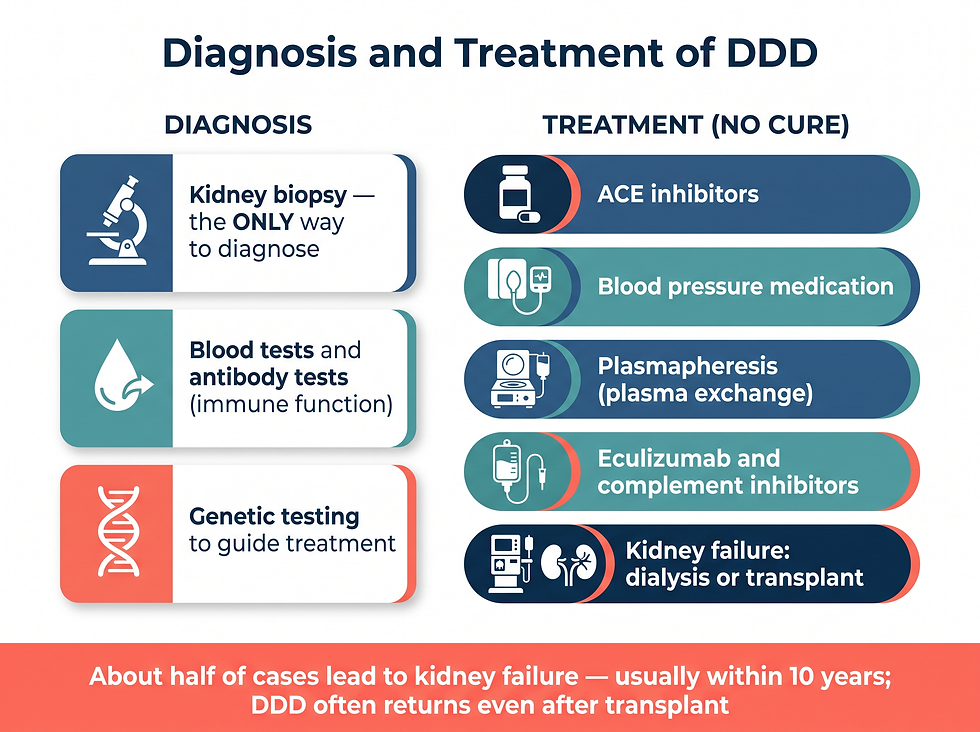
A kidney biopsy is the only way to diagnose dense deposit disease. Your kidney specialist (nephrologist) removes a small amount of kidney tissue and uses an electron microscope to look for unusual deposits.
What other tests can help with a diagnosis?
You may receive blood tests or antibody tests to figure out if your immune system is working properly. Your provider may also recommend genetic testing to provide more information that can help guide your treatment.
Is there a cure for dense deposit disease?
DDD has no cure, but treatments may slow the disease and treat kidney failure.
What treatments are used for dense deposit disease?
Your treatment depends on the severity of the disease and how it affects your kidneys. You may receive:
Treatment | Purpose |
ACE inhibitors | Blood pressure control and kidney protection |
Blood pressure medication | Managing high blood pressure |
Plasmapheresis (plasma exchange) | Filtering the blood |
Eculizumab and other complement inhibitors | Targeting the immune system proteins involved |
About half of all people with DDD experience end-stage kidney failure, the last stage of kidney disease and a life-threatening condition. When your kidneys stop working, specialists typically recommend dialysis or a kidney transplant.
Eye and vision problems often develop later in the disease. If this occurs, an eye care specialist (ophthalmologist) can help treat and manage symptoms.
What’s the difference between dense deposit disease and C3 glomerulonephritis?
Dense deposit disease and C3 glomerulonephritis (C3GN) are both types of C3 glomerulopathies. But they look different under an electron microscope.
DDD has dense deposits that look like ribbons in the glomerular basement membrane. C3GN doesn’t have dense deposits in the glomerular basement membrane.
What is the outlook for dense deposit disease?
The outlook for dense deposit disease is typically poor. Kidney failure is common, usually within 10 years after diagnosis. Even in those who receive kidney transplants, DDD often comes back.
How do I take care of myself or my loved one with this condition?
Keep all medical appointments and closely follow your provider’s instructions. Your care team can support you in your health journey.
When should I see my healthcare provider?
Alert your provider if you develop new or worsening symptoms. You may wish to ask the following questions during your appointments:
Question | Why it matters |
Do you think I’ll have end-stage kidney failure? | About half of people with DDD do, so planning matters |
Do you think I’ll develop eye and vision problems? | Eye symptoms often develop later |
What are the side effects of your recommended treatments? | Worth knowing before starting |
Are there any clinical trials for DDD that I may qualify for? | Options for a disease with no cure |
Can you recommend any support groups? | Living with a rare disease is hard, and support helps |
A note from the clinical source: “While dense deposit disease (DDD) can be a daunting diagnosis, treatments can help. Your care team will work closely with you to manage your symptoms and maintain your health as long as possible. Talk to your provider about any concerns or questions you have so you feel comfortable and confident in your care.”
Conclusion: a rare disease that needs early, steady management
Dense deposit disease is one of the rarest kidney conditions, estimated at fewer than 5,000 people in the United States, yet its impact is significant. It damages the kidney’s microscopic filters through dense, sausage-shaped immune deposits, and it can reach the eyes too, depositing drusen that raise the risk of macular degeneration.
The honest picture: no cure exists, kidney failure is common within 10 years of diagnosis, and the disease often recurs even after transplant. But treatment is real. ACE inhibitors, blood pressure medication, plasmapheresis, and complement inhibitors like eculizumab can slow progression and manage symptoms, and dialysis and transplant are available for end-stage failure. The source’s message to patients is direct and hopeful: a daunting diagnosis, but treatments can help, and your care team is there for the journey.
Your next step: if you or a loved one, especially a child or young adult, has unexplained blood or protein in the urine, swelling, high blood pressure, less-frequent urination, unusual fatigue, or emerging vision changes, see a healthcare provider promptly. Ask about referral to a nephrologist and mention DDD by name if you’ve encountered the term. Early diagnosis via kidney biopsy gives treatment the best chance to slow the disease.
Frequently asked questions
What is dense deposit disease?
Dense deposit disease (DDD) is a rare and serious condition that mainly affects the kidneys and eyes, usually occurring in children and young adults. It belongs to a group of kidney conditions called complement 3 glomerulopathies (C3G).
Is dense deposit disease common?
No. Experts estimate fewer than 5,000 people in the United States have it. The broader C3G group affects roughly 2 to 3 people out of every 1 million.
What does DDD stand for?
DDD stands for dense deposit disease, named for the thick, sausage-shaped deposits immune proteins form on the kidney’s filtering units.
What causes dense deposit disease?
Providers don’t know the exact cause. They suspect a combination of genetic and immune system problems.
What are glomeruli?
Glomeruli are the millions of tiny kidney filters that remove fluids and waste from your blood to produce urine. DDD damages them.
Is dense deposit disease the same as MPGN type 2?
Yes. DDD may also be called membranoproliferative glomerulonephritis type 2, mesangiocapillary glomerulonephritis type 2, or MPGN 2.
What are the kidney symptoms of DDD?
Blood in urine (hematuria), less-frequent urination (oliguria), confusion or unusual fatigue, high blood pressure, high protein in urine (proteinuria), kidney inflammation (acute nephritis), loss of appetite, and swelling (edema).
Does DDD affect the eyes?
Yes. It can cause whitish-yellow deposits (drusen) on Bruch’s membrane in the eye and increase the risk of age-related macular degeneration. Eye symptoms include color blindness, vision loss, and night blindness (nyctalopia).
What is Bruch’s membrane?
An inner layer of the eye that divides the retina from the choroid, the tissue layer between the retina and the white of the eye (sclera).
Does DDD increase macular degeneration risk?
Yes. The source states DDD can increase your risk of developing age-related macular degeneration (AMD).
Who usually gets DDD?
Anyone can get it, but it most often occurs in children and young adults.
How is DDD diagnosed?
A kidney biopsy is the only way to diagnose dense deposit disease. A nephrologist removes a small kidney tissue sample, and an electron microscope looks for unusual deposits.
What other tests help with diagnosis?
Blood tests or antibody tests (to check immune system function) and possibly genetic testing (to help guide treatment).
Is there a cure for DDD?
No. DDD has no cure, but treatments may slow the disease and treat kidney failure.
How is DDD treated?
Treatments include ACE inhibitors, blood pressure medication, plasmapheresis (plasma exchange), and eculizumab and other complement inhibitors, depending on severity.
What is plasmapheresis?
Plasmapheresis, or plasma exchange, is a treatment that filters your blood. It’s used for DDD.
What happens if my kidneys fail?
About half of all people with DDD experience end-stage kidney failure. Specialists typically recommend dialysis or a kidney transplant.
Does DDD come back after a kidney transplant?
Yes. Even in those who receive kidney transplants, DDD often comes back.
What is the outlook for DDD?
The outlook is typically poor. Kidney failure is common, usually within 10 years after diagnosis.
What is the difference between DDD and C3 glomerulonephritis?
Both are C3 glomerulopathies, but they look different under an electron microscope. DDD has ribbon-like dense deposits in the glomerular basement membrane; C3GN does not.
When should I see my provider?
Alert your provider if you develop new or worsening symptoms, such as blood in urine, swelling, high blood pressure, reduced urination, or vision changes.
What questions should I ask my provider?
Ask about your risk of end-stage kidney failure, whether you’ll develop eye and vision problems, treatment side effects, whether you qualify for clinical trials, and support groups.
Is DDD related to the immune system?
Yes. DDD belongs to the C3 glomerulopathy family, which affects the immune system and kidneys. Immune proteins form the deposits, and complement inhibitors target this process.
Can genetic testing help with DDD?
Yes. Providers may recommend genetic testing to provide more information that can help guide your treatment.
How do I care for someone with DDD?
Keep all medical appointments and closely follow your provider’s instructions. Your care team can support you in your health journey.
External references
Cleveland Clinic: Dense Deposit Disease (primary source, medically reviewed, last updated Oct 27, 2025)
Disclaimer: This article is for general educational purposes only and does not constitute medical advice. It is based on a single referenced clinical source and should not replace professional diagnosis or treatment. If you experience blood in urine, swelling, high blood pressure, reduced urination, unusual fatigue, or vision changes, consult a healthcare provider.
Comments