Cutaneous B-Cell Lymphoma: What It Is, the 3 Types, Symptoms, Survival Rates and Treatment — What You Need to Know

Updated: 2 days ago
Medically reviewed by Dr. Baraa Alnahhal, MD · Last reviewed: September 2026
Quick Answer: Cutaneous B-cell lymphoma (CBCL) is a rare cancer that starts in white blood cells called B cells living in your skin. It usually looks like a rash, bump, or tumor (abnormal skin areas called lesions). It is a lymphoma that involves the skin, not a skin cancer. Most forms grow slowly, do not spread, and are not life-threatening. Treatment ranges from watch-and-wait monitoring to radiation, surgery, corticosteroids, chemotherapy, and immunotherapy, and the most common slow-growing types have a five-year survival rate of 95% to 100%.
TL;DR. A DNA mutation turns a B cell in your skin into a cancer cell, producing rash-like lesions. The three types behave very differently: two common slow-growing forms (follicle center and marginal zone) versus one rare aggressive "leg type." Most cases are stage 1E, meaning skin only. It is usually cured or controlled, though half the time it comes back and responds to treatment again. Persistent unusual skin changes deserve an early provider visit.
Limitation: This article draws on one medically reviewed health reference last updated June 2025. The survival statistics quoted here come directly from that source and its cited study; no independent prevalence or incidence figures for CBCL exist in it, so none are quoted. Individual prognosis depends on your type, stage, and health. Your oncology team is the right source for decisions about your care.
What is cutaneous B-cell lymphoma?
Cutaneous B-cell lymphoma (CBCL) is a rare cancer that starts in your skin. It causes lesions that look like a rash or bumps. Treatment includes radiation, surgery, chemotherapy, and immunotherapy.
Rare forms are aggressive and hard to treat. But most CBCLs grow slowly, don't spread, and aren't life-threatening.
The full name, primary cutaneous B-cell lymphoma (PCBCL), describes exactly where it begins. It's a rare type of non-Hodgkin lymphoma that develops from white blood cells called lymphocytes, or B cells.
Is cutaneous B-cell lymphoma a skin cancer?
No, and this is the key point that confuses many people.
Most B-cell lymphomas start in lymphatic system tissue, like your lymph nodes. PCBCL doesn't. It develops from B cells living in your skin.
Because the cancer starts in B cells rather than skin cells, it's a lymphoma involving your skin, not a skin cancer. This matters for how doctors diagnose, stage, and treat it.

What are the three types of cutaneous B-cell lymphoma?
The type you have drives almost everything else: how it behaves, where lesions appear, and which treatment fits.
Type | Where lesions usually appear | Who it affects | How it behaves |
Primary cutaneous follicle center lymphoma | Head, neck, or chest | Slightly more common in males | Slow-growing ("indolent"); the most common type |
Primary cutaneous marginal zone B-cell lymphoma | Arms or upper body | Twice as common in males; also called a lymphoproliferative disorder | Slow-growing (indolent) |
Primary cutaneous diffuse large B-cell lymphoma, leg type | Lower legs | Most common in females older than 65 | Rare, aggressive, harder to treat; often spreads beyond skin |
The two most common forms grow slowly, and your provider may describe them as "indolent." The third type is rare, tends to grow fast, and is harder to treat.
What does cutaneous B-cell lymphoma look like?
PCBCL may involve one lesion or several. They may appear on just one part of your body or many areas, close together or spread out.
What are the symptoms of cutaneous B-cell lymphoma?
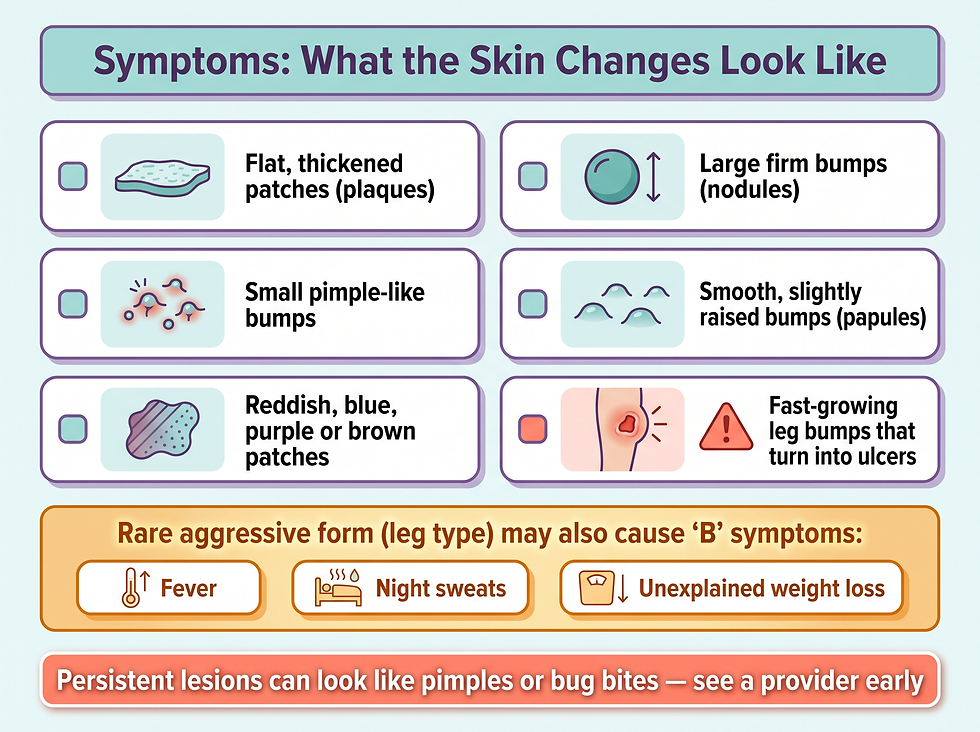
The skin changes themselves are the symptoms. Cutaneous B-cell lymphoma may look like:
Flat, thickened areas of skin (plaques)
Large, firm bumps (nodules) or small, pimple-like bumps
Slightly raised skin that's solid and smooth (papules)
Skin patches that are reddish, blue, purple, or brown
Fast-growing bumps on your legs that turn into ulcers
These appearances can affect any skin tone. Patch colors in particular may read differently on lighter and deeper skin, so reddish, brown, purple, or blue tones each deserve attention.
The rare, more serious form that usually affects the lower legs may also cause "B" symptoms:
Fever
Night sweats
Unexplained weight loss
Why do people delay getting skin lesions checked?
CBCL can look like pimples, bug bites, allergic reactions, scabs, or other skin conditions. Because of this, many people wait to seek medical attention.
"Cutaneous B-cell lymphoma (CBCL) can look like pimples, bug bites, allergic reactions, scabs or other skin conditions. Because of this, many people wait to seek medical attention. Fortunately, most forms of primary cutaneous B-cell lymphoma (PCBCL) grow slowly and don't spread. But the rarer types are more serious and do often spread. This is why you should see a healthcare provider if you notice unusual skin changes. Your primary care provider or dermatologist can take a look and explain what you're dealing with." (Note from the referenced medical source.)
What causes cutaneous B-cell lymphoma?
Scientists don't know the exact cause of PCBCL. But they do know that it starts in B cells that affect your skin.
The normal B cells develop an error (mutation) in their DNA. The mutation causes them to become cancer cells that multiply out of control. The cancer causes skin lesions.
Who is at higher risk?
The main risk factor for PCBCL is having a weak immune system over the long term. People who have HIV and recipients of an organ transplant tend to have weakened immune systems.
There's also an association between hepatitis C infections and PCBCL.

How is cutaneous B-cell lymphoma diagnosed?
Your healthcare provider can diagnose PCBCL with a physical exam and skin biopsy. During the exam, they'll look for unusual skin lesions. During the biopsy, they'll test tissue samples to look for PCBCL, and the biopsy also shows what type you have.
Afterward, you'll need tests to see if the cancer is only in your skin or has spread. The treatment for lymphoma that's only in your skin is different from lymphoma that's in other places.
Test | What it checks |
Blood tests | Overall blood and organ function markers |
CT scan | Imaging to look for spread |
PET scan | Imaging to look for spread |
Bone marrow biopsy | Whether cancer is in the bone marrow |
Lymph node biopsy | Whether cancer has reached lymph nodes |
What do the stages mean?
The PCBCL stage describes whether the cancer has spread and how much. The cancer stage is important because it helps your provider plan treatment.
Most PCBCL is stage 1E, meaning it affects only your skin and hasn't spread anywhere else. It may also be called stage 1AE if you don't have "B" symptoms like weight loss. Your provider will explain how the cancer stage relates to your treatment.
How is cutaneous B-cell lymphoma treated?
Treatment depends on the type, how many lesions you have, and how spread out they are. Usually, it involves destroying or removing the lesions.
Treatment | How it works | When it's used |
Active surveillance | "Watch and wait": no medicine or procedure right away | Slow-growing PCBCL where treatment isn't yet necessary |
Radiation therapy | Radiation destroys the lesions; only affected skin areas get exposed | Common first-line treatment |
Surgery | Lesions removed | Few lesions that are easy to remove; radiation may be better if you're worried about scarring |
Corticosteroids | Medicine rubbed on skin or given as an injection | Mostly for smaller lesions |
Chemotherapy | Drugs travel through the bloodstream to kill cancer throughout your body | The aggressive type of PCBCL |
Immunotherapy | Treatment like rituximab helps your immune system fight the cancer | Aggressive PCBCL; also slow-growing types with lesions in many places |
When should you contact your healthcare provider?
Contact your provider if you have any unusual chemotherapy or immunotherapy side effects. Your provider will explain possible side effects before you get treatment, so make sure you know which ones are expected and which ones require an appointment.
And at the start of the journey: if you notice unusual skin changes that look like persistent pimples, bug bites, or scabs, don't wait. A primary care provider or dermatologist can examine them early.
Can cutaneous B-cell lymphoma be cured?
CBCL usually goes away with treatment. Half the time, it's cured: it goes away and doesn't come back. When it does come back, it usually goes away again with treatment.
Most people with PCBCL live the rest of their lives with the condition. They don't usually die from it.
It's possible for PCBCL to progress to more serious forms of lymphoma. But this is incredibly rare. Still, your healthcare provider will monitor you closely to check for new growths.
What is the survival rate for cutaneous B-cell lymphoma?
The prognosis for most CBCL is excellent. The more common types that grow slowly have a five-year survival rate of 95% to 100%, meaning most people diagnosed are alive five years later.
The rarer, more aggressive type has a five-year survival rate of 60% to 70%, meaning 6 to 7 out of 10 people are alive five years later. Newer treatments, like immunotherapy, are helping people live longer than ever.
What should I expect during follow-up?
One of the best things you can do is understand how your diagnosis will affect your daily life, including how often you'll need check-ups to look for new lesions.
The frequency of appointments depends on factors unique to you. You may need a check-up every few weeks, months, or annually. Follow-up appointments may involve skin checks, blood work, imaging tests, or biopsies.
What should you ask your healthcare provider?
Your question | What the answer tells you |
Which type of PCBCL do I have? | Which behavior pattern and treatment path apply to you |
What stage is my cancer? | Whether it's limited to skin (most cases are stage 1E) |
Do I need treatment right now, or watch-and-wait? | Whether active surveillance fits your case |
Which lesions need biopsy? | Whether testing is needed to confirm type |
What side effects should I expect? | Which symptoms are normal and which need a call |
How often will I need follow-up check-ups? | Your individual monitoring schedule |
Conclusion and what to do next
Cutaneous B-cell lymphoma is a rare lymphoma that begins in the skin's own B cells, not a skin cancer. Its defining facts are reassuring for most people: the majority of cases are stage 1E, the two common types grow slowly, and most forms respond well to treatment, with five-year survival rates of 95% to 100% for the slow-growing types. The one exception is the rare aggressive leg type, which needs faster, stronger treatment.
The single most important action you can take is early attention to your skin. Lesions that look like pimples, bug bites, or scabs delay care far too often, and early diagnosis matters most for the aggressive forms.
Call to action: If you have unusual skin patches, bumps, or lesions that don't fade, see a primary care provider or dermatologist. A skin biopsy is a simple step, and if it does show PCBCL, you'll be in a group where treatment usually works and life goes on.
Frequently asked questions
What is cutaneous B-cell lymphoma in simple terms? It's a rare cancer that starts in white blood cells (B cells) living in your skin, creating lesions that look like a rash or bumps.
Is cutaneous B-cell lymphoma a skin cancer? No. It starts in B cells, not skin cells, so it's a lymphoma involving the skin rather than a skin cancer.
What is PCBCL? Primary cutaneous B-cell lymphoma, the full name for the condition when it starts in the skin rather than in the lymphatic system.
What are the three types of cutaneous B-cell lymphoma? Primary cutaneous follicle center lymphoma (head/neck/chest, most common), primary cutaneous marginal zone B-cell lymphoma (arms/upper body), and primary cutaneous diffuse large B-cell lymphoma, leg type (rare, aggressive).
Which type is most common? Primary cutaneous follicle center lymphoma, with lesions usually on the head, neck, or chest.
What does "indolent" mean? It means slow-growing. The two most common types of PCBCL are indolent.
Is cutaneous B-cell lymphoma life-threatening? Most forms are not. Most CBCLs grow slowly, don't spread, and aren't life-threatening; the rare aggressive type is more serious.
What do the skin lesions look like? Flat thickened plaques, large firm nodules, small pimple-like bumps, smooth raised papules, reddish/blue/purple/brown patches, or fast-growing bumps on legs that turn into ulcers.
Does skin color change how lesions appear? The same colors can present differently across skin tones. Reddish, brown, purple, or blue patches all deserve evaluation.
What are "B symptoms"? Fever, night sweats, and unexplained weight loss. They may occur with the rare aggressive leg type.
What causes cutaneous B-cell lymphoma? Scientists don't know the exact cause. Normal B cells develop a DNA mutation that turns them into cancer cells multiplying out of control.
Who is at higher risk? People with a weakened immune system over the long term, such as people with HIV or organ transplant recipients, and people with hepatitis C infections, which show an association with PCBCL.
Is it more common in men or women? The marginal zone type is twice as common in males; the follicle center type is slightly more common in males; the aggressive leg type is most common in females older than 65.
How is it diagnosed? A physical exam plus a skin biopsy, which confirms PCBCL and shows which type you have.
What tests check whether the cancer has spread? Blood tests, CT or PET scans, and biopsies of the bone marrow and lymph nodes.
What does stage 1E mean? The cancer affects only your skin and hasn't spread anywhere else. Most PCBCL is stage 1E.
What is stage 1AE? Stage 1E without "B" symptoms like unexplained weight loss.
How is cutaneous B-cell lymphoma treated? Depending on type and spread: active surveillance, radiation therapy, surgery, corticosteroids, chemotherapy, or immunotherapy, usually aimed at destroying or removing lesions.
What is rituximab? The most common immunotherapy used to treat aggressive PCBCL, and sometimes slow-growing cases with lesions in many places.
Can I just watch and wait? Sometimes. With slow-growing PCBCL, active surveillance ("watch and wait") may be appropriate until treatment is necessary.
Can cutaneous B-cell lymphoma be cured? It usually goes away with treatment, and half the time it's cured. When it comes back, it usually goes away again with treatment.
What is the five-year survival rate? 95% to 100% for the common slow-growing types; 60% to 70% for the rarer aggressive type.
Can PCBCL turn into a more serious lymphoma? It's possible but incredibly rare. Your provider will monitor you closely for new growths.
How often will I need follow-up check-ups? It depends on your individual situation (every few weeks, months, or annually) and may include skin checks, blood work, imaging, or biopsies.
When should I contact my provider during treatment? If you have any unusual chemotherapy or immunotherapy side effects; make sure you know which symptoms are expected and which require an appointment.
Why shouldn't I wait if I have a persistent skin lesion? CBCL can look like pimples, bug bites, or scabs, and waiting delays care. Most forms grow slowly, but the rare aggressive types often spread, which is why early evaluation matters.
References
1. Cutaneous B-Cell Lymphoma: Types, Symptoms & Treatment, medically reviewed, last updated June 3, 2025.
For educational purposes only. This is not medical advice. Always consult a qualified healthcare professional for diagnosis and treatment of any health condition.
Comments