Cryptogenic Organizing Pneumonia (COP): Symptoms, Causes, Treatment and Recovery — What You Need to Know

Updated: 2 days ago
Medically reviewed by Dr. Baraa Alnahhal, MD · Last reviewed: September 2026
Quick Answer: Cryptogenic organizing pneumonia (COP) is a rare lung condition that inflames and scars the air sacs (alveoli) and small airways (bronchioles) of the lungs. It often begins with flu-like symptoms — chills, dry cough, fever, fatigue — but it is not a true infection. Around three-quarters of people go on to develop a chronic cough and shortness of breath with exertion. Providers diagnose COP after ruling out infections and similar conditions, and they usually treat it with corticosteroids like prednisone for 3 to 6 months. Most people make a complete recovery and live long, full lives, though symptoms can return.
TL;DR
Cryptogenic organizing pneumonia (COP) is a rare lung disease that causes inflammation and scarring in the air sacs and small airways. It is "cryptogenic" because the exact cause is unknown, and it is not an infection even though it often starts like the flu. Diagnosis requires ruling out infections and similar lung conditions through imaging, airway sampling, biopsy, and breathing tests. Treatment is usually corticosteroids taken for 3 to 6 months with a slow taper.
Important limitation: the information here reflects a single authoritative medical review from September 2022; prevalence, diagnosis, and treatment guidance should be re-verified with a current clinical source, as this content is not a substitute for professional medical advice.
What Is Cryptogenic Organizing Pneumonia?
Cryptogenic organizing pneumonia (COP) is a rare lung condition that affects the air sacs (alveoli) and small airways (bronchioles) of the lungs. It causes lung inflammation and can cause lung scarring.
COP often starts with a flu-like illness, but it is not a true infection. It can progress into a worsening cough with shortness of breath while moving (exertion).
Healthcare providers usually prescribe corticosteroids to treat COP after making sure there isn't an infection. Most people make a complete recovery, but this can take time. Sometimes symptoms come back despite treatment.

How common is COP?
COP is rare. It affects 1 to 3 out of every 100,000 people admitted to the hospital in the United States.
Who might get cryptogenic organizing pneumonia?
COP can affect anyone regardless of sex, ethnicity, or race. It often affects people aged 40 to 60 years old. Most people with COP don't smoke.
Your risk of getting COP may increase if you have an inflammatory disease, such as:
Inflammatory condition | Type |
Lupus | Autoimmune disease |
Rheumatoid arthritis | Autoimmune disease |
Scleroderma | Autoimmune disease |
Multiple sclerosis | Autoimmune disease |
Inflammatory bowel disease (Crohn's disease or ulcerative colitis) | Inflammatory disease |
What Causes Cryptogenic Organizing Pneumonia?
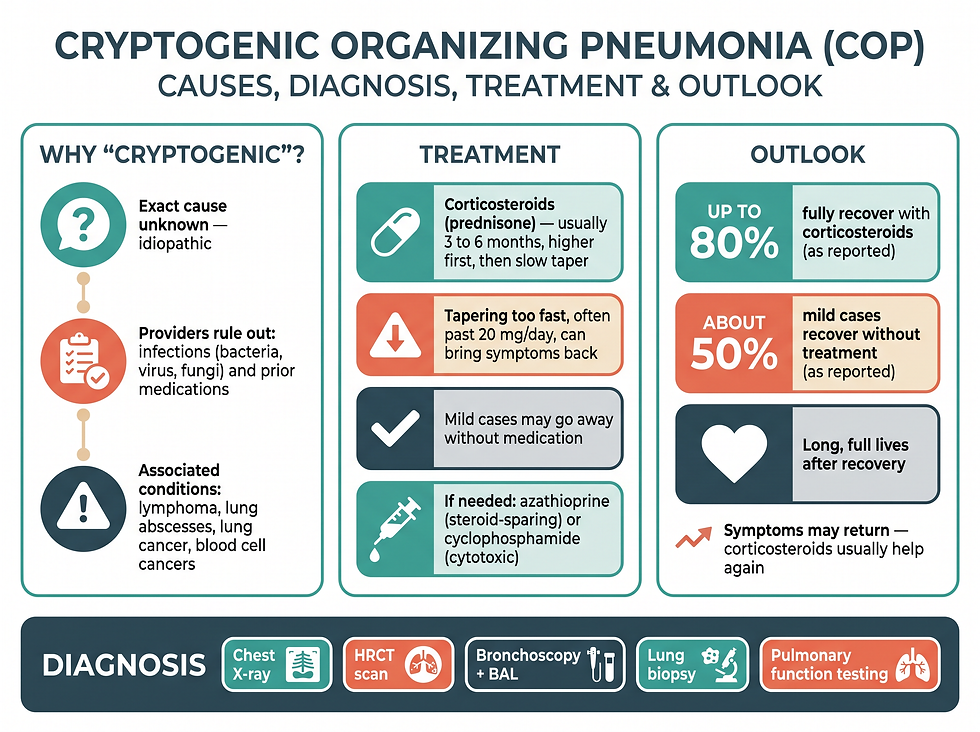
COP is a kind of idiopathic diffuse interstitial lung disease. The words "cryptogenic" and "idiopathic" mean that health providers don't know the exact cause.
Usually, the healthcare provider will rule out an infection (from bacteria, a virus, or fungi) and prior medications as causes before diagnosing COP.
Conditions associated with cryptogenic organizing pneumonia include:
Associated condition | What it is |
Lymphoma | Cancer of the lymphatic system |
Lung abscesses | Pus-filled pockets in the lung |
Lung cancer | Cancer of the lung tissue |
Hematological cancers | White blood cell or red blood cell cancers |
What Are the Symptoms of Cryptogenic Organizing Pneumonia?
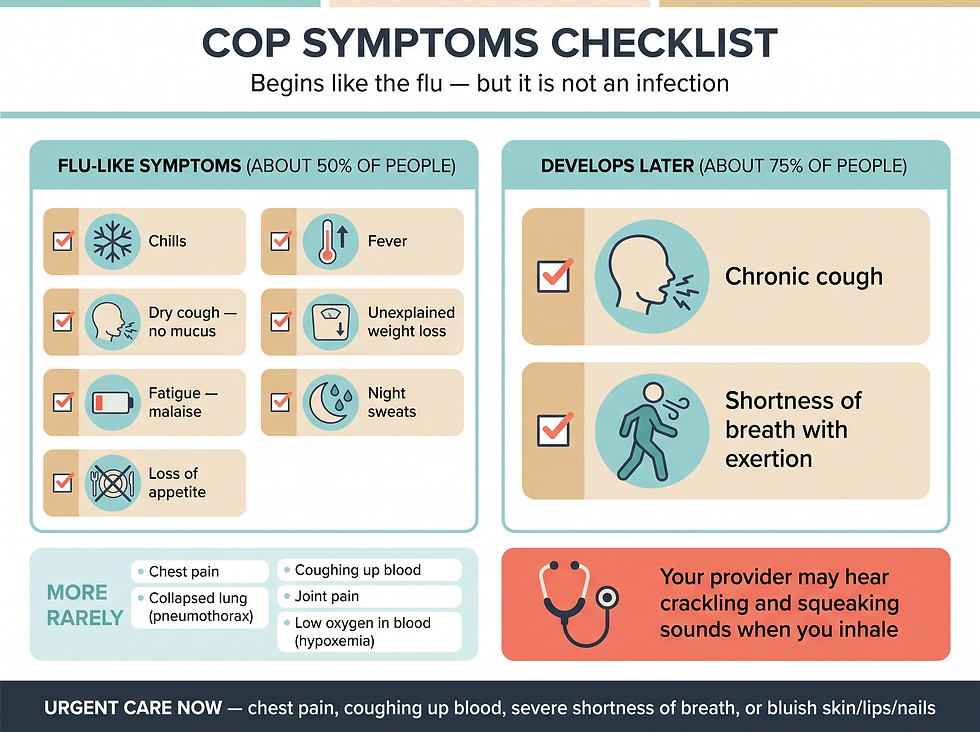
Fifty percent of people with COP have flu-like symptoms. These symptoms usually include:
Flu-like symptom | Description |
Chills | Sudden shivering or cold feeling |
Dry cough | Nonproductive cough (no mucus) |
Fatigue | Malaise, general tiredness |
Loss of appetite | Reduced desire to eat |
Fever | Elevated body temperature |
Unexplained weight loss | Weight loss without an obvious cause |
Night sweats | Sweating during sleep |
About 75% of people then develop symptoms that include a chronic cough and shortness of breath (dyspnea) with exertion.
More rarely, symptoms may include:
Rare symptom | Description |
Chest pain | Pain in the chest area |
Collapsed lung (pneumothorax) | Air trapped between lung and chest wall |
Coughing up blood | Blood in sputum |
Joint pain | Pain in the joints |
Hypoxemia | Low oxygen levels in your blood |
When to seek urgent or emergency care
Seek emergency care for chest pain, coughing up blood, a collapsed lung, or severe shortness of breath with bluish skin, lips, or nails. These can signal serious lung or oxygen problems that need immediate treatment.
The reference material does not include a formal emergency section, but the rare symptoms it lists are ones that warrant prompt medical attention. Contact your provider promptly if you have flu-like symptoms that persist or worsen into a chronic cough or breathlessness with exertion. Prompt evaluation helps providers rule out infection and start treatment early.
How Is Cryptogenic Organizing Pneumonia Diagnosed?
Your healthcare provider will first ask about your symptoms and do a physical exam. They will need to rule out other conditions with similar symptoms, such as:
Condition to rule out | Key feature |
Secondary organizing pneumonia | Caused by infection, medications, or an autoimmune issue |
Bacterial, fungal, or viral pneumonia | True infections |
Chronic eosinophilic pneumonia | Eosinophilia in your lungs |
Hypersensitivity pneumonitis | Inflammation from inhaled irritants |
Chronic lung diseases | Long-term lung conditions |
Primary pulmonary lymphoma | Lymphoma of the lung |
During your physical exam, your provider will listen to your lungs with a stethoscope. They may hear crackling sounds and squeaking sounds when you inhale.
COP vs. organizing pneumonia (secondary OP)
Secondary organizing pneumonia (OP) has similar symptoms to COP. But unlike COP, infections, medications, cancers, and autoimmune issues can cause secondary OP. Providers have also linked secondary OP to hematologic malignancy (cancer that impacts blood-forming tissue), drug exposures, and radiation exposure to your lungs.
Your provider will want to rule out secondary OP before starting treatment. Treatment for secondary OP is different from treatment for COP, and people with secondary OP also tend to have worse outcomes.
What tests help diagnose COP?
If your provider suspects COP, they may suggest tests, including:
Test | What it does |
Chest X-ray | Uses beams of radiation to create an image of your lungs |
High-resolution CT (HRCT) scan | Takes multiple X-rays to visualize the lungs and inflammation caused by COP |
A thin tube with a light and camera delivers sterile saline into the lungs to collect a fluid sample; may show increased white blood cells and helps rule out infection | |
Lung biopsy | A transbronchial biopsy removes a sample of lung tissue to rule out other conditions; sometimes a surgical lung biopsy is needed for more tissue |
Pulmonary function testing | Measures how well your lungs work; with COP you usually hold less air than normal, may have low oxygen at rest, and lower oxygen during exercise |
How Is Cryptogenic Organizing Pneumonia Treated?
Providers usually treat COP with corticosteroids, such as prednisone. You will usually take this medication for 3 to 6 months with higher doses at first, then slowly come down.
Some symptoms can come back if the corticosteroids are lowered too quickly. This is commonly seen when the prednisone is lowered past 20 mg a day.
Mild cases of COP may go away without medications.
If COP symptoms continue or you are unable to tolerate the corticosteroids due to side effects, your provider may suggest a steroid-sparing agent like azathioprine or cytotoxic medications, such as cyclophosphamide, temporarily.
Treatment option | Details |
Corticosteroids (prednisone) | Usual first-line treatment; 3–6 months; higher doses at first, then slow taper |
Adjusting the taper | Lowering prednisone too fast, often past 20 mg/day, can bring symptoms back |
No medication | Mild cases may go away on their own |
Steroid-sparing agent | Azathioprine, if symptoms continue or corticosteroids aren't tolerated |
Cytotoxic medication | Cyclophosphamide, temporarily, in difficult cases |
What Are the Complications of Cryptogenic Organizing Pneumonia?
Without treatment, COP can cause serious lung damage with lung scarring.
What Is the Outlook If I Have Cryptogenic Organizing Pneumonia?
Most people with COP recover quickly. About 50% of people with mild cases recover without treatment. Up to 80% of people treated with corticosteroids completely recover from COP.
But COP symptoms may return. Treatment with corticosteroids usually helps to improve symptoms if they happen again. People who have recovered from COP usually live long, full lives.
Can I Reduce My Risk of Cryptogenic Organizing Pneumonia?
You can't reduce your risk of COP. But you can look for the signs so you can get prompt monitoring and treatment, if needed.
How Do I Take Care of Myself With Cryptogenic Organizing Pneumonia?
See your healthcare provider as soon as possible if you have COP symptoms. Prompt treatment can help prevent future episodes of COP.
If your provider prescribes corticosteroids to treat COP, let them know about any side effects. They can adjust your medication as needed.
Questions to Ask Your Healthcare Provider
Question | Why it matters |
How did you rule out infection and secondary organizing pneumonia? | COP treatment differs from secondary OP treatment |
How long will I take corticosteroids? | Treatment is usually 3–6 months |
How will the prednisone dose be tapered? | Lowering it too fast, often past 20 mg/day, can bring symptoms back |
What side effects should I watch for? | Your provider can adjust medication as needed |
What should I do if symptoms return? | Corticosteroids usually improve recurring symptoms |
Could any of my medications have caused this? | Prior medications are a possible cause providers rule out |
When to See a Healthcare Provider
See your healthcare provider promptly if you have flu-like symptoms that don't resolve, a persistent dry cough, or shortness of breath with exertion — especially if you have an autoimmune or inflammatory condition. Seek emergency care for chest pain, coughing up blood, or severe breathlessness.
A note from the referenced medical source: "Cryptogenic organizing pneumonia (COP) is a rare lung condition that causes lung inflammation and scarring. Common COP symptoms include cough and shortness of breath. Healthcare providers usually treat COP with corticosteroids, though mild COP may go away on its own. Cryptogenic organizing pneumonia may come back again. But people with COP usually recover fully and can lead long lives."
Conclusion: The Bottom Line
Cryptogenic organizing pneumonia is a rare lung condition that inflames and can scar the air sacs and small airways of the lungs. Although it begins like the flu, it is not an infection, and its exact cause remains unknown. With corticosteroid treatment over 3 to 6 months, up to 80% of people recover completely, and even about half of mild cases may resolve without medication. The key actions are to get a proper diagnosis that rules out infection and secondary organizing pneumonia, follow the medication plan and taper closely, report any side effects, and watch for returning symptoms. If you have persistent flu-like symptoms that turn into a chronic cough or breathlessness, see a healthcare provider promptly.
Next step: If you or a loved one has ongoing respiratory symptoms, book an appointment with a healthcare provider to discuss testing for COP and other lung conditions.
FAQ
What does cryptogenic organizing pneumonia mean?
Cryptogenic organizing pneumonia (COP) is a rare lung condition affecting the air sacs (alveoli) and small airways (bronchioles). "Cryptogenic" and "idiopathic" mean the exact cause is unknown. It causes lung inflammation and can cause lung scarring.
Is COP a true infection?
No. COP often starts with a flu-like illness, but it is not a true infection. Providers rule out infections from bacteria, viruses, or fungi before diagnosing COP.
What causes cryptogenic organizing pneumonia?
The exact cause is unknown — that is what "cryptogenic" and "idiopathic" mean. Providers rule out infection and prior medications as causes before making the diagnosis.
What are the first symptoms of COP?
About 50% of people with COP have flu-like symptoms: chills, dry (nonproductive) cough, fatigue (malaise), loss of appetite, fever, unexplained weight loss, and night sweats.
How does COP cause shortness of breath?
COP inflames the air sacs and small airways. About 75% of people go on to develop a chronic cough and shortness of breath (dyspnea) with exertion.
Who is most likely to get COP?
COP can affect anyone regardless of sex, ethnicity, or race. It often affects people aged 40 to 60. Most people with COP don't smoke.
Does having an autoimmune disease raise COP risk?
Yes. Risk may increase if you have an inflammatory disease such as lupus, rheumatoid arthritis, scleroderma, multiple sclerosis, or inflammatory bowel disease (Crohn's disease or ulcerative colitis).
What cancers are linked to COP?
Associated conditions include lymphoma (cancer of the lymphatic system), lung cancer, hematological (white or red blood cell) cancers, and lung abscesses.
What does COP sound like on a stethoscope?
Your provider may hear crackling sounds and squeaking sounds when you inhale.
What is secondary organizing pneumonia?
Secondary organizing pneumonia (OP) has similar symptoms to COP but is caused by infections, medications, cancers, or autoimmune issues. It is also linked to hematologic malignancy, drug exposures, and radiation exposure to the lungs. Providers rule it out before treating COP because the treatment differs and outcomes tend to be worse.
What tests diagnose COP?
Tests include a chest X-ray, high-resolution CT (HRCT) scan, bronchoscopy with bronchoalveolar lavage (BAL), transbronchial or surgical lung biopsy, and pulmonary function testing.
What does a bronchoscopy with BAL do?
A thin tube with a light and camera delivers sterile saline into the lungs to collect a fluid sample. It may show increased white blood cells and, more importantly, helps rule out an infection.
What do pulmonary function tests show in COP?
You can usually hold less air in your lungs than normal, may have low oxygen in your blood at rest, and lower oxygen during exercise.
How is COP treated?
Providers usually treat COP with corticosteroids such as prednisone, typically for 3 to 6 months with higher doses at first, then a slow taper. Mild cases may go away without medications.
How long do I take prednisone for COP?
Usually 3 to 6 months, with higher doses at first that slowly come down over time.
Can symptoms return when lowering prednisone?
Yes. Symptoms can come back if corticosteroids are lowered too quickly, commonly when prednisone is lowered past 20 mg a day.
What if corticosteroids don't work or cause side effects?
Your provider may suggest a steroid-sparing agent like azathioprine or a cytotoxic medication such as cyclophosphamide, temporarily.
Can COP go away on its own?
Yes. About 50% of people with mild cases of COP recover without treatment.
How many people recover from COP with treatment?
Up to 80% of people treated with corticosteroids completely recover from COP.
Can COP come back after recovery?
Yes, COP symptoms may return. Treatment with corticosteroids usually helps to improve symptoms if they happen again.
What is the long-term outlook for COP?
People who have recovered from COP usually live long, full lives. Most people with COP recover quickly.
What happens if COP is not treated?
Without treatment, COP can cause serious lung damage with lung scarring.
Can I prevent cryptogenic organizing pneumonia?
You can't reduce your risk of COP. But you can look for the signs so you can get prompt monitoring and treatment if needed.
When should I go to the emergency room for COP symptoms?
Seek emergency care for chest pain, coughing up blood, a collapsed lung, or severe shortness of breath, especially with bluish skin, lips, or nails.
What should I report to my provider while on corticosteroids?
Report any side effects so your provider can adjust your medication as needed. See your provider as soon as possible if you have COP symptoms — prompt treatment can help prevent future episodes.
External References
Medical Disclaimer
This content is for general educational purposes only and is not a substitute for professional medical advice, diagnosis, or treatment. Always seek the advice of a qualified healthcare provider with any questions about a medical condition. Never disregard professional medical advice or delay seeking care because of something you have read here.
Comments