Cryptic Pregnancy: What It Is, Why It Happens, Risks and What to Do — What You Need to Know

Updated: 2 days ago
Medically reviewed by Dr. Baraa Alnahhal, MD · Last reviewed: September 2026
Quick Answer: A cryptic pregnancy (also called a stealth pregnancy) is when you're pregnant but don't know it — sometimes until labor begins. Most people discover pregnancy between 4 and 12 weeks, but with a cryptic pregnancy nothing triggers that realization: pregnancy symptoms are absent, dismissed, or mistaken for something else (like a virus), or a home pregnancy test shows a false negative. Studies suggest about 1 in 475 pregnancies go unnoticed until around 20 weeks, and about 1 in 2,500 go unnoticed until delivery. Risk rises if you recently gave birth, are breastfeeding, have irregular periods from a condition like PMOS, use birth control, are in perimenopause, or have never been pregnant before. The main risks come from missed prenatal care, not the pregnancy itself.
TL;DR
A cryptic pregnancy means being pregnant without realizing it. The pregnancy itself is the same as any other — same symptoms, same development — the only difference is that the pregnant person doesn't connect their symptoms to pregnancy. Most people discover pregnancy between weeks 4 and 12, but research cited in the source suggests roughly 1 in 475 pregnancies goes unnoticed until about 20 weeks, and about 1 in 2,500 goes unnoticed until delivery. Risk factors include recent childbirth, breastfeeding, PMOS (unpredictable periods), birth control use, perimenopause, and never having been pregnant. The real danger lies in what goes unmanaged: no prenatal care, continued smoking or alcohol use, undiagnosed gestational diabetes or preeclampsia, missed genetic testing, and a higher likelihood of premature birth. If there is any chance you could be pregnant, the source's advice is clear — take a home test or have a provider confirm with a blood or urine test.
Important limitation: the two statistics quoted above (1 in 475 and 1 in 2,500) are the only figures in the referenced medical source and are quoted as presented ("studies suggest"). No other prevalence, demographic, or outcome statistics are quoted because none exist in the source.
What is a cryptic pregnancy?
A cryptic pregnancy — sometimes called a stealth pregnancy — is when you're pregnant but don't know it. It's even possible not to realize you're pregnant until labor begins.
Most people realize they're pregnant somewhere between 4 and 12 weeks of pregnancy. This usually happens because they have pregnancy symptoms, they miss a period, or a positive pregnancy test confirms it.
With a cryptic pregnancy, nothing triggers you to believe you're pregnant. This could be because you don't have pregnancy symptoms, you mistake pregnancy symptoms for something like a virus, or your pregnancy test result was wrong.
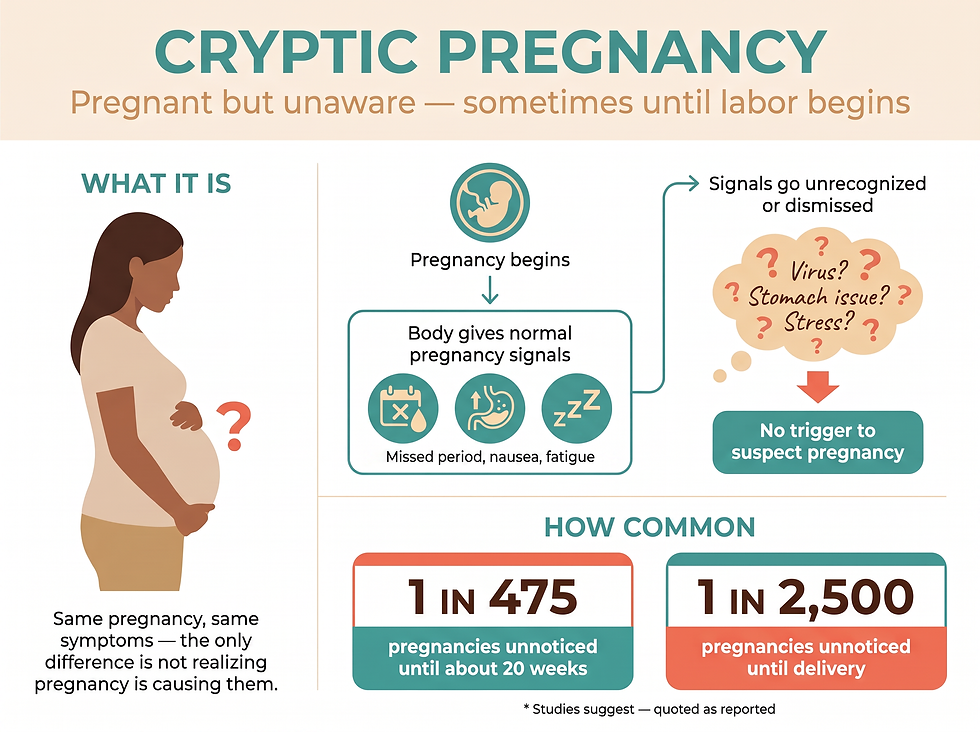
How common is a cryptic pregnancy?
Cryptic pregnancies are uncommon. Studies suggest about 1 in 475 pregnancies go unnoticed until about 20 weeks of gestation. About 1 in 2,500 pregnancies go unnoticed until delivery.
Who is at risk for a cryptic pregnancy?
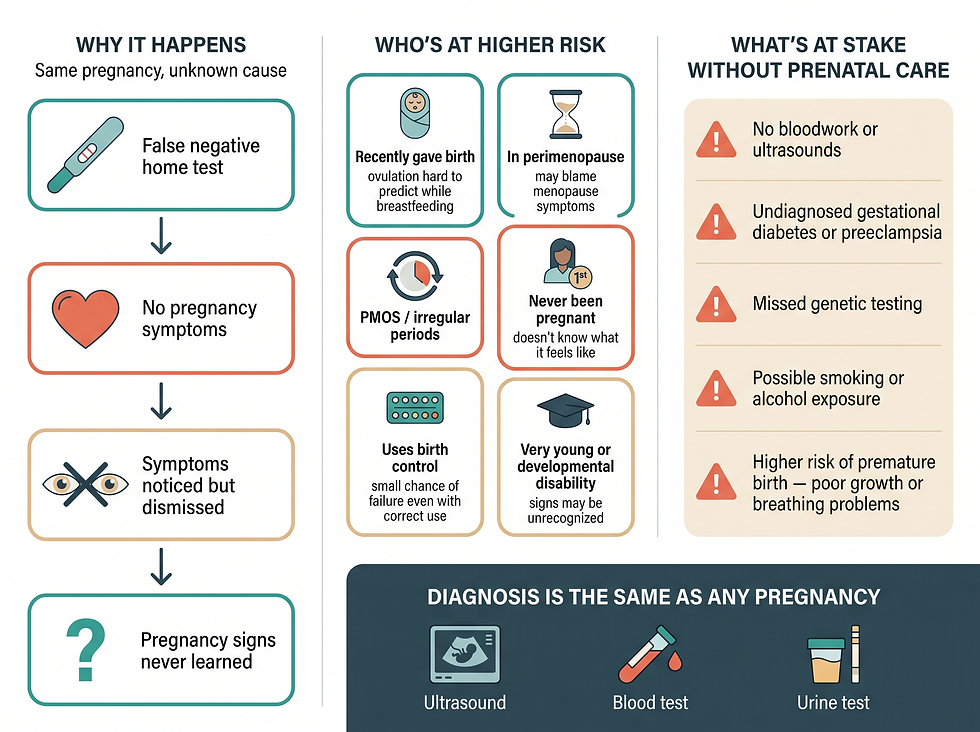
Anyone can have a cryptic pregnancy. But you may be at higher risk in the following situations.
Risk factor | Why it raises the risk |
Recently gave birth | After birth, it may take several months for your period to return, and you may not ovulate if you're breastfeeding — creating the false impression that you're completely safe from pregnancy. It's difficult to predict when you'll first ovulate during breastfeeding and become fertile again. |
Have a condition like PMOS | With polyendocrine metabolic ovarian syndrome, your periods are unpredictable. Because skipping periods is normal for you, you may not realize you're pregnant if you miss one. |
Use birth control | You may mistakenly think you're protected from pregnancy. Even when used correctly, there's a small chance of failure. |
Are in perimenopause | In your 40s, you may think you're too old to get pregnant, or mistake pregnancy symptoms for menopause symptoms. |
Have never been pregnant | You're less likely to know what being pregnant feels like, so a pregnancy could go unnoticed for longer. |
Will a cryptic pregnancy show on a pregnancy test?
You should still get a positive pregnancy test with a cryptic pregnancy. However, using an at-home pregnancy test correctly is the only way to get an accurate result.
If you don't use it correctly, you may get a false negative — meaning you're pregnant but the test says you aren't. Be sure to follow the instructions on the package, and wait several days after your missed period to take an at-home test.
If your symptoms don't agree with your home pregnancy test result, it's always best to have a healthcare provider confirm pregnancy with a blood test.
Do you get your period in a cryptic pregnancy?
No. A cryptic pregnancy is similar to a regular pregnancy in that you don't get a true menstrual period. However, you may experience implantation bleeding or abnormal pregnancy bleeding and think it's your period.
What causes a cryptic pregnancy?
There are several reasons why you may not realize you're pregnant:
An at-home pregnancy test may have shown a false negative result.
You don't have pregnancy symptoms.
You don't notice the pregnancy symptoms or dismiss them.
You don't know the symptoms, and therefore don't know you're pregnant.
What are the signs of a cryptic pregnancy?
If you have a cryptic pregnancy, the symptoms are the same as those for a known pregnancy. The key difference is that you don't realize pregnancy is causing your symptoms. For example, you may think you're nauseous from eating a certain food, or that you're tired because you need more sleep.
Other signs of a stealth pregnancy include:
Sign | Why it gets missed |
Missed period | A missed period is the clue for most people, but if your periods are always irregular, you may not realize you've missed one due to pregnancy. |
Spotting or light bleeding | Light spotting in early pregnancy can be mistaken for a period. |
False negative pregnancy test | You're actually pregnant, but the test says you're not — usually because the test wasn't used correctly. |
Weight gain or swollen belly | You may not notice pregnancy-related weight gain, or you might attribute an unusually bloated belly to a certain food. |
Fetal movement | Fetal movements usually aren't noticeable until about halfway through pregnancy. If you have an anterior placenta (in the front of your belly), it can make it harder to feel kicks — which can be why you don't realize you're pregnant. |
Not knowing pregnancy symptoms | If you're very young or have developmental disabilities, you may be unaware of common signs of pregnancy, like a missed period, tender breasts, or nausea. |

How long does a cryptic pregnancy last?
Most people realize they're pregnant about 20 weeks into the pregnancy. However, it's possible to be unaware you're pregnant during the entire 40 weeks of pregnancy.
There have been cases where a person goes to the emergency room with pelvic pain only to discover she's in labor.
What are the risks and complications of a cryptic pregnancy?
Studies suggest cryptic pregnancies are more likely to result in preterm birth due to lack of prenatal care, poor nutrition, or lifestyle choices. The complications are a direct result of not knowing you're pregnant.
Complication | What it means in practice |
No pregnancy care | You haven't seen a provider for prenatal care — no bloodwork, nutritional counseling, ultrasounds, or other support for a healthy pregnancy. You could also go into labor alone, without help from a skilled healthcare provider. |
Lifestyle exposures | Smoking and alcohol are harmful during pregnancy. Not knowing you're pregnant means you may use these substances or take medications and supplements that are generally unsafe during pregnancy. |
Higher risk of medical conditions | You won't receive the care or tests needed to diagnose conditions like gestational diabetes or preeclampsia. |
Higher risk of congenital conditions | The fetus is at risk for congenital conditions because you didn't receive genetic tests or other evaluations that help diagnose birth disorders. |
Premature birth | Infants born from cryptic pregnancies are more likely to be born premature, which puts them at risk for poor growth or respiratory issues. |
When to see a healthcare provider
The source draws a clear line: if you believe there's any chance you could be pregnant, take a home pregnancy test or visit a healthcare provider for a blood or urine test. A practical rule drawn from the source's content:
Any chance of pregnancy → take a home test; wait several days after a missed period and follow the package instructions.
Symptoms don't match your test result → have a provider confirm with a blood test.
New or unexplained pelvic pain → seek care promptly — in documented cases, emergency-room visits for pelvic pain have revealed a person in labor.
Higher-risk situation (recently postpartum, breastfeeding, PMOS, birth control, perimenopause, first pregnancy) → lower your threshold for testing, since the usual clues (missed period, familiar symptoms) may not alert you.
How is a cryptic pregnancy diagnosed?
Pregnancy care providers diagnose a cryptic pregnancy the same way they would a typical pregnancy. Providers confirm pregnancy with:
Ultrasound
Blood test
Urine (pee) test
How is a cryptic pregnancy treated?
Treatment depends on when you realize you're pregnant. If you're still months away from delivery, a pregnancy care provider will try to catch you up on the prenatal care you've missed. This could include:
Blood and urine tests
Ultrasound
Measuring fundal height
A physical exam
Nutritional and lifestyle counseling
Can you prevent a cryptic pregnancy?
The best way to prevent a stealth pregnancy is to be aware of your body and sexual health. If you believe there's any chance you could be pregnant, it's always best to take a home pregnancy test or visit a healthcare provider for a blood or urine test.
A note from the referenced medical source
"Not knowing you're pregnant is a real condition. In a cryptic pregnancy, you may go several months or the entire pregnancy without knowing you're pregnant. The best thing you can do if you're sexually active is to know the signs of pregnancy and get a pregnancy test from a healthcare provider if you at all think you might be pregnant. Getting regular prenatal care is important for the health and safety of you and the fetus."
Conclusion
A cryptic pregnancy is not a different kind of pregnancy — it is an ordinary pregnancy that goes unrecognized. The body gives the same signals it always does: missed periods (for some), spotting, nausea, fatigue, weight gain, and eventually fetal movement. What changes is the interpretation of those signals, or their absence altogether.
The stakes are real but specific: complications come from missed prenatal care, not from the pregnancy itself. Undiagnosed gestational diabetes, untreated preeclampsia, missed genetic testing, and continued smoking or alcohol use are the preventable harms. That's exactly why the source's guidance matters — if there is any chance of pregnancy, test, and have a provider confirm with a blood test when symptoms and results don't line up.
Next step: If anything in this article describes your situation — an unexpected test result, a missed period you can't explain, unusual bloating, or a high-risk circumstance like recent childbirth or perimenopause — take a home pregnancy test today and follow up with a healthcare provider. One test can close the gap between an unseen pregnancy and the prenatal care that keeps both parent and baby healthy.
FAQ
What is a cryptic pregnancy?
A cryptic pregnancy (or stealth pregnancy) is when you're pregnant but don't know it — sometimes until labor begins.
What is a stealth pregnancy?
"Stealth pregnancy" is another name for cryptic pregnancy — being pregnant without realizing it.
How common are cryptic pregnancies?
Uncommon. Studies suggest about 1 in 475 pregnancies go unnoticed until about 20 weeks of gestation, and about 1 in 2,500 go unnoticed until delivery.
Can you really be pregnant and not know?
Yes. It's even possible not to realize you're pregnant until labor begins.
When do most people realize they're pregnant?
Most people realize they're pregnant somewhere between 4 and 12 weeks of pregnancy, through symptoms, a missed period, or a positive pregnancy test.
How long can a cryptic pregnancy last?
Most people realize around 20 weeks, but it's possible to be unaware for the entire 40 weeks of pregnancy.
Why would someone not know they're pregnant?
Reasons include a false negative home pregnancy test, no pregnancy symptoms, noticing but dismissing symptoms, or not knowing the common signs of pregnancy at all.
Are cryptic pregnancy symptoms different?
No — the symptoms are the same as any known pregnancy. The difference is that you don't realize pregnancy is causing them.
Can you have a period during a cryptic pregnancy?
No true menstrual period — same as a regular pregnancy. But implantation bleeding or abnormal pregnancy bleeding can be mistaken for a period.
Why would a pregnancy test be negative when pregnant?
Usually because the at-home test wasn't used correctly, producing a false negative. Follow the package instructions and wait several days after a missed period.
What should I do if my symptoms don't match my test result?
Have a healthcare provider confirm pregnancy with a blood test.
Does an anterior placenta hide pregnancy?
An anterior placenta sits in the front of the belly and can make fetal kicks harder to feel — which can be one reason a pregnancy isn't noticed.
When can you feel fetal movement?
Fetal movements usually aren't noticeable until about halfway through pregnancy.
Why does PMOS raise the risk?
With polyendocrine metabolic ovarian syndrome, periods are unpredictable. Since skipping periods is normal for you, a pregnancy-related missed period may not stand out.
Why does recent childbirth raise the risk?
After giving birth, it may take several months for your period to return, and you may not ovulate if you're breastfeeding — creating a false impression of being completely safe from pregnancy.
Can you get pregnant while breastfeeding?
It's difficult to predict when you'll first ovulate during breastfeeding and become fertile again, so pregnancy is possible before your period returns.
Does birth control make cryptic pregnancy more likely?
If you use birth control, you may mistakenly think you're protected. Even when used correctly, there's a small chance of failure.
Why does perimenopause raise the risk?
In your 40s, you may think you're too old to get pregnant or mistake pregnancy symptoms for menopause symptoms.
Can very young people or people with developmental disabilities have cryptic pregnancies?
Yes — if you're very young or have developmental disabilities, you may be unaware of common signs of pregnancy like a missed period, tender breasts, or nausea.
What are the complications of a cryptic pregnancy?
No prenatal care (no bloodwork, counseling, or ultrasounds), possible smoking or alcohol exposure, undiagnosed gestational diabetes or preeclampsia, missed genetic testing for congenital conditions, and a higher likelihood of premature birth.
Are cryptic pregnancies more likely to end in premature birth?
Some studies suggest they are more likely to result in preterm birth due to lack of prenatal care, poor nutrition, or lifestyle choices.
Can you give birth without knowing you were in labor?
There have been cases where a person went to the emergency room with pelvic pain only to discover she was in labor.
How is a cryptic pregnancy diagnosed?
The same way as a typical pregnancy: ultrasound, blood test, and urine test.
What happens when a cryptic pregnancy is discovered?
If you're still months from delivery, a provider will catch you up on missed prenatal care — blood and urine tests, ultrasound, fundal height measurement, physical exam, and nutritional and lifestyle counseling.
Can cryptic pregnancy be prevented?
The best prevention is body and sexual health awareness: if there's any chance you could be pregnant, take a home pregnancy test or see a provider for a blood or urine test.
External References
Medical Disclaimer
This article is for general informational purposes only and is based on the referenced medical sources. It is not a substitute for professional medical advice, diagnosis, or treatment. Always seek the advice of a qualified healthcare provider with any questions about pregnancy, prenatal care, or reproductive health. Never disregard or delay professional medical advice because of something you have read here. If you believe you might be pregnant — or experience sudden pelvic pain — consult a licensed healthcare provider promptly.
Comments