Creutzfeldt-Jakob Disease (CJD): Symptoms, Causes, Treatment and Prognosis — What You Need to Know

Updated: 2 days ago
Medically reviewed by Dr. Baraa Alnahhal, MD · Last reviewed: September 2026
Quick Answer
Creutzfeldt-Jakob disease (CJD, pronounced "croy-tz-felt yah-cob") is a rare, severe and always-fatal degenerative brain disorder caused by abnormal, infectious proteins called prions. These misfolded proteins build up in brain cells, destroy them and trigger more normal proteins to misfold, so the disease progresses very quickly, causing dementia (memory loss, confusion), behavior changes and movement problems like tremors, spasms and balance loss. There's no cure or way to slow it; care focuses on comfort (palliative care, seizure medication, hospice). Most people don't survive more than a year after diagnosis, though genetic forms can last 1 to 10 years.
TL;DR
Creutzfeldt-Jakob disease is a rare prion disease. Abnormal proteins misfold like damaged origami, can't be cleared by brain cells, pile up and destroy them, and even spread the misfolding to healthy proteins, which is why CJD advances so fast. It's classified as a transmissible spongiform encephalopathy because a prion-damaged brain looks full of holes, like a sponge, under a microscope. Eleven hallmark symptoms progress from early forgetfulness and confusion to late-stage spasms, seizures, paralysis and muscle atrophy. There are four types: sporadic (most common, unknown cause), genetic (inherited; includes GSS syndrome and fatal familial insomnia), acquired (transplant or contaminated surgical equipment) and variant CJD (from eating BSE-infected "mad cow" beef). Diagnosis combines neurological exam, MRI, spinal tap, EEG, blood tests and sometimes brain biopsy. Because nothing can cure or slow CJD, management centers on palliative symptom relief, supportive care, hospice, advance-directive planning and mental-health support, plus clinical trials for those who qualify.
Important limitation: this article only quotes the statistics present in the referenced source (1 to 2 cases per 1 million people worldwide and about 350 U.S. diagnoses per year), plus the documented survival windows. No other prevalence or outcome figures exist in the source.
Why prompt evaluation matters: CJD isn't a 911 emergency, but rapid-onset memory loss, confusion, vision problems, or new movement issues (tremors, spasms, balance loss) deserve fast evaluation by a neurologist. Many CJD-like symptoms have treatable causes, and an early workup is the only path to an accurate answer.

What Is Creutzfeldt-Jakob Disease?
Creutzfeldt-Jakob (pronounced "croy-tz-felt" "yah-cob") disease (CJD) is a rare, degenerative brain disorder caused by abnormal proteins called prions. These proteins build up in brain cells and destroy them. As a result, CJD causes dementia symptoms, such as memory loss and confusion, and may also cause behavioral and movement changes. (For another cause of dementia, see our article on alcohol-related dementia.)
CJD is always fatal. There's no cure or way to slow its progression. Care and support options are available to help you stay comfortable.
It's a very rare disease, with 1 to 2 cases happening in every 1 million people worldwide. About 350 people receive a diagnosis of CJD in the U.S. each year.
A well-known but also very rare type is variant CJD (vCJD). It's caused by eating beef from cattle infected with bovine spongiform encephalopathy (BSE), commonly known as "mad cow disease."
What Are the Symptoms of CJD?
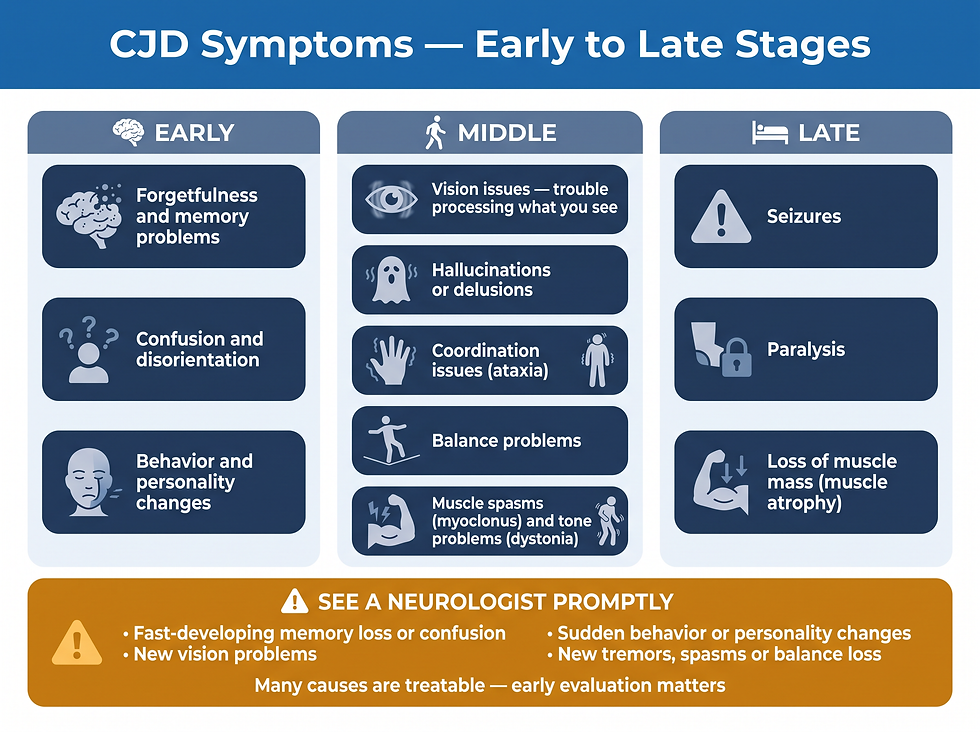
Creutzfeldt-Jakob disease symptoms develop quickly as the condition progresses. The most common symptoms of CJD, listed in order from early to late stages, include:
Stage | Symptom | What it involves |
Early | Forgetfulness and memory problems | Memory becomes unreliable as brain cells are damaged |
Early | Confusion and disorientation | Difficulty understanding where you are or what's happening |
Early | Behavior and personality changes | Noticeable shifts in how you act and who you seem to be |
Middle | Vision issues | Problems processing and understanding what you see |
Middle | Hallucinations or delusions | Seeing things that aren't there or holding false beliefs |
Middle | Coordination issues (ataxia) | Trouble coordinating movements |
Middle | Balance problems | Unsteadiness and falls |
Middle | Muscle spasms and tone problems | Uncontrolled spasms (myoclonus) and abnormal muscle tone (dystonia) |
Late | Sudden, uncontrolled electrical activity in the brain | |
Late | Paralysis | Loss of ability to move |
Late | Loss of muscle mass (muscle atrophy) | Muscles shrink from disuse and nerve damage |
What Causes CJD?
Abnormal proteins called prions cause Creutzfeldt-Jakob disease. Proteins are molecules, tiny particles that need to hold a specific shape to function. They fold like origami. Sometimes, the folding process goes wrong. When a protein misfolds, your brain cells can't use it.
As your cells can't get rid of misfolded proteins, they build up. In the case of prions, the buildup damages and eventually destroys brain cells. In addition, prions are infectious. They trigger normal proteins to misfold, creating even more prions. As they multiply and spread, the disease progresses rapidly.
What Are the 4 Types of CJD?
Type | How it develops | Notes |
Sporadic CJD | Happens for unknown reasons | The most common kind of CJD |
Genetic CJD | You inherit an abnormal gene from one or both parents | Includes two subtypes: Gerstmann-Sträussler-Scheinker (GSS) syndrome and fatal familial insomnia |
Acquired CJD | Develops after a medical procedure | Can follow an organ or tissue transplant or come from contaminated surgical equipment |
Variant CJD (vCJD) | Eating beef from a cow with bovine spongiform encephalopathy (BSE) | BSE is a prion-related disease; its prions can spread to humans and other species, leading to vCJD |
Who Is at Risk?
Creutzfeldt-Jakob disease can affect anyone. You may have prions for years before symptoms appear. But when they do start, symptoms progress very quickly as the disease damages and destroys more of your brain.
It typically affects people between the ages 50 and 80. However, the genetic types usually happen between age 30 and 50.
Is CJD Contagious?
CJD isn't easily contagious from person-to-person contact. The only way to spread it from person to person is through organ or tissue transplants or certain types of hormones taken from a donor who had CJD.
Variant CJD may be passed in blood transfusions, but this is extremely rare. Variant CJD is also extremely rare on its own.

How Is CJD Diagnosed?
A healthcare provider will diagnose CJD by looking for signs and symptoms during a physical and neurological exam. They may ask you to do certain tasks, which can help them identify problems with how your brain functions.
Experts classify CJD as a type of transmissible spongiform encephalopathy. This refers to how your brain with prion damage looks under a microscope (full of holes, like a sponge). Your provider will review tests, like an MRI or spinal tap (lumbar puncture), to confirm a CJD diagnosis. If you're wondering what to expect afterward, our article on spinal headache after a lumbar puncture explains a common side effect.
Your provider may use other tests to evaluate for CJD and conditions with similar symptoms:
Test | What it evaluates |
MRI | Imaging of brain structure to look for prion-pattern changes |
Spinal tap (lumbar puncture) | Cerebrospinal fluid analysis to help confirm CJD |
Blood tests | General evaluation and ruling out other conditions |
Genetic testing | Identifies inherited abnormal genes in genetic CJD |
Electroencephalogram (EEG) | Measures brain electrical activity |
Urinalysis | Urine testing to rule out other causes |
Brain biopsy | Tissue sample examined for prion damage |
What Are the Treatment Options?
There's no way to cure, treat or slow the progress of CJD. Your provider may offer options for symptom relief (palliative care). Some examples may include medications to help with seizures, behavioral changes or uncontrollable muscle jerks. However, these treatments offer limited benefits.
This condition worsens quickly. Supportive care is available for you and your loved ones. During the late stages, hospice services can be very helpful.
Your care team might recommend participating in a clinical trial if you qualify. Clinical trials help providers study new treatment options.
Can CJD Be Prevented?
Most cases of CJD can't be prevented. The exception is variant CJD. This comes from eating beef from cows with bovine spongiform encephalopathy (BSE).
Animal inspections help keep BSE-infected cattle out of the food supply. But uninspected or improperly processed meat can still pose a risk. To stay safe, avoid eating uninspected or unregulated sources of meat, especially brain tissue or bone marrow.
What Is the Outlook for CJD?
CJD has a very poor outlook because the condition isn't curable or treatable. After symptoms start, you'll soon lose the ability to care for yourself, move and communicate.
Most cases of CJD are fatal within months to a year after diagnosis. The exception is genetic CJD, which can have a survival time of one to 10 years after symptoms start. Your provider can give you the most up-to-date information on your case specifically. Remember that individuals are not statistics.
What Should Families Plan Ahead?
As changes can happen fast, it's important to work with your care team to make sure your wishes and needs are met. Everyone, whether you currently have an illness or not, should complete an advance directive document to tell your providers what type of care you'd like to receive when you're unable to tell them yourself. Completing an advance directive is even more important in the early stages of a rapidly progressive disease like CJD.
Because this condition is so severe, you and your loved ones should consider speaking with a mental health professional to help you cope with the effects and changes that are to come.
"A Creutzfeldt-Jakob disease (CJD) diagnosis is life-changing. It's like you're losing your connection to yourself and the world around you in the blink of an eye. That kind of change is difficult on both you and the people closest to you. If you're unsure what to expect or how to move forward, your care team is just a question away. They can help you plan ahead and feel more prepared for what's to come."
When Should You Seek a Neurological Evaluation?
CJD itself isn't a medical emergency, but because its early symptoms overlap with many treatable conditions, the right move is a prompt neurological workup whenever rapid changes appear:
Fast-developing memory loss or confusion
New vision problems: trouble processing or understanding what you see
Sudden behavior or personality changes
New movement problems: tremors, muscle spasms, balance loss, clumsiness
An early evaluation can identify treatable causes quickly, and if a prion disease is suspected, a specialist team can confirm the diagnosis and begin comfort-focused care sooner.
Conclusion
Creutzfeldt-Jakob disease sits in its own category of illness: a rare, always-fatal brain disorder driven not by bacteria or viruses but by misfolded proteins, the prions, that act like damaged origami, pile up inside brain cells and convert healthy proteins into more prions. That self-spreading mechanism is why the disease advances so quickly, why a prion-damaged brain looks spongy under a microscope, and why the eleven symptoms march from early forgetfulness and confusion all the way to spasms, seizures, paralysis and muscle atrophy.
The four types tell different stories: sporadic (most common, cause unknown), genetic (inherited, with subtypes like GSS syndrome and fatal familial insomnia), acquired (from transplants or contaminated surgical equipment) and variant CJD (linked to eating BSE-infected beef). Diagnosis takes a team approach: neurological exam, MRI, spinal tap, EEG, blood and genetic tests, and sometimes brain biopsy. Since nothing can cure or slow CJD, care is about comfort and connection: palliative medications for seizures and spasms, hospice in the late stages, advance directives completed while the person can still speak for themselves, and mental-health support for the whole family. Prevention is only possible for variant CJD, by avoiding uninspected or unregulated meat, especially brain tissue and bone marrow.
Next step: if you or a loved one is experiencing rapidly worsening memory, confusion, vision changes or new movement problems, don't wait. Request a neurological evaluation promptly, since many causes of these symptoms are treatable. And if CJD has entered your family's story, ask your care team about advance care planning, hospice resources and clinical trials; the referenced source reminds us that individuals are not statistics, and your team is there to help you plan ahead and feel prepared.
Related Reading
References
This article is based solely on the referenced source. It is for informational purposes only and is not medical advice.
FAQ
What is Creutzfeldt-Jakob disease?
A rare, severe, degenerative brain disorder caused by abnormal proteins called prions. These proteins build up in brain cells and destroy them, causing dementia symptoms like memory loss and confusion, plus behavioral and movement changes. CJD is always fatal.
How do you pronounce Creutzfeldt-Jakob?
It's pronounced "croy-tz-felt" "yah-cob."
What is a prion?
A misfolded protein. Proteins need to hold a specific shape to function; they fold like origami. When the folding goes wrong, brain cells can't use the protein, and prions can trigger normal proteins to misfold too, spreading the damage.
What causes Creutzfeldt-Jakob disease?
Abnormal proteins called prions. They build up because cells can't get rid of misfolded proteins, damaging and eventually destroying brain cells. Prions are also infectious: they trigger normal proteins to misfold, creating even more prions, so the disease progresses rapidly.
Is CJD a form of dementia?
It causes dementia symptoms (memory loss and confusion) along with behavioral and movement changes, but it's a distinct prion disease rather than a typical dementia.
How rare is CJD?
Very rare: 1 to 2 cases in every 1 million people worldwide, with about 350 people receiving a diagnosis in the U.S. each year.
What are the first symptoms of CJD?
The earliest symptoms include forgetfulness and memory problems, confusion and disorientation, and behavior and personality changes. Symptoms develop quickly as the condition progresses.
What are all the symptoms of CJD in order?
From early to late: forgetfulness and memory problems; confusion and disorientation; behavior and personality changes; vision processing issues; hallucinations or delusions; coordination issues (ataxia); balance problems; uncontrolled muscle spasms (myoclonus) and tone problems (dystonia); seizures; paralysis; and loss of muscle mass (muscle atrophy).
What is ataxia?
Issues with coordinating movements.
What is myoclonus?
Uncontrolled muscle spasms.
What is dystonia?
Abnormal muscle tone causing sustained or repetitive muscle contractions.
How is CJD different from mad cow disease?
Mad cow disease (bovine spongiform encephalopathy, or BSE) is a prion disease of cattle. Eating beef from BSE-infected cattle can cause variant CJD (vCJD) in humans, because the prions responsible for BSE can spread to humans and other species.
What are the types of CJD?
Four types: sporadic CJD (most common; happens for unknown reasons), genetic CJD (inherited abnormal gene; includes GSS syndrome and fatal familial insomnia), acquired CJD (after organ/tissue transplant or contaminated surgical equipment), and variant CJD (from eating BSE-infected beef).
Can you inherit CJD?
Yes. Genetic CJD comes from inheriting an abnormal gene from one or both parents. Its two subtypes are Gerstmann-Sträussler-Scheinker (GSS) syndrome and fatal familial insomnia. Genetic types usually appear between ages 30 and 50.
Can CJD spread from person to person?
Not easily. The only person-to-person spread happens through organ or tissue transplants or certain hormones taken from a donor who had CJD. Variant CJD may also be passed in blood transfusions, but this is extremely rare.
What age does CJD usually affect?
Typically people between ages 50 and 80. The genetic types usually happen between ages 30 and 50.
How is CJD diagnosed?
Through a physical and neurological exam plus tests, most importantly an MRI or spinal tap (lumbar puncture) to confirm. Other tests may include blood tests, genetic testing, EEG, urinalysis and brain biopsy.
Why is CJD called a transmissible spongiform encephalopathy?
Because a brain with prion damage looks full of holes, like a sponge, under a microscope.
Is there a cure for CJD?
No. There's no way to cure, treat or slow the progress of CJD. Care focuses on symptom relief (palliative care), with medications for seizures, behavioral changes or uncontrollable muscle jerks, though these offer limited benefits.
What role does hospice play?
Because the condition worsens quickly, hospice services can be very helpful during the late stages, with supportive care available for the patient and loved ones.
What is the life expectancy with CJD?
Most cases are fatal within months to a year after diagnosis. The exception is genetic CJD, which can have a survival time of one to 10 years after symptoms start. But as the referenced source notes, individuals are not statistics.
Can CJD be prevented?
Most cases can't be prevented. Variant CJD can, by avoiding uninspected or unregulated sources of meat, especially brain tissue or bone marrow, since animal inspections keep BSE-infected cattle out of the food supply.
Should someone with CJD complete an advance directive?
Yes. It's especially important in the early stages of a rapidly progressive disease like CJD, before the person loses the ability to communicate their wishes about future care.
Why is mental health support recommended?
Because the condition is so severe and life-changing, the referenced source advises that patients and loved ones consider speaking with a mental health professional to help cope with the effects and changes ahead.
What should I do if symptoms appear suddenly and progress fast?
Seek a prompt neurological evaluation. Rapid memory loss, confusion, vision problems or new movement issues can have treatable causes, and an early workup is essential for an accurate diagnosis and the right care plan.
Medical disclaimer: This content is for informational purposes only and is not a substitute for professional medical advice, diagnosis, or treatment. Always seek the advice of your physician or other qualified health provider with any questions you may have regarding a medical condition. Never disregard professional medical advice or delay in seeking it because of something you have read here. In a medical emergency, call 911 or your local emergency number immediately.
Comments