Costello Syndrome: Symptoms, Causes, Diagnosis, Treatment and Outlook — What You Need to Know

Updated: 2 days ago
Medically reviewed by Dr. Baraa Alnahhal, MD · Last reviewed: September 2026
Quick Answer
Costello syndrome is a rare genetic condition that causes cells to divide and replicate faster than they should, leading to both cancerous and noncancerous tumors. It also affects the brain, bones, heart, muscles and skin, with symptoms such as heart problems, feeding difficulties in infancy, spinal curves and mild to moderate intellectual disability. It is almost always caused by a new genetic change in the HRAS gene rather than inheritance. There is no cure, but treatment addresses symptoms — including heart medications, surgery, therapy and tumor management — and early treatment leads to a positive outlook.
TL;DR
Costello syndrome is a rare genetic condition in which a mutation of the HRAS gene makes cells grow and divide too quickly, causing tumors and affecting the brain, bones, heart, muscles and skin. It affects at least 100 to 1,500 people worldwide. There is no cure, but symptoms are treatable, and early treatment leads to a positive outlook. Life expectancy varies based on symptom severity, especially heart-related symptoms.
Important limitation: beyond the number of people affected worldwide, the source material does not provide additional statistics (such as survival rates or incidence by age), so no other figures are quoted here. Everything in this article is drawn from a single medically reviewed reference page.
When to get emergency help: take your child to the emergency room immediately if they experience symptoms affecting their heart — an abnormally slow or fast heartbeat, shortness of breath, chest pain, or fainting or dizziness.
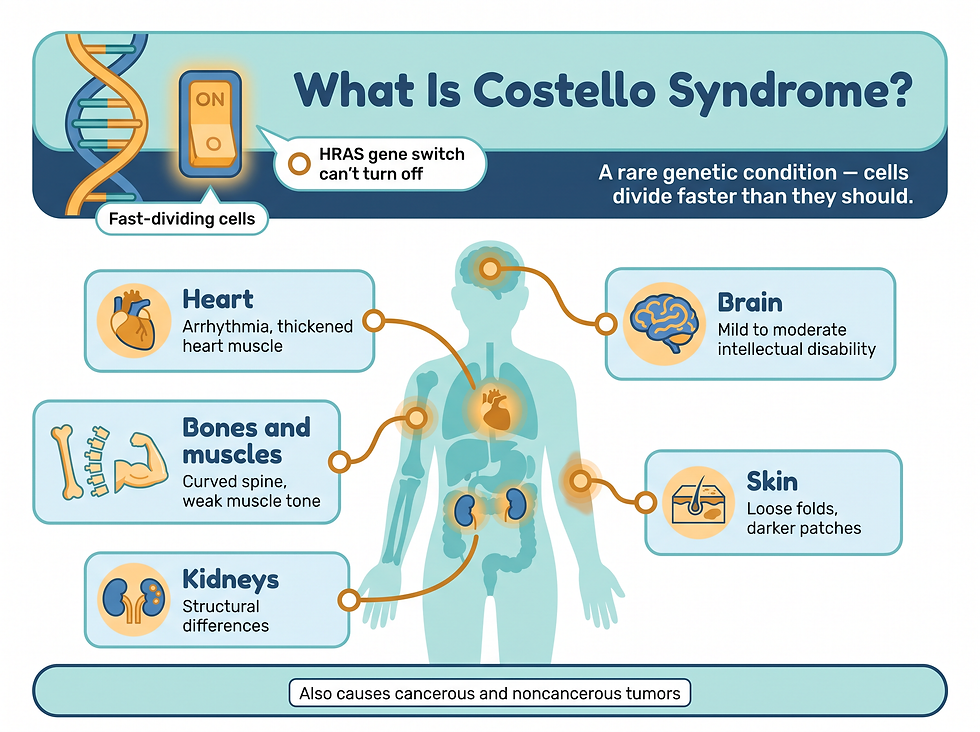
What Is Costello Syndrome?
Costello syndrome is a rare genetic condition that affects multiple organs, including the brain, bones, heart, stomach, muscles, kidneys and skin.
A genetic change causes proteins to tell cells to grow and divide more often than they need to. Because cells are multiplying too quickly, you are more at risk of developing cancerous or noncancerous tumors.
The condition affects the whole body rather than a single organ system, which is why care often involves several types of specialists.
How Common Is Costello Syndrome?
Costello syndrome is rare. It affects at least 100 to 1,500 people worldwide.
What Are the Symptoms of Costello Syndrome?
Symptoms range in severity and affect different parts of the body, including the brain, bones, heart, muscles and skin.
Symptom area | What it looks like |
Heart | Heart problems such as arrhythmia (irregular heartbeat) or hypertrophic cardiomyopathy (thickened heart muscle) |
Feeding | Feeding difficulties during infancy, sometimes requiring a feeding tube |
Spine | Curve of the spine — scoliosis or kyphosis |
Brain and development | Intellectual disability (mild to moderate) and growth abnormalities of the brain, such as Chiari malformation |
Vision and dental | Vision and dental problems |
Kidneys | Structural kidney differences |
Muscles | Weak muscle tone (hypotonia) |
For more on spinal curves, see our scoliosis guide.
What Physical Characteristics Does Costello Syndrome Cause?
People diagnosed with Costello syndrome have distinct physical characteristics:
Flexible finger and wrist joints.
Tight cords on the back of the heel (Achilles tendon).
A large head and mouth, full lips, wide nostrils and coarse facial features.
Loose folds of skin on the hands and feet (cutis laxa).
Slow growth during childhood and short stature during adulthood.
Areas of skin darker than the surrounding skin (hyperpigmentation).
What Types of Tumors Form With Costello Syndrome?
The genetic change responsible for a Costello syndrome diagnosis causes cells to continuously grow and divide, which causes tumors to form. Tumors can be cancerous or noncancerous (benign).
Tumor type | Cancerous or benign? | Details |
Papilloma | Noncancerous | Small growths that look like warts; form around the nose, mouth or anus |
Rhabdomyosarcoma | Cancerous | A childhood cancer that forms in muscle tissue |
Neuroblastoma | Cancerous | A tumor common in children and adolescents that forms in nerve cells |
Transitional cell carcinoma | Cancerous | A type of bladder cancer that forms in adults |

What Causes Costello Syndrome?
A genetic change (mutation) of the HRAS gene causes Costello syndrome.
The HRAS gene creates the H-Ras protein, which is responsible for cell growth and cell division. When the HRAS gene has a mutation, the protein’s power switch can’t turn off.
This causes the protein to overwork by creating too many proteins that tell cells they need to grow and divide more frequently than they should.
Is Costello Syndrome Inherited?
While you can inherit Costello syndrome from a parent, almost all cases result from a new genetic change in people with no family history of the condition.
In rare cases of inheritance, Costello syndrome is autosomal dominant — meaning only one biological parent needs to have the gene change to pass it on. In that case, the child has a 50% chance of inheriting it.
Costello syndrome could affect anyone. Most cases happen randomly or sporadically, without any history of the condition in someone’s family (de novo).

How Is Costello Syndrome Diagnosed?
A Costello syndrome diagnosis occurs in early childhood.
Your healthcare provider will diagnose it after a physical examination of your child’s symptoms, followed by a genetic test to confirm the gene change responsible. Your provider will also ask whether you have a history of any genetic conditions in your family, since your child could inherit the condition.
Your provider’s diagnostic approach eliminates conditions that share the same symptoms. Physical symptoms of Costello syndrome are very similar to those of cardiofaciocutaneous syndrome (CFC syndrome) and Noonan syndrome. A genetic test that identifies the responsible gene sets each condition apart and leads to a complete diagnosis.
How Is Costello Syndrome Treated?
Treatment addresses symptoms of the condition, since there is no cure.
Treatment approach | What it involves |
Surgery | Treats heart problems, feeding problems, curved spine, and other structural issues |
Heart medications | Beta-blockers, calcium channel blockers and antiarrhythmic medications manage heart symptoms |
Vision care | Wearing corrective lenses or undergoing eye surgery to improve vision |
Physical and occupational therapy | Wearing a brace and participating in therapy to improve muscle strength and address bone growth abnormalities |
Education support | Enrolling in special education programs in school |
Tumor management | Surgery or chemotherapy for cancerous tumors; freezing off (with dry ice) noncancerous tumors |
How Serious Is Costello Syndrome?
Costello syndrome is a lifelong condition without a cure.
People diagnosed with Costello syndrome have a varied life expectancy that depends on the severity of their symptoms — especially symptoms that affect the heart.
Treatment addresses symptoms as well as the tumors that form as a result of the body’s cells dividing too frequently. The outlook is positive with early treatment.
Living With Costello Syndrome
When Should You See Your Healthcare Provider?
Visit your healthcare provider if your child diagnosed with Costello syndrome experiences symptoms that affect their ability to thrive — especially if they have problems eating.
Go to the emergency room immediately if your child experiences any of these heart-related symptoms:
Emergency sign | What it means |
An abnormally slow or fast heartbeat | Heart involvement needs immediate evaluation |
Shortness of breath | Can signal serious heart problems |
Chest pain | Can signal serious heart problems |
Fainting or feeling dizzy | Can signal serious heart problems |
Questions to Ask Your Provider
Your question | What the answer helps you understand |
Are there side effects to the treatment? | What to monitor as your child takes medications or completes therapy |
Does my child need surgery? | Whether surgical treatment is needed for heart, feeding or spine problems |
How often does my child need preventive checkups to monitor their symptoms? | The monitoring schedule that catches tumors and heart changes early |
Does my child need to see a specialist? | Which additional specialists (cardiology, oncology, and others) should join the care team |
“It may be overwhelming to hear that your child has a rare genetic condition, but your healthcare provider will offer the best care possible to treat your child’s symptoms. This will help them lead a healthy life. It’s important to monitor your child for symptoms, especially small tumors that form on their body as a result of their cells overworking. Early treatment leads to the best outlook.”
Conclusion
Costello syndrome is a rare genetic condition in which a mutated HRAS gene makes cells grow and divide too quickly, causing tumors and affecting the brain, bones, heart, muscles and skin. It is almost always caused by a new genetic change rather than inheritance, and it is diagnosed in early childhood through physical examination and genetic testing.
There is no cure, but treatment addresses the symptoms — heart medications, surgery, therapy, vision care and tumor management — and the outlook is positive with early treatment. Life expectancy varies based on symptom severity, especially heart-related symptoms, which is why emergency care for heart signs matters so much.
Next step: if your child has symptoms consistent with Costello syndrome — unusual physical features, feeding problems, heart signs, or developmental differences — talk to your healthcare provider. If you already have a diagnosis, keep every checkup and watch closely for small tumors and any heart symptoms, bringing them to medical attention right away.
Frequently Asked Questions
What is Costello syndrome in simple terms?
Costello syndrome is a rare genetic condition that causes cells to divide and replicate faster than they should, forming tumors and affecting the brain, bones, heart, muscles and skin.
What causes Costello syndrome?
A genetic change (mutation) of the HRAS gene. The HRAS gene creates the H-Ras protein, which controls cell growth and division; when mutated, its “power switch” can’t turn off and cells divide too often.
Is Costello syndrome genetic?
Yes. It is caused by a mutation of the HRAS gene. Almost all cases are new genetic changes (de novo), not inherited.
Is Costello syndrome inherited?
Usually not — almost all cases result from a new genetic change with no family history. In rare cases it is autosomal dominantly inherited, meaning one parent with the gene change gives the child a 50% chance of inheriting it.
Who does Costello syndrome affect?
It could affect anyone. Most cases happen randomly or sporadically (de novo).
How rare is Costello syndrome?
It affects at least 100 to 1,500 people worldwide.
What are the most common symptoms of Costello syndrome?
Heart problems, feeding difficulties in infancy, spinal curves, mild to moderate intellectual disability, weak muscle tone (hypotonia), vision and dental problems, and structural kidney differences.
What physical features are typical of Costello syndrome?
Flexible finger and wrist joints, tight Achilles tendons, a large head and mouth with full lips and wide nostrils, coarse facial features, loose skin folds on hands and feet (cutis laxa), slow childhood growth, short adult stature, and hyperpigmented skin.
What tumors are associated with Costello syndrome?
Papillomas (noncancerous, wart-like growths around the nose, mouth or anus), rhabdomyosarcoma (cancerous, childhood muscle cancer), neuroblastoma (cancerous, in nerve cells), and transitional cell carcinoma (cancerous bladder cancer in adults).
Are tumors in Costello syndrome always cancerous?
No. Tumors can be cancerous or noncancerous (benign), such as papillomas.
What is the difference between Costello syndrome and Noonan syndrome?
Their physical symptoms are very similar (cardiofaciocutaneous/CFC syndrome also looks similar). A genetic test identifying the responsible gene sets each condition apart and confirms the diagnosis.
When is Costello syndrome diagnosed?
Diagnosis occurs in early childhood, after a physical examination followed by a genetic test to confirm the gene change.
Can Costello syndrome be cured?
No. It is a lifelong condition without a cure. Treatment addresses symptoms and tumors.
How is Costello syndrome treated?
Surgery for heart, feeding and spine problems; heart medications (beta-blockers, calcium channel blockers, antiarrhythmics); corrective lenses or eye surgery; braces and physical/occupational therapy; special education programs; and surgery or chemotherapy for cancerous tumors (or freezing off benign ones).
What medications are used for heart symptoms in Costello syndrome?
Beta-blockers, calcium channel blockers and antiarrhythmic medications.
Does Costello syndrome affect intelligence?
It can cause intellectual disability, ranging from mild to moderate.
Does Costello syndrome affect growth?
Yes. It causes slow growth during childhood and short stature during adulthood, and can cause structural kidney differences.
What is hypotonia in Costello syndrome?
Hypotonia is weak muscle tone, listed as one of the condition’s symptoms.
Does Costello syndrome affect life expectancy?
Life expectancy varies and depends on the severity of symptoms — especially symptoms affecting the heart.
What is the outlook for a child with Costello syndrome?
The outlook is positive with early treatment, even though there is no cure.
When should I take my child to the emergency room for Costello syndrome?
Immediately, if they show heart symptoms: an abnormally slow or fast heartbeat, shortness of breath, chest pain, or fainting/dizziness.
When should I call my child’s provider about Costello syndrome?
If your child has symptoms that affect their ability to thrive, especially eating problems.
What questions should I ask my child’s doctor?
Ask about treatment side effects, whether surgery is needed, how often preventive checkups are needed to monitor symptoms, and whether a specialist is needed.
Should I monitor my child for tumors with Costello syndrome?
Yes. It is important to monitor for small tumors that form as a result of cells overworking, and report them promptly.
Can Costello syndrome cause feeding problems?
Yes. Feeding difficulties occur during infancy and sometimes require a feeding tube.
Related Reading
Source
Medical Disclaimer
This content is for informational purposes only and is not a substitute for professional medical advice, diagnosis, or treatment. Always seek the advice of your physician or other qualified health provider with any questions you may have regarding a medical condition. Never disregard professional medical advice or delay in seeking it because of something you have read here. In a medical emergency, call 911 or your local emergency number immediately.
Comments