Conjunctival Melanoma: Symptoms, Causes, Diagnosis, Treatment and Prognosis — What You Need to Know

Updated: 2 days ago
Medically reviewed by Dr. Baraa Alnahhal, MD · Last reviewed: September 2026
Quick Answer
Conjunctival melanoma is a rare eye cancer that forms in the conjunctiva — the clear tissue that covers the whites of your eyes and the inside of your eyelids.
It often starts as a spot that may be flat or raised, colored or colorless, and appears in only one eye. It may not cause symptoms at first, and is sometimes found during a routine eye exam.
Treatment usually involves surgery to remove the spot or cryotherapy (freezing). Radiation and topical chemotherapy are used as follow-up treatments. If it is treated, the survival outlook is generally good — but untreated melanoma can lead to vision loss and can be fatal.
TL;DR
Conjunctival melanoma is a rare form of ocular melanoma, making up about 2% of all eye tumors and about 0.25% of all melanomas. Its incidence has been rising in recent years.
It starts in melanocytes, the pigment-making cells, growing in the tissue that protects the sclera (the white of the eye). Two conditions are linked to it: primary acquired melanosis (PAM) and conjunctival nevi (moles or freckles on the eye).
It can be fatal, especially if it spreads — usually to the lungs and lymph nodes. But when treated, the survival outlook is good.
When Should You See an Eye Care Provider?
If you notice any new or worsening spot of color or thickness in the whites of your eyes, contact an eye care provider. That is the single most important action this article recommends.
Do not wait for pain or vision problems. Conjunctival melanoma may not cause symptoms at first, and early diagnosis with early treatment gives you the best prognosis. Also see your provider promptly if you have any other new or worrisome issues with your health or vision outside of your regularly scheduled appointments.
What Is Conjunctival Melanoma?
Conjunctival melanoma — sometimes called conjunctival malignant melanoma — is a rare type of eye cancer that develops in the conjunctiva. The conjunctiva is the clear tissue that covers the inside of your eyelids and the white part of your eye (called the sclera). Most often, the cancer affects the bulbar conjunctiva — the mucous membrane that protects your sclera.
It is a form of ocular melanoma (melanoma of the eye). Melanoma starts with the uncontrolled growth of melanocytes — the cells that make the pigment called melanin. Melanin gives hair, skin, and eyes their color. Melanoma happens most often in the skin.
Conjunctival melanoma can look like a freckle or brown spot in the conjunctiva that may cover part of the iris and sclera. It can be fatal.

How Common Is It?
Conjunctival melanoma is rare, amounting to about 2% of all tumors in the eye and about a quarter of 1% (0.25%) of all melanomas. The incidence has been increasing in recent years.
Share of eye tumors: about 2%.
Share of all melanomas: about 0.25% (a quarter of 1%).
Annual incidence (Western world): 0.2 to 0.5 cases per 1 million people.
Trend: increasing in recent years.
Most affected group: non-Hispanic white people, though people of Asian, Black, and Hispanic backgrounds can also develop it.
Children: rarely affected.
It is a different disease than intraocular melanoma (which affects the uvea, the eye's middle layer, and is the most common eye cancer) and retinoblastoma (which affects the retina at the back of the eye).
What Are the Symptoms?
Melanoma of the eye may not cause symptoms at first. When signs do appear, they center on a spot that:
Coloring: may have pigment. A spot without color may be "amelanotic" conjunctival melanoma — amelanotic means "without melanin."
Shape: may be flat or nodular (raised).
Location: present in only one eye (unilateral).
A spot like this can sometimes be mistaken for a harmless freckle — which is why changes in the whites of your eyes deserve a professional look.

What Causes Conjunctival Melanoma?
Because it is so rare, researchers aren't sure what causes it. Genetics may play a role, but it is not contagious and doesn't spread from person to person.
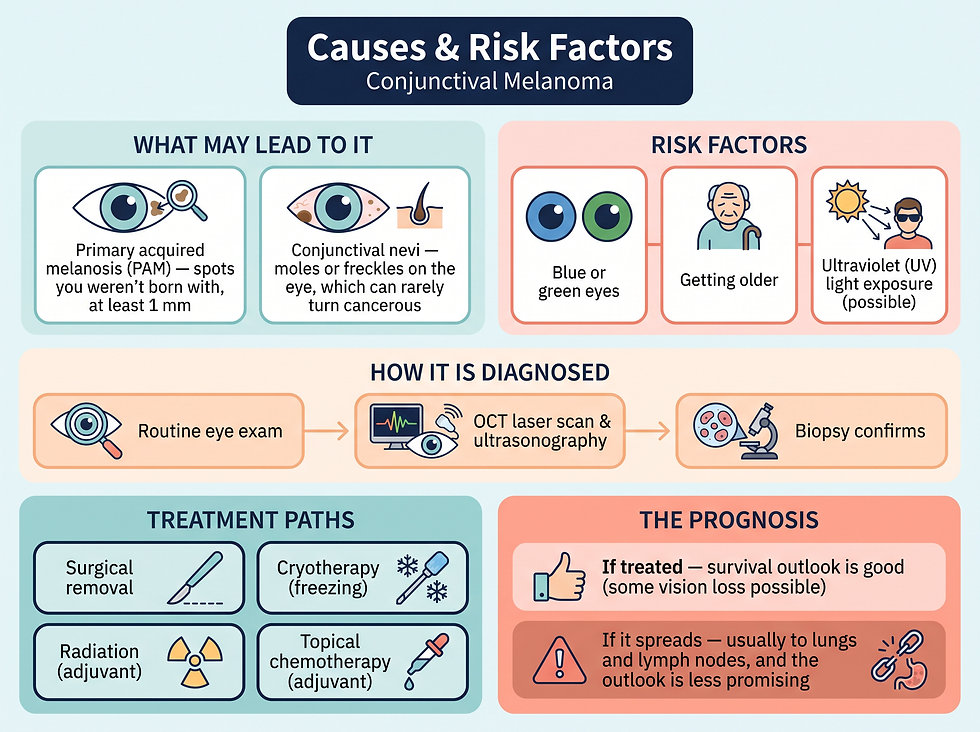
Two conditions have a more defined link to developing conjunctival melanoma:
Primary acquired melanosis (PAM): spots, sometimes with color, that you weren't born with and that are at least 1 millimeter in diameter. PAM can happen with or without abnormal cells.
Conjunctival nevi: often called moles or freckles on the eye.
What Are the Risk Factors?
Risk factors for ocular (eye) melanoma in general include:
Eye color: blue or green eyes; people with brown eyes are less likely to develop ocular melanoma than people with light-colored eyes.
Ethnicity: white people are more likely than other ethnic groups.
Age: risk increases as you get older.
Ultraviolet light: scientists think UV exposure may also be a risk factor.
What Are the Complications If Untreated?
Untreated melanoma can lead to loss of vision and to death.
How Is Conjunctival Melanoma Diagnosed?
An eye care provider or ophthalmologist may find conjunctival melanoma during a routine eye examination. If they suspect it, they may order:
Ultrasonography: ultrasound imaging of the eye.
OCT (optical coherence tomography): a laser scan that assesses conjunctival thickness.
Biopsy: a tissue sample analyzed for cancer cells.
If the provider thinks the melanoma might have metastasized (spread to another part of your body), additional tests may include blood tests, a PET scan, a CT scan, or an MRI scan.
How Is It Treated?
Your healthcare provider will discuss options to find the best treatment for your situation. Treatments may include:
Surgical removal of the lesion: removes the spot directly.
Cryotherapy: freezing treatment.
Radiation therapy: adjuvant treatment (not the first therapy chosen); can include brachytherapy or external beam radiation.
Topical chemotherapy: adjuvant treatment (not the first therapy chosen).
What Are the Treatment Side Effects?
Surgery: corneal scarring, infection, diplopia (double vision).
Cryotherapy: temporary or permanent damage to parts of the eye, including eyelids; iritis (inflammation in the iris).
Topical chemotherapy: tearing, eye irritation, eye pain, blepharospasm, corneal scarring.
Radiation: dry eyes, temporary corneal abrasions, loss of eyelashes, focal cataracts.
If these treatments don't work well, your provider may need to remove the affected eye. Recovery time depends on which treatment you receive — your provider will discuss expectations when you decide.
What Is the Prognosis?
If you have conjunctival melanoma and it's treated, the outlook for survival is good. It's possible, however, that you may have some vision loss.
The outlook is less promising if the melanoma spreads (metastasizes). In those cases, it is most likely to travel to your lungs and lymph nodes.
Can Conjunctival Melanoma Be Prevented?
You can't prevent it from developing, but you may be able to decrease your risk by:
Wearing appropriate sunglasses and hats when it's bright outside, to protect against ultraviolet light.
Considering avoiding going out in bright sunlight.
How Do I Live With Conjunctival Melanoma?
Helpful self-care steps include scheduling and keeping regular appointments with your healthcare team, eating well, getting regular activity, decreasing stress, and asking for and accepting services related to low vision or double vision.
What Is the Difference Between a Conjunctival Nevus and Melanoma?
A conjunctival nevus is a noncancerous (benign) spot on your conjunctiva. In everyday language, a nevus is called a mole, birthmark, or beauty mark. A nevus isn't cancerous, but there are instances when a conjunctival nevus turns into cancer — and thus becomes conjunctival melanoma.
This is another reason to have any eye spot monitored rather than ignored.
Conclusion
Conjunctival melanoma is a rare but serious eye cancer of the clear tissue covering the whites of the eyes and the inner eyelids. It represents about 2% of eye tumors and about 0.25% of all melanomas, with incidence rising in recent years. It often begins as a flat or raised spot — pigmented or colorless — in one eye, sometimes found first at a routine eye exam.
Two conditions carry a defined link: primary acquired melanosis (PAM) and conjunctival nevi. Risk factors include light eye color, older age, and possibly ultraviolet light exposure.
The honest reality: untreated, it can cost vision and life. The encouraging reality: treated, the survival outlook is good. The bridge between those two realities is a single action — having any new or changing spot on the white of your eye examined by an eye care provider without delay.
If you notice a new spot, color change, or thickening on the whites of your eyes, book an eye exam now — early diagnosis is the strongest predictor of the best prognosis.
Frequently Asked Questions (FAQ)
What is conjunctival melanoma?
It is a rare eye cancer that forms in the conjunctiva — the clear tissue covering the whites of your eyes and the inside of your eyelids.
Is conjunctival melanoma rare?
Yes. It accounts for about 2% of all eye tumors and about 0.25% (a quarter of 1%) of all melanomas.
Where does it most often develop?
Most often in the bulbar conjunctiva — the mucous membrane that protects the sclera (the white of the eye).
Is it the same as other eye cancers?
No. It is different from intraocular melanoma (which affects the eye's middle layer) and retinoblastoma (which affects the retina).
Can it be fatal?
Yes. Conjunctival melanoma can be fatal, especially if untreated or if it spreads.
What does it look like?
It can look like a freckle or brown spot in the conjunctiva that may cover part of the iris and sclera. The spot may be flat or raised, colored or colorless.
Does it cause symptoms early?
It may not cause symptoms at first, which is why routine eye exams matter.
What is amelanotic conjunctival melanoma?
Amelanotic means "without melanin" — a spot that has no color. It is still melanoma.
Does it affect one eye or both?
It is present in only one eye (unilateral).
What causes it?
Researchers aren't sure — it is so rare that causes are not fully understood. Genetics may play a role. It is not contagious.
What is primary acquired melanosis (PAM)?
Spots, sometimes with color, that you weren't born with and that are at least 1 millimeter in diameter. PAM can occur with or without abnormal cells and is linked to a higher risk of conjunctival melanoma.
What is a conjunctival nevus?
A noncancerous spot on the conjunctiva — commonly called a mole or freckle. A nevus isn't cancerous, but can sometimes turn into conjunctival melanoma.
Who is at higher risk?
Risk factors for eye melanoma include having blue or green eyes, being white, and getting older. Scientists also think UV light exposure may be a risk factor.
Are people with brown eyes at lower risk?
People with brown eyes are less likely to develop ocular melanoma than people with light-colored eyes.
Is it increasing in frequency?
Yes — the incidence has been increasing in recent years.
How is it diagnosed?
Often first found during a routine eye exam, then confirmed with ultrasonography, OCT (a laser scan of conjunctival thickness), and biopsy. If spread is suspected: blood tests, PET, CT, or MRI scans.
How is it treated?
Mainly surgery to remove the spot or cryotherapy (freezing). Radiation therapy and topical chemotherapy are used as adjuvant (follow-up) treatments.
What if treatments don't work?
If treatments don't work well, your provider may need to remove the affected eye.
Does it spread?
If it metastasizes, it most likely travels to the lungs and lymph nodes.
What is the prognosis?
If treated, the survival outlook is good, though some vision loss is possible. The outlook is less promising if it has spread.
Can it be prevented?
You can't prevent it entirely, but wearing sunglasses and hats outdoors may decrease your risk by limiting UV exposure.
How do I live with it?
Keep regular appointments with your healthcare team, eat well, stay active, reduce stress, and accept low-vision or double-vision services if needed.
When should I see a provider?
If you have any new or worrisome issues with your health or vision outside regular appointments — and immediately if you notice any new or worsening spot of color or thickness in the whites of your eyes.
Do children get it?
It rarely happens in children.
Is it different from a skin freckle?
An eye freckle (nevus) is benign, but like skin moles, it can occasionally turn cancerous — so changing eye spots should always be checked.
Sources
Medical disclaimer: This article is for general informational purposes only and does not constitute medical advice, diagnosis, or treatment. Always seek the advice of your physician or another qualified health provider with any questions you may have regarding a medical condition. If you notice any new or changing spot on the whites of your eyes, see an eye care provider promptly — early diagnosis gives the best prognosis.
Comments