Antisocial Personality Disorder (ASPD): Signs, Symptoms, and Treatment

Updated: 2 days ago
Medically reviewed by Dr. Baraa Alnahhal, MD · Last reviewed: September 2026
TL;DR
Antisocial personality disorder (ASPD) is a mental health condition that affects how a person thinks and interacts with others, leading to manipulation, law-breaking, aggression, and a lack of remorse. It affects an estimated 1% to 4% of U.S. adults and usually begins before age 15 as conduct disorder. Symptoms are typically worst between ages 20 and 40 and tend to improve after age 40. There is no cure — treatment (medication plus therapy) is lifelong, but it can keep people safe and reduce harm to those around them.
Quick Answer
What it is: ASPD is a mental health condition affecting the way you think and interact with others, leading people to manipulate or deceive, exploit others, disregard the law or others' rights, and feel no remorse.
How common: It affects an estimated 1% to 4% of adults in the U.S. and usually begins before age 15, first presenting as conduct disorder.
Symptom course: Aggression, recklessness, law-breaking, charm-based manipulation, and no remorse are usually worst between ages 20 and 40 and tend to improve after 40.
Treatment: There is no cure and no FDA-approved medication; treatment combines psychotherapy (often CBT) with medications for aggression and mood, and must continue lifelong to prevent complications.
What Is Antisocial Personality Disorder?
Antisocial personality disorder (ASPD) is a mental health condition that can affect the way you think and interact with others. It can lead you to manipulate or deceive people, exploit or take advantage of someone else for your own benefit, disregard the law or the rights of other people, and feel no remorse for your actions.
It's common for people diagnosed with ASPD to show a lack of respect toward others, break the law, ignore the consequences of their actions, or refuse to take responsibility. ASPD can be dangerous since you're at a high risk of causing physical or emotional harm to yourself and those around you.
Antisocial personality disorder is one of many personality disorders. Personality disorders affect the way you think or behave.

Many people think of antisocial personality disorder as not liking the company of others and preferring to be alone. Rather, ASPD is a serious mental health condition. You may act without thinking about the consequences of your behaviors or how they affect others.
How Common Is Antisocial Personality Disorder?
Antisocial personality disorder affects an estimated 1% to 4% of adults in the U.S.
Prevalence statistic | Figure |
U.S. adults affected by ASPD | 1% to 4% |
Typical onset | Before age 15 (as conduct disorder) |
Symptom peak | Ages 20 to 40 |
What Are the Symptoms of Antisocial Personality Disorder?
Symptoms of ASPD affect the way you think and how you interact with others. Symptoms may include:
Symptom | Description |
Physical aggression | Hostility or violence toward others |
Reckless behavior | Impulsive actions without considering consequences |
Law-breaking | Disregarding rules and social norms |
Superiority feelings | Feeling angry, more powerful, or better than others |
Manipulation | Using wit, flattery, and charm to lie or deceive for personal gain or enjoyment |
Irresponsibility | Not taking responsibility for actions or behaviors |
No remorse | No regret or concern for behaviors |
Antisocial personality disorder may look different for each person who experiences it. You might lean more toward certain behaviors than others.
If at any point you feel the urge to hurt yourself or others, reach out for help. Contact a healthcare provider or call the Suicide and Crisis Lifeline by dialing or texting 988 (U.S.). Someone is available 24 hours a day, seven days a week. If you or a loved one is in immediate danger, call 911 or your local emergency services number.

At What Age Does Antisocial Personality Disorder Develop?
Antisocial personality disorder usually begins before age 15. The initial diagnosis is conduct disorder. Children with conduct disorder show a pattern of aggressive or disobedient behavior that can harm others. They may lie, steal, ignore rules, or bully other children. Two behaviors that are warning signs of ASPD during childhood are setting fires and animal cruelty.
Sometimes parents or healthcare providers miss the signs of conduct disorder. The signs may overlap with other conditions, like:
Overlapping condition | Shared feature |
Attention-deficit/hyperactivity disorder (ADHD) | Impulsivity and rule-breaking |
Depression | Behavioral changes in children |
Oppositional defiant disorder (ODD) | Disobedient behavior |
When a conduct disorder diagnosis occurs and treatment begins early in childhood, there's a chance the behaviors may not continue into adulthood. If they do, the diagnosis becomes antisocial personality disorder after age 18.
Studies suggest that symptoms of ASPD are the worst between ages 20 and 40 and tend to improve after age 40.
What Causes Antisocial Personality Disorder?
Healthcare providers aren't sure of the exact cause of ASPD. Research suggests it may involve many different factors, from your genetic composition to certain experiences you had growing up. One leading factor is brain biology. You may have abnormal levels of serotonin in your brain — a chemical that regulates your mood and feelings of happiness. Changes to the amount of serotonin may cause ASPD behaviors.
Is Antisocial Personality Disorder Genetic?
Your genetic makeup may make it more likely for you to develop ASPD. Research is ongoing to learn more about how your genes can contribute to this condition, but the exact genes responsible are yet to be identified. Studies found that your risk increases if you have a biological relative with ASPD.
What Are the Risk Factors for Antisocial Personality Disorder?
Antisocial personality disorder can affect anyone. You may be more at risk of developing the condition if you:
Risk factor | Details |
Conduct disorder before age 15 | The earliest known predictor |
Being male | ASPD is more commonly diagnosed in males |
Early childhood trauma or abuse | Adverse experiences during development |
Substance use disorder (SUD) | Personal SUD or a biological relative with the condition |
Family mental health history | Mental health conditions in your biological family |
Lower academic performance | Compared to your peers |
Incarceration | Having spent time in jail or prison |
What Are the Complications of Antisocial Personality Disorder?
ASPD is a dangerous, often life-threatening condition for the affected person and others around them. It can lead to the following complications:
Complication | Impact |
Abuse or cruelty | Physical or emotional harm to others |
Neglect | Failure to care for dependents |
Suicide | Elevated risk of suicidal behavior |
Substance use disorder | Dependence on drugs |
Alcohol use disorder | Dependence on alcohol |
Arrest and incarceration | Legal consequences of rule-breaking |
Health complications | Physical health deterioration |
Other mental health conditions | Depression, anxiety, and more |
Failing commitments | Inability to meet personal, social, work, or academic obligations |
How Is Antisocial Personality Disorder Diagnosed?
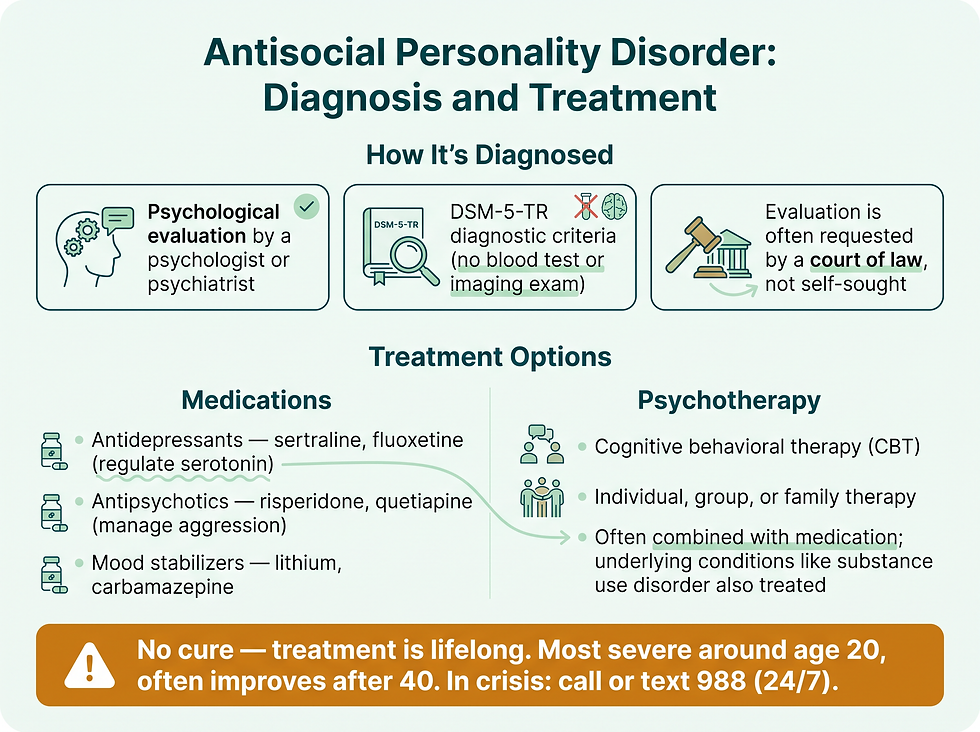
A healthcare provider who specializes in mental health conditions, like a psychologist or psychiatrist, will diagnose ASPD. They'll perform a psychological evaluation — a method to evaluate a person's thoughts and behaviors that looks for patterns relating to ASPD. Providers refer to the diagnostic criteria in the fifth edition of the Diagnostic and Statistical Manual of Mental Illnesses, or DSM-5-TR (the latest version, where "TR" stands for "text revision") — the American Psychiatric Association's professional guide to mental health conditions.
Most people who experience ASPD don't seek a diagnosis on their own. A mental health evaluation is usually requested by a court of law.
Is There a Test for Antisocial Personality Disorder?
No self-assessment, blood test, or imaging exam can diagnose ASPD. If certain signs or behaviors raise a red flag, seek medical attention. You may first choose to see a primary care physician (PCP). They'll consider your health history, perform a physical exam, assess your symptoms, and refer you to a psychiatrist or psychologist for a mental health evaluation that leads to an ASPD diagnosis.
Diagnostic step | Purpose |
PCP visit | Health history, physical exam, symptom assessment |
Psychological evaluation | Identifies thought and behavior patterns by a psychologist or psychiatrist |
DSM-5-TR criteria | Professional diagnostic standard from the American Psychiatric Association |
What Conditions Can Mimic ASPD?
A differential diagnosis is a way for your healthcare provider to distinguish between several conditions sharing similar symptoms. Certain conditions can mimic ASPD, so your provider may refer to the following before making an official diagnosis:
Condition | Overlapping feature |
Borderline personality disorder (BPD) | Unstable moods and manipulative behavior |
Narcissistic personality disorder (NPD) | Inflated sense of self-importance |
Substance use disorder | Dependence on drugs or alcohol |
How Is Antisocial Personality Disorder Treated?
Your healthcare providers may recommend the following treatment for ASPD:
Medications can help treat symptoms like aggression and mood changes. Psychotherapy — cognitive behavioral therapy (CBT) is a type of counseling that focuses on changing your thinking and behavior. Therapy can help you see how your behavior affects others. You may benefit from individual therapy, group therapy, or family therapy.
Your healthcare provider might recommend a combination of medications and psychotherapy. They may also offer treatment for any underlying health conditions like substance use disorder.
ASPD is difficult to treat clinically because you might not recognize that your behaviors and thoughts are harmful. It's common to feel reactive or upset when someone offers to help. Understand that treatment is available when you're ready to accept it. It isn't easy, but treatment can keep you safe and protect those around you.
What Medications Treat Antisocial Personality Disorder?
There isn't a single, FDA-approved medication for ASPD. Medication can help you manage aggression, depression, or erratic moods. Your provider may recommend:
Medication class | What it does | Examples |
Antidepressants | Regulate serotonin levels in the brain | Sertraline, fluoxetine |
Antipsychotics | Regulate violent behavior or aggression | Risperidone, quetiapine |
Mood stabilizers | Manage severe changes in mood or behavior | Lithium, carbamazepine |
What Is the Outlook for Antisocial Personality Disorder?
Antisocial personality disorder is a lifelong condition. Symptoms are usually most severe around age 20 and sometimes improve by age 40. Research is ongoing to learn more about why symptoms change as we age.
While participating in treatment, your outlook may be positive, but you'll need to continue treatment throughout your life to prevent complications. Treatment isn't easy for ASPD — it takes a lot of energy and effort to make personal changes. Stopping treatment can cause your symptoms to worsen, putting you at risk of harming yourself and others.
Outlook factor | Detail |
Symptom peak | Usually most severe around age 20 |
Symptom improvement | Sometimes by age 40 |
Cure status | No cure — management is lifelong |
Long-term success factors | Healthy relationships and a support system |
Does Antisocial Personality Disorder Go Away?
There's no cure for ASPD. Managing the condition is possible with treatment, which is lifelong. The right treatment may help you adjust your behavior and reduce harm to those around you. Maintaining healthy relationships and having a support system are key factors in managing ASPD long-term.
Can Antisocial Personality Disorder Be Prevented?
There isn't a way to prevent ASPD. If conduct disorder is detected and diagnosed during childhood, there's a chance that early treatment could reduce your risk of developing ASPD as an adult.
When Should I See a Healthcare Provider?
If you or someone you know has any of the following symptoms, seek medical attention right away:
Warning sign | Action |
Extreme mood changes | Contact a provider immediately |
Self-harm | Contact a provider immediately |
Suicidal thoughts | Call or text 988 |
Violent behavior | Call 911 or local emergency services |
You can call or text the Suicide and Crisis Lifeline at 988. This hotline connects you to a network of local crisis centers that provide free and confidential emotional support for people in suicidal crisis or emotional distress 24 hours a day, seven days a week. In an emergency, call 911 or your local emergency services number.
Conclusion
Antisocial personality disorder is far more serious than its name suggests — it is not a preference for solitude, but a lifelong mental health condition that changes how a person thinks and relates to everyone around them. Marked by manipulation, law-breaking, impulsivity, and an absence of remorse, ASPD affects an estimated 1% to 4% of U.S. adults. Its roots typically run back to childhood conduct disorder, its symptoms peak between ages 20 and 40, and while they often soften after 40, the condition never simply disappears.
The encouraging message is that treatment works — but only when it's sustained. A combination of psychotherapy (especially CBT) and medications that regulate serotonin, aggression, and mood can help people adjust their behavior, stay safe, and protect those around them. Early detection of conduct disorder in children may even reduce the risk of ASPD developing in adulthood.
If you recognize these signs in yourself or someone you know, don't wait. Contact a mental health professional for an evaluation — often the first critical step — and lean on the free, confidential Suicide and Crisis Lifeline at 988 whenever you need support. If treatment feels difficult or frustrating, remember that sticking with it is what keeps you and the people you love safe.
FAQ
What is antisocial personality disorder?
Antisocial personality disorder (ASPD) is a mental health condition that affects the way you think and interact with others, leading to manipulating or deceiving people, exploiting others for personal benefit, disregarding the law or the rights of other people, and feeling no remorse. It can cause physical or emotional harm to yourself and those around you.
How common is antisocial personality disorder?
ASPD affects an estimated 1% to 4% of adults in the U.S. It usually begins before age 15 as conduct disorder, and symptoms are typically worst between ages 20 and 40.
What are the signs of antisocial personality disorder?
Signs include physical aggression or violence, reckless or impulsive behavior, breaking the law or disregarding social norms, feeling angry or superior to others, using charm and flattery to manipulate and deceive, not taking responsibility, and showing no remorse. In childhood, fire-setting and animal cruelty are warning signs.
Is antisocial personality disorder the same as psychopathy?
ASPD is the clinical diagnosis used in the DSM-5-TR. It is commonly associated with the term "psychopathy" in popular culture, but ASPD is the formal diagnosis based on a behavioral pattern that begins with conduct disorder before age 15.
What causes antisocial personality disorder?
The exact cause is unknown, but research points to a combination of genetic factors (risk increases with a biological relative who has ASPD) and early experiences. Abnormal serotonin levels — a chemical that regulates mood — are considered a leading biological factor.
How is antisocial personality disorder treated?
There is no single FDA-approved medication for ASPD. Treatment typically combines psychotherapy — especially cognitive behavioral therapy (CBT) in individual, group, or family formats — with medications such as antidepressants (sertraline, fluoxetine), antipsychotics (risperidone, quetiapine), or mood stabilizers (lithium, carbamazepine) to manage aggression and mood.
Does antisocial personality disorder go away?
There is no cure. ASPD is a lifelong condition, but treatment is possible and symptoms often improve after age 40. Lifelong treatment, healthy relationships, and a support system are key to managing it long-term.
Is antisocial personality disorder genetic?
Your genetic makeup may increase your risk — studies show risk rises if you have a biological relative with ASPD — but the exact genes responsible have not yet been identified. Research is ongoing.
References
Fisher KA, Hany M. Antisocial Personality Disorder. 2023 May 8. In: StatPearls [Internet]. Treasure Island (FL): StatPearls Publishing. ncbi.nlm.nih.gov/books/NBK546673
Black DW. The Natural History of Antisocial Personality Disorder. Can J Psychiatry. 2015;60(7):309-314. ncbi.nlm.nih.gov/pmc/articles/PMC4500180
American Psychiatric Association. What Are Personality Disorders? psychiatry.org/patients-families/personality-disorders/what-are-personality-disorders
American Psychiatric Association. Antisocial Personality Disorder: Often Overlooked and Untreated. psychiatry.org/news-room/apa-blogs/antisocial-personality-disorder-often-overlooked
American Academy of Child and Adolescent Psychiatry. Conduct Disorder. aacap.org/Conduct-Disorder-033
Merck Manual, Professional Version. Antisocial Personality Disorder (ASPD). merckmanuals.com/professional/psychiatric-disorders/personality-disorders/antisocial-personality-disorder-aspd
National Library of Medicine (U.S.). Antisocial personality disorder. medlineplus.gov/ency/article/000921.htm
Medical Disclaimer: This article is for general informational purposes only and is not a substitute for professional medical advice, diagnosis, or treatment. Only a qualified mental health professional can diagnose antisocial personality disorder. If you or someone you know is experiencing extreme mood changes, self-harm, suicidal thoughts, or violent behavior, seek medical attention immediately. Call or text 988 to reach the Suicide and Crisis Lifeline (available 24/7, free and confidential), or dial 911 in an emergency.
Comments