Anterior Placenta: Why the Cushion Position Is Normal and What It Changes for Your Pregnancy

Updated: 2 days ago
Medically reviewed by Dr. Baraa Alnahhal, MD · Last reviewed: September 2026
TL;DR
An anterior placenta means the placenta grows on the front wall of the uterus, right behind your belly. It is a normal position found in up to half of all pregnancies, and it does not harm you or the baby, change your belly shape, or affect how the placenta works. Its main practical effects are that fetal kicks may arrive a bit later (around 20 weeks instead of 18) and feel softer, and the baby's heartbeat can take longer to find with a handheld Doppler. There is no treatment because no treatment is needed.
Quick Answer
An anterior placenta is a normal, harmless placenta position on the front wall of the uterus, present in roughly 48–50% of pregnancies. It does not cause complications or affect your baby's health. The two realistic differences: you may feel fetal kicks later (around 20 weeks) and more softly, and your provider may need a bit more time to find the heartbeat with a Doppler. It is diagnosed on the routine 18–21 week ultrasound, needs no treatment, and has an excellent outlook. [1] [2]
What Exactly Is an Anterior Placenta?
The placenta is the temporary organ that develops during pregnancy to supply the fetus with oxygen and nutrients, carry away waste, and produce hormones. The position of the placenta depends on where the fertilized egg happens to implant in the uterus.
When the placenta grows on the front wall of the uterus — the wall closest to your belly — it is called an anterior placenta. It sits right behind your abdomen and acts like a cushion between your belly and the fetus [1].
An anterior placenta is a normal position, not a disorder. It causes no health problems for you or your baby, and it is very common, occurring in up to half of all pregnancies [1].
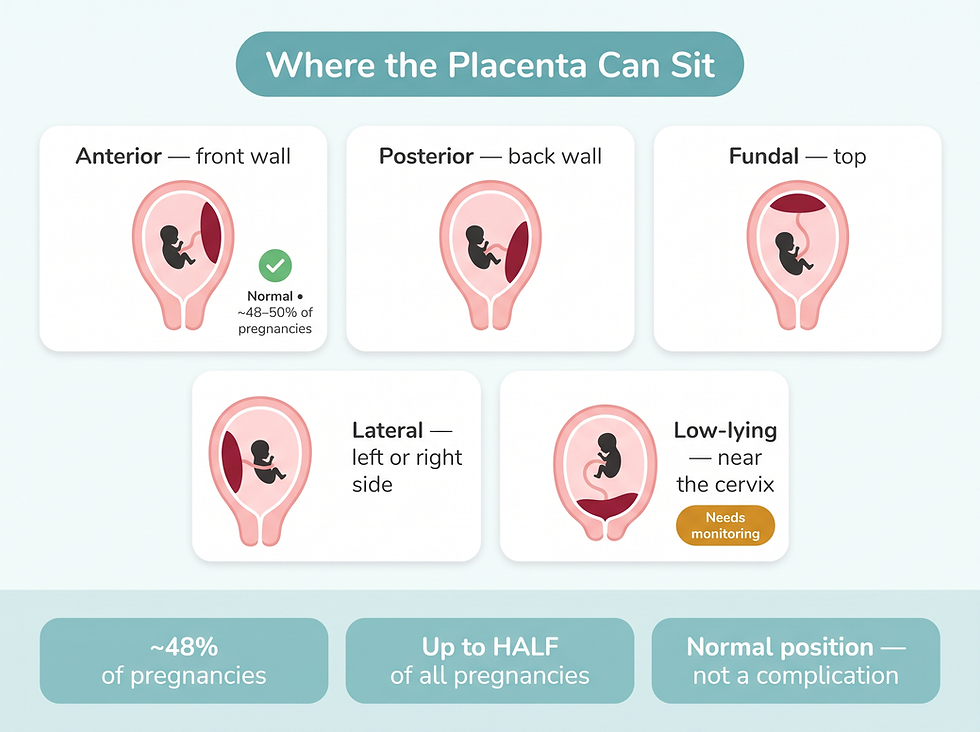
The placenta can develop in several normal positions:
Position | Where it sits | Notes |
Anterior | Front of the uterus, nearest the abdomen | Normal; most common alongside posterior [1] |
Posterior | Back of the uterus, closest to the spine | Normal [1] |
Fundal | Top of the uterus | Normal; rarely associated with slightly higher risks in some studies [1] [3] |
Lateral | Left or right side of the uterus | Normal [1] |
Low-lying | Bottom of the uterus, near or covering the cervix | May require monitoring; sometimes resolves on its own [1] |
It is worth separating the common anterior position from a low-lying placenta or placenta previa, which sits at the bottom of the uterus and may cover all or part of the cervix. That is a different situation that providers monitor more closely — and the two are unrelated: an anterior placenta can be perfectly positioned at the top or middle of the front wall while still being anterior [1].
How Common Is an Anterior Placenta?
Large population data shows that anterior and posterior positions split pregnancies almost evenly down the middle.
Placenta position | Share of pregnancies (large cohort study) |
Anterior | 47.8% |
Posterior | 46.4% |
Fundal | 3.3% |
Lateral | 2.5% |
In the Scandinavian population study of over 74,000 first pregnancies, 35,409 women (47.8%) had an anterior placenta — nearly identical to the 34,344 (46.4%) with a posterior placenta [3]. A 2014 cohort study of 729 healthy singleton pregnancies found the same pattern, with 51.1% of placentas anterior and 39.2% posterior [4]. Consumer estimates commonly describe the range as 33–50% of pregnancies [5].
The single most important fact: an anterior placenta is not rare, not abnormal, and not a warning sign. The location simply reflects where the fertilized egg implanted, and providers do not know why implantation happens in one spot versus another [1].
Does an Anterior Placenta Cause Symptoms?
No. An anterior placenta itself produces no symptoms. Most of the time it is discovered incidentally at the mid-pregnancy ultrasound and is not something to worry about [1].
What it can do is change how you experience two routine parts of pregnancy:
Experience | Without anterior placenta | With anterior placenta |
Feeling first kicks ("quickening") | Around 18 weeks | May not feel them until ~20 weeks or a little later [1] |
Strength of kicks felt | Full, direct | Weaker or softer — the placenta cushions them [1] |
Detecting the heartbeat with a Doppler | Typically quick | Can take longer — the placenta lies between the fetus and the probe [1] |
Belly shape and size | Unchanged | Unchanged — the placenta is a thin organ [1] |
Two things the position does not do, despite common worries: it does not make your belly bigger or differently shaped, because the placenta is a thin organ, and it does not weaken the placenta or reduce how well it delivers oxygen and nutrients [1].

Why do kicks feel later and softer? Research suggests the sensation of fetal movement comes from pressure against the abdominal wall structures. When the placenta sits between the fetus and that wall, the cushioning effect dampens what reaches the surface [6]. One classic study found that reports of decreased fetal movement were 2.10 times as likely (95% CI 1.51–2.92) in pregnancies with an anterior placenta, and similar to the effect of higher maternal weight [6]. Importantly, perception is not the same as reality — the baby moves just as much; you feel it differently [6].
What Causes an Anterior Placenta?
The location of the placenta depends entirely on where the fertilized egg implants in the uterine lining. Nothing about diet, exercise, sex position, prior pregnancies, or anything else you did or didn't do causes an anterior placenta [1]. Healthcare providers don't know why a fertilized egg implants where it does — only that it is essentially random [1].
What providers do know, with confidence, is that the location of the placenta alone does not affect how it works. An anterior placenta functions exactly like a posterior one [1].
Are There Complications?
For most people, there are typically no complications at all. The differences compared with other placenta positions are practical rather than medical [1]:
Difference | What it means for you |
Kicks felt later | Movement may be noticed around 20 weeks instead of 18 [1] |
Doppler detection slower | The provider may take longer to find the heartbeat with the handheld device [1] |
Amniocentesis more challenging | The needle must work around the placenta; with modern ultrasound guidance this is usually just a slight inconvenience [1] [5] |
Notably, large cohort research found that the placenta positions associated with measurably higher risks of preterm birth, small-for-gestational-age babies, and delivery complications were fundal and lateral — not anterior [3]. An anterior placenta, sitting near the back of the abdominal wall with a rich blood supply, behaves like the baseline (posterior) position [3].
The one scenario that deserves distinction is a low-lying placenta that happens to be anterior — sometimes described informally as "anterior placenta previa" in early ultrasounds. Even then, placentas often migrate away from the cervix as the uterus grows, and early low-lying findings frequently resolve before delivery [5]. This is different from a standard anterior placenta, which sits away from the cervix entirely [1].
How Is an Anterior Placenta Diagnosed?
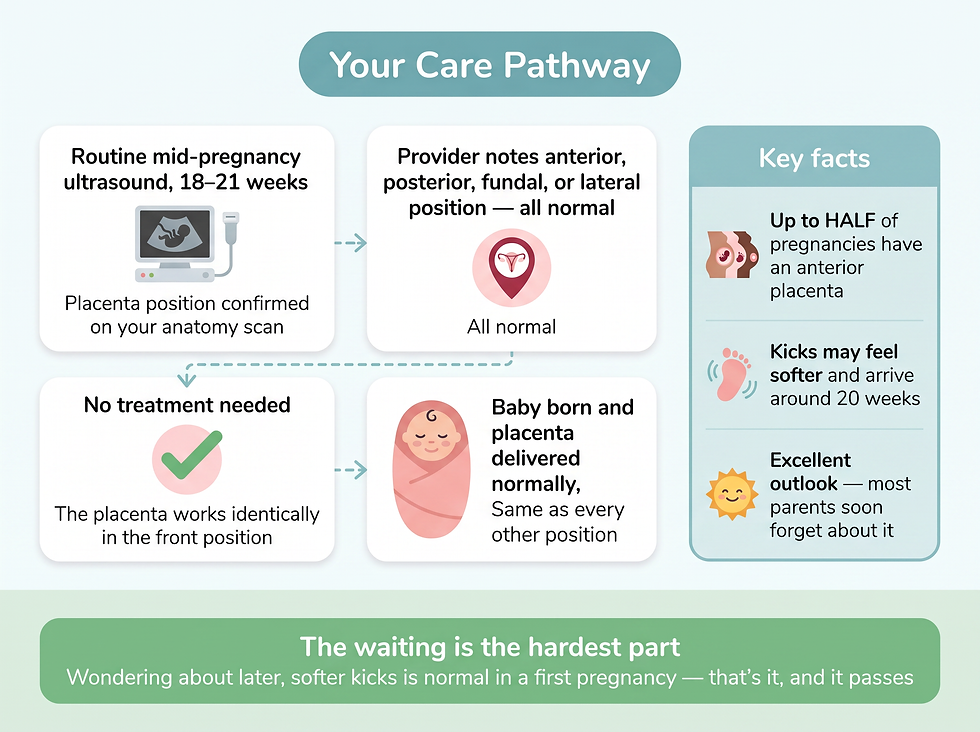
Your healthcare provider determines the placenta's location during a routine ultrasound, usually performed around 18 to 21 weeks of pregnancy as part of the mid-pregnancy anatomy scan [1].
The ultrasound clearly shows whether the placenta is anterior, posterior, fundal, or lateral, and whether it is far from or close to the cervix. Because this is all part of the standard anatomy scan, you usually learn about your placenta's position the same day as the scan — there is no separate test needed [1].
Diagnostic step | What happens |
Mid-pregnancy ultrasound (18–21 weeks) | Placenta location is visualized and recorded [1] |
Position confirmed on anatomy scan | Provider notes anterior vs. posterior vs. other [1] |
Cervix check | Provider confirms the placenta is not low-lying or covering the cervix [1] [5] |
Is There Treatment for an Anterior Placenta?
No treatment is needed — and no treatment exists — because an anterior placenta doesn't usually cause complications. It doesn't affect the health of your pregnancy, your delivery, or your baby [1].
There is nothing to correct: the placenta works identically in the front position, labor and delivery proceed the same way, and the placenta is delivered normally after birth regardless of where it grew [1].
When Should You Contact Your Healthcare Provider?
While the anterior position itself is benign, these signs during pregnancy always deserve a call to your provider [1]:
Sign | Why it matters |
Decreased fetal movement | Always worth checking — especially with an anterior placenta, where kicks already feel softer [1] |
Vaginal bleeding | Can signal a low-lying placenta or other issue needing evaluation [1] |
Contractions | May indicate preterm labor needing assessment [1] |
Severe back or abdominal pain | Requires prompt medical evaluation [1] |
A practical note for anyone with an anterior placenta: because kicks normally feel muffled, the threshold for "something feels off" matters even more. If your baby's movement pattern changes in a way that worries you — even if you assumed the placenta was the reason — call your provider and get checked. There is no harm in an evaluation, and reassurance is part of the job [5] [6].
What Is the Outlook?
The outlook is excellent. An anterior placenta usually isn't a cause for concern, and it doesn't affect how the placenta works [1].
The hardest part for many parents is the waiting period: if this is your first pregnancy, it is normal to wonder why kicks aren't arriving as early or as strong as expected, and that waiting can feel worrying in the early months. Most people eventually forget about the placenta's position entirely, because it doesn't cause any problems [1].
Research supports the reassuring picture. In studies of anterior versus posterior positions, anterior pregnancies did not show the elevated complication risks seen with fundal or lateral positions [3]. And while women with an anterior placenta are more likely to report decreased movement perception, that is a sensing issue, not an outcome issue — perception of movement arises from pressure against the abdominal wall, and a softer sensation doesn't mean a less active baby [6].
Does an Anterior Placenta Predict the Baby's Sex?
You may have seen the folklore: an anterior placenta means a girl, a posterior one means a boy. There is no data supporting this. Your chances of having a boy or a girl remain the same regardless of placenta position [1]. Studies examining placenta location and fetal sex have found no meaningful link [7]. The placenta lands where the egg lands — it carries no information about the fetus's sex.
Key Takeaways
An anterior placenta means the placenta grows on the front wall of your uterus — a normal position found in nearly half of all pregnancies. It is a cushion, not a complication: it doesn't harm you or your baby, doesn't change your belly, and doesn't affect placenta function or delivery. Realistically, you may feel kicks a bit later (around 20 weeks) and more softly, and your provider may need extra seconds to find the heartbeat on a Doppler. It is diagnosed on the routine 18–21 week ultrasound, needs no treatment, and carries an excellent outlook.
Call to action: If you've learned your placenta is anterior, let it ease your mind rather than occupy it. Do attend your routine ultrasounds and anatomy scan, and keep the simple rule in place: if fetal movement drops, bleeding starts, contractions begin, or severe pain develops, contact your obstetric provider right away. For questions about your placenta position, movement patterns, or any prenatal testing, schedule a conversation at your next prenatal visit.
Frequently Asked Questions
1. Is an anterior placenta normal?
Yes. An anterior placenta — one that grows on the front wall of the uterus — is a completely normal position found in roughly 48–50% of pregnancies, nearly as common as the posterior position [1] [3]. It does not cause health problems for you or your baby [1].
2. Is an anterior placenta better or worse than posterior?
Neither is better or worse for the pregnancy itself; both work identically. The practical difference is only experiential: with an anterior placenta, kicks tend to be felt later and softer, and the heartbeat can take longer to find with a Doppler [1]. Some research found the elevated-risk positions were fundal and lateral, not anterior [3].
3. Can an anterior placenta move during pregnancy?
Placentas can appear to "migrate" as the uterus grows — the tissue doesn't crawl, but the growing uterus changes where the placenta sits relative to the cervix. This migration concept mostly matters for low-lying placentas, which often move away from the cervix by the third trimester [5]. A standard anterior placenta away from the cervix doesn't need monitoring for movement.
4. When will I feel the baby kick with an anterior placenta?
Most people feel first movements around 18 weeks; with an anterior placenta, movement is often noticed around 20 weeks or a bit later, and the kicks can feel weaker or softer because the placenta cushions them [1]. Research shows decreased-movement reports are about twice as likely with an anterior placenta — a sensing difference, not an activity difference [6].
5. Does an anterior placenta make your belly bigger?
No. The shape and size of your belly shouldn't change with an anterior placenta. The placenta is a thin organ and doesn't affect belly shape — you can't tell the placenta's position from the outside [1].
6. Will an anterior placenta affect my delivery?
No. An anterior placenta doesn't impact how your pregnancy or delivery proceeds. Labor, birth, and placenta delivery happen the same way [1]. The position only matters during delivery in the rare case of a prior cesarean with a low-lying anterior placenta, which your provider would have identified and managed long before labor [8].
7. How do doctors find the placenta's position?
During the routine mid-pregnancy ultrasound, usually around 18 to 21 weeks, the provider visualizes where the placenta is attached and notes whether it is anterior, posterior, fundal, lateral, or low-lying [1]. No separate test is needed.
8. Is there any treatment for an anterior placenta?
No treatment is needed because an anterior placenta doesn't cause complications. It doesn't affect placenta function, your health, or your baby's health, and nothing needs to be corrected [1].
References
Anterior Placenta — medically reviewed, last updated 05/20/2026. https://my.clevelandclinic.org/health/diseases/23306-anterior-placenta
Placenta: What It Is and What It Does — Cleveland Clinic. https://my.clevelandclinic.org/health/body/22337-placenta
Placental location and pregnancy outcomes in nulliparous women: A population-based cohort study — Granfors M, et al. Acta Obstetricia et Gynecologica Scandinavica, 2019 (summary via The ObG Project, March 2019). https://www.obgproject.com/2019/03/14/is-placental-location-other-than-previa-linked-to-adverse-perinatal-outcomes/
Maternal perception of decreased fetal movements from maternal and fetal perspectives, a cohort study — Sheikh M, et al. BMC Pregnancy and Childbirth, 2014. https://pmc.ncbi.nlm.nih.gov/articles/PMC4148945/
What It Means to Have an Anterior Placenta — The Bump, August 2021. https://www.thebump.com/a/anterior-placenta
Fetal movements; factors affecting their perception — Tuffnell DJ, et al. European Journal of Obstetrics & Gynecology and Reproductive Biology, 1991. https://pubmed.ncbi.nlm.nih.gov/2032586/
Anterior Placenta and Gender: What the Research Says — Healthline, September 2025. https://www.healthline.com/health/pregnancy/anterior-placenta-and-gender
Clinical Comparison of Anterior or Posterior Placental Location with Placenta Previa and History of Previous Cesarean Section Delivery — Findik FM, Icen MS. Medical Science Monitor, 2023. https://pubmed.ncbi.nlm.nih.gov/36987375/
Health information, not medical advice. This article is for general education and is not a substitute for professional diagnosis or treatment. Always consult a qualified healthcare provider about your own health, and seek emergency care for urgent symptoms.
Comments