Anovulation: Why Your Body Skips Ovulation and How Treatment Restores It

Updated: 2 days ago
Medically reviewed by Dr. Baraa Alnahhal, MD · Last reviewed: September 2026
TL;DR
Anovulation is a condition in which an egg does not release from the ovary during a menstrual cycle. It is most often caused by hormonal imbalances, and its main symptom is irregular vaginal bleeding. Anovulation is a common condition and accounts for approximately 30% of infertility cases. Healthcare providers treat it with lifestyle changes and/or medication to restore hormonal balance, and the first-line medication (clomiphene citrate) helps about 80% of people ovulate.
Quick Answer
What it is: Anovulation means an egg does not release from the ovary during a menstrual cycle, removing the possibility of fertilization that cycle.
How common: It is the cause of approximately 30% of infertility cases, and polyendocrine metabolic ovarian syndrome (PMOS/PCOS) alone causes 70% of anovulation cases.
Main symptom: Irregular vaginal bleeding — including periods that are very heavy (over 80 mL or longer than 7 days), very light (under 20 mL), or absent.
Treatment: Clomiphene citrate, the most common first-line medication, has about an 80% success rate at helping people ovulate; lifestyle changes and other drugs also treat it.
What Is Anovulation?
Anovulation (also called an anovulatory cycle) happens when an egg does not release from the ovary. Ovulation only happens one time during your menstrual cycle, and the released egg has the potential to be fertilized by sperm to create a pregnancy.
Anovulation often happens due to a hormone imbalance. Since multiple hormones contribute to ovulation, there can be many causes. Because ovulation is critical to pregnancy, anovulation is a common cause of infertility.
Being aware of your menstrual cycle length and how your body changes throughout your cycle can help you identify signs of anovulation. It is important to contact a healthcare provider if you notice irregular menstrual cycles or abnormal vaginal bleeding, so they can determine the underlying cause and recommend treatment.
How Does Ovulation Normally Work?
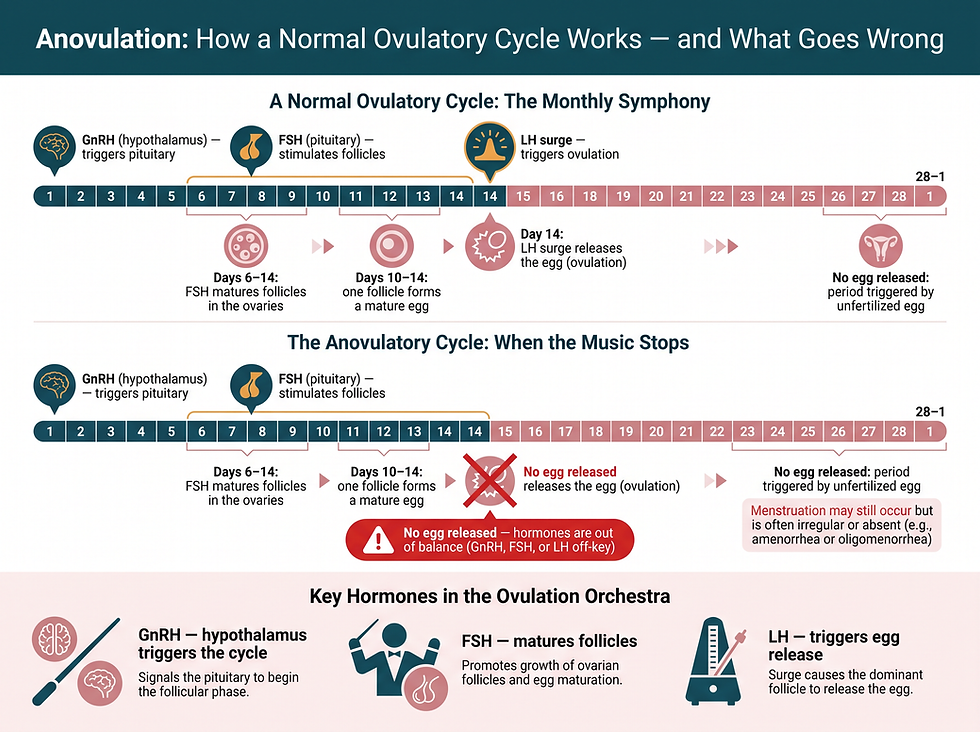
Ovulation typically happens on day 14 of a 28-day menstrual cycle. The exact day can vary and, depending on your cycle length, may happen sooner or later.
The process begins when your hypothalamus (a part of your brain) releases gonadotropin-releasing hormone (GnRH). GnRH causes your pituitary gland (a gland in your brain) to secrete follicle-stimulating hormone (FSH) and luteinizing hormone (LH).
| Cycle stage | What happens | | --- | --- | | Cycle start | Hypothalamus releases GnRH, triggering the pituitary gland | | Days 6–14 | FSH causes follicles — small sacs of fluid in the ovaries containing a developing egg — to mature | | Days 10–14 | Only one developing follicle forms a fully mature egg | | Around day 14 | A sudden surge in LH causes the ovary to release its egg |
You can think of ovulation as an orchestra with your hormones acting as the instruments. When everything is playing in harmony, the song flows from beginning to end effortlessly. But if even one instrument is off-key, the entire song is disrupted. This is similar to what happens when one hormone is slightly off in the days leading up to ovulation.
How Common Is Anovulation?
Anovulation is a common condition and is the cause of approximately 30% of infertility cases.
Who Does Anovulation Affect?
Anovulation can affect anyone who has ovaries and is of childbearing age, which on average is between the ages of 12 and 51. You are more likely to experience anovulation in the following situations:
| Situation | Why risk increases | | --- | --- | | Just started getting periods | Transitional hormonal imbalances are common at menarche | | In perimenopause | Hormones shift as the body transitions to menopause | | Primary ovarian insufficiency (POI) | Ovarian function declines prematurely | | Polyendocrine metabolic ovarian syndrome (PMOS/PCOS) | Excess androgens prevent follicles from maturing | | Very low body mass index (BMI) | Usually from an eating disorder or excessive exercise, suppressing pituitary hormones |
What Are the Signs and Symptoms of Anovulation?
Being aware of the general signs of ovulation and tracking your menstrual cycles can alert you to anovulation. It is important to remember that having a period does not necessarily mean you have ovulated.

Signs and symptoms of anovulation include:
| Sign or symptom | What to look for | | --- | --- | | Irregular periods | The length of time between periods keeps changing; the average cycle is 28 days, give or take a couple of days | | Very heavy periods | Losing over 16 teaspoons (80 mL) of blood and/or a period lasting longer than seven days; in general, filling a pad every hour for several hours in a row indicates a heavy period | | Very light periods | Fewer than 4 teaspoons (20 mL) of blood throughout the period | | Missed periods (amenorrhea) | Missing one or more periods without being pregnant | | No egg-white cervical mucus | Discharge right before and during ovulation normally resembles raw egg whites — clear, slippery, and stretchy | | Irregular basal body temperature | Basal body temperature is measured fully at rest, right after waking and before getting out of bed; ovulation normally causes a slight increase |
Can You Have Anovulation and Still Have Your Period?
Technically, you cannot menstruate without ovulating — menstruation happens because an egg was not fertilized by sperm, and when you do not ovulate, there is no egg to fertilize.
However, you can still bleed — experience a "period" — without ovulating. This is known as abnormal uterine bleeding (AUB), or anovulatory bleeding. AUB is uterine bleeding that is irregular and does not follow a cycle. Abnormal uterine bleeding is common — approximately 30% of females experience it at some point in their lives.
What Causes Anovulation?
In general, the cause of anovulation is an imbalance of one or more hormones, especially the hormones directly involved in ovulation: GnRH, FSH, and LH. Even hormones not directly involved — such as testosterone and prolactin — can impact the hormones your body needs for ovulation.
Five hormonal imbalance categories cause anovulation:
| Cause | Mechanism | Common conditions behind it | | --- | --- | --- | | High androgen levels (hyperandrogenism) | Excess androgens keep follicles small instead of enlarging and maturing before ovulation | PMOS, obesity, adrenal gland issues, pituitary disorders (Cushing's syndrome, acromegaly), anabolic steroids | | Pituitary gland dysfunction (hypogonadotropic hypogonadism) | Pituitary does not release enough LH and FSH | Very low body weight/BMI, long-term excessive or intense exercise, Sheehan's syndrome, pituitary tumor, pituitary damage | | High prolactin (hyperprolactinemia) | Elevated prolactin disrupts the ovulation hormones | Breastfeeding, prolactinoma (pituitary tumor), pituitary damage, kidney/liver/thyroid illness, psychotropic drugs, narcotics, ulcer/stomach-acid medications | | Low thyroid hormones (hypothyroidism) | Low thyroxine raises prolactin, which suppresses LH and FSH | Hashimoto's thyroiditis, thyroid surgery, radiation therapy, lithium and similar medications | | Low GnRH | Without hypothalamic GnRH, the pituitary is never triggered to release LH and FSH | Damage to the hypothalamus |
What Are the Risk Factors?
Several factors raise your likelihood of anovulatory cycles:
| Risk factor | Effect | | --- | --- | | PMOS (PCOS) | A common condition that causes 70% of anovulation cases — excess androgens keep follicles from maturing | | Obesity | Causes the body to make too many androgens, limiting mature follicle production | | Low body weight or long-term excessive exercise | Affects the pituitary gland's ability to produce enough LH and/or FSH | | Excessive stress | Disrupts GnRH, LH, and FSH balance | | Very young or late reproductive years | Hormonal transitions when periods first start or wind down |
What Are the Complications of Anovulation?
Not everyone with anovulation experiences complications, but several are possible. Not ovulating is itself a major cause of infertility, and missing regular periods is called amenorrhea. Hormonal imbalance can also produce other symptoms such as weight gain, hair loss, and acne.
Anovulation can also increase your risk for the following health conditions:
| Condition | Why the risk rises | | --- | --- | | Endometrial hyperplasia | Without ovulation there is no progesterone, so the uterine lining (endometrium) does not shed properly and can become too thick | | Osteoporosis | Insufficient estrogen — critical for strong bones | | Cardiovascular disease | Some studies show hormone changes increase risk; for example, low estrogen can increase insulin resistance, raising diabetes risk |
How Is Anovulation Diagnosed?
In general, the diagnosis of anovulation is having irregular periods. Your healthcare provider can determine if you have anovulation by listening to your symptoms and noting that you do not menstruate regularly. The provider will then investigate and determine the cause, which may lead to another diagnosis.
Tests depend on what your provider suspects is causing the anovulation and mainly consist of hormone blood tests:
| Test | Purpose | | --- | --- | | Blood progesterone level | Confirms whether ovulation occurred | | Blood thyroid levels | Checks for hypothyroidism as a cause | | Blood prolactin levels | Checks for hyperprolactinemia | | Pelvic ultrasound | Examines the pelvic organs and follicles |
If you are experiencing symptoms of a specific hormone imbalance condition, your provider may order additional tests.
What Is the Treatment for Anovulation?
Treatment depends on correcting the hormonal imbalance that is causing anovulation, if possible.
Lifestyle Changes
Lifestyle adjustments that may treat anovulation include:
| Change | How it is applied | | --- | --- | | Managing stress | Limiting stressors and using techniques such as meditation, yoga, or deep breathing | | Maintaining a healthy weight | Losing weight if you have obesity; gaining weight if your BMI is very low — always with your provider or a registered dietitian | | Decreasing exercise frequency and intensity | Limiting the amount and intensity of exercise if your routine is suspected of causing anovulation |
Medications and Procedures
| Treatment | Notes | | --- | --- | | Medication for other conditions | Treating the underlying cause can resolve anovulation — for example, hypothyroidism medication | | Adjusting current medications | Anti-epileptic and antipsychotic drugs can cause anovulation; your provider may adjust them. Never adjust or stop medications without your provider | | Clomiphene citrate (CC) | Often the first line of treatment; about an 80% success rate at helping you ovulate (common brand: Clomid) | | Letrozole | Off-label use (not FDA-approved for anovulation, but research indicates benefit); brand Femara — used instead of clomiphene citrate | | HCG injection | A synthetic form of human chorionic gonadotropin that causes the ovary to release an egg; often taken with clomiphene citrate or letrozole | | FSH injection | Synthetic FSH if your body is not making enough and other treatments have not worked | | GnRH agonist/antagonist injections | Control the levels of LH your body makes, which is needed for ovulation |
If fertility and pregnancy are your goal and lifestyle changes and/or medication do not work, you may still be able to experience pregnancy through in vitro fertilization (IVF) or intrauterine insemination (IUI). Talk to your healthcare provider or a fertility specialist.

What Is the Outlook for Anovulation?
The outlook depends on the cause. In most cases, lifestyle changes, fertility drugs, or medication that treats the underlying health condition can treat anovulation. If you are experiencing perimenopause, anovulation is more difficult to treat because hormonal changes are a natural and normal part of reaching menopause — but your provider can still help treat your symptoms.
| Scenario | Outlook | | --- | --- | | Most causes | Temporary or chronic depending on the cause; medication and/or lifestyle changes often — but not always — treat it | | Perimenopause | Harder to treat; hormonal changes are a natural part of reaching menopause |
Can I Get Pregnant If I Have Anovulation?
Lifestyle changes and/or medication can often treat anovulation, which means you will have an opportunity to get pregnant — but many other factors contribute to a successful pregnancy.
If you are receiving treatment for anovulation and are still having difficulty getting pregnant, your provider may recommend IVF or IUI.
Can Anovulation Be Prevented?
You cannot prevent anovulation, but some of the reasons you have anovulatory cycles are manageable:
| Prevention strategy | How it helps | | --- | --- | | Healthy habits | Enough sleep, nutritious foods, moderate exercise, and stress management all help regulate hormones | | Tracking your cycles | Records of cycle length, bleeding amount, and discharge changes identify irregularities early and give your provider useful data | | Treating hormonal imbalances | Treating conditions like PMOS or thyroid dysfunction increases your chances of ovulation |
When Should I See My Healthcare Provider?
Contact your healthcare provider if any of the following apply to you:
| Warning sign | Details | | --- | --- | | Unpredictable bleeding | Vaginal bleeding at unpredictable and random intervals | | Abnormal flow or duration | Bleeding that is very heavy, very light, or lasts longer than one week | | Pelvic or abdominal pain | Pain during or between cycles | | Difficulty conceiving | Unable to conceive after six months (if older than 35) or one year (if younger than 35) of regular, unprotected sex |
If you are receiving treatment for anovulation and still having issues conceiving, contact your healthcare provider or fertility specialist.
Conclusion
Anovulation is one of the most common — and most treatable — causes of infertility. The monthly symphony of GnRH, FSH, and LH only works when every hormone plays its part in tune, and a single off-key hormone can silence ovulation entirely. The body's most visible warning is an irregular, unusually heavy, unusually light, or absent period — and importantly, bleeding that looks like a period may not mean you ovulated at all.
The good news is that treatment works. Lifestyle changes address many causes, medication for underlying conditions such as hypothyroidism can restore ovulation, and clomiphene citrate — the most common first-line drug — helps about 80% of people ovulate. Beyond fertility, treating anovulation matters for long-term bone and heart health.
CTA: If your periods are irregular, unusually heavy or light, or absent — or if you have been trying to conceive without success — track your cycles and contact a healthcare provider. Ask what is causing your anovulation, which lifestyle changes fit your situation, and how long treatment typically takes for your case. Early attention protects both your fertility and your overall health.
FAQ
What is anovulation?
Anovulation is a condition in which an egg does not release from the ovary during a menstrual cycle (an anovulatory cycle). It is usually caused by a hormone imbalance, and its main symptom is irregular vaginal bleeding.
What are the symptoms of anovulation?
Symptoms include irregular periods, very heavy periods (over 80 mL of blood or longer than seven days), very light periods (under 20 mL), missed periods without pregnancy, absence of egg-white cervical mucus, and an irregular basal body temperature pattern.
What percentage of infertility is caused by anovulation?
Anovulation causes approximately 30% of infertility cases, making it one of the most common causes of infertility.
What causes anovulation?
Five hormonal imbalances cause it: high androgens (hyperandrogenism), pituitary gland dysfunction (not enough FSH and LH), high prolactin, low thyroid hormone, and low GnRH. Polyendocrine metabolic ovarian syndrome (PMOS/PCOS) alone causes 70% of cases.
Can you have a period without ovulating?
Technically no — but you can still bleed without ovulating, which is called abnormal uterine bleeding (anovulatory bleeding). About 30% of females experience it at some point in their lives.
How is anovulation diagnosed?
Diagnosis is generally based on a report of irregular periods, supported by blood tests for progesterone, thyroid hormones, and prolactin, plus a pelvic ultrasound to examine the ovaries and pelvis.
What is the treatment for anovulation?
Treatment corrects the underlying hormonal imbalance through lifestyle changes (stress management, healthy weight, moderating exercise) and/or medications such as clomiphene citrate (about 80% success), letrozole, HCG/FSH/GnRH injections, or treatment of the underlying condition; IVF or IUI are options if these fail.
Can I get pregnant with anovulation?
Yes — in most cases lifestyle changes or medication restore ovulation, giving you an opportunity to conceive. If treatment does not lead to pregnancy, providers may recommend IVF or intrauterine insemination.
References
Centers for Disease Control and Prevention (U.S.). Infertility FAQs. Last reviewed 4/2023. https://www.cdc.gov/reproductivehealth/infertility/index.htm
Jones K, Sung S. Anovulatory Bleeding. In: StatPearls [Internet]. Treasure Island (FL): StatPearls Publishing; 2024 Jan. https://www.ncbi.nlm.nih.gov/books/NBK549773/
Cunha A, Póvoa AM. Infertility management in women with polycystic ovary syndrome: a review. Porto Biomed J. 2021 Jan;6(1):e116. https://www.ncbi.nlm.nih.gov/pmc/articles/PMC7846416/
Ryczkowska K, Adach W, Janikowski K, et al. Menopause and women's cardiovascular health: is it really an obvious relationship? Arch Med Sci. 2022 Dec;19(2):458-466. https://www.ncbi.nlm.nih.gov/pmc/articles/PMC10074318/
Zhang B, Zhou W, Shi Y, et al. Lifestyle and environmental contributions to ovulatory dysfunction in women of polycystic ovary syndrome. BMC Endocr Disord. 2020 Jan;20(1):19. https://pubmed.ncbi.nlm.nih.gov/32000752/
Medical Disclaimer: This article is for general informational purposes only and is not a substitute for professional medical advice, diagnosis, or treatment. Always seek the advice of a qualified healthcare provider with any questions you may have about a medical condition or fertility concerns. Never adjust or stop prescribed medications without consulting your healthcare provider, and seek prompt care for bleeding that is very heavy, lasts longer than a week, or is accompanied by pelvic or abdominal pain.
Comments